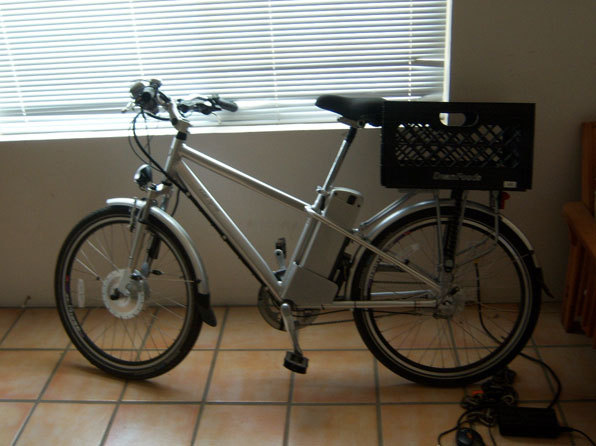
I just bought a pretty cool electric scooter (looks more like a tote goat) the other day. It goes 30 mph for about 30 miles. It cost me $350. I use off-peak electricity to heat my house at night, and so recharging the scooter costs less than a penny per mile.
My electricity is wind-produced through one of those green-energy programs.
My only problem so far is convincing the town that this is not a "pocket-rocket," those toy motorcycles they outlawed last year so the kids don't kill themselves.
I probably need some solar panels so I can charge this thing without the grid if I have to.


PeakOil is You
Go Electric ?
First unread post • 14 posts
• Page 1 of 1
 by Colorado-Valley » Wed 16 Mar 2005, 18:12:01
-

Colorado-Valley - Tar Sands

- Posts: 729
- Joined: Mon 16 Aug 2004, 03:00:00
by DriveElectric » Wed 16 Mar 2005, 18:21:51
If people started getting electric scooters or vehicles, most of them would likely be charged at night. From everything I have read, the electric grid is underutilized at night.
Peak grid usage is in the mid afternoon during the summer months.
The grid is mostly powered by base load during the evening hours. Coal and nuclear.
Peak grid usage is in the mid afternoon during the summer months.
The grid is mostly powered by base load during the evening hours. Coal and nuclear.
-
DriveElectric - Tar Sands
- Posts: 599
- Joined: Sat 12 Mar 2005, 04:00:00
by MarkR » Wed 16 Mar 2005, 18:23:49
Power grids are on edge during the peak few hours, on the few high demand days during the year.
For 90% of the time, there is a good amount of capacity margin. At night, this margin can be as high as 50%.
E.g. in the UK the electricity grid has a generation and distribution capacity of about 80 GW, in order to reliably handle loads of up to 65 GW on a Winter evening. During the night, typical load in Winter is about 40 GW, and in Summer about 20 GW.
That is an enormous amount of spare capacity available overnight (about 120 GWh if you want to leave a huge safety margin). That's enough for every man, woman and child to have their own electric scooter - with plenty of power left over.
Some cars could be accomodated, although it certainly wouldn't be possible for everybody to charge a 100 mile battery at teh same time.
Current state-of-the-art battery cars are aiming for around 5 miles/kWh. This spare capacity works out as about 600 million vehicle-miles per day (or about 30 miles per vehicle on the road today).
Even this is rather optimistic though, because it doesn't account for the distribution of the electricity thte last few miles. There's plenty of bulk capacity and plenty of generation capacity, but last mile distribution is concentrated in industrial and commercial areas.
In residential areas the grid is weak. In the UK, the electricity companies typically plan for about 3000W per house as the maximum average. This would be pushed very close to capacity if most households had an electric car.
The other issue is that generating electricity is inefficient. It's fine if your power is coming from 'baseload' generators (i.e. those that run full power all the time) which can be good and efficient (An electric car charged by a combined cycle gas turbine plant is more efficient than a gasoline car, even when you count in grid and charging losses). It's not fine if you're charging off 'peaking' plants, which are built as cheaply as possible with virtually no regard given to efficiency.
Then, of course, where are you going to get the fuel for your power stations.
For 90% of the time, there is a good amount of capacity margin. At night, this margin can be as high as 50%.
E.g. in the UK the electricity grid has a generation and distribution capacity of about 80 GW, in order to reliably handle loads of up to 65 GW on a Winter evening. During the night, typical load in Winter is about 40 GW, and in Summer about 20 GW.
That is an enormous amount of spare capacity available overnight (about 120 GWh if you want to leave a huge safety margin). That's enough for every man, woman and child to have their own electric scooter - with plenty of power left over.
Some cars could be accomodated, although it certainly wouldn't be possible for everybody to charge a 100 mile battery at teh same time.
Current state-of-the-art battery cars are aiming for around 5 miles/kWh. This spare capacity works out as about 600 million vehicle-miles per day (or about 30 miles per vehicle on the road today).
Even this is rather optimistic though, because it doesn't account for the distribution of the electricity thte last few miles. There's plenty of bulk capacity and plenty of generation capacity, but last mile distribution is concentrated in industrial and commercial areas.
In residential areas the grid is weak. In the UK, the electricity companies typically plan for about 3000W per house as the maximum average. This would be pushed very close to capacity if most households had an electric car.
The other issue is that generating electricity is inefficient. It's fine if your power is coming from 'baseload' generators (i.e. those that run full power all the time) which can be good and efficient (An electric car charged by a combined cycle gas turbine plant is more efficient than a gasoline car, even when you count in grid and charging losses). It's not fine if you're charging off 'peaking' plants, which are built as cheaply as possible with virtually no regard given to efficiency.
Then, of course, where are you going to get the fuel for your power stations.
- MarkR
- Peat

- Posts: 198
- Joined: Sun 18 Jul 2004, 03:00:00
- Location: S. Yorkshire, UK
by jimmyz » Wed 16 Mar 2005, 19:52:56
I personaly would love to have a small plug-in electric hybrid right now. I drive about 20 miles round trip to work and back, but i do have to go see my son who is 300 miles from where i live. Also i think the concept of supply electric back to the grid durring the day for (peak local use) is a good idea
-
jimmyz - Peat
- Posts: 125
- Joined: Sun 06 Feb 2005, 04:00:00
- Location: north of New Orleans
by NeoPeasant » Wed 16 Mar 2005, 21:07:11
The future of transportation is not going to be personal electric vehicles. After a painful adjustment period, the future of transportation for all but the rich is going to be feet, bicycles, public transportation, and the occasional horse or mule.
The electical grid may have the physical capacity to charge up a lot of electric vehicles overnight, but that doesn't mean that it's free or that we should use it. You would have a much larger base load if millions of high current battery chargers were plugged in. You would have to burn a lot more coal and provide more nuclear capacity. vehicles based on batteries charged by remote power plants is a horrifically inefficient way to use energy. Were going to need that energy to provide for our basic needs like food production and keeping the water supplies and the sewers functioning.
Mankind has lived in cities without personal motor vehicles for 9.9 of the last 10 millenia and will learn to do so again.
The electical grid may have the physical capacity to charge up a lot of electric vehicles overnight, but that doesn't mean that it's free or that we should use it. You would have a much larger base load if millions of high current battery chargers were plugged in. You would have to burn a lot more coal and provide more nuclear capacity. vehicles based on batteries charged by remote power plants is a horrifically inefficient way to use energy. Were going to need that energy to provide for our basic needs like food production and keeping the water supplies and the sewers functioning.
Mankind has lived in cities without personal motor vehicles for 9.9 of the last 10 millenia and will learn to do so again.
- NeoPeasant
- Heavy Crude

- Posts: 1003
- Joined: Tue 12 Oct 2004, 03:00:00
by DriveElectric » Wed 16 Mar 2005, 23:51:21
$this->bbcode_second_pass_quote('kochevnik', '
')On another thread a month or so back we did an extended mathematical analysis of the energy required to convert all transportation from fossil fuel to electricity. Both for Great Britain and the USA the numbers indicated that making such a move would require increasing the number of power plants by more than 300 percent. That still sounds like trouble to me.
')On another thread a month or so back we did an extended mathematical analysis of the energy required to convert all transportation from fossil fuel to electricity. Both for Great Britain and the USA the numbers indicated that making such a move would require increasing the number of power plants by more than 300 percent. That still sounds like trouble to me.
I have read a few studies on this issue and I believe those numbers are not realistic.
1) Not all transportation is suitable for electric grid transportation. Only daily commute transportation of 50 miles or less would be feasible under current battery technology. Therefore, trucks, planes, trains, buses, clearly would not be included.
2) Recharging a 50 mile battery would take a few hours, but it obviously does not have to be during the peak hours of late afternoon. Have you lived in a state that has lawn watering restrictions? odd numbers houses water on certain days, even number houses on certain days. The same concept could be applied to recharging your vehicle. Having a timer on the socket your vehicle is plugged into could easily regulate the hours people are allowed to recharge. When the battery is full, the plug automatically disconnect to avoids excess phantom energy consumption.
3) It is also feasible for every home to be part of a distributed net metering system, where your home is able to sell electricity back to the grid. Peak electricity consumption is on hot summer days. That is also when solar panels are most effective.
-
DriveElectric - Tar Sands
- Posts: 599
- Joined: Sat 12 Mar 2005, 04:00:00
by savethehumans » Thu 17 Mar 2005, 00:18:20
The grid is old, badly maintained, and is well on the way to collapse.
My adult tricycle looks better to me every day!
My adult tricycle looks better to me every day!
-
savethehumans - Heavy Crude
- Posts: 1468
- Joined: Wed 20 Oct 2004, 03:00:00
by DriveElectric » Thu 17 Mar 2005, 00:35:41
$this->bbcode_second_pass_quote('savethehumans', 'T')he grid is old, badly maintained, and is well on the way to collapse.
What country do you live in? I think you need some perspective when comparing electric grids. Are you spoiled in the USA with having the electric grid be up 99.999% of the time?
Or do you live in a 3rd world country where there is a brown out every afternoon?
-
DriveElectric - Tar Sands
- Posts: 599
- Joined: Sat 12 Mar 2005, 04:00:00
by Antimatter » Thu 17 Mar 2005, 00:55:44
http://www.vectrixusa.com/
There would be enough spare capacity in the grid overnight to charge lots of these. They claim 70 miles per charge - more than enough for most commutes. Some sort of timing/demand rationing system would have to be implemented to ensure people don't plug them in at 5pm on a hot day.
There would be enough spare capacity in the grid overnight to charge lots of these. They claim 70 miles per charge - more than enough for most commutes. Some sort of timing/demand rationing system would have to be implemented to ensure people don't plug them in at 5pm on a hot day.
-

Antimatter - Tar Sands
- Posts: 587
- Joined: Tue 04 Jan 2005, 04:00:00
- Location: Australia
by BorneoRagnarok » Thu 17 Mar 2005, 02:26:57
$this->bbcode_second_pass_quote('kochevnik', '
')I don't remember the name of the guy who was forecasting that PO would bring blackouts but when I first read that, I thought there was not much chance of that occurring until much later in the Crisis because so little electricity is generated with oil. I was wrong. After adding the datum above and rethinking the scenarios, I would have to say it seems much more likely that the electric grid will not escape unscathed.
')I don't remember the name of the guy who was forecasting that PO would bring blackouts but when I first read that, I thought there was not much chance of that occurring until much later in the Crisis because so little electricity is generated with oil. I was wrong. After adding the datum above and rethinking the scenarios, I would have to say it seems much more likely that the electric grid will not escape unscathed.
Richard C. Duncan. Olduvai theory.
When all the rivers run dry, all the forests have been cleared, all the food has been eaten, tell me the value of your money
-

BorneoRagnarok - Lignite
- Posts: 242
- Joined: Sat 18 Sep 2004, 03:00:00
- Location: East Malaysia

by ararboin » Thu 17 Mar 2005, 14:50:11
$this->bbcode_second_pass_quote('', 'V')ectrix will also have service trucks roaming major cities that will assist, free of charge, any Vectrix scooter in distress.
Vectrix Scooter is sure gonna take care of its customers. Why can't Ford, or Chevy or Toyota do this?

-
ararboin - Lignite
- Posts: 224
- Joined: Tue 12 Oct 2004, 03:00:00