<i>“The trains will start flying in 2018. They will be powered by the Sun. Earth will take a rest since they will stop extracting oil.” (1960)</i>
Solar Mag-lev?
<i>The people will fight for energy, but they will have enough soul to stop. And then time will turn back.(1994)</i>
When the lights go out.
Vanga is Bulgaria's Edgar Cayce.
Her most shocking prediction was made in 1980. The blind old woman said: “At the turn of the century, in August of 1999 or 2000, Kursk will be covered with water, and the whole world will be weeping over it.”
The prediction did not make any sense back then. Twenty years on, it made a horrifying sense. A Russian nuclear submarine perished in an accident in August of 2000. The sub was named after the city of Kursk , which by no means could have been covered with water.
Does the gift of foreseeing really exist?
Gone with a tornado
Vanga (Vangelia) Pandeva was born on January 31, 1911 . She died on August 11, 1996 . She lived in the city of Petrich , Bulgaria . She was buried in a churchyard of the Saint Petca Bulgarian Church in the Rupite region.
Vanga lost her sight when she was 12. She was swept away by a mighty tornado. Later she was found alive, covered with dirt and stones, with sand in her eyes. She became blind as a result.
Vanga started making predictions when she was 16. She helped her father find a sheep stolen from the flock. She provided a detailed description of a yard where the animal was being hidden by the thieves. Her powers of foreseeing took shape after she turned 30.
Many a statesman visited Vanga. Adolf Hitler called on her one day. He left her house looking rather upset.
The predictions
<i>“Horror, horror! The American brethren will fall after being attacked by the steel birds. The wolves will be howling in a bush, and innocent blood will be gushing.” (1989)</i>
Happened as predicted. The World Trade Center Towers in New York collapsed following terrorist attacks on September 11, 2001 . The WTC Towers were dubbed “Twins” or “Brothers.” The terrorists drove passenger planes –“the steel birds”- into the towers. “The bush” obviously relates to the surname of the current U.S. president.
<i>“Numerous catastrophes and disasters will shake the world. The mentality of the people will change. They will be divided by their faith…” (date unknown)</i>
http://english.pravda.ru/science/mysteries/75360-1/
One of the popular predictions about Russia is that when the permafrost thaws and the floods come, nothing will survive on Earth but Russia. The climate will change and Russia will occupy the best inhabitable zone.
Remember, she died in 1996, before any of this was apparent.
http://mnweekly.ru/local/20080606/55332043.html
But we may have bigger problems.
<b>The flood will be too, in 30 or 40 years. The large body will fly to the Earth and will hit the water. The waves will wash away a lot of countries, and the sun will dim for three years. The good-hearted people will survive, and malicious people, which consider themselves clever, will perish. Many people will perish. And then will be a very good life.(1994)</b>
<i>Near-Earth asteroid 1997XF11, discovered on December 6 1997. The special interest in this object began when International Astronomical Union minor planet notice #6837 released by Brian Marsden on March 11 estimated a miss distance of only 50,000 km in its passage near Earth on October 26, 2028. Marsden wrote in a press release reproduced below: "Recent orbit computations indicate it is virtually certain that it will pass within the Moon's distance of the Earth a little more than 30 years from now. The chance of an actual collision is small, but one is not entirely out of the question."</i>
Now 20 yrs 2 months 22 days
http://impact.arc.nasa.gov/news_detail.cfm?ID=63
link
link



PeakOil is You
Vanga's Peak Oil Prophecy
Vanga's Peak Oil Prophecy
 by Cid_Yama » Mon 04 Aug 2008, 04:16:58
Last edited by Cid_Yama on Mon 04 Aug 2008, 04:53:41, edited 1 time in total.
"For my part, whatever anguish of spirit it may cost, I am willing to know the whole truth; to know the worst and provide for it." - Patrick Henry
The level of injustice and wrong you endure is directly determined by how much you quietly submit to. Even to the point of extinction.
The level of injustice and wrong you endure is directly determined by how much you quietly submit to. Even to the point of extinction.
-

Cid_Yama - Light Sweet Crude

- Posts: 7169
- Joined: Sun 27 May 2007, 03:00:00
- Location: The Post Peak Oil Historian
Re: Vanga's Peak Oil Prophecy
by berechia » Mon 04 Aug 2008, 04:39:53
incorrect, once you are wrong once, your a false prophet.
no one will be alive in teb years here.
no one will be alive in teb years here.
-

berechia - Wood

- Posts: 33
- Joined: Sun 03 Aug 2008, 03:00:00
Re: Vanga's Peak Oil Prophecy
by Cid_Yama » Mon 04 Aug 2008, 05:08:48
I remember when the news about the asteroid first broke. The very next day they hauled out a bunch of experts who said unequivocally and unanimously that it would be close but there was no way it would hit the earth. After that, total news blackout. I'll tell you what, I don't know anyone who could verify the calculations with complete certainty in a day. Also, a lot of things can happen to a space object in 30 years. Even a small deflection with 30 years to follow could dramatically change the trajectory. Any calculations 30 years ahead of time are mearly a ball park estimate, and this looks like a pretty small ballpark.
Last edited by Cid_Yama on Mon 04 Aug 2008, 09:25:33, edited 1 time in total.
"For my part, whatever anguish of spirit it may cost, I am willing to know the whole truth; to know the worst and provide for it." - Patrick Henry
The level of injustice and wrong you endure is directly determined by how much you quietly submit to. Even to the point of extinction.
The level of injustice and wrong you endure is directly determined by how much you quietly submit to. Even to the point of extinction.
-
Cid_Yama - Light Sweet Crude
- Posts: 7169
- Joined: Sun 27 May 2007, 03:00:00
- Location: The Post Peak Oil Historian
Re: Vanga's Peak Oil Prophecy
by vision-master » Mon 04 Aug 2008, 07:53:52
$this->bbcode_second_pass_quote('', 'T')he flood will be too, in 30 or 40 years. The large body will fly to the Earth and will hit the water. The waves will wash away a lot of countries, and the sun will dim for three years. The good-hearted people will survive, and malicious people, which consider themselves clever, will perish. Many people will perish. And then will be a very good life.(1994)
$this->bbcode_second_pass_quote('', '"')When the Purifier comes we will see him first as a small Red Star which will come very close and sit in our heavens watching us. Watching us to see how well we have remembered the sacred teachings.
"This Purifier will show us many miraculous signs in our heavens In this way we will know Creator is not a dream. Even those who do not feel their connection to spirit will see the face of creator across the sky. Things unseen will be felt very strongly.
“Many things will begin to occur that will not make sense, for reality will be shifting back in and out of the dream state. There will be many doorways to the lower world that will open at this time. Things long forgotten will come back to remind us of our past creations. All living things will want to be present for this day when time ends, and we enter the forever cycle of the Fifth World.
http://standeyo.com/NEWS/06_Prophecy/06 ... anetX.html
Avebury Manor Crop Circle- 2012 and Nibiru
- vision-master
Re: Vanga's Peak Oil Prophecy
by Micki » Mon 04 Aug 2008, 08:03:37
I knew we were in for bad news as soon as I saw her picture.

Some of the predictions were real headscratchers though
2016 - Europe is almost empty
2088 - New disease. - People are getting old in few seconds.
2111 - People become robots.
2154 - Animals become half-humans.
2291 - Sun cools. Attempts to fire it up again are taken.
2354 - Accident on one of the man made suns, will result in drought.
...just to mention a few.

Predictions
I guess the one to keep an eye on for now is:
2008 - Assassination attempts on four heads of states. Conflict in Indonesia. That becomes one of the causes for the start of WWIII.
Personally I don't see right now how Indonesia could be the cause for WW3....Maybe if they find a huge oil field, I'll revise my opinion.
What I am concerned over otherwise is what could have gone lost in translation etc.
Like the "911 prophecy" It has some keywords that makes us link it to a specific event. Like brethren steelbirds and bush which we instantly associate with twin towers, planes and president Bush.
So besides the case of having incorrect association (just becasue it quacks like a duck it's not necessarily a duck), I am thinking that there could be the case of liberal translation, especially if the interpretation is done after the event it supposedly predicted.
Anyway, interesting and perhpas even material for a new scary avatar. Hope more people will add their 5 cents worth here.
Some of the predictions were real headscratchers though
2016 - Europe is almost empty
2088 - New disease. - People are getting old in few seconds.
2111 - People become robots.
2154 - Animals become half-humans.
2291 - Sun cools. Attempts to fire it up again are taken.
2354 - Accident on one of the man made suns, will result in drought.
...just to mention a few.
Predictions
I guess the one to keep an eye on for now is:
2008 - Assassination attempts on four heads of states. Conflict in Indonesia. That becomes one of the causes for the start of WWIII.
Personally I don't see right now how Indonesia could be the cause for WW3....Maybe if they find a huge oil field, I'll revise my opinion.
What I am concerned over otherwise is what could have gone lost in translation etc.
Like the "911 prophecy" It has some keywords that makes us link it to a specific event. Like brethren steelbirds and bush which we instantly associate with twin towers, planes and president Bush.
So besides the case of having incorrect association (just becasue it quacks like a duck it's not necessarily a duck), I am thinking that there could be the case of liberal translation, especially if the interpretation is done after the event it supposedly predicted.
Anyway, interesting and perhpas even material for a new scary avatar. Hope more people will add their 5 cents worth here.
- Micki
Re: Vanga's Peak Oil Prophecy
by vision-master » Mon 04 Aug 2008, 08:13:09
Sylvia Browne - THE NEXT 100 YEARS
$this->bbcode_second_pass_quote('', 'A')fter 2050, the "Age of the Messiah" is upon us. People turn totally toward Spirituality, peace will rein for a long time. People will return to community living, loving each other, and working together.
$this->bbcode_second_pass_quote('', 'A')fter 2050, the "Age of the Messiah" is upon us. People turn totally toward Spirituality, peace will rein for a long time. People will return to community living, loving each other, and working together.

- vision-master
Re: Vanga's Peak Oil Prophecy
by Cid_Yama » Mon 04 Aug 2008, 09:08:58
<i>Personally I don't see right now how Indonesia could be the cause for WW3</i>
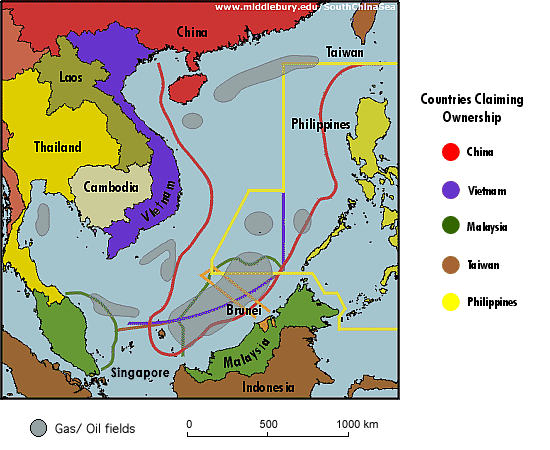
Spratly Islands are right there.
<b>Beijing threatens ExxonMobil over deal with Vietnam in South China Sea</b>
China issued a sharp warning to the world’s largest corporation, ExxonMobil, over an oil deal with Vietnam. Hanoi has indirectly responded that its agreement is in force and will proceed.
A Hong Kong newspaper says Beijing’s diplomats have threatened retaliation if ExxonMobil goes ahead with a preliminary agreement with the Vietnamese state oil firm PetroVietnam. The deal covers exploitation in the South China Sea off Vietnam's south and central coasts, according to the Sunday Morning Post.
Beijing claims a huge swath of the South China Sea just east of the Indochina peninsula and west of the Philippines and has acted to control sea lanes and oil rights in the area with several military skirmishes. The most serious occurred in 1976, when China invaded and captured the Paracel Islands from Vietnam. In 1988, Chinese and Vietnamese navies clashed at Johnson Reef in the Spratly Islands, sinking several Vietnamese boats and killing more than 70 sailors.
The Hong Kong newspaper quoted unidentified sources saying Exxon Mobil was confident of Vietnam's sovereign rights to the blocks it was now seeking to explore. But it is clear that ExxonMobil could not dismiss China's warnings out of hand given the rapidly increasing Chinese market for crude oil and oil products.
Last year, Chinese media targeted an agreement between Vietnam and BP near the Spratlys maintaining that those islands had been an “indisputable part of Chinese territory since ancient times.” The Spratlys, like other island groups in the region, are uninhabited rocky outcroppings and coral but are in an area that may contain large oil and gas deposits.
link
The Spratlys, a cluster of islands, submerged banks and reefs believed to be rich in oil and mineral reserves, is claimed in part or in whole by China, Philippines, Brunei, Malaysia, Vietnam and Taiwan.
Taiwan has been separated from the Chinese mainland since 1949 but the Beijing government claims the island as part of its territory.
Not a single Asean country has forged diplomatic ties with Taiwan nor recognize the island as a state in deference to the One China policy laid down by Beijing.
In March, Taiwan sparked renewed tension in the region after then President Chen Shui-bian made a visit to the Spratly islands to apparently underscore Taipei’s claim to the disputed area.
The trip, which came before the presidential polls were held in Taiwan on March 22, was aimed at drumming up support for Frank Hsieh, the ruling independence-leaning Democratic Progressive Party’s (DPP) candidate in the elections.
Ma Ying-jeou, a former mayor of Taipei and Harvard Law School graduate, though won the presidency.
Chen, who retired in May after eight years in office, took an Air Force C-130 transport aircraft to the Taiping Islet, the biggest island in the Spratlys.
Taiwan defense ministry began building a 1,150-meter-long (3,795-feet) runway in the fortified Taiping Islet in mid-2006, despite protest from Vietnam.
The Spratly islands, which has a total land area of less than five square kilometers and scattered across approximately 800,000 square kms of the South China Sea, is being entirely claimed by both China and Taiwan, while Vietnam, Brunei, Malaysia and the Philippines claim only some parts, based on proximity to their shores.
All claimants, except Brunei, have troops based on the archipelago of more than 100 islets, reefs and atolls.
http://www.tribune.net.ph/nation/20080729nat1.html
Spratly Islands are right there.
<b>Beijing threatens ExxonMobil over deal with Vietnam in South China Sea</b>
China issued a sharp warning to the world’s largest corporation, ExxonMobil, over an oil deal with Vietnam. Hanoi has indirectly responded that its agreement is in force and will proceed.
A Hong Kong newspaper says Beijing’s diplomats have threatened retaliation if ExxonMobil goes ahead with a preliminary agreement with the Vietnamese state oil firm PetroVietnam. The deal covers exploitation in the South China Sea off Vietnam's south and central coasts, according to the Sunday Morning Post.
Beijing claims a huge swath of the South China Sea just east of the Indochina peninsula and west of the Philippines and has acted to control sea lanes and oil rights in the area with several military skirmishes. The most serious occurred in 1976, when China invaded and captured the Paracel Islands from Vietnam. In 1988, Chinese and Vietnamese navies clashed at Johnson Reef in the Spratly Islands, sinking several Vietnamese boats and killing more than 70 sailors.
The Hong Kong newspaper quoted unidentified sources saying Exxon Mobil was confident of Vietnam's sovereign rights to the blocks it was now seeking to explore. But it is clear that ExxonMobil could not dismiss China's warnings out of hand given the rapidly increasing Chinese market for crude oil and oil products.
Last year, Chinese media targeted an agreement between Vietnam and BP near the Spratlys maintaining that those islands had been an “indisputable part of Chinese territory since ancient times.” The Spratlys, like other island groups in the region, are uninhabited rocky outcroppings and coral but are in an area that may contain large oil and gas deposits.
link
The Spratlys, a cluster of islands, submerged banks and reefs believed to be rich in oil and mineral reserves, is claimed in part or in whole by China, Philippines, Brunei, Malaysia, Vietnam and Taiwan.
Taiwan has been separated from the Chinese mainland since 1949 but the Beijing government claims the island as part of its territory.
Not a single Asean country has forged diplomatic ties with Taiwan nor recognize the island as a state in deference to the One China policy laid down by Beijing.
In March, Taiwan sparked renewed tension in the region after then President Chen Shui-bian made a visit to the Spratly islands to apparently underscore Taipei’s claim to the disputed area.
The trip, which came before the presidential polls were held in Taiwan on March 22, was aimed at drumming up support for Frank Hsieh, the ruling independence-leaning Democratic Progressive Party’s (DPP) candidate in the elections.
Ma Ying-jeou, a former mayor of Taipei and Harvard Law School graduate, though won the presidency.
Chen, who retired in May after eight years in office, took an Air Force C-130 transport aircraft to the Taiping Islet, the biggest island in the Spratlys.
Taiwan defense ministry began building a 1,150-meter-long (3,795-feet) runway in the fortified Taiping Islet in mid-2006, despite protest from Vietnam.
The Spratly islands, which has a total land area of less than five square kilometers and scattered across approximately 800,000 square kms of the South China Sea, is being entirely claimed by both China and Taiwan, while Vietnam, Brunei, Malaysia and the Philippines claim only some parts, based on proximity to their shores.
All claimants, except Brunei, have troops based on the archipelago of more than 100 islets, reefs and atolls.
http://www.tribune.net.ph/nation/20080729nat1.html
Last edited by Cid_Yama on Mon 04 Aug 2008, 09:18:47, edited 1 time in total.
"For my part, whatever anguish of spirit it may cost, I am willing to know the whole truth; to know the worst and provide for it." - Patrick Henry
The level of injustice and wrong you endure is directly determined by how much you quietly submit to. Even to the point of extinction.
The level of injustice and wrong you endure is directly determined by how much you quietly submit to. Even to the point of extinction.
-
Cid_Yama - Light Sweet Crude
- Posts: 7169
- Joined: Sun 27 May 2007, 03:00:00
- Location: The Post Peak Oil Historian
Re: Vanga's Peak Oil Prophecy
by Micki » Mon 04 Aug 2008, 09:10:57
This chap is also interesting;
Mitar Tarabich (1829-1899)- Serbian Prophet
"Men will build a box and within will be some kind of gadget with images, but they will not be able to communicate with me already dead, even though this image gadget will be as close to this other world as hairs on the human scalp are close to each other. With the help of this image gadget, man will be able to see everything that is happening all over the world."
"People will drill wells deep in the ground and dig out gold, which will give them light, speed and power, and the Earth will shed tears of sorrow because there will be much more gold and light on its surface than in its interior. The Earth will suffer because of these open wounds. Instead of working in the fields, people will dig everywhere, in right and wrong places, but the real power will be all around them, not being able to tell them, ’Come on, take me; don’t you see that I am here, all around you?’ Only after many a summer, people will remember this real power, and then they will realize how stupid it was to dig all those holes."
- That one really sound like black gold or perhaps yellowcake and then alternative energy like wind or sun.
"Man will travel to other worlds to find lifeless deserts there, and still, God forgive him, he will think that he knows better than God himself. There, except for the eternal peace of God, he will see nothing, but he will sense with his heart and soul all of God’s beauty and power. People will drive in rigs upon the Moon and stars. They will look for life, but life similar to ours they will not find. It will be there, but they will not be able to understand it and see that it is life. One who goes there, God forgive him, not believing in God as it is proper for an honourable and decent person, when he comes back he will say, ’Oh, you people who mention God’s name with doubt, go there where I was; then you will see what is God’s mind and power’.
"Those who will read and write different books with numbers will think that they know the most. These learned men will let their lives be led by their calculations, and they will do and live exactly how these numbers tell them. Among these learned men there will be good and evil men. The evil ones will do evil deeds. They will poison air and water and spread pestilence over the seas, rivers and earth, and people will start to die suddenly of various ailments. Those good and wise will see that all this effort and hard work is not worth a penny and that it leads to the destruction of the world, and instead of looking for wisdom in numbers they will start to seek it in meditation."
"When they start to meditate more, they will be closer to God’s wisdom, but it will be too late because the evil ones will already ravage the whole Earth and men will start to die in great numbers. Then people will run away from cities to the country and look for the mountains with three crosses, and there, inside, they will be able to breathe and drink water. Those who will escape will save themselves and their families, but not for long, because a great famine will appear. There will be plenty of food in towns and villages, but it will be poisoned. Many will eat because of hunger and die immediately. Those who will fast to the end will survive, because the Holy Ghost will save them and they will be close to God.
And then comes a weird one; (I was thinking neutron bomb first but you of course dont' wake up from that. )
"People waging this war will have their scientists who will invent different and strange cannonballs. When they explode, these cannonballs instead of killing will cast a spell over all that lives—people, armies and livestock. This spell will make them sleep, and sleep they will instead of fighting, and after this they will come back to their senses.
Predictions
Mitar Tarabich (1829-1899)- Serbian Prophet
"Men will build a box and within will be some kind of gadget with images, but they will not be able to communicate with me already dead, even though this image gadget will be as close to this other world as hairs on the human scalp are close to each other. With the help of this image gadget, man will be able to see everything that is happening all over the world."
"People will drill wells deep in the ground and dig out gold, which will give them light, speed and power, and the Earth will shed tears of sorrow because there will be much more gold and light on its surface than in its interior. The Earth will suffer because of these open wounds. Instead of working in the fields, people will dig everywhere, in right and wrong places, but the real power will be all around them, not being able to tell them, ’Come on, take me; don’t you see that I am here, all around you?’ Only after many a summer, people will remember this real power, and then they will realize how stupid it was to dig all those holes."
- That one really sound like black gold or perhaps yellowcake and then alternative energy like wind or sun.
"Man will travel to other worlds to find lifeless deserts there, and still, God forgive him, he will think that he knows better than God himself. There, except for the eternal peace of God, he will see nothing, but he will sense with his heart and soul all of God’s beauty and power. People will drive in rigs upon the Moon and stars. They will look for life, but life similar to ours they will not find. It will be there, but they will not be able to understand it and see that it is life. One who goes there, God forgive him, not believing in God as it is proper for an honourable and decent person, when he comes back he will say, ’Oh, you people who mention God’s name with doubt, go there where I was; then you will see what is God’s mind and power’.
"Those who will read and write different books with numbers will think that they know the most. These learned men will let their lives be led by their calculations, and they will do and live exactly how these numbers tell them. Among these learned men there will be good and evil men. The evil ones will do evil deeds. They will poison air and water and spread pestilence over the seas, rivers and earth, and people will start to die suddenly of various ailments. Those good and wise will see that all this effort and hard work is not worth a penny and that it leads to the destruction of the world, and instead of looking for wisdom in numbers they will start to seek it in meditation."
"When they start to meditate more, they will be closer to God’s wisdom, but it will be too late because the evil ones will already ravage the whole Earth and men will start to die in great numbers. Then people will run away from cities to the country and look for the mountains with three crosses, and there, inside, they will be able to breathe and drink water. Those who will escape will save themselves and their families, but not for long, because a great famine will appear. There will be plenty of food in towns and villages, but it will be poisoned. Many will eat because of hunger and die immediately. Those who will fast to the end will survive, because the Holy Ghost will save them and they will be close to God.
And then comes a weird one; (I was thinking neutron bomb first but you of course dont' wake up from that. )
"People waging this war will have their scientists who will invent different and strange cannonballs. When they explode, these cannonballs instead of killing will cast a spell over all that lives—people, armies and livestock. This spell will make them sleep, and sleep they will instead of fighting, and after this they will come back to their senses.
Predictions
- Micki
Re: Vanga's Peak Oil Prophecy
by Micki » Mon 04 Aug 2008, 09:30:34
$this->bbcode_second_pass_quote('Cid_Yama', '&')lt;i>Personally I don't see right now how Indonesia could be the cause for WW3</i>
Spratly Islands are right there.
Spratly Islands are right there.
Bit on the wrong side of Borneo, so I don't see Indonesia laying claim on that. But who knows, once their oil depletion starts to hurt, we'll see what stunts they pull.
Definetly an area for tension.
- Micki