Bolivia's War Over Water
http://www.democracyctr.org/waterwar/
http://www.citizen.org/cmep/water/



PeakOil is You
THE Peak Fresh Water Thread (merged)
Re: Water shortages/inadequate drinking water the future wor
 by paimei01 » Wed 14 Mar 2007, 06:48:11
- paimei01
- Tar Sands

- Posts: 539
- Joined: Tue 27 Feb 2007, 04:00:00
- Location: Romania
Re: Water shortages/inadequate drinking water the future wor
by jdmartin » Thu 15 Mar 2007, 23:40:19
I run a municipal water & sewer district for a living.
On the original post on this thread, there is no way that electricity costs are 80% of the cost of distributing and treating water. By far the biggest costs involved in water treatment/distribution are labor costs. Due to EPA regulations (ie Safe Drinking Water Act et al), it takes certified operators to run water treatment plants, operate distribution systems, etc. In addition, there is a multitude of treatment that goes far beyond your basic disinfection, much of which addresses factors that contribute to taste, odor, and asthetic objections, despite the fact that the water is safe to drink.
As for electric, the majority of electricity used in water operations goes towards pumping costs - pumps designed to maintain a certain pressure in the system, fill a water storage tank, etc.
In matters of a crisis, a lot of costs associated with treating water could be drastically reduced or eliminated. Water could be treated at a bare minimum for pathogens (read: chlorinated and out the door), and all other filtration could be eliminated. Mandatory bans on irrigation, car washing, and other non-essential uses would easy reduce demand by 50% or more. In a worst-case scenario, water could be treated and maintained at a single site, allowing residents to travel to that site in order to procure water.
The reported figures on infrastructure replacement are of concern, but they are seriously overblown. Good quality pipes - cast iron, and more recently, ductile iron - can last for many hundreds of years and still be serviceable. In our system, lines do occasionally break, and when they do we don't go out and find a couple of million dollars to replace that line, we repair the break and move on. The majority of breaks, btw, are usually caused by improper initial installation.
As for water usage devices, the single-handle device for mixing alluded to above can only flow the amount of water that the end-point (showerhead, aerator, etc) allows. Most new devices already restrict water flow by mixing in a significant amount of air into the final product.
In short, at least here in the US, I wouldn't worry too much about the availability of basically safe water for drinking. Other uses, maybe, but basic, safe drinking water can be made for ridiculously cheap costs here that it's really not much of an issue.
On the original post on this thread, there is no way that electricity costs are 80% of the cost of distributing and treating water. By far the biggest costs involved in water treatment/distribution are labor costs. Due to EPA regulations (ie Safe Drinking Water Act et al), it takes certified operators to run water treatment plants, operate distribution systems, etc. In addition, there is a multitude of treatment that goes far beyond your basic disinfection, much of which addresses factors that contribute to taste, odor, and asthetic objections, despite the fact that the water is safe to drink.
As for electric, the majority of electricity used in water operations goes towards pumping costs - pumps designed to maintain a certain pressure in the system, fill a water storage tank, etc.
In matters of a crisis, a lot of costs associated with treating water could be drastically reduced or eliminated. Water could be treated at a bare minimum for pathogens (read: chlorinated and out the door), and all other filtration could be eliminated. Mandatory bans on irrigation, car washing, and other non-essential uses would easy reduce demand by 50% or more. In a worst-case scenario, water could be treated and maintained at a single site, allowing residents to travel to that site in order to procure water.
The reported figures on infrastructure replacement are of concern, but they are seriously overblown. Good quality pipes - cast iron, and more recently, ductile iron - can last for many hundreds of years and still be serviceable. In our system, lines do occasionally break, and when they do we don't go out and find a couple of million dollars to replace that line, we repair the break and move on. The majority of breaks, btw, are usually caused by improper initial installation.
As for water usage devices, the single-handle device for mixing alluded to above can only flow the amount of water that the end-point (showerhead, aerator, etc) allows. Most new devices already restrict water flow by mixing in a significant amount of air into the final product.
In short, at least here in the US, I wouldn't worry too much about the availability of basically safe water for drinking. Other uses, maybe, but basic, safe drinking water can be made for ridiculously cheap costs here that it's really not much of an issue.
After fueling up their cars, Twyman says they bowed their heads and asked God for cheaper gas.There was no immediate answer, but he says other motorists joined in and the service station owner didn't run them off.
-

jdmartin - Heavy Crude

- Posts: 1272
- Joined: Thu 19 May 2005, 03:00:00
- Location: Merry Ol' USA
Peak water ?
by Armageddon » Fri 12 Oct 2007, 10:17:56
-

Armageddon - Light Sweet Crude

- Posts: 7450
- Joined: Wed 13 Apr 2005, 03:00:00
- Location: St.Louis, Mo
Re: Peak water ?
by wisconsin_cur » Fri 12 Oct 2007, 10:25:55
a lot of that development is about to come to a screeching halt.
It is a problem and, no doubt, it will be a problem regionally for the long-term. But I think we will run out of something else before we run out of water.
It is a problem and, no doubt, it will be a problem regionally for the long-term. But I think we will run out of something else before we run out of water.
http://www.thenewfederalistpapers.com
-

wisconsin_cur - Light Sweet Crude
- Posts: 4576
- Joined: Thu 10 May 2007, 03:00:00
- Location: 45 degrees North. 883 feet above sealevel.
Water shortages more dangerous then peakoil
by Mettezz » Wed 28 May 2008, 01:02:17
I'm afraid that peakoil isn't the worst thing that can happen to the world we live in.
I saw in a documentary that by 2025 almost 2/3 or 66% of the world have no acces to drinkable water.
I found this map of wich countries have the biggest danger for severe water shortages
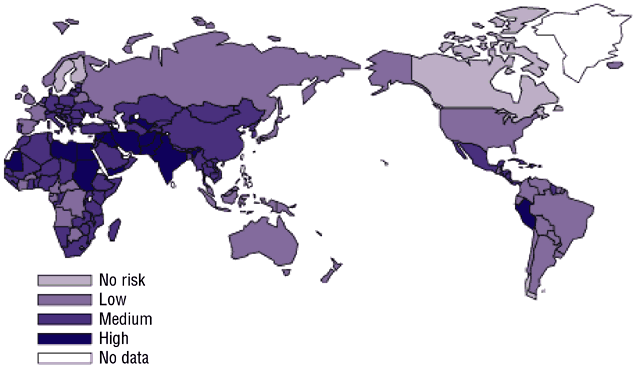
Great parts of Africa, South Asia, Middle East, India, China and Mexico are in problems.
I suggest people who live there get the hell away while you can.
Even entire eastern Europe is at risk.
Only almost entire south america, U.S.A., Canada, western Europe, and oceania don't have that many problems with water... yet
ps: i dindn't know where i had too put this so if i put this in the wrong place i'm sorry
I saw in a documentary that by 2025 almost 2/3 or 66% of the world have no acces to drinkable water.
I found this map of wich countries have the biggest danger for severe water shortages
Great parts of Africa, South Asia, Middle East, India, China and Mexico are in problems.
I suggest people who live there get the hell away while you can.
Even entire eastern Europe is at risk.
Only almost entire south america, U.S.A., Canada, western Europe, and oceania don't have that many problems with water... yet
ps: i dindn't know where i had too put this so if i put this in the wrong place i'm sorry
- Mettezz
- Peat

- Posts: 52
- Joined: Mon 05 May 2008, 03:00:00
Re: Water shortages more dangerous then peakoil
by mefistofeles » Wed 28 May 2008, 03:59:41
Unless we expand our resource base as a species in terms of we're going to have to some serious issues. Its only a question of what resource will run out first.
-

mefistofeles - Coal
- Posts: 420
- Joined: Mon 21 Mar 2005, 04:00:00
Re: Water shortages more dangerous then peakoil
by alokin » Wed 28 May 2008, 06:01:26
This map is a bit weird, we're living on the driest continent of the world and having only a low possibility of water shortages??
There must be some explanations somewhere how the countries are classified.
There must be some explanations somewhere how the countries are classified.
-

alokin - Heavy Crude
- Posts: 1255
- Joined: Fri 24 Aug 2007, 03:00:00
Re: Water shortages more dangerous then peakoil
by Cashmere » Wed 28 May 2008, 06:33:50
Agreed that water is a major issue.
Map is not useful - too simple.
Map is not useful - too simple.
Massive Human Dieoff <b>must</b> occur as a result of Peak Oil. Many more than half will die. It will occur everywhere, including where <b>you</b> live. If you fail to recognize this, then your odds of living move toward the "going to die" group.
-

Cashmere - Heavy Crude
- Posts: 1882
- Joined: Thu 27 Mar 2008, 03:00:00
Re: Water shortages more dangerous then peakoil
by Dukkha » Wed 28 May 2008, 06:53:26
It's not the clearest map in the world but it looks like Bangladesh is at medium risk of water shortage, which seems a little unlikely given that this is the risk level for Saudi Arabia. But it's a pressing issue. Many parts of India are now royally fucked thanks to over-pumping of aquifers and Pakistan is facing some serious, serious problems due to over-extraction from the Indus.
-

Dukkha - Peat
- Posts: 136
- Joined: Fri 14 Dec 2007, 04:00:00
Re: Water shortages more dangerous then peakoil
by Pops » Wed 28 May 2008, 20:49:42
The answer is to do some homework and move where it rains during the growing season.
The legitimate object of government, is to do for a community of people, whatever they need to have done, but can not do, at all, or can not, so well do, for themselves -- in their separate, and individual capacities.
-- Abraham Lincoln, Fragment on Government (July 1, 1854)
-- Abraham Lincoln, Fragment on Government (July 1, 1854)
-

Pops - Elite

- Posts: 19746
- Joined: Sat 03 Apr 2004, 04:00:00
- Location: QuikSac for a 6-Pac
Re: Water shortages more dangerous then peakoil
by eastbay » Wed 28 May 2008, 20:55:12
I'm not too sure about that. There's still hope that a water crisis can be averted. Here's how:
If the population manages to get down to around one billion by 2025, as a result of the rapidly developing peak oil crisis, there might be plenty of clean fresh water for all (remaining)!
If the population manages to get down to around one billion by 2025, as a result of the rapidly developing peak oil crisis, there might be plenty of clean fresh water for all (remaining)!
Got Dharma?
Everything is Impermanent. Shakyamuni Buddha
Everything is Impermanent. Shakyamuni Buddha
-

eastbay - Expert
- Posts: 7186
- Joined: Sat 18 Dec 2004, 04:00:00
- Location: One Mile From the Columbia River
Re: Water shortages more dangerous then peakoil
by joeltrout » Wed 28 May 2008, 21:01:03
This may totally be a dumb question and feel free to heckle me as much as you want. 
Can water be destroyed or used up? Or does it get recycled eventually back to fresh water through evaporation or other processes? Do we have the same amount of water on earth as we did 2000 years ago? Just in different forms?
When oil is used it is gone. But I didn't know if water can be destroyed.
I am totally ignorant when it comes to water but not afraid to ask questions.
joeltrout
Can water be destroyed or used up? Or does it get recycled eventually back to fresh water through evaporation or other processes? Do we have the same amount of water on earth as we did 2000 years ago? Just in different forms?
When oil is used it is gone. But I didn't know if water can be destroyed.
I am totally ignorant when it comes to water but not afraid to ask questions.
joeltrout
- joeltrout
- Heavy Crude
- Posts: 1297
- Joined: Wed 19 Sep 2007, 03:00:00
Re: Water shortages more dangerous then peakoil
by Ludi » Wed 28 May 2008, 21:05:14
For those who can't move to Missouri or other blessed realms:
http://www.harvestingrainwater.com/rain ... resources/
http://rainwaterharvesting.tamu.edu/
http://www.oasisdesign.net/
http://www.harvestingrainwater.com/rain ... resources/
http://rainwaterharvesting.tamu.edu/
http://www.oasisdesign.net/
- Ludi
Re: Water shortages more dangerous then peakoil
by alokin » Wed 28 May 2008, 21:51:02
water can be polluted. Or it runs into the ocean were in former times there were floodplains that feed the water table...
And then there is global warming and you don't know which regions of the world will get dryer.
And then there is global warming and you don't know which regions of the world will get dryer.
-
alokin - Heavy Crude
- Posts: 1255
- Joined: Fri 24 Aug 2007, 03:00:00
Re: Water shortages more dangerous then peakoil
by Cashmere » Wed 28 May 2008, 21:53:02
Water volume on earth is about constant.
Massive Human Dieoff <b>must</b> occur as a result of Peak Oil. Many more than half will die. It will occur everywhere, including where <b>you</b> live. If you fail to recognize this, then your odds of living move toward the "going to die" group.
-
Cashmere - Heavy Crude
- Posts: 1882
- Joined: Thu 27 Mar 2008, 03:00:00
Peak Water - A lesson from History
by Ainan » Fri 15 Aug 2008, 04:59:45
I stumbled across something interesting today. We all know that fossil water is being used like fossil fuel in todays modern farming systems. But most of us don't realise this is not a new idea. Have a read of this.
$this->bbcode_second_pass_quote('', 'K')ingdom of the Sands Volume 57 Number 2, March/April 2004
by David Keys
How a Saharan slave-trading people made the desert bloom
During the past six years, an archaeological survey in the Fazzan area of southern Libya, led by David Mattingly of the University of Leicester, has revealed that a remarkable, yet obscure desert civilization known to the Romans as the Garamantes constructed almost a thousand miles of underground tunnels and shafts in a successful bid to mine long-buried fossil water.
Descended from Berbers and Saharan pastoralists, the Garamantes were likely present as a tribal people in the Fazzan by at least 1000 B.C. They first appeared in the historical record in the fifth century B.C., when Herodotus noted the Garamantes were an exceedingly numerous people who herded cattle (that grazed backward!) and who hunted "troglodyte Ethiopians" from four-horse chariots.
Archaeologists had excavated parts of the Garamantian capital, Garama, in the 1960s. But prior to recent investigations, most scholars still thought of the Garamantes as little more than desert barbarians living in one small town, a couple of villages, and scattered encampments. The research, however, now suggests that the Garamantes had about eight major towns (three of which have now been examined) and scores of other important settlements, and that they controlled a substantial state. "The new archaeological evidence is showing that the Garamantes were brilliant farmers, resourceful engineers, and enterprising merchants who produced a remarkable civilization," says Mattingly.
The success of the Garamantes was based on their subterranean water-extraction system, a network of tunnels known as foggaras in Berber. It not only allowed their part of the Sahara to bloom again--it also triggered a political and social process that led to population expansion, urbanism, and conquest. But in order to retain and extend their newfound prosperity, they needed above all to maintain and expand the water-extraction tunnel systems--and that necessitated the acquisition of many slaves.
Luckily for the Garamantes--but less so for their neighbors--Garamantian population growth gave the new Saharan power a demographic and military advantage over other peoples in Saharan and sub-Saharan Africa, enabling them to expand their territory, conquer other peoples, and acquire vast numbers of slaves.
By around A.D. 150 the slave-based Garamantian kingdom covered 70,000 square miles in present-day southern Libya. It was the first time in history that a nonriverine area of the Sahara (or indeed any other major desert) had produced an urban society. The largest town, Garama (in what is now called the Jarma Oasis), had a population of some four thousand. A further six thousand people probably lived in suburban satellite villages located within a three-mile radius of the urban center.
Thanks to their aggressive mentality and the slaves and water it produced, the Garamantes lived in planned towns and feasted on locally grown grapes, figs, sorghum, pulses, barley, and wheat, as well as on imported luxuries such as wine and olive oil. "The combination of their slave-acquisition activities and their mastery of foggara irrigation technology enabled the Garamantes to enjoy a standard of living far superior to that of any other ancient Saharan society," says archaeologist Andrew Wilson of the University of Oxford, who has been surveying the foggara system. Without slaves, they would not have had a kingdom, let alone even a whiff of the good life. They would have survived--just--in conditions of relative poverty, as most desert dwellers have done before and since.
In the end, depletion of easily mined fossil water sounded the death knell of the Garamantian kingdom. After extracting at least 30 billion gallons of water over some 600 years, the fourth-century A.D. Garamantes discovered that the water was literally running out. To deal with the problem, they would have needed to add more man-made underground tributaries to existing tunnels and dig additional deeper, much longer water-extraction tunnels. For that, they would have needed vastly more slaves than they had. The water difficulties must have led to food shortages, population reductions, and political instability (local defensive structures from this era may be evidence for political fragmentation). Conquering more territories and pulling in more slaves was therefore simply not militarily feasible. The magic equation between population and military and economic power on the one hand and slave-acquisition capability and water extraction on the other no longer balanced.
The desert kingdom declined and fractured into small chiefdoms and was absorbed into the emerging Islamic world. Like its more famous Roman neighbor, the once-great Saharan kingdom became, little by little, simply a thing of myth and memory. Along with the rest of the world, Berbers living in the Fazzan today have all but forgotten their ancestors. The kingdom's legacy has faded so dramatically that local residents believe the vast water-extraction system--the pride of the Garamantes--is the handiwork of Romans.
$this->bbcode_second_pass_quote('', 'K')ingdom of the Sands Volume 57 Number 2, March/April 2004
by David Keys
How a Saharan slave-trading people made the desert bloom
During the past six years, an archaeological survey in the Fazzan area of southern Libya, led by David Mattingly of the University of Leicester, has revealed that a remarkable, yet obscure desert civilization known to the Romans as the Garamantes constructed almost a thousand miles of underground tunnels and shafts in a successful bid to mine long-buried fossil water.
Descended from Berbers and Saharan pastoralists, the Garamantes were likely present as a tribal people in the Fazzan by at least 1000 B.C. They first appeared in the historical record in the fifth century B.C., when Herodotus noted the Garamantes were an exceedingly numerous people who herded cattle (that grazed backward!) and who hunted "troglodyte Ethiopians" from four-horse chariots.
Archaeologists had excavated parts of the Garamantian capital, Garama, in the 1960s. But prior to recent investigations, most scholars still thought of the Garamantes as little more than desert barbarians living in one small town, a couple of villages, and scattered encampments. The research, however, now suggests that the Garamantes had about eight major towns (three of which have now been examined) and scores of other important settlements, and that they controlled a substantial state. "The new archaeological evidence is showing that the Garamantes were brilliant farmers, resourceful engineers, and enterprising merchants who produced a remarkable civilization," says Mattingly.
The success of the Garamantes was based on their subterranean water-extraction system, a network of tunnels known as foggaras in Berber. It not only allowed their part of the Sahara to bloom again--it also triggered a political and social process that led to population expansion, urbanism, and conquest. But in order to retain and extend their newfound prosperity, they needed above all to maintain and expand the water-extraction tunnel systems--and that necessitated the acquisition of many slaves.
Luckily for the Garamantes--but less so for their neighbors--Garamantian population growth gave the new Saharan power a demographic and military advantage over other peoples in Saharan and sub-Saharan Africa, enabling them to expand their territory, conquer other peoples, and acquire vast numbers of slaves.
By around A.D. 150 the slave-based Garamantian kingdom covered 70,000 square miles in present-day southern Libya. It was the first time in history that a nonriverine area of the Sahara (or indeed any other major desert) had produced an urban society. The largest town, Garama (in what is now called the Jarma Oasis), had a population of some four thousand. A further six thousand people probably lived in suburban satellite villages located within a three-mile radius of the urban center.
Thanks to their aggressive mentality and the slaves and water it produced, the Garamantes lived in planned towns and feasted on locally grown grapes, figs, sorghum, pulses, barley, and wheat, as well as on imported luxuries such as wine and olive oil. "The combination of their slave-acquisition activities and their mastery of foggara irrigation technology enabled the Garamantes to enjoy a standard of living far superior to that of any other ancient Saharan society," says archaeologist Andrew Wilson of the University of Oxford, who has been surveying the foggara system. Without slaves, they would not have had a kingdom, let alone even a whiff of the good life. They would have survived--just--in conditions of relative poverty, as most desert dwellers have done before and since.
In the end, depletion of easily mined fossil water sounded the death knell of the Garamantian kingdom. After extracting at least 30 billion gallons of water over some 600 years, the fourth-century A.D. Garamantes discovered that the water was literally running out. To deal with the problem, they would have needed to add more man-made underground tributaries to existing tunnels and dig additional deeper, much longer water-extraction tunnels. For that, they would have needed vastly more slaves than they had. The water difficulties must have led to food shortages, population reductions, and political instability (local defensive structures from this era may be evidence for political fragmentation). Conquering more territories and pulling in more slaves was therefore simply not militarily feasible. The magic equation between population and military and economic power on the one hand and slave-acquisition capability and water extraction on the other no longer balanced.
The desert kingdom declined and fractured into small chiefdoms and was absorbed into the emerging Islamic world. Like its more famous Roman neighbor, the once-great Saharan kingdom became, little by little, simply a thing of myth and memory. Along with the rest of the world, Berbers living in the Fazzan today have all but forgotten their ancestors. The kingdom's legacy has faded so dramatically that local residents believe the vast water-extraction system--the pride of the Garamantes--is the handiwork of Romans.
http://www.archaeology.org/0403/abstracts/sands.html
You can read much more on the Garamantes by googling. They, like us created a comfortable existance based on fossil water and slave labour. Oh sure we use fossil fuel instead of slaves(how morally superior are we?
 ) Then they reached 'peak water' and it started taking more and more slaves to extract the same amount of water. Of course they needed to extract enough water to keep the slaves alive and provide an excesss for them to consume.
One thought occurs, do you think a number of their top engineers got together and talked about the same issues we face? How can we get more slaves effciently. Can we improve the effciency of the tunnels to extract more water? Is there any way to find more water? We have to keep our growth and prosperity going at all costs! Of course theres that one guy in the corner screaming 'Dooom!!'
April 2008 Global Population: 6.8 billion
April 2010 Global Population: 7 billion
April 2012 Global Population: 7.2 billion
April 2010 Global Population: 7 billion
April 2012 Global Population: 7.2 billion
-

Ainan - Tar Sands
- Posts: 599
- Joined: Mon 18 Feb 2008, 04:00:00
Re: Peak Water - A lesson from History
by Kingcoal » Fri 15 Aug 2008, 10:49:18
The precious fossil water is being extracted and then polluted with fertilizers and insecticides; that is the problem. Feeding a plant Ancient Sunshine (petrochemical fertilizers) and Ancient Water to make it blossom, then allowing the runoff to drain into the fragile ecosystem is bad. I think that it would be better to invest in completely hydroponic farming where runoff is reclaimed and recycled. Of course, this is another one of my ideas that requires trillions of dollars which of course is currently spent to preserve the status quo. However, "change or die" is mother natures reply.
"That's the problem with mercy, kid... It just ain't professional" - Fast Eddie, The Color of Money
-

Kingcoal - Expert
- Posts: 2149
- Joined: Wed 29 Sep 2004, 03:00:00
- Location: Pennsylvania, USA
97 posts
• Page 5 of 5 • 1, 2, 3, 4, 5
Return to Open Topic Discussion
Who is online
Users browsing this forum: No registered users and 2 guests