On this site that is updated each month?
I did a quick search - no dice.
If there is not one, might want to consider having a graph that is easily found.



PeakOil is You
Is there a production graph?
First unread post • 10 posts
• Page 1 of 1
Is there a production graph?
 by Cashmere » Tue 13 May 2008, 09:26:58
Massive Human Dieoff <b>must</b> occur as a result of Peak Oil. Many more than half will die. It will occur everywhere, including where <b>you</b> live. If you fail to recognize this, then your odds of living move toward the "going to die" group.
-

Cashmere - Heavy Crude

- Posts: 1882
- Joined: Thu 27 Mar 2008, 03:00:00
Re: Is there a production graph?
by joeltrout » Tue 13 May 2008, 12:53:34
- joeltrout
- Heavy Crude
- Posts: 1297
- Joined: Wed 19 Sep 2007, 03:00:00
Re: Is there a production graph?
by Cashmere » Tue 13 May 2008, 13:10:32
Thanks Joel.
Massive Human Dieoff <b>must</b> occur as a result of Peak Oil. Many more than half will die. It will occur everywhere, including where <b>you</b> live. If you fail to recognize this, then your odds of living move toward the "going to die" group.
-
Cashmere - Heavy Crude
- Posts: 1882
- Joined: Thu 27 Mar 2008, 03:00:00
Re: Is there a production graph?
by bodigami » Tue 13 May 2008, 15:24:55
...according to that graphs, 2005 was the peak of crude oil, but we have not experience yet the peak of total liquids... and there are some reserves to refine.
How many years from the peak of conventional crude oil until shortages become more common and prices "skyrocket"? 3-5 years? from 2008 to 2010?
How many years from the peak of conventional crude oil until shortages become more common and prices "skyrocket"? 3-5 years? from 2008 to 2010?
- bodigami
- Permanently Banned
- Posts: 1921
- Joined: Wed 26 Jul 2006, 03:00:00
Re: Is there a production graph?
by FreddyH » Tue 13 May 2008, 16:35:35
$this->bbcode_second_pass_quote('zensui', '.')..according to that graphs, 2005 was the peak of crude oil, but we have not experience yet the peak of total liquids... and there are some reserves to refine.
How many years from the peak of conventional crude oil until shortages become more common and prices "skyrocket"? 3-5 years? from 2008 to 2010?
How many years from the peak of conventional crude oil until shortages become more common and prices "skyrocket"? 3-5 years? from 2008 to 2010?
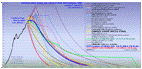
New capacity announcements will preclude shortages in the near future. If there will be a problem with rising production, it will occur in 2013 as that is the first forseeable year where proposed capacity additions are less than the projected annual loss due to the underlying decline (4.8-mbd) associated with mature fields.
OTOH, if producers bring on in excess of 5-mbd of new capacity in 2013, 2014, etc ... the plateau and/or growth can be extended. The barrier is capital cost and skilled employees. It costs $36-Billion to bring each 1-mbd of new extraction & refining capacity to fruition and there is a 4 - 7yr associated time line.
I update these and other relevant charts monthly:


www.TrendLines.ca/scenarios.htm Home of the Real Peak Date ... set by geologists (not pundits)
-
FreddyH - Lignite

- Posts: 321
- Joined: Mon 14 Jan 2008, 04:00:00
- Location: The Yukon
Re: Is there a production graph?
by BigTex » Tue 13 May 2008, 16:49:08
Freddy,
I'm sure you have commented on this elsewhere, but this is a pretty good place to rehash it.
Assuming your projected production curve is accurate, I would think that there will still be terrific price pressure as demand continues to prevent any spare capacity from showing up at any point in the next few years.
In other words, I think that if the world's appetite in five years would be for 105 million barrels a day, even if we are at 96 million barrels a day, there is no reason to believe that prices are going anywhere but up from here.
What do you think?
Also, where does declining EROEI come into play? If 87 mbd currently provides us with, say, 70 mbd of net energy, how much more net energy will 97 mbd provide in 2015?
It also occurs to me that a gradual increase in production ought to give us some gradual economic growth for the next few years. What do you think about that?
It's hard for me to imagine an economic collapse in an environment where you still have gradually increasing production, so long as there is actually an increase on a net energy basis as well.
I'm sure you have commented on this elsewhere, but this is a pretty good place to rehash it.
Assuming your projected production curve is accurate, I would think that there will still be terrific price pressure as demand continues to prevent any spare capacity from showing up at any point in the next few years.
In other words, I think that if the world's appetite in five years would be for 105 million barrels a day, even if we are at 96 million barrels a day, there is no reason to believe that prices are going anywhere but up from here.
What do you think?
Also, where does declining EROEI come into play? If 87 mbd currently provides us with, say, 70 mbd of net energy, how much more net energy will 97 mbd provide in 2015?
It also occurs to me that a gradual increase in production ought to give us some gradual economic growth for the next few years. What do you think about that?
It's hard for me to imagine an economic collapse in an environment where you still have gradually increasing production, so long as there is actually an increase on a net energy basis as well.

-

BigTex - Intermediate Crude

- Posts: 3858
- Joined: Thu 03 Aug 2006, 03:00:00
- Location: Graceland
Re: Is there a production graph?
by FreddyH » Tue 13 May 2008, 18:35:56
$this->bbcode_second_pass_quote('BigTex', 'F')reddy,
I'm sure you have commented on this elsewhere, but this is a pretty good place to rehash it.
Assuming your projected production curve is accurate, I would think that there will still be terrific price pressure as demand continues to prevent any spare capacity from showing up at any point in the next few years.
In other words, I think that if the world's appetite in five years would be for 105 million barrels a day, even if we are at 96 million barrels a day, there is no reason to believe that prices are going anywhere but up from here.
What do you think?
I'm sure you have commented on this elsewhere, but this is a pretty good place to rehash it.
Assuming your projected production curve is accurate, I would think that there will still be terrific price pressure as demand continues to prevent any spare capacity from showing up at any point in the next few years.
In other words, I think that if the world's appetite in five years would be for 105 million barrels a day, even if we are at 96 million barrels a day, there is no reason to believe that prices are going anywhere but up from here.
What do you think?
As mentioned yesterday on the shale thread, this chart "is not accurate"! In light of a higher apparent Underlying Decline Rate (3.3%) and a lower estimate of URR for Conventional Oil, the May version of this chart will show a reduced 91-mbd Peak. This will only exacerbate your concerns over spare capacity.
WRT to price, i see less correlation to spare capacity in the last five years. Price spikes are spec activity driven by about six bucks. But the general trend is more vulnerable to monthly surplus/draw balance.
The four major price corrections in 2003, 2004, 2005 & 2006 all coincided with monthly surpluses between 1 to 1.5-mbd. There was no correction in 2007 'cuz the highest surplus was a paltry 0.3-mbd. We were mainly in "draw" mode.
In short, surplus capacity is of no use unless it is drawn upon to bring equilibrium to the marketplace. To see one of these 30% price drops, we need a serious bump in production or some decent demand destruction. I foresee neither.
As seen in my Barrel Meter analysis, Price seems to have detatched itself from fundamentals. There appears to a $50/barrel bubble but it is not driven by speculation activity. It is merely "speculation" of perceived weather, geopolitical and depletion issues. And like any bubble, it can burst w/o intervention or notice. The producers are the beneficiary of this windfall.
$this->bbcode_second_pass_quote('', 'A')lso, where does declining EROEI come into play? If 87 mbd currently provides us with, say, 70 mbd of net energy, how much more net energy will 97 mbd provide in 2015?
This is where i throw a bouquet to the EIA. They have decided to break with IEA and commence methodology that reduces energy inputs from the gross processing figures for BTL, heavy, x-heavy & bitumen. This is the reason for the 1.4-mbd (and growing) spread in supply stats (as seen in the above blue chart) between the Agencies.
Some would say that this should be taken to the next level and adjust for BTU content.
$this->bbcode_second_pass_quote('', 'I')t also occurs to me that a gradual increase in production ought to give us some gradual economic growth for the next few years. What do you think about that?
It's hard for me to imagine an economic collapse in an environment where you still have gradually increasing production, so long as there is actually an increase on a net energy basis as well.
Economic growth will continue regardless of production levels. While there is some correlation since the 70's, it is not perfect and there are a plethora of substitution, conservation and alternative options via other energy sources etc.
It would only cause me concern if the post peak decline would breach the 2% annually threshold. In that regard, the PPDR in my last model run was a mere 1% to 2050 ... and basically in plateau 'til 2031.
www.TrendLines.ca/scenarios.htm Home of the Real Peak Date ... set by geologists (not pundits)
-
FreddyH - Lignite
- Posts: 321
- Joined: Mon 14 Jan 2008, 04:00:00
- Location: The Yukon

