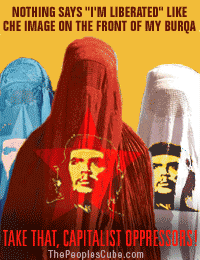
Yet another communist murderer whitewashed as a hero:
$this->bbcode_second_pass_quote('', 'G')uevara might have been enamored of his own death, but he was much more enamored of other people’s deaths. In April 1967, speaking from experience, he summed up his homicidal idea of justice in his “Message to the Tricontinental”: “hatred as an element of struggle; unbending hatred for the enemy, which pushes a human being beyond his natural limitations, making him into an effective, violent, selective, and cold-blooded killing machine.” His earlier writings are also peppered with this rhetorical and ideological violence. [...] In a letter to his mother in 1954, written in Guatemala, where he witnessed the overthrow of the revolutionary government of Jacobo Arbenz, he wrote: “It was all a lot of fun, what with the bombs, speeches, and other distractions to break the monotony I was living in.”
[...] An earlier letter to his former girlfriend Tita Infante had observed that “if there had been some executions, the government would have maintained the capacity to return the blows.” It is hardly a surprise that during the armed struggle against Batista, and then after the triumphant entry into Havana, Guevara murdered or oversaw the executions in summary trials of scores of people—proven enemies, suspected enemies, and those who happened to be in the wrong place at the wrong time.
In January 1957, as his diary from the Sierra Maestra indicates, Guevara shot Eutimio Guerra because he suspected him of passing on information: “I ended the problem with a .32 caliber pistol, in the right side of his brain.... His belongings were now mine.” Later he shot Aristidio, a peasant who expressed the desire to leave whenever the rebels moved on. While he wondered whether this particular victim “was really guilty enough to deserve death,” he had no qualms about ordering the death of Echevarria, a brother of one of his comrades, because of unspecified crimes: “He had to pay the price.” At other times he would simulate executions without carrying them out, as a method of psychological torture.[...]
But the “cold-blooded killing machine” did not show the full extent of his rigor until, immediately after the collapse of the Batista regime, Castro put him in charge of La Cabana prison.[...] In a manner chillingly reminiscent of Lavrenti Beria, Guevara presided during the first half of 1959 over one of the darkest periods of the revolution. [...]
Che was in charge of the Comision Depuradora. The process followed the law of the Sierra: there was a military court and Che’s guidelines to us were that we should act with conviction, meaning that they were all murderers and the revolutionary way to proceed was to be implacable. My direct superior was Miguel Duque Estrada. My duty was to legalize the files before they were sent on to the Ministry. Executions took place from Monday to Friday, in the middle of the night, just after the sentence was given and automatically confirmed by the appellate body. On the most gruesome night I remember, seven men were executed.
[...]There were about eight hundred prisoners in a space fit for no more than three hundred: former Batista military and police personnel, some journalists, a few businessmen and merchants. The revolutionary tribunal was made of militiamen. Che Guevara presided over the appellate court. He never overturned a sentence. I would visit those on death row at the galera de la muerte. A rumor went around that I hypnotized prisoners because many remained calm, so Che ordered that I be present at the executions. After I left in May, they executed many more, but I personally witnessed fifty-five executions. There was an American, Herman Marks, apparently a former convict. We called him “the butcher” because he enjoyed giving the order to shoot. I pleaded many times with Che on behalf of prisoners. I remember especially the case of Ariel Lima, a young boy. Che did not budge. Nor did Fidel, whom I visited. I became so traumatized that at the end of May 1959 I was ordered to leave the parish of Casa Blanca, where La Cabana was located and where I had held Mass for three years. I went to Mexico for treatment. The day I left, Che told me we had both tried to bring one another to each other’s side and had failed. His last words were: “When we take our masks off, we will be enemies.”
How many people were killed at La Cabana? Pedro Corzo offers a figure of some two hundred, similar to that given by Armando Lago, a retired economics professor who has compiled a list of 179 names as part of an eight-year study on executions in Cuba. Vilasuso told me that four hundred people were executed between January and the end of June in 1959 (at which point Che ceased to be in charge of La Cabana). Secret cables sent by the American Embassy in Havana to the State Department in Washington spoke of “over 500.” According to Jorge Castaneda, one of Guevara’s biographers, a Basque Catholic sympathetic to the revolution, the late Father Inaki de Aspiazu, spoke of seven hundred victims. [...]
Which brings us back to Carlos Santana and his chic Che gear. In an open letter published in El Nuevo Herald on March 31 of this year, the great jazz musician Paquito D’Rivera castigated Santana for his costume at the Oscars, and added: “One of those Cubans [at La Cabana] was my cousin Bebo, who was imprisoned there precisely for being a Christian. He recounts to me with infinite bitterness how he could hear from his cell in the early hours of dawn the executions, without trial or process of law, of the many who died shouting, ‘Long live Christ the King!’”
Che’s lust for power had other ways of expressing itself besides murder. The contradiction between his passion for travel—a protest of sorts against the constraints of the nation-State—and his impulse to become himself an enslaving state over others is poignant. In writing about Pedro Valdivia, the conquistador of Chile, Guevara reflected: “He belonged to that special class of men the species produces every so often, in whom a craving for limitless power is so extreme that any suffering to achieve it seems natural.” He might have been describing himself. At every stage of his adult life, his megalomania manifested itself in the predatory urge to take over other people’s lives and property, and to abolish their free will.
In 1958, after taking the city of Sancti Spiritus, Guevara unsuccessfully tried to impose a kind of sharia, regulating relations between men and women, the use of alcohol, and informal gambling—a puritanism that did not exactly characterize his own way of life. He also ordered his men to rob banks, a decision that he justified in a letter to Enrique Oltuski, a subordinate, in November of that year: “The struggling masses agree to robbing banks because none of them has a penny in them.” This idea of revolution as a license to re-allocate property as he saw fit led the Marxist Puritan to take over the mansion of an emigrant after the triumph of the revolution.
The urge to dispossess others of their property and to claim ownership of others’ territory was central to Guevara’s politics of raw power. In his memoirs, the Egyptian leader Gamal Abdel Nasser records that Guevara asked him how many people had left his country because of land reform. When Nasser replied that no one had left, Che countered in anger that the way to measure the depth of change is by the number of people “who feel there is no place for them in the new society.” This predatory instinct reached a pinnacle in 1965, when he started talking, God-like, about the “New Man” that he and his revolution would create.
Che’s obsession with collectivist control led him to collaborate on the formation of the security apparatus that was set up to subjugate six and a half million Cubans. In early 1959, a series of secret meetings took place in Tarara, near Havana, at the mansion to which Che temporarily withdrew to recover from an illness. That is where the top leaders, including Castro, designed the Cuban police state. Ramiro Valdes, Che’s subordinate during the guerrilla war, was put in charge of G-2, a body modeled on the Cheka. Angel Ciutah, a veteran of the Spanish Civil War sent by the Soviets who had been very close to Ramon Mercader, Trotsky’s assassin, and later befriended Che, played a key role in organizing the system, together with Luis Alberto Lavandeira, who had served the boss at La Cabana. Guevara himself took charge of G-6, the body tasked with the ideological indoctrination of the armed forces. The U.S.-backed Bay of Pigs invasion in April 1961 became the perfect occasion to consolidate the new police state, with the rounding up of tens of thousands of Cubans and a new series of executions. As Guevara himself told the Soviet ambassador Sergei Kudriavtsev, counterrevolutionaries were never “to raise their head again.”


PeakOil is You
The crimes of Che Guevara
18 posts
• Page 1 of 1
The crimes of Che Guevara
 by btu2012 » Sat 23 Feb 2008, 19:11:04
Full article at:
http://www.independent.org/newsroom/article.asp?id=1535

only the paranoid survive
-

btu2012 - Heavy Crude

- Posts: 1802
- Joined: Mon 24 Sep 2007, 03:00:00
- Location: third from the sun
Re: The crimes of Che Guevara
by Plantagenet » Sat 23 Feb 2008, 19:24:32
Sure Che was a mass murderer, but teeny boppers still like to wear his picture on their T-shirts! 
-

Plantagenet - Expert

- Posts: 26765
- Joined: Mon 09 Apr 2007, 03:00:00
- Location: Alaska (its much bigger than Texas).
Re: The crimes of Che Guevara
by btu2012 » Sat 23 Feb 2008, 19:26:11
$this->bbcode_second_pass_quote('Plantagenet', 'S')ure Che was a mass murderer, but teeny boppers still like to wear his picture on their T-shirts!
The real question is why some companies push this criminal as a model for teenagers.
Btu
only the paranoid survive
-
btu2012 - Heavy Crude
- Posts: 1802
- Joined: Mon 24 Sep 2007, 03:00:00
- Location: third from the sun
Re: The crimes of Che Guevara
by mos6507 » Sat 23 Feb 2008, 19:53:50
$this->bbcode_second_pass_quote('Plantagenet', 'S')ure Che was a mass murderer, but teeny boppers still like to wear his picture on their T-shirts!
It goes without saying that when you are handsome, people overlook your moral character.
- mos6507
Re: The crimes of Che Guevara
by Plantagenet » Sat 23 Feb 2008, 20:20:43
$this->bbcode_second_pass_quote('mos6507', '')$this->bbcode_second_pass_quote('Plantagenet', 'S')ure Che was a mass murderer, but teeny boppers still like to wear his picture on their T-shirts!
It goes without saying that when you are handsome, people overlook your moral character.
Teeny boppers who wear Che T-shirts do so to act out their adolescent rebellions against their mommies and daddies. The teeny boppers say, "like hey mom, big girls can wear lipstick and Che T-shirts too, so there....."
-
Plantagenet - Expert
- Posts: 26765
- Joined: Mon 09 Apr 2007, 03:00:00
- Location: Alaska (its much bigger than Texas).