Donate Bitcoin

Donate Paypal


PeakOil is You

PeakOil is You

Do bear markets destroy wealth?

Discussions about the economic and financial ramifications of PEAK OIL

Do bear markets destroy wealth?

Poll ended at Thu 13 Mar 2008, 12:26:02

yes
12
No votes
no
27
No votes
 
Total votes : 39

Re: Do bear markets destroy wealth?

Unread postby evilgenius » Mon 18 Feb 2008, 09:10:43

I agree with Mr. Bill. I think bear markets redistribute wealth.

Sure, people who lose their nerve or are in the wrong time of life can lose their wealth. The thing is, as an aggregate figure, there are just as many rich people taking advantge of those sales and adding to the number of shares they own at the lower prices. What you have is a situation where at times when the market is boiling and all that people care about is earnings per share the rich don't need to own as many shares in order to exercise a certain level of control. In order to exercise the same level of control in a bear market the same person may need to buy up a greater percentage of shares (at reduced prices). This happens because what people demand from companies changes from eps to actual return. In other words, the time horizon of investments shrinks. It is no longer possible in most cases to realize tomorrow today. It is still possible to realize today. The rich person buys the extra shares with the idea of selling them when the next bull comes along, be that in their own or their family's time.

It is when today is destroyed that wealth is lost. We haven't yet lost today.
When it comes down to it, the people will always shout, "Free Barabbas." They love Barabbas. He's one of them. He has the same dreams. He does what they wish they could do. That other guy is more removed, more inscrutable. He makes them think. "Crucify him."
User avatar
evilgenius
Intermediate Crude
Intermediate Crude
 
Posts: 3730
Joined: Tue 06 Dec 2005, 04:00:00
Location: Stopped at the Border.

Re: Do bear markets destroy wealth?

Unread postby cube » Tue 19 Feb 2008, 14:23:38

$this->bbcode_second_pass_quote('MrBill', 'E')very transaction involves a buyer and a seller. The buyer benefits when they buy a share or a house and it goes up in price, but the seller does not.

Conversely, when the seller sells to the buyer and the price of the share or house falls the buyer is worse off, but the seller still has the proceeds from the sale price.

Therefore, bear markets by definition cannot destroy wealth. They help to re-distribute wealth from buyers to sellers.
I like that explanation but I'd like to add to it. Recently there was about a $7 Trillion global loss within the financial markets and counting. Does that mean somebody lost $7 T and someone else gained $7 T? *grin* Well no. In order for that to happen there had to be a financial transaction and there wasn't. So what did happen?-->here's my theory.

Perhaps I should clarify when I said "illusion" of wealth being destroyed. Suppose Joe Sixpack puts money into the stock market and the market triples in price.
Question: did he really triple his money?
What would happen to say the Dow Jones if EVERY American tried to sell their stocks tomorrow? As mentioned before a financial transaction must have both a buyer and seller so therefore the transaction would be impossible (it takes 2 to tangle as Americans like to joke!). The price would have to drop until enough sellers changed their minds and become buyers. Then the financial transaction can take place. The DOW was never worth 14,000++ because society as a whole could NOT have cashed out. A small percentage of people with good forethought can cash out. (wealth redistribution) For 90% of society what was lost? An illusion. Of course I do not expect people to see things my way. A lot of people would get mighty upset if the DOW dropped to 4,000!

BTW I heard that Isaac Newton lost a bundle in the South Sea Fiasco. I think in the end it is our emotions and not lack of intellect that causes our downfall. Most people who invest actually win money in the beginning.......but most will eventually lose it b/c they held on too long. :)
cube
Intermediate Crude
Intermediate Crude
 
Posts: 3909
Joined: Sat 12 Mar 2005, 04:00:00

Re: Do bear markets destroy wealth?

Unread postby evilgenius » Tue 19 Feb 2008, 14:34:22

Don't forget, in a no winners game, when the losses build up and aren't reversed something else has usually to give. That something else could be political power or it could be currency valuations (relative wealth of nations). Both of those things are an extension of money as it performs within an economy.
When it comes down to it, the people will always shout, "Free Barabbas." They love Barabbas. He's one of them. He has the same dreams. He does what they wish they could do. That other guy is more removed, more inscrutable. He makes them think. "Crucify him."
User avatar
evilgenius
Intermediate Crude
Intermediate Crude
 
Posts: 3730
Joined: Tue 06 Dec 2005, 04:00:00
Location: Stopped at the Border.

Re: Do bear markets destroy wealth?

Unread postby CrudeAwakening » Tue 19 Feb 2008, 16:10:26

$this->bbcode_second_pass_quote('cube', '
')Perhaps I should clarify when I said "illusion" of wealth being destroyed. Suppose Joe Sixpack puts money into the stock market and the market triples in price.
Question: did he really triple his money?
What would happen to say the Dow Jones if EVERY American tried to sell their stocks tomorrow? As mentioned before a financial transaction must have both a buyer and seller so therefore the transaction would be impossible (it takes 2 to tangle as Americans like to joke!). The price would have to drop until enough sellers changed their minds and become buyers. Then the financial transaction can take place. The DOW was never worth 14,000++ because society as a whole could NOT have cashed out. A small percentage of people with good forethought can cash out. (wealth redistribution) For 90% of society what was lost? An illusion. Of course I do not expect people to see things my way. A lot of people would get mighty upset if the DOW dropped to 4,000!

Cube, I agree with you 100%. The only people who make capital gains/losses are those transacting, while their transactions affect the perceived value of the asset for those who choose to hold. An 'externality' of sorts. The actions of a few set the perceived asset values held by the many.

The market cap of a stock is in some ways a misleading number as it is impossible for all shares to be sold at current market value.
"Who knows what the Second Law of Thermodynamics will be like in a hundred years?" - Economist speaking during planning for World Population Conference in early 1970s
User avatar
CrudeAwakening
Tar Sands
Tar Sands
 
Posts: 834
Joined: Tue 28 Jun 2005, 03:00:00

Re: Do bear markets destroy wealth?

Unread postby cube » Tue 19 Feb 2008, 19:07:32

$this->bbcode_second_pass_quote('CrudeAwakening', '.')..
The market cap of a stock is in some ways a misleading number as it is impossible for all shares to be sold at current market value.
In theory only a maximum of 50% can sell because the other 50% must buy. :P

BTW when 70 million American baby boomers retire *looks at watch* sometime pretty soon and they wish to "cash out" aka sell their stocks, who's going to buy? Or maybe the more important question is at what price? This is one of the reasons why I absolutely despise the 401K retirement system. It is a scam. I think some people are going to learn a very bitter lesson--->we all cannot make money off the market.
cube
Intermediate Crude
Intermediate Crude
 
Posts: 3909
Joined: Sat 12 Mar 2005, 04:00:00

Re: Do bear markets destroy wealth?

Unread postby BigTex » Tue 19 Feb 2008, 19:32:55

$this->bbcode_second_pass_quote('cube', '')$this->bbcode_second_pass_quote('CrudeAwakening', '.')..
The market cap of a stock is in some ways a misleading number as it is impossible for all shares to be sold at current market value.
In theory only a maximum of 50% can sell because the other 50% must buy. :P

BTW when 70 million American baby boomers retire *looks at watch* sometime pretty soon and they wish to "cash out" aka sell their stocks, who's going to buy? Or maybe the more important question is at what price? This is one of the reasons why I absolutely despise the 401K retirement system. It is a scam. I think some people are going to learn a very bitter lesson--->we all cannot make money off the market.


That mass exodus from the workforce will start in earnest in 2012. That's right, the same year that the earth's poles reverse polarity, so it's going to be a tough year all the way around.

I don't think your 50%/50% is right. Let me illustrate. I follow Chevron and the average daily volume is 12 million shares and the total number of outstanding shares is 2.1 billion. Thus, on an average day .5% (or so) of the outstanding shares are traded. How much more than .5% would have to be offered for sale on a given day to crash the price? I don't know, but I suspect that if 3% to 5% of the outstanding shares hit the market at the same time the stock would nosedive.

If there are no buyers there is no market. It only takes a small percentage of a stock hitting the market at once to kill it. Which makes your point about a bunch of market participants cashing out at the same time even worse.

Don't forget, they are not only going to be slowly selling their investments, they are also going to be rotating into fixed income and most of them will not be working any more, or will be working a lot less, so the economic growth created by their employment will also be lost.

Look at how the decline in the 45-54 year old population in Japan coincides with their economy sputtering. It's kind of scary.

Maybe MrBill can put a good spin on my observations.
:)
User avatar
BigTex
Intermediate Crude
Intermediate Crude
 
Posts: 3858
Joined: Thu 03 Aug 2006, 03:00:00
Location: Graceland
Top

Re: Do bear markets destroy wealth?

Unread postby MrBill » Wed 20 Feb 2008, 04:29:07

$this->bbcode_second_pass_quote('cube', '')$this->bbcode_second_pass_quote('CrudeAwakening', '.')..
The market cap of a stock is in some ways a misleading number as it is impossible for all shares to be sold at current market value.
In theory only a maximum of 50% can sell because the other 50% must buy. :P

BTW when 70 million American baby boomers retire *looks at watch* sometime pretty soon and they wish to "cash out" aka sell their stocks, who's going to buy? Or maybe the more important question is at what price? This is one of the reasons why I absolutely despise the 401K retirement system. It is a scam. I think some people are going to learn a very bitter lesson--->we all cannot make money off the market.


Scam? It is and it isn't. The market is a store of value. True, that value changes, but your pension funds that will pay-out on retirement have to have some place to put their money, be it stocks, bonds or those infamous alternative investments.

The truth is that we live in the moment and so does our money. Yesterday is gone and tomorrow is not here. Any investment into the future requires a leap of faith that tomorrow may look something like yesterday or today. Otherwise you would have to go 100% to cash or precious metals and save 100% of your retirement.

Really the true value of a stock is its discounted future cash flow. You are exchanging your cash today for those future earnings. The capital appreciation is only in anticipation of faster or slower growth prospects. Also in the future, so also uncertain.

But even a bond needs future cash flow or profits in order to pay interest plus principle on maturity. And those alternative investments? It is the greater fool strategy. Buy something hoping that someone will buy it off you tomorrow for more money.

However, when Warren Buffett decides to sell PetroChina do you want your pension fund buying what he doesn't want as a long-term value investor? ; - )
The organized state is a wonderful invention whereby everyone can live at someone else's expense.
User avatar
MrBill
Expert
Expert
 
Posts: 5630
Joined: Thu 15 Sep 2005, 03:00:00
Location: Eurasia
Top

Re: Do bear markets destroy wealth?

Unread postby mkwin » Wed 20 Feb 2008, 08:07:09

$this->bbcode_second_pass_quote('', 'L')ook at how the decline in the 45-54 year old population in Japan coincides with their economy sputtering. It's kind of scary.


The increased savings rate as people prepare for retirement almost certainly contributed to the asset bubbles that eventually popped leading to the deflationary recessionary environment still present.

In regards to who will buy shares and other assets when the glut of the baby boomers retire? There is still a lot of capital around in the form of private equity, sovereign wealth, emerging market investors and traditional institutional investors and if the shares reflect value they will find buyers. A glut of assets would, though, have a depressing affect on the price. If it was not for the uncertainty regarding peak oil, it would be a fantastic time to buy value.
User avatar
mkwin
Tar Sands
Tar Sands
 
Posts: 625
Joined: Fri 01 Jun 2007, 03:00:00
Top

Re: Do bear markets destroy wealth?

Unread postby cube » Wed 20 Feb 2008, 09:26:54

$this->bbcode_second_pass_quote('MrBill', '.')..
Scam? It is and it isn't. The market is a store of value. True, that value changes, but your pension funds that will pay-out on retirement have to have some place to put their money, be it stocks, bonds or those infamous alternative investments.
...
Maybe being a day trader has messed me up in the head. I still believe most relationships in life are based on mutual benefits. Both sides win, marriage, friendships, etc... However when it comes to investments I simply can NOT accept the idea that the majority will win. The 401K system is based on the idea that the majority of us will win if we simply buy and hold for the long haul.-->no

The majority must and will LOSE.

Imagine if we play a gambling game (against each other, NOT the house). Eventually in the end 10% will collect the lion share's of the profits. That's just the way gambling works. The stock market is like that too. To have faith in the 401K system, one must believe the stock market is a "socialistic" means of distributing wealth. :oops:

But yes I see what you're saying. You have to put your money somewhere......
cube
Intermediate Crude
Intermediate Crude
 
Posts: 3909
Joined: Sat 12 Mar 2005, 04:00:00
Top

Re: Do bear markets destroy wealth?

Unread postby MrBill » Wed 20 Feb 2008, 09:58:19

cube wrote:
$this->bbcode_second_pass_quote('', 'I')magine if we play a gambling game (against each other, NOT the house). Eventually in the end 10% will collect the lion share's of the profits. That's just the way gambling works. The stock market is like that too. To have faith in the 401K system, one must believe the stock market is a "socialistic" means of distributing wealth.


Usually at a poker game you end up with one winner at the end of the evening. Hence winner takes all.

However, it is a poor analogy for the equity market. The equity market is not a game. It represents ownership stakes in public companies. Their share prices in turn reflect their future earnings. So in reality it is like a poker game with no fixed pot because anonymous donors (i.e. consumers) keep adding money to the overall pot by giving each player more money each hand (in the form of earnings or profits).

Investors can still lose money if they overpay for a stock, which is basically giving those future earnings the wrong discount factor i.e. over-estimating future profits. That can happen to individual stocks and it can happen to the broader market as well if investors become overly bullish and are willing to pay unrealistic multiples for stocks that end up disappointing to the downside at a later date.

Baby boomers going into retirement should have zero effect on the stock market per se if stocks are fairly valued. As foreign investors who are not going into retirement, but looking to earn a return on their capital buy up those shares. It would be crazy not to buy a share at say a P/E of 10 if that represents an ownership in a public company that is growing, making profits and paying dividends to its shareholders.

However, that is not to say that shares might not fall if those companies are producing something that baby boomers are no longer buying or need in which case the company is no longer growing, no longer making profits and no longer paying dividends, so even a P/E ratio of 10 might be too high.

I tend to agree with BigTex. I do not think you need a majority of shareholders to sell to start a stampede for the exits. All you need is a few sellers and a dearth of buyers to magnify that down move. That is why we closely watch volatility and volume. A large price spike on low volume is not as an important indicator as a large price spike on high volume that is a stronger signal.

Psychologically though if you have a down move. Say the first 5% globally on a Monday when there is a US holiday like on January 21st. Then this sets the US up for an even bigger fall when they come in on Tuesday as the buyers are not likely to step in at 99, 98, 97%, but immediately move their buying interest down to 95, 94, 93%. Whereas no one will be lifting offers at 100, 101, 103%. So essentially that first 5% disappears without any trading, and then sellers are forced to hit the next best bids that might be well below where they might have sold even a day earlier. Poof!

I think this is basically why when you see the broad market up or down say 2% on the day, that you will also notice a lot of individual stocks up or down 2% on that day as well. Or maybe individual stocks within a sector that move in tandem. More so on big up or big down days. Herd mentality.

So as far as cashing out your 401K at a profit it would not depend critically on how long you were invested, but at what price you bought and where that price is when you decide to sell. The closer you are to retirement the more you should be actively rebalancing your portfolio by reducing your percentage of growth stocks and increasing the proportion of defensive stocks while allocating more to high grade bonds for their capital guarantee.

Otherwise if you're a perfect stock picker and a hellova gambler you can just put it all on one share and let her ride! ; - )
The organized state is a wonderful invention whereby everyone can live at someone else's expense.
User avatar
MrBill
Expert
Expert
 
Posts: 5630
Joined: Thu 15 Sep 2005, 03:00:00
Location: Eurasia
Top

Re: Do bear markets destroy wealth?

Unread postby JoeW » Wed 20 Feb 2008, 16:27:10

$this->bbcode_second_pass_quote('mkwin', '
')Bubbles by definition are episodes of market mania where speculation is a key characteristic.
<snip>
I don't think many people are suggesting the oil price is in a bubble.


Speculation is a key characteristic of the current run-up in crude prices. The price does not necessarily reflect the market fundamentals. Inventories are at normal levels, but the price continues to rise.

The only thing that makes it not a bubble is if the speculators are correct about the future. Perhaps the speculators believe that the summer driving season will deplete inventories, or that a hurricane will take some production offline, or that oil production will peak in 2008 and irreversibly decline. If they are right, the ever-higher prices are justified. Present supply, demand, and inventory figures that I have seen posted here on peakoil.com (mainly from US DOE) do not justify the higher prices.

Peak oil is inevitable and the market has become aware of that. But it still is speculation...
I wouldn't call it a bubble, though.
User avatar
JoeW
Tar Sands
Tar Sands
 
Posts: 647
Joined: Tue 12 Oct 2004, 03:00:00
Location: The Pit of Despair
Top

Re: Do bear markets destroy wealth?

Unread postby MrBill » Thu 21 Feb 2008, 06:04:13

I do not think that speculation on rising prices or a bull market are synonomous with a bubble.

A bubble occurs when a bull trend turns into a one way bet, and therefore all caution, risk management and fundamental analysis are forgotten in the froth.

Bubbles tend to destroy the wealth of buyers because they pay far more for an asset than it is realistically worth. Not just a little more, but far more.

The net losses may offset the net wins by the sellers, but the gains and losses are asymmetrical. Not all of the losses accrue to those that can afford them. And not all the winnings are distributed equally.

As we say, the bulls and the bears make money, while the pigs get slaughtered! ; - )
The organized state is a wonderful invention whereby everyone can live at someone else's expense.
User avatar
MrBill
Expert
Expert
 
Posts: 5630
Joined: Thu 15 Sep 2005, 03:00:00
Location: Eurasia

Re: Do bear markets destroy wealth?

Unread postby shakespear1 » Thu 21 Feb 2008, 07:11:21

$this->bbcode_second_pass_code('', 'As we say, the bulls and the bears make money, while the pigs get slaughtered! ; - )') :-D :-D :-D :-D :-D :-D

That's good.
Men argue, nature acts !
Voltaire

"...In the absence of the gold standard, there is no way to protect savings from confiscation through inflation."

Alan Greenspan
shakespear1
Heavy Crude
Heavy Crude
 
Posts: 1532
Joined: Fri 13 May 2005, 03:00:00

Re: Do bear markets destroy wealth?

Unread postby cube » Thu 21 Feb 2008, 11:04:38

$this->bbcode_second_pass_quote('JoeW', '.')...
Speculation is a key characteristic of the current run-up in crude prices. ....

Why is it that when the stock market was reaching ridiculous levels back in the 1990's mainstream media would say weird things like: "a rising tide lifts all boats." When the housing boom was at it's peak everybody was walking around with a smile a mile wide. And finally we have a commodities boom and people are just crying and complaining like there's no tomorrow.....Demanding things like a windfall profit tax on oil companies.

Do I smell a little bit of favoritism here? How come there's no LOVE for commodities?
cube
Intermediate Crude
Intermediate Crude
 
Posts: 3909
Joined: Sat 12 Mar 2005, 04:00:00
Top

Re: Do bear markets destroy wealth?

Unread postby MrBill » Thu 21 Feb 2008, 11:53:28

$this->bbcode_second_pass_quote('cube', '')$this->bbcode_second_pass_quote('JoeW', '.')...
Speculation is a key characteristic of the current run-up in crude prices. ....

Why is it that when the stock market was reaching ridiculous levels back in the 1990's mainstream media would say weird things like: "a rising tide lifts all boats." When the housing boom was at it's peak everybody was walking around with a smile a mile wide. And finally we have a commodities boom and people are just crying and complaining like there's no tomorrow.....Demanding things like a windfall profit tax on oil companies.

Do I smell a little bit of favoritism here? How come there's no LOVE for commodities?


People invest in and own houses and stocks. You can borrow against their rising value to consume. Whereas higher commodity prices are seen as a cost and therefore a tax on consumption.

We have to do something to keep the costs for necessities as inexpensive as possible to encourage the greatest consumption of luxury goods as is possible! ; - )

No one even wants to pay for a good education anymore...
$this->bbcode_second_pass_quote('', 'A')mid calls by some U.S. lawmakers for wealthy universities to lower tuition costs, officials at Stanford University said on Wednesday they would no longer charge tuition to students from families earning less than $100,000 a year.

For students whose families earn less than $60,000 a year, Stanford University will not charge for either tuition or room and board, officials at the prestigious university near San Francisco said.


Source: Stanford waives tuition if income under $100,000

Meanwhile back in China where getting rich is glorious the consumer gets a helping hand from the state....

$this->bbcode_second_pass_quote('', 'W')hen Yuan Shanchun became China's first farmer to receive a government subsidy to buy a refrigerator, he was inundated with queries from just about everyone he knew asking how they could get one too.

"Who can believe it? How come the government is giving us money to buy things?" the bubbly 51-year-old asked, speaking in the thick accent of the eastern province of Shandong.

"This is like free food falling from the sky!"


Source: China farmers to get fridges, TVs to boost consumption

I have pretty much stopped trying to make sense of anything anymore! ; - ))

Stop the world and let me off
I'm tired of goin' 'round n' 'round
I played the game enough and lost
So, stop the world and let me off.
The organized state is a wonderful invention whereby everyone can live at someone else's expense.
User avatar
MrBill
Expert
Expert
 
Posts: 5630
Joined: Thu 15 Sep 2005, 03:00:00
Location: Eurasia
Top

Re: Do bear markets destroy wealth?

Unread postby Kingcoal » Thu 21 Feb 2008, 12:11:28

Who cares about "wealth" when we are running out of the fuel that powers the machine that creates it? Want to see a bear market? Jack the price of oil up to $200/bl, and you'll see a bear market like none in recent history.

Still, for those positioned properly, there are always ways to make money in a bear market. Owning a productive oil field is about as close to a money printing press as you are going to get, regardless of market conditions. The world doesn't just want oil; it needs it to remain wealthy.

I could go into a long discussion about how our entire economy is supported by cheap energy, but that would be rehashing old threads. I'll just say that you have to delve down into the support mechanisms for your wealth and you'll find cheap energy. That house in the suburbs, that fortune 500 company, that currency market, they are all absolutely dependant on the flow of inexpensive oil. Most of what we call wealth today does not stand on its own; it's completely supported by cheap oil.
"That's the problem with mercy, kid... It just ain't professional" - Fast Eddie, The Color of Money
User avatar
Kingcoal
Expert
Expert
 
Posts: 2149
Joined: Wed 29 Sep 2004, 03:00:00
Location: Pennsylvania, USA

Re: Do bear markets destroy wealth?

Unread postby yesplease » Thu 21 Feb 2008, 19:08:28

$this->bbcode_second_pass_quote('Kingcoal', 'I') could go into a long discussion about how our entire economy is supported by cheap energy, but that would be rehashing old threads.
Feel free! I'm very interested because none of those rehashes really quantify a whole lot. If I ask for figures, I'm either ignored, or considered rude. So, please, do tell/quantify...
$this->bbcode_second_pass_quote('Professor Membrane', ' ')Not now son, I'm making ... TOAST!
User avatar
yesplease
Intermediate Crude
Intermediate Crude
 
Posts: 3765
Joined: Tue 03 Oct 2006, 03:00:00
Top

Re: Do bear markets destroy wealth?

Unread postby MrBill » Fri 22 Feb 2008, 05:42:44

$this->bbcode_second_pass_quote('yesplease', '')$this->bbcode_second_pass_quote('Kingcoal', 'I') could go into a long discussion about how our entire economy is supported by cheap energy, but that would be rehashing old threads.
Feel free! I'm very interested because none of those rehashes really quantify a whole lot. If I ask for figures, I'm either ignored, or considered rude. So, please, do tell/quantify...


A lot of growth has been made possible by relatively cheap and abundant energy. That is to be expected as the economy is made up of land, labor, capital, technological know-how and, of course, energy. When energy is cheap and abundant it is used as a substitute for land or labor that may either be in short supply or relatively more expensive. Automation is a response to higher labor costs and/or shortages of skilled labor.

Naturally, if you remove petroleum from your existing energy mix - and if you cannot replace it with anything else - then you have less total energy available to run the economy. That will make all other energy - wind, wave, geo-thermal, solar, hydroelectric, nuclear, bio-fuel, natural gas and King Coal - more valuable in relative terms.

It is useless to compare their economics to petroleum. They may have a lower EROEI or simply they are inferior as a liquid transport fuel. However, once petroleum is gone - forever - it is like comparing solid oak furniture to press wood IKEA crap. IKEA crap is clearly inferior, but once all your old oaks are gone then you have to accept press wood with a 1/8th of an inch cheap oak veneer if you are lucky. More likely it will be a vinyl 'real wood' look a like.

So once petroleum is gone we will be comparing the EROEI and the viability of wind, wave, geo-thermal, solar, hydroelectric, nuclear, bio-fuel, natural gas and King Coal with one another because petroleum is no longer in our energy mix. Therefore, wealth will be created (or stored) by those that can successfully turn those alternative sources of energy into useful end products and/or use them to provide food, shelter, heat and other basic necessities.

Wealth will be destroyed anywhere that it is invested in existing infrastructure or assets that are no longer economically viable with either a permanently lower level of total energy or where alternatives are simply not available.

Because we still have petroleum in our current energy mix it is completely distorting the fundamental economics of alternative energy. The litany is that there is no shortage of renewable energy, but it is just not where we need it. Well, duh, we are trying to transport energy to where we need it - now - versus concentrating on moving production to where there is reliable energy. Again, once petroleum is gone, we will find there is no choice but to be where there is energy. Not vice versa! ; - )
The organized state is a wonderful invention whereby everyone can live at someone else's expense.
User avatar
MrBill
Expert
Expert
 
Posts: 5630
Joined: Thu 15 Sep 2005, 03:00:00
Location: Eurasia
Top

Re: Do bear markets destroy wealth?

Unread postby yesplease » Fri 22 Feb 2008, 06:36:20

$this->bbcode_second_pass_quote('MrBill', 'T')herefore, wealth will be created (or stored) by those that can successfully turn those alternative sources of energy into useful end products and/or use them to provide food, shelter, heat and other basic necessities.
What is using energy sources in order to garner wealth considered? For instance, it's hardly in the best economic interests of those who benefit from petroleum production/sales to encourage efficient use because it minimizes profitability in the short term, and possibly endangers the viability of selling what they have in the long term because the longer they sit on what they have, the more likely it is that something else will come along and replace their product's uses. So... Even if we do benefit from cheap and abundant energy in some respects, given how many cheap and abundant sources of energy we've managed to harness in the past century, it's far more financially remunerative for those who have the capital and position wrt energy supply, to use it to encourage as much consumption as possible, regardless of what it actually does to society's wealth.

Is this the difference between something as a fuel, and that something as a fuel and commodity?
$this->bbcode_second_pass_quote('Professor Membrane', ' ')Not now son, I'm making ... TOAST!
User avatar
yesplease
Intermediate Crude
Intermediate Crude
 
Posts: 3765
Joined: Tue 03 Oct 2006, 03:00:00
Top

Re: Do bear markets destroy wealth?

Unread postby MrBill » Fri 22 Feb 2008, 07:00:06

yesplease, America and many other former oil producers have aleady used up most or all of their petroleum. The four largest economies in the world - USA, Japan, China and Germany - are all net importers of oil. They therefore have an incentive to switch to alternative sources of energy. There is no way you can tell me that these countries and others are being held hostage by either oil producing nations or oil companies.

Oil companies are quite happy to use their cash cows to pay their shareholders dividends and do share buybacks with their extra revenues. They have no incentive to encourage consumers to use more oil or to consume it at a faster rate. They know they are sitting on limited reserves. They are struggling to replace those reserves. Those reserves are getting more expensive to replace. They know they are losing the battle. The bottleneck is really in the refining capacity.


Image

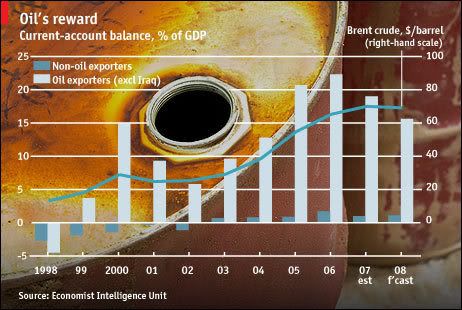
Oil royalties to host nations far exceed oil company profits as in many case the oil companies do not own the reserves, only the right to extract them. Everyone else downstream is working on margins. The difference between where they are able to buy crude and where they are able to sell petroleum products. So it is really those oil producing nations that would suffer if the world all of a sudden no longer needed their crude. But how likely is that to happen? Not very! ; - )
The organized state is a wonderful invention whereby everyone can live at someone else's expense.
User avatar
MrBill
Expert
Expert
 
Posts: 5630
Joined: Thu 15 Sep 2005, 03:00:00
Location: Eurasia

PreviousNext

Return to Economics & Finance

Who is online

Users browsing this forum: No registered users and 1 guest

cron