Say bye bye bucky...
Got gold?



PeakOil is You
Fed cuts prime rate 25bp
First unread post • 18 posts
• Page 1 of 1
Fed cuts prime rate 25bp
 by roccman » Tue 11 Dec 2007, 16:06:40
"There must be a bogeyman; there always is, and it cannot be something as esoteric as "resource depletion." You can't go to war with that." Emersonbiggins
-

roccman - Light Sweet Crude

- Posts: 4065
- Joined: Fri 27 Apr 2007, 03:00:00
- Location: The Great Sonoran Desert
Re: Ben cuts 25 bp
by firestarter » Tue 11 Dec 2007, 16:14:31
Not what the Wall Street whores were after. This is going to get interesting. Dow 10,000 here we come?
Civilization: the biosphere's skin disease
-

firestarter - Heavy Crude

- Posts: 1171
- Joined: Sun 19 Mar 2006, 04:00:00
Re: Ben cuts 25 bp
by bonehead » Tue 11 Dec 2007, 16:17:01
Crude just crossed $90 immediately.Way to go Ben!Short term fix for a much bigger problem.
Gimme some demand destruction.
-

bonehead - Peat

- Posts: 176
- Joined: Mon 15 Oct 2007, 03:00:00
- Location: Northeast U.S.Heating oil heaven.
Re: Ben cuts 25 bp
by I_Like_Plants » Tue 11 Dec 2007, 16:20:52
Did he do it? Every time the Fed does that, it essentially "shrinks" the dollar.
- I_Like_Plants
- Intermediate Crude

- Posts: 3839
- Joined: Sun 12 Jun 2005, 03:00:00
- Location: 1st territorial capitol of AZ
Re: Ben cuts 25 bp
by emersonbiggins » Tue 11 Dec 2007, 16:23:19
$this->bbcode_second_pass_quote('I_Like_Plants', 'D')id he do it? Every time the Fed does that, it essentially "shrinks" the dollar.
Yep.
Bloomberg
The market's reaction:

"It's called the American Dream because you'd have to be asleep to believe it."
George Carlin
George Carlin
-

emersonbiggins - Expert

- Posts: 5150
- Joined: Sun 10 Jul 2005, 03:00:00
- Location: Dallas
Re: Ben cuts 25 bp
by FoxV » Tue 11 Dec 2007, 16:30:21
$this->bbcode_second_pass_quote('roccman', 'S')ay bye bye bucky...
Got gold?
Got gold?
This was not what the crack addict traders were expecting so its actualy bad for gold.
What we'll get is further sliding in the market which will take money out of gold and commodities to cover margin positions.
Dollar will probably take a hit not so much from the interest rate drop but from banks not getting the 0.5% they wanted.
Credit crisis should accelerate now as bank margins get nailed further
Angry yet?
- FoxV
- Heavy Crude
- Posts: 1321
- Joined: Wed 02 Mar 2005, 04:00:00
- Location: Canada
Re: Ben cuts 25 bp
by firestarter » Tue 11 Dec 2007, 16:37:41
Right you are, Fox.
The market was really expecting--wanting--50bp on the FFT, and at least 50 on the DW. This will not bode well for anyone who went long over the past six weeks.
Lumps of coal for Wall Street. Ben played Scrooge today. Good for him.
The market was really expecting--wanting--50bp on the FFT, and at least 50 on the DW. This will not bode well for anyone who went long over the past six weeks.
Lumps of coal for Wall Street. Ben played Scrooge today. Good for him.
-
firestarter - Heavy Crude
- Posts: 1171
- Joined: Sun 19 Mar 2006, 04:00:00
Re: Ben cuts 25 bp
by Bas » Tue 11 Dec 2007, 16:40:20
so he couldn't choose.......
no cut for fighting inflation...or 50 bp for kickstarting the economy....
indecisive Ben.
no cut for fighting inflation...or 50 bp for kickstarting the economy....
indecisive Ben.
- Bas
Re: Ben cuts 25 bp
by sittinguy » Tue 11 Dec 2007, 16:53:06
I LOVE IT. He's just giving crumbs. They don't want us to get fat and lazy,, oh wait to late. buy stock in popcorn 
-
sittinguy - Coal
- Posts: 478
- Joined: Fri 07 Sep 2007, 03:00:00
Re: Ben cuts 25 bp
by evilgenius » Tue 11 Dec 2007, 16:59:47
What a cockup only moving 25 bps, everything you don't do now you have to do in such increased measure a few months down the road! Ah, but Ben is after the interests of the rich and, as I have said in other places, inflationary moves are not in the interests of the rich. Look, all of you hyperinflation doomers, the system let the country slide into deflation in the 30's even though they knew that it would be bad. The policies taken will always reflect the condition of the rich (read wealthy and not nec. illuminati and such). They will try their hardest to induce deflation until the country rises up and threatens to toss them from power, well, practically. Bernanke needs to feel some pressure before he makes any big moves. He also needs to know that he has sufficiently telegraphed any moves that could result in a sea change. His ass is hanging on the line if he doesn't.
I believe that history will judge the failure today harshly.
I believe that history will judge the failure today harshly.
When it comes down to it, the people will always shout, "Free Barabbas." They love Barabbas. He's one of them. He has the same dreams. He does what they wish they could do. That other guy is more removed, more inscrutable. He makes them think. "Crucify him."
-

evilgenius - Intermediate Crude
- Posts: 3730
- Joined: Tue 06 Dec 2005, 04:00:00
- Location: Stopped at the Border.
Re: Ben cuts 25 bp
by firestarter » Tue 11 Dec 2007, 17:10:08
Deflation is now a fait accompli. Actually they could have cut 450bp and deflation would still have been a fait accompli. The coming bust will more than equal the recent boom.
Got cash?
Got cash?
Civilization: the biosphere's skin disease
-
firestarter - Heavy Crude
- Posts: 1171
- Joined: Sun 19 Mar 2006, 04:00:00
Re: Ben cuts 25 bp
by Plantagenet » Tue 11 Dec 2007, 17:21:34
Voting for the FOMC monetary policy action were: Ben S. Bernanke, Chairman; Timothy F. Geithner, Vice Chairman; Charles L. Evans; Thomas M. Hoenig; Donald L. Kohn; Randall S. Kroszner; Frederic S. Mishkin; William Poole; and Kevin M. Warsh.
Voting against was Eric S. Rosengren, who preferred to lower the target for the federal funds rate by 50 basis points at this meeting.
9-1 vote for the 25 basis points.
Voting against was Eric S. Rosengren, who preferred to lower the target for the federal funds rate by 50 basis points at this meeting.
9-1 vote for the 25 basis points.
-

Plantagenet - Expert
- Posts: 26765
- Joined: Mon 09 Apr 2007, 03:00:00
- Location: Alaska (its much bigger than Texas).
Re: Ben cuts 25 bp
by Andrew_S » Tue 11 Dec 2007, 17:22:57
But isn't a rate cut good for the economy and thereby stock market?
Or have the rules changed?
Or have the rules changed?
- Andrew_S
- Tar Sands

- Posts: 634
- Joined: Sun 09 Jan 2005, 04:00:00
Re: Ben cuts 25 bp
by FoxV » Tue 11 Dec 2007, 17:24:05
$this->bbcode_second_pass_quote('evilgenius', 'A')h, but Ben is after the interests of the rich and, as I have said in other places, inflationary moves are not in the interests of the rich.
I disagree quite strongly with this. Inflation benefits those closest to the source of money (remember good 'ol trickle down economics).
The line up for the little piggies at the trough starts with:
Banks
Government
Hedge funds
Large independent investment houses/individuals
The ones at the back of the line are:
Regulated investors (pensions/mutual funds)
Non-investment institutions (hospitals, municipalities)
retail investors
Joe six pack
Todays mistake will just be another side bar note in a long list of mistakes that started in 1987 when Greenspan took the helm (at the beginning of the Kondrieff winter)
Angry yet?
- FoxV
- Heavy Crude
- Posts: 1321
- Joined: Wed 02 Mar 2005, 04:00:00
- Location: Canada
Re: Ben cuts 25 bp
by roccman » Tue 11 Dec 2007, 17:32:55
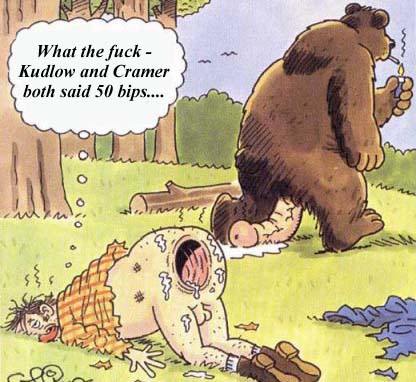
"There must be a bogeyman; there always is, and it cannot be something as esoteric as "resource depletion." You can't go to war with that." Emersonbiggins
-
roccman - Light Sweet Crude
- Posts: 4065
- Joined: Fri 27 Apr 2007, 03:00:00
- Location: The Great Sonoran Desert
Re: Ben cuts 25 bp
by Mechler » Tue 11 Dec 2007, 18:41:13
$this->bbcode_second_pass_quote('roccman', '[')url=http://www.denninger.net/images/bear_attack_no50.jpg]Image NOT SAFE FOR WORK[/url]
 That is hilarious!
"It is certain that free societies would have no easy time in a future dark age. The rapid return to universal penury will be accomplished by violence and cruelties of a kind now forgotten." - Roberto Vacca, The Coming Dark Age
- Mechler
- Lignite
- Posts: 293
- Joined: Thu 02 Feb 2006, 04:00:00
- Location: Denver, USA