The Energy Bulletin staff made the these comments about the following article:
One of the better articles criticizing peak oil theory, although I think most of its objections have been answered.
Interestingly, the article starts out by saying that the idea of peak oil is self-evident. Thus we we have passed into the last stage a truth reaching acceptance. According to a widely disseminated quote (sometimes attributed to Schopenhauer):
"All truth passes through three stages: First, it is ridiculed; Second, it is violently opposed; and Third, it is accepted as self-evident."
The Peak Oil Theory by Robert Mabro
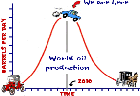
$this->bbcode_second_pass_quote('', 'T')he statement that the production of crude oil, an exhaustible resource, will reach a peak will not be entirely a tautology if it also told us something about the production pattern over time; something that is not necessarily implied in the exhaustibility concept. The peak story tells us, indeed, that after rising over years, decades or centuries, production will enter a phase of decline. The peak could take different shapes however. It could appear as the apex of an acute angle, or stretch out over a long period in the form of a plateau, or emerge more than once in the shape of a saddle or as a chain of dunes.
One major reason for their propensity to bring forward the dreaded event seems to be an eschatological inclination. Consciously or sub-consciously they are inclined to predict the end of a world economy that was fuelled by cheap oil over several decades. They also want to catch the headlines. For these reasons they need to predict an early peak. To tell us, for example, that oil production will peak in 2030 and oil resources be fully exhausted by 2080 would have little impact. The prediction has to be about an imminent event.
Exhaustibility is not a problem if there is time available to develop substitutes, and for technological progress to proceed further and delay the peak outcome. There is no doubt that the adjustments to scarcer and scarcer (which means more and more expensive) oil will occur. The critical question, once again, is ‘when?’ Once again one should emphasise that time is of the essence. The gestation lags of R&D and energy investments are long, sometime very long indeed. And investors – be it private companies or public sector entities – are increasingly slow in their responses because the future is always perceived as uncertain.
The peak oil theory, as defined above, has a harmful impact because it focuses on the wrong problem and in doing so it shifts attention away from more vital issues.
There is no ‘physical’ problem in the long run. There are, however, investment problems on the transition path from the oil to the ‘other liquids’ era. The ride is likely to be bumpy. And what we need to worry about now, and seek solutions to, are the investment and technical progress issues. Governments of OECD countries and private energy companies are not yet addressing these problems, worrying instead about the imminence of peak oil (a falsely alarming issue) for the security of energy supplies (a grossly misunderstood concept) and climate change (the most important about which the most significant polluters are unwilling to tackle.)
Re-focusing the debate away from the peak oil paranoia and towards the need to invest in the production of liquid fuels at the right time will put us on the road to a solution.


PeakOil is You
The Peak Oil Theory
Human history becomes more and more a race between education and catastrophe. H. G. Wells.
Fatih Birol's motto: leave oil before it leaves us.
Fatih Birol's motto: leave oil before it leaves us.
-

Graeme - Fusion

- Posts: 13258
- Joined: Fri 04 Mar 2005, 04:00:00
- Location: New Zealand
Re: The Peak Oil Theory
 by Nano » Tue 27 Nov 2007, 11:30:34
Re-focusing the debate away from the peak oil paranoia and towards the need to invest in the production of liquid fuels at the right time will put us on the road to a solution.
Well obviously.
The reason for my personal 'peak oil paranoia' is not the fact that peak oil will occur, but rather that it will remain impossible to predict with certainty when it will occur. Peak oil will be recognised only in hindsight. Therefore, it will be totally impossible to make the necessary investments for change in a timely manner.
In other words: we will have to adjust to the ramifications of Peak Oil during the very time when those ramifications are already upon us. And they might force us to enact solutions very different from the many options that we will have had pre-peak, due to the sharp decrease in surplus energy availability.
Post-peak government policy might very well involve increased international aggression and reduced civil liberties, instead of the support of expensive long-term sustainable development.
How is the state going to support long term investment when unemployment is at an all-time record high and rising? The voters will demand immediate support, creating a downward spiral into chaos and poverty, and eventually the rise of totalitarian neo-communist and/or -fascist regimes.
That is what scares me about peak oil.
Well obviously.
The reason for my personal 'peak oil paranoia' is not the fact that peak oil will occur, but rather that it will remain impossible to predict with certainty when it will occur. Peak oil will be recognised only in hindsight. Therefore, it will be totally impossible to make the necessary investments for change in a timely manner.
In other words: we will have to adjust to the ramifications of Peak Oil during the very time when those ramifications are already upon us. And they might force us to enact solutions very different from the many options that we will have had pre-peak, due to the sharp decrease in surplus energy availability.
Post-peak government policy might very well involve increased international aggression and reduced civil liberties, instead of the support of expensive long-term sustainable development.
How is the state going to support long term investment when unemployment is at an all-time record high and rising? The voters will demand immediate support, creating a downward spiral into chaos and poverty, and eventually the rise of totalitarian neo-communist and/or -fascist regimes.
That is what scares me about peak oil.
-

Nano - Lignite

- Posts: 333
- Joined: Sun 16 Jan 2005, 04:00:00
- Location: Delft, Netherlands
Re: The Peak Oil Theory
by PeakingAroundtheCorner » Tue 27 Nov 2007, 12:33:44
The key word in all of this is production. Peak Oil is a peak in production, the act of extracting oil from the ground. There's still plenty of oil. It is just not humanly possible to get to it. Geophysical contraints are placed on what we can get to and Hubbert's Peak takes over. All the investment in the world won't overcome Hubbert's Peak.
And they know it.
And they know it.
-
PeakingAroundtheCorner - Tar Sands

- Posts: 522
- Joined: Sun 08 Apr 2007, 03:00:00
Re: The Peak Oil Theory
by Aaron » Tue 27 Nov 2007, 12:51:35
If peak oil is a theory, it's on the level of the theory of gravity.
No serious claims have been made disputing peak oil per se... only when it will occur is in dispute.
The USGS & others also predict a production peak... just decades later than ASPO et al.
No serious claims have been made disputing peak oil per se... only when it will occur is in dispute.
The USGS & others also predict a production peak... just decades later than ASPO et al.
The problem is, of course, that not only is economics bankrupt, but it has always been nothing more than politics in disguise... economics is a form of brain damage.
Hazel Henderson
Hazel Henderson
-

Aaron - Resting in Peace
- Posts: 5998
- Joined: Thu 15 Apr 2004, 03:00:00
- Location: Houston
Re: The Peak Oil Theory
by JohnDenver » Tue 27 Nov 2007, 13:03:26
$this->bbcode_second_pass_quote('Aaron', 'I')f peak oil is a theory, it's on the level of the theory of gravity.
No serious claims have been made disputing peak oil per se... only when it will occur is in dispute.
No serious claims have been made disputing peak oil per se... only when it will occur is in dispute.
The likely effects are also in dispute.
- JohnDenver
- Intermediate Crude

- Posts: 2145
- Joined: Sun 29 Aug 2004, 03:00:00
Re: The Peak Oil Theory
by Aaron » Tue 27 Nov 2007, 14:39:41
$this->bbcode_second_pass_quote('JohnDenver', '')$this->bbcode_second_pass_quote('Aaron', 'I')f peak oil is a theory, it's on the level of the theory of gravity.
No serious claims have been made disputing peak oil per se... only when it will occur is in dispute.
No serious claims have been made disputing peak oil per se... only when it will occur is in dispute.
The likely effects are also in dispute.
Conceded.
Although a dispute about "how bad is bad?", isn't much of a debate.
The problem is, of course, that not only is economics bankrupt, but it has always been nothing more than politics in disguise... economics is a form of brain damage.
Hazel Henderson
Hazel Henderson
-
Aaron - Resting in Peace
- Posts: 5998
- Joined: Thu 15 Apr 2004, 03:00:00
- Location: Houston