PeakOil is You
THE Jevons Paradox Thread Pt. 2
Re: How to offset Jevons' Paradox in a free market
 by MonteQuest » Thu 19 Jul 2007, 21:31:02
$this->bbcode_second_pass_quote('Ludi', 'I')t seems to me the answer is what the Puritans won't want to hear - we need an incredibly lazy, inefficient way of life, in which we produce virtually nothing beyond our needs for survival, and produce those in a way which doesn't require much, if any, non-living (human, animal, or plant) energy. This is so counter to our society, our culture, our historical values, as to be anathema to many, possibly most, people.
Yes, demands for increased efficiency only come from having exceeded the sustainable limits.
If our human footprint were sustainable, we wouldn't need to be more efficient.
No other life form plants crops.
Why must we?
For power.
A Saudi saying, "My father rode a camel. I drive a car. My son flies a jet-plane. His son will ride a camel."
-

MonteQuest - Expert

- Posts: 16593
- Joined: Mon 06 Sep 2004, 03:00:00
- Location: Westboro, MO
Re: How to offset Jevons' Paradox in a free market
by DavidFolks » Thu 19 Jul 2007, 21:41:36
$this->bbcode_second_pass_quote('MonteQuest', '')$this->bbcode_second_pass_quote('aflurry', 'I') think there have probably been many observable efficiency gains, but very few genuine conservation gains. We have yet to know the effect of a genuine, sustained conservation effort.
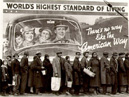
Sure we do. We called it the Great Depression.
The great depression was caused by a disparity in monetary income and oversupply of goods. Rampant speculation produced artificial "wealth" and strong supply of goods. This led to a credit economy for low wage earners in the middle and lower class citizens. Eventually, production outstripped demand, stocks fell, jobs were lost, loans were defaulted on. Then the depression started, and then conservation and stretching what resources could be purchased began in earnest.
Asserting that conservation caused the depression is exactly opposite to what really happened.
If we knew what we were doing, it wouldn't be called research. ~A. Einstein
TANSTAAFL ~R.A.H.
The best time to plant a tree is 20 years ago. The next best time is today. ~Chinese proverb
TANSTAAFL ~R.A.H.
The best time to plant a tree is 20 years ago. The next best time is today. ~Chinese proverb
-

DavidFolks - Expert
- Posts: 160
- Joined: Mon 19 Mar 2007, 03:00:00
- Location: Ontario, Canada
Re: How to offset Jevons' Paradox in a free market
by MonteQuest » Thu 19 Jul 2007, 22:23:11
$this->bbcode_second_pass_quote('DavidFolks', ' ')Asserting that conservation caused the depression is exactly opposite to what really happened.
LOL! I guess that one was over your head.
Let me rephrase aflurry's comment.
"We have yet to know the effect of a genuine, sustained reduction in economic activity."
Which is the same as a "sustained conservation effort."
The effects are massive unemployment, loss of homes and businesses, and a scarcity of money.
A Saudi saying, "My father rode a camel. I drive a car. My son flies a jet-plane. His son will ride a camel."
-
MonteQuest - Expert
- Posts: 16593
- Joined: Mon 06 Sep 2004, 03:00:00
- Location: Westboro, MO