Donate Bitcoin

Donate Paypal


PeakOil is You

PeakOil is You

Wireless electricity (MIT's successful experiment)

What's on your mind?
General interest discussions, not necessarily related to depletion.

Re: Wireless electricity (MIT's successful experiment)

Postby steam_cannon » Fri 08 Jun 2007, 21:12:09

$this->bbcode_second_pass_quote('kochevnik', 'I') think people are leary because they are tired of getting screwed by yet one more 'technological miracle' that ends up causing more problems than it solves.

Yeah, like mercury in Fluorescent Lamps used in schools and offices... :roll:
Image

Or Asbestos...
Image

Or from long ago, the "revigator" Radium Ore Water Cooler...
Image
Glowing with health! These really worked by the way. Many people died... One rich guy drank enough for his bones to fall apart, died horribly. Then it was banned.

But hey, something amusing - Tesla coils
"One of the many interesting properties of a Tesla Coil is its ability to light up a fluorescent bulb or neon tube with absolutely no physical connection!"


Image Image
User avatar
steam_cannon
Expert
Expert
 
Posts: 2859
Joined: Thu 28 Dec 2006, 04:00:00
Location: MA

Re: Wireless electricity (MIT's successful experiment)

Postby Judgie » Fri 08 Jun 2007, 21:23:51

Ok, let's all get back on track.

Being able to have our mobile phones and laptops post-peak is all good if we have the generation capacity in place. The real concern though is, can this system be used to power transportation systems as they are today, or is it only good for small scale applications?
Judgie
Coal
Coal
 
Posts: 418
Joined: Mon 07 May 2007, 03:00:00
Location: Adelaide, South Australia

Re: Wireless electricity (MIT's successful experiment)

Postby denverdave » Sat 09 Jun 2007, 01:21:44

Putting aside the potential health effects for a moment, this seems like it would be a horribly wasteful way to transmit power, especially in an energy-scarce future. There is a huge difference between transmitting information using electromagnetism, and saturating an area with enough power to charge a phone or run a laptop, let alone run a car.
'If a ruler hearkens to lies, all his officials become wicked.'
User avatar
denverdave
Peat
Peat
 
Posts: 83
Joined: Tue 09 Aug 2005, 03:00:00

Re: Wireless electricity (MIT's successful experiment)

Postby Judgie » Sat 09 Jun 2007, 03:17:40

$this->bbcode_second_pass_quote('denverdave', 'P')utting aside the potential health effects for a moment, this seems like it would be a horribly wasteful way to transmit power, especially in an energy-scarce future. There is a huge difference between transmitting information using electromagnetism, and saturating an area with enough power to charge a phone or run a laptop, let alone run a car.


Thankyou Dave :). My thoughts exactly.
Judgie
Coal
Coal
 
Posts: 418
Joined: Mon 07 May 2007, 03:00:00
Location: Adelaide, South Australia

Re: Wireless electricity (MIT's successful experiment)

Postby untothislast » Sat 09 Jun 2007, 03:30:05

$this->bbcode_second_pass_quote('Valdemar', '
')
As a biologist, I find the very idea of pumping poison into your body reprehensible


And yet, in an earlier post, you waved the flag for fluoridation - a mass forced-medication programme devised principally to dispose of toxic industrial waste.

Back to the topic. Wireless electricity? Doesn't bother me in the slightest. We've had it round our way for years, only we've always called it 'lightning'.
User avatar
untothislast
Tar Sands
Tar Sands
 
Posts: 686
Joined: Sat 22 Oct 2005, 03:00:00
Location: European Capital of Kulcha 2008

Re: Wireless electricity (MIT's successful experiment)

Postby Fiddlerdave » Sat 09 Jun 2007, 04:23:25

You can pretty much be sure wireless transmission of power will be at least one, if not two levels of magnitude less efficient than hooking up a couple wires.

IAs you try to allocate the 8 hours of power you get from from your solar panels to all the things you'd like to operate, using 10 or a 100 watts to operate a 1 watt device will be very expensive indeed to avoid the copper leash.

This technology will come of age when fusion power is the main source.
User avatar
Fiddlerdave
Tar Sands
Tar Sands
 
Posts: 582
Joined: Sun 18 Mar 2007, 03:00:00

Re: Wireless electricity (MIT's successful experiment)

Postby mididoctors » Sat 09 Jun 2007, 05:57:22

$this->bbcode_second_pass_quote('Madpaddy', 'T')he Daily WAIL - that's good.

I agree that wireless technology is an almost overwhelmingly good thing. In fact for the type of powerdown society which may be enforced upon us by PO, mobile phones, wireless and satellite broadband etc. will be absolutely essential.


sorry if this has been covered... but wouldn't power transmission be incredibly inefficient... power must radiate out and be lost...unless beamed in some incredible MASER..

being able to pick up 60W anywhere in a room means a hell of a lot of energy is being radiated out in un-used directions?

Boris
London

edit: should have read last page first before posting..eh
User avatar
mididoctors
Tar Sands
Tar Sands
 
Posts: 578
Joined: Mon 30 Aug 2004, 03:00:00
Location: London

Re: Wireless electricity (MIT's successful experiment)

Postby gg3 » Sat 09 Jun 2007, 07:11:07

All the folks in this thread who are in favor of this technology have just placed their hands in a monkey trap.

Did you notice the part where MIT said that the energy transfer is presently 60% efficient, and could be raised to 80% efficient?

Translation: At present, 40% of the energy is wasted, and at best, 20% of the energy would be wasted.

Further translation: Just when we need to reduce energy consumption, along comes a technology that would increase energy consumption by 20% to 40% for the devices it powers. And if you want to limit it to low-power devices, all you're doing is creating the latest class of "energy vampires," exactly akin to those little wall-wart transformers that, in another topic, folks here discovered (with the aid of their Kill-A-Watt meters) were sucking down electricity in their homes to a degree they had never thought possible.

Further translation: Once again, the false god of convenience has trumped common sense.

F---ing shameful if you ask me, or even if you don't.

---

Then there's also the "stupid and unnnecessary" department.

Today a colleague and I were in the field on an RF transmission complaint.

We have a client that's a medical clinic. They have a bunch of hardwired phones and an "in-office cellular" system using handsets that communicate with base transceivers located throughout the office. They have legitimate need for these wireless handsets because doctors and nurses and staff are moving around the clinic from one room to the next and need to be reachable when they are not at fixed locations.

Last week, suddenly the wireless handsets developed a truly nasty transmission problem: interference that caused a fluttering breakup of the voice signal in certain parts of the suite.

Today we spent six person-hours troubleshooting this. At $160 per person-hour, this was nearly a thousand bucks' worth of time ($960 to be specific) that we had to consider as nonbillable hours ("NBHs" as we call it). What we found was that a wireless computer network was using the same channels as the handsets, so when we switched the wireless network up out of the frequency range occupied by the handsets, the problem went away. Mostly. There was something else still causing interference. Clinic staff told us there were other wireless networks in the building, and they'd occasionally seen them on their computers when trying to log into their own networks. We went through the building but were unable to access some of the other suites so the problem remained to some extent.

Let's be quite clear about something. The people working at this clinic had no need for a wireless computer network. They do not carry computers around from one room to the next. When they are using a computer they are at a fixed location, unlike when using a phone. When they are using a computer they are logged into something from whatever computer they are using, unlike when using a phone where calls are transferred to them.

The ways in which people use these two devices are entirely different. The phones need both fixed locations and mobile capability on this site. The computers need only fixed locations on this site. For a site where computers as well as telephones need mobile capability, we would propose wireless IP handsets, which aren't that much more expensive than the wireless handsets we provided on this site.

The moral of the story is this: unnecessary uses of wireless technologies interferes with necessary uses of wireless technologies, degrades reliability, and imposes all manner of hidden costs. In this case we had to eat a thousand bucks' worth of field time and reschedule both a sales call on a five-figure project and a service call that would have generated billable time.

The only benefit of the wireless computer network in this case is that it avoids the use of an inexpensive network hub (less than $100) at each of a few locations where the number of connected devices exceeds the number of wired ethernet jacks at any given point. Oh yes, and the "convenience" of not needing to plug in one more ethernet cable at each of those locations.

This is like using a gasoline-powered automobile to drive to your neighbor's house which is three houses away from your own house. Pure abject waste for the sake of questionable convenience.

And if we start doing it for "power" as well as for "signal," we'll be increasing the power consumption of these devices by 20 - 40%.

That's why I call this a monkey trap.

Now you can let go of the damn shiny new magical coconut and thereby remove your hand from the jar.


---


Edit: Credit to DenverDave et. al. for getting this point first. I hadn't read through to your postings before I posted this; I was responding to the early posts that were all eyes-glazed-over in favor of adopting this wasteful technology just because it's "cool." Now you see how people get hooked into buying SUVs and all that other wasteful crap we detest.
Last edited by gg3 on Sat 09 Jun 2007, 07:48:43, edited 1 time in total.
User avatar
gg3
Expert
Expert
 
Posts: 3271
Joined: Mon 24 May 2004, 03:00:00
Location: California, USA

Re: Wireless electricity (MIT's successful experiment)

Postby gg3 » Sat 09 Jun 2007, 07:44:42

Ten points to SteamCannon for the item on electromagnetic stimulation of the brain.

This is not psuedoscientific nonsense. When I was in grad school I read all of Michael Persinger's papers up to that point, which were published in the peer-reviewed journal Perception and Motor Skills. Yes, you can induce the "numinous feeling of being personally connected to something greater than yourself" via electromagnetic stimulation of the temporal lobes of the brain.

There are a whole bunch of interesting implications of Persinger's research for comparative religion, which I won't digress the topic to go into right now. One of them even gets at the distinction between fundamentalism (the highly concrete branch of religion) and mysticism (the highly abstract branch of religion). But the bottom line is, Persinger is on solid scientific ground here.

And if Tesla later in life believed he was being contacted by ETs, that would be a wholly predictable outcome of exposing the brain to EM fields in the right frequency ranges.

Do you want to be the next guinea pig?

Once again, the monkey trap of a shiny new magical coconut inside a jar, where you reach in and grab the coconut, and as long as you grasp the coconut, you can't remove your hand from the jar.

---

Hey Armageddon, I'm one of those dickheads who smoke. I smoke a pipe (and that only, no cigarettes), for which the health risk is truly negligible. In fact pipe smokers live slightly longer than nonsmokers, though not to a statistically significant degree.

As for nuclear power (Valdemar), no it doesn't belong in automobiles, Ford Nucleon or otherwise. It belongs in fixed-location power plants where it can be operated with complete safety, not in cars that are subject to being ripped to shreds in serious crashes. What belongs in automobiles is some form of chemical energy storage such as a battery. I'll have my nuclear-powered automobile by way of plugging it into the wall socket to recharge from a nuclear power plant nearby.

---

Kochevnik, re. Tesla's experiments and the Tuingska meteor event: How close was the timing? And was the location of the apparent meteor hit at the diamatric opposite point on the Earth from where Tesla had his transmitter? For while Tesla may not have caused Tuingska, you might be on to another element of this that's potentially interesting.

Reason I ask is, back in the 70s, NSA discovered something related and very interesting about intercepting radio signals. If you have a transmitter at any point on earth, the signal at the diametrically opposite point on earth (e.g. the North Pole and the South Pole) is nearly as strong as it is right next to the transmitter.

So, for example, let's say you want to intercept the radio communications of a Soviet military unit engaged in practice exercises inland in the Soviet Union where you can't get a mobile intercept station right up close to them (as you might be able to in a battlefield situation where your forces and theirs are in closer proximity). What you do is pick the point at the exact opposite location on the globe, and set up your intercept station there. And then tune in the Soviet military unit as loudly & clearly as if you were sitting next to them.

What's going on is, the radio waves are being emitted in a pattern of concentric circles emanating from the antenna. Now think of those concentric circles spreading out over the globe, dissipating as they do, and then re-converging at the opposite point of the globe, where they would be nearly as strong as at their point of origin.

Thus it makes sense that if you are transmitting power rather than signal, the power transmission could behave in a similar manner and re-converge at the opposite point on the globe. And at the point where the waves converge, there could be a significant discharge of power. Maybe not enough to blow up a forest, but maybe enough to start a fire under the right conditions.

I'm not an RF engineer (I was in the subordinate role to my colleague on the RF troubleshoot mentioned above) so I don't know how various frequencies behave relative to their propagation around the Earth (straight line vs. following the Earth's curvature), but this is an interesting topic that deserves further study.
User avatar
gg3
Expert
Expert
 
Posts: 3271
Joined: Mon 24 May 2004, 03:00:00
Location: California, USA

Re: Wireless electricity (MIT's successful experiment)

Postby Frank » Sat 09 Jun 2007, 07:48:08

I share the concerns about efficiency with such a device, but to be fair this is in very early stages of development. It might be a useful technology someday if (for example) transmitters could be buried in roads at stop signs or in specific spots where electric vehicles could recharge a bit while stopped. Efficiency would have to be 95+% IMO though to make this worth considering. I wonder what max theoretical efficiency is?
User avatar
Frank
Tar Sands
Tar Sands
 
Posts: 556
Joined: Wed 15 Dec 2004, 04:00:00
Location: Maine/Nova Scotia

Re: Wireless electricity (MIT's successful experiment)

Postby gg3 » Sat 09 Jun 2007, 08:29:44

Ten points to Frank for a potentially valid application of the technology: recharging electric vehicles in public parking spaces. In this case, the vehicles would need one standardized component, which is the resonant frequency coupling device. And it would need to be operable within a distance of one or two feet from the tranmitter, which is not unreasonable.

---

Smart engineers think like pharmacologists.

By which I mean this:

When you are treating a disease, you use only the specific medications that are relevant to the cause of the disease, and you use them in the minimum dosages that are likely to have the desired therapeutic effects. You don't throw a whole bunch of medications at a problem in large doses and hope that one sticks.

When you are engaged in an engineering design project, you take the big-picture view and use the necessary technologies for each application in the project, and you don't clobber the project with unnecessary technology in unnecessary quantities. For example when digging a foundation for a building you may need a hydraulic excavator, but you don't then call in a whole fleet of scrapers and dozers for the hell of it.

Donald Trump once staged a photo op on a building he was putting up. He arranged to have a line of concrete trucks going around the block, by way of creating an impressive picture as they queued up to pour concrete for the foundation. "I, Donald Trump, have the power to summon a whole fleet of concrete trucks at will!" Right.

But any engineer will tell you, that when you're doing a project of this type, you don't want more than one or two trucks waiting in queue, and you don't want them queued for more than 30 minutes at most. Otherwise you're throwing money away (the holding time charges on the trucks), and you risk having the concrete go out of spec before it can be poured (the fineness modulus of the aggregates gets thrown off; for example more than 120 revolutions of the drum and you can't use that load in CalTrans work).

Trump was throwing away his own money, which is his privilege because it's his money. But any project manager for an investor-owned company who tried that stunt would have been fired for wasting the investors' money, because it's their money, not his to waste.

(And to anyone with engineering knowledge or even project management experience, Trump's stunt would have seemed really stupid, like a photo op showing off an airport by depicting lots and lots of planes queued on the runway waiting forever for permission to take off while the passengers onboard are obviously not pleased about the delays, and their respective airlines are losing money as they wait.)

---

And so it goes with wireless anything.

You use wireless where you can't use wires. You don't use wireless just because it's cool or "because you can" or because it's cheaper to install than it is to hire a cable crew to properly wire a building.

Electromagnetic spectrum is not an unlimited resource; there is a cost in terms of reliability and interference as you load up the spectrum with devices. This is true whether in a private network within an office building, or in a public network that covers a city, country, or the world.

---

And for transportation, you use an automobile where you truly need to use one, not just for convenience or to look cool on the road. And you use a bicycle or a bus or a train wherever you can, when you need to move yourself plus a small load that fits in a backpack or a handcart, for example groceries.

The generalization here is, always start from the technology that has the lowest level of energy and resource use for the project or the job, and then use higher-impact technologies only where they are truly needed.

Wireless power transmission makes sense to recharge EVs that are parked on the street (and cities could make decent revenues doing so). Wireless power transmission makes sense for a few other applications we'll discover as we discuss. But it sure as hell doesn't make sense for fixed-location devices in a home or workplace or out in public, such as a table lamp or a street kiosk, just to "look cool" or externalize the initial cost of a wire by wasting radiated power.

And it especially doesn't make sense to do it frivolously in an era where cheap energy is a thing of the past and a climate catastrophe may very well be a thing of the near future.
User avatar
gg3
Expert
Expert
 
Posts: 3271
Joined: Mon 24 May 2004, 03:00:00
Location: California, USA

Re: Wireless electricity (MIT's successful experiment)

Postby EnergyUnlimited » Sat 09 Jun 2007, 10:24:20

I think, wireless electricity is a pie on the sky idea, which will never be used in large scale, unless it is applied for power transmissions of orbiting solar power plants to Earth, if such a gizmos are ever built, but who knows, maybe they will if some miracle help...

Basically on the Earth it is:
1. Wasteful.
2. Expensive (transmitters and receivers capable of handling significant powers must be built - wire between socket and appliance may prove cheaper).
3. Causing more or less founded health concerns.
4. Short range only, unless directed laser beams are used.
5. Causing societal resistance due to 3.
6. Irrelevant due to immediate concerns related to PO.
User avatar
EnergyUnlimited
Light Sweet Crude
Light Sweet Crude
 
Posts: 7537
Joined: Mon 15 May 2006, 03:00:00

Re: Wireless electricity (MIT's successful experiment)

Postby Valdemar » Sat 09 Jun 2007, 11:05:35

gg3: I was joking about the Nucleon. ;) I'm all for EVs using mains power from fourth gen. plants. And I agree entirely about this technology with respect to efficiency and convenience. Nice gimmick, but sadly not useful in the coming age.
"Nothing survives. Not your parents. Not your children. Not even stars."
-Pinbacker, Sunshine
User avatar
Valdemar
Lignite
Lignite
 
Posts: 356
Joined: Wed 28 Mar 2007, 03:00:00
Location: Cambs., UK

Re: Wireless electricity (MIT's successful experiment)

Postby steam_cannon » Sat 09 Jun 2007, 12:46:08

$this->bbcode_second_pass_quote('gg3', 'T')en points to Frank for a potentially valid application of the technology: recharging electric vehicles in public parking spaces.
Yeah, that's pretty good! In a parking garage, wires would work fine. But this technology could make outside recharging much easier.

The problems with charging a car outside...
1. Vandals plug up sockets with gum.
2. If the outside charger has a cable that may be cut.
3. Rain or water can cause shorting.

So I imagine with this technology the car drives up. It has a receiver box built into it's bumper or under the car. The driver puts coins in a meter or their car communicates wirelessly with their account info. Then the car charges rain or shine. And if you wait in your car you can dream you were abducted by aliens! :lol:

I'm joking, maybe their would be a sign that you shouldn't wait in your car. But sure, there may be some safe applications. I was thinking this would be good for powering devices inside pressure vessels, space stations, armored vehicles, drones, or charging missile control system batteries. Applications where working rain or shine is very important and holes for wires could cause problems...

But yeah, charging parked cars would probably be the best application of this technology, great incite Frank!
User avatar
steam_cannon
Expert
Expert
 
Posts: 2859
Joined: Thu 28 Dec 2006, 04:00:00
Location: MA
Top

Re: Wireless electricity (MIT's successful experiment)

Postby steam_cannon » Sat 09 Jun 2007, 13:14:27

$this->bbcode_second_pass_quote('gg3', 'A')nd if Tesla later in life believed he was being contacted by ETs, that would be a wholly predictable outcome of exposing the brain to EM fields in the right frequency ranges.
I hadn't thought about that before, but that would make sense. Tesla was brilliant but then got crazy in his latter years and a lot of people stopped listening to him. Well, that's my impression from reading about him. And I wouldn't be surprised if he didn't purposefully strap magnets onto his head. I can imagine him trying to use magnets to communicate radio directly into the brain, just to try. And then perhaps he succeeded, sort of... The stimulation could have created the hallucination that it worked and probably brain damage too.

It made me sad as a kid to think how Marie Curie fried herself and died of radiation poisoning from her research. Now I have to wonder did Tesla fry himself too, just in a different way. But unlike Marie, the cause of his illness would go unknown. And that would be even sadder.
User avatar
steam_cannon
Expert
Expert
 
Posts: 2859
Joined: Thu 28 Dec 2006, 04:00:00
Location: MA
Top

Re: Wireless electricity (MIT's successful experiment)

Postby I_Like_Plants » Mon 11 Jun 2007, 00:29:10

The theory that the point opposite on the globe working as well as "being there" for a transmitter doesn't work that way - the ionosphere is not that simple. But you can get into other areas on the other side of the world well, using skip, directional antennas, etc. That is real science, that ham radio ops and the gov't use all the time. Listen to the shortwave bands and the ditty-dah of morse code and the squeep of ionosondes, there are real people using the ionosphere all the time and they know this stuff.

Transmitting power by Earth resonance as Tesla tried is the most promising but still takes TONS of power to get anything useable at the other end. Transmitting power by radio waves is extremely ineffecient, even if like the MIT folks are doing, you use the magnetic vector instead of the electric. I can build an antenna here in Silicon Valley out of some scrap Heliax that's shielded from the electric vector, should not work, but will very well, to hear Cuba on the other side of the world. Or Europe, or anywhere - mag-loops can be very cool. (They are also extremely high Q, need hi-Q hi-voltage capacitors, typically vacuum variables, which are best motor-driven, and that's just for recieving - they're even trickier to talk out of. This is not because of using the magnetic vector, but because of the hi-Q nature of the antenna.

No, that MIT's doing is interesting just as an exercise, and will get someone tenure and a few students some brownie points and maybe a PhD or two, but other than that, no it's not going to save us.

Conventional radio transmission and reception has proven to be incredibly safe. Radio receivers are not hard to build that are amazingly sensitive, which means you only need to get a TINY signal into your house or at your antenna to hear 'em loud and clear. As for higher powers, there's nothing showing a correlation between high exposure to EM fields and physical harm, until you get to power levels that cause actual heating effect. Yes, a few people have been COOKED by radars, and eye injuries (cataracts) have occurred due to people looking into waveguides emitting a signal and even IR emitters like IR lasers.

It shows how much the "advance of technology" is actually going retrograde that a technique of power transmission found impractical 100 years ago can be rehashed by MIT and make the news. All this new stuff you keep hearing about in science is generally 50-100 years old! There are very very few exceptions to this rule.
I_Like_Plants
Intermediate Crude
Intermediate Crude
 
Posts: 3839
Joined: Sun 12 Jun 2005, 03:00:00
Location: 1st territorial capitol of AZ

Re: Wireless electricity (MIT's successful experiment)

Postby steam_cannon » Mon 11 Jun 2007, 11:09:17

$this->bbcode_second_pass_quote('I_Like_Plants', 'A')s for higher powers, there's nothing showing a correlation between high exposure to EM fields and physical harm, until you get to power levels that cause actual heating effect.
As for higher powers, I don't know if I can make you see the light (hahaha) but heating is not the only effect of EM radiation. Earlier I mentioned a few medical procedures that use magnetic fields to induce electrical currents in the brain and studies showing low power levels affect the brain quite remarkably (below a threshold that's would cause measurable heating). The brain has been proven to be sensitive to fairly weak magnetic fields. So I wouldn't just worry about heating and damage, even at low power there can be psychological effects.

In Psychology, weak magnetic fields have been shown to affect the brain and cause hallucinations of god.
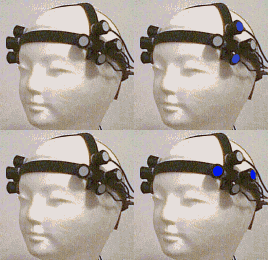
The God helmet: "Persinger uses a modified snowmobile helmet or a head-circlet device nicknamed the Octopus that contain solenoids which create a weak but complex magnetic field over the brain's right-hemisphere parietal and temporal lobes. "
http://en.wikipedia.org/wiki/God_helmet

In medicine, stronger magnetic fields are used to induce currents in the brain to treat depression.
electromagnetic brain stimulation: "Repetitive Transcranial Magnetic Stimulation: A powerful electromagnet positioned over a part of the brain implicated in depression induces the flow of current in neurons there. Though the stimulation is done only for minutes a day over a period of weeks, it alters the activity of the neurons in the long term."
http://www.spectrum.ieee.org/print/3050

A system that uses small low power magnets based on Persinger design.
$this->bbcode_second_pass_quote('', '
')Image

"Used according to instructions, Shiva Neural Technology can help you develop psychic abilities."
http://www.shaktitechnology.com/
Another way of saying that is: "Used according to instructions, this device will drive you insane." :lol:
Magnetic fields can induce impressive side effects.

$this->bbcode_second_pass_quote('I_Like_Plants', '.')..MIT's doing is interesting just as an exercise, and will get someone tenure and a few students some brownie points and maybe a PhD or two, but other than that, no it's not going to save us.
That, I believe! :wink:
User avatar
steam_cannon
Expert
Expert
 
Posts: 2859
Joined: Thu 28 Dec 2006, 04:00:00
Location: MA
Top

PreviousNext

Return to Open Topic Discussion

Who is online

Users browsing this forum: No registered users and 2 guests

cron