Donate Bitcoin

Donate Paypal


PeakOil is You

PeakOil is You

Logistic equation model for collapse, or?

Discuss research and forecasts regarding hydrocarbon depletion.

Re: Logistic equation model for collapse, or?

Unread postby WebHubbleTelescope » Tue 05 Jun 2007, 02:02:41

$this->bbcode_second_pass_quote('jimk', '')$this->bbcode_second_pass_quote('WebHubbleTelescope', '
')look familiar?



Thanks for the link!

The graph is surely almost identical to what I posted. But there is one odd thing. The prey peak looks just like my P peak... but P would seem to correspond more to the predator in my equations. Maybe it just has to do with the parameter values.

Anyway, fun stuff to explore.


I don't find it odd that R is actually the prey term. You have to remember that R is oil in reserve. Forget the "c" term you added. R will decrease to zero and the thing that looks like the production curve is P*R, which is the absolute rate of change in R according to your equation. Which means the PR curve you showed earlier is the correct one to use as the production curve.
User avatar
WebHubbleTelescope
Tar Sands
Tar Sands
 
Posts: 950
Joined: Thu 08 Jul 2004, 03:00:00

Re: Logistic equation model for collapse, or?

Unread postby jimk » Tue 05 Jun 2007, 15:16:10

$this->bbcode_second_pass_quote('WebHubbleTelescope', '
')I don't find it odd that R is actually the prey term. You have to remember that R is oil in reserve. Forget the "c" term you added. R will decrease to zero and the thing that looks like the production curve is P*R, which is the absolute rate of change in R according to your equation. Which means the PR curve you showed earlier is the correct one to use as the production curve.


Yes, of course R=oil should be the prey, my "c" term is just a distraction, and PR is production.

What throws me off a bit is looking at the baboons and the cheetahs. My R curve doesn't really look like that baboon curve! But the equations really are different.

Anyway, thanks much for seeing the link to predator-prey, that is really interesting to think about. I will take some time to study your discovery / shock model next.
User avatar
jimk
Peat
Peat
 
Posts: 90
Joined: Sun 12 Feb 2006, 04:00:00
Location: New York State, USA

Re: Logistic equation model for collapse, or?

Unread postby WebHubbleTelescope » Tue 05 Jun 2007, 23:19:09

$this->bbcode_second_pass_quote('jimk', '
')Anyway, thanks much for seeing the link to predator-prey, that is really interesting to think about. I will take some time to study your discovery / shock model next.


The discovery model is straightforward to derive. The basic premise is to imagine a stochastic probe of varying volume that sweeps through a volume of material that contains a small fraction of sporadically positioned oil. The discovery peak comes about due to two factors: the upswing comes about as the probe volume monotonically increases each year as exploration improves, while the downswing occurs as the probe starts hitting the limits of oil-containing regions. The long decline occurs as we continue to hit unexplored regions with a finite probability; this part effectively models reserve growth.

The shock model describes the dynamics of oil depletion and can use either the discovery model or discovery data as input. The main premise here is to assume Markovian rate laws to describe the latencies as oil flows out of the ground.

I can say that this combined model is so far removed from the typical Logistic approach as to require a different mindset. I agree with you about trying to come up with different ideas as the current approaches add about zero insight and generate no intuition as to the way things might proceed into the future.
User avatar
WebHubbleTelescope
Tar Sands
Tar Sands
 
Posts: 950
Joined: Thu 08 Jul 2004, 03:00:00

Re: Logistic equation model for collapse, or?

Unread postby jimk » Thu 07 Jun 2007, 18:42:47

I like the general angle you're proposing with this discovery / shock model. I think the predator / prey equations are really assuming that geography doesn't count, that predator and prey are uniformly mixed.

Here are some additional factors... I wonder if you have thought about these or included them in your model...

Some oil is easily accessible, other oil is much more difficult. Probably depth is the key factor, under how much water and under how much rock. This accessibility will matter not just for discovery but also for depletion. Deeply buried oil will be harder to discover and harder to recover.

There is also the matter of flow rates, and probably quality of what comes out, heavy/light, sweet/sour, stuff I know nothing about, but it goes all the way to shale oil I suppose. Some oil will be easy enough to access but difficult to use effectively.

Both difficulties, of access and of use, can be abstracted as "net energy". To make a joule of energy available in e.g. diesel fuel, we will need to burn how many joules of energy in amortized exploration etc.

Another very interesting challenge that seems to be arising: To extract fuel, we not only need fuel to power the rigs etc., but we also need steel and whatever other materials. These other materials can also become scarce or expensive. Maybe we just don't have enough molybdenum or whatever to build enough pumping platforms to access all the deep oil fields we need in order to increase production to whatever rate.

It's not just a matter of scarcity. There is also an increasing energy cost to mine/produce the various materials. E.g. aluminum and concrete are not scarce, but are energy intensive.

What became clear to me in thinking through the equations that turned out to be a predator and non-renewable prey - how the peak and downslope of petroleum production looks, that depends a lot on what alternatives we develop or exploit. If we ramp up say coal-to-liquid so that energy scarcity doesn't hinder our efforts to extract petroleum, then the downslope will be relatively steep. Alternatively, the decline of petroleum could bring the decline of our ability to find and extract what's left, in which case the downslope won't be as steep.

What I am starting to see now is that energy scarcity is not the only factor. Water, of course, is huge, but that may be mostly indirect - oil can't be produced without humans, humans can't live without food, food can't be grown without water. Whereas the path to e.g. molybdenum could be shorter: oil can't be produced without steel, steel can't be produced without molybdenum. There must be many such potentially limiting resources. But as the next decades play out, we will not actually hit every possible wall. One or two walls will likely suffice to reduce our speed considerably! Which walls will those be? Or maybe we will innovate around every wall for centuries to come!!!

One thing that these kinds of models might be able to do is to help us understand which wall is going to be the main one that limits growth in consumption. It seems like such a model would have to include maybe the most likely dozen or so walls, and from there perhaps some kind of Monte Carlo set of simulation runs could winnow the contenders down to the most like champion/villain or two.

That's one thing that I think is useful in developing these sorts of models, is to be a bit clear on what one hopes to learn from the model. Given that reality is very noisy, the question of "when will we hit peak petroleum production" - that is hard to determine and actually not very meaningful, plus or minus a few years. Peak in 2005 or 2050, ok, that is plenty meaningful! More useful and meaningful, I think, is: what will the peak production level be? 85 MB/day or 95 or 105? Also, questions like: what will the production level be in 2020? 95 or 85 or 75 MB/day?

These questions of production levels are mostly useful from a consumer's point of view. If you're involved on the production side, it may be more interesting to get some kind of picture about: what rabbits must I learn to pull out of what hats, if I am to be producing effectively in 2010, 2015, 2020. How should I be investing today in order to be profitable in the future?
User avatar
jimk
Peat
Peat
 
Posts: 90
Joined: Sun 12 Feb 2006, 04:00:00
Location: New York State, USA

Re: Logistic equation model for collapse, or?

Unread postby jimk » Fri 08 Jun 2007, 00:01:57

Image
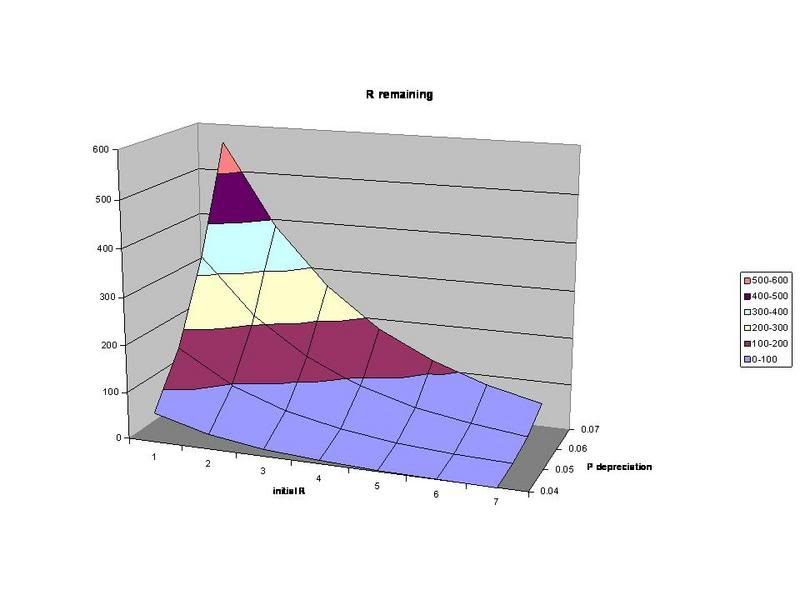
This non-renewable prey system does not end up recovering all the resource. The above is a plot of the asymptotic remaining resource as I tweak a couple parameters.

I leave constant a=0.00003; P(0)=1E-07; I vary b, the depreciation or death rate, which is correctly labelled in the figure. On the other axis I vary R(0) from 6000 to 12000. (Sorry about bogus excel axis labels. I don't know how to control that!)

The first wild thing that one can see - the more the initial resource, the less gets left behind. More intuitively, the faster the death rate of the predators, the more gets left behind. The greater initial resource allows P to build up bigger which then allows more resource to be recovered ultimately.
User avatar
jimk
Peat
Peat
 
Posts: 90
Joined: Sun 12 Feb 2006, 04:00:00
Location: New York State, USA

Re: Logistic equation model for collapse, or?

Unread postby WebHubbleTelescope » Fri 08 Jun 2007, 02:03:16

$this->bbcode_second_pass_quote('jimk', 'T')he first wild thing that one can see - the more the initial resource, the less gets left behind. More intuitively, the faster the death rate of the predators, the more gets left behind. The greater initial resource allows P to build up bigger which then allows more resource to be recovered ultimately.


That does seem odd. I know that in numerically solving these equations, you have to have a good adaptive step algorithm or you might experience underflow during the integration. The fact that you are even attemoting to solve these equations indicates that you probably know what you are doing, so I am just offering a sanity check here.

In other words you have to think that the value for P*R is very rapidly trending toward zero, faster than the integration of dR/dt can keep up with it, thus leading to a potential to floating-point underflow if you don't retain sufficient numerical resolution.

Or else what could happen is that the P term goes to zero rapidly, so that P*R also drops to zero, thus preventing R from depleting. But why this would depend on the intial size of R I don't know.
User avatar
WebHubbleTelescope
Tar Sands
Tar Sands
 
Posts: 950
Joined: Thu 08 Jul 2004, 03:00:00
Top

Re: Logistic equation model for collapse, or?

Unread postby WebHubbleTelescope » Fri 08 Jun 2007, 02:12:45

$this->bbcode_second_pass_quote('jimk', 'H')ere are some additional factors... I wonder if you have thought about these or included them in your model...


The problem with additional factors is the same problem that arises when you include "additional factors" into a field like statistical mechanics -- they all come out in the wash as an aggregate average with a statistical distribution of values. Give me a good mean and I will assume a maximum entropy variance from that mean and come up with a good model. And this is as it should be when we consider a macro-view of something like global oil depletion.
User avatar
WebHubbleTelescope
Tar Sands
Tar Sands
 
Posts: 950
Joined: Thu 08 Jul 2004, 03:00:00
Top

Re: Logistic equation model for collapse, or?

Unread postby jimk » Fri 08 Jun 2007, 02:35:03

$this->bbcode_second_pass_quote('WebHubbleTelescope', '
')Or else what could happen is that the P term goes to zero rapidly, so that P*R also drops to zero, thus preventing R from depleting. But why this would depend on the intial size of R I don't know.


It could be a numerical problem - I am not being very careful at all! But I don't think that's what's happening.

Consider what happens starting from a situation where R < (b/a). That will mean that P is decreasing! So the existing predators will nibble away a bit at the R, but soon enough they will die off and just leave almost all of the R sitting there. It's only when R > (b/a) that P will be growing.

So when R crosses the (b/a) threshold, that's when the predator population starts to decrease. The question then becomes, what is the predator population at that point? The bigger that population, the smaller R will get ultimately. What a big initial R does is to feed the predators and let them grow, so that by the time the die-off starts, there are enough predators around to chew deeply into the remaining R.
User avatar
jimk
Peat
Peat
 
Posts: 90
Joined: Sun 12 Feb 2006, 04:00:00
Location: New York State, USA
Top

Re: Logistic equation model for collapse, or?

Unread postby WebHubbleTelescope » Fri 08 Jun 2007, 09:06:11

$this->bbcode_second_pass_quote('jimk', ' ')What a big initial R does is to feed the predators and let them grow, so that by the time the die-off starts, there are enough predators around to chew deeply into the remaining R.


I would hope that it is not the absolute numbers that are important but the relative numbers, and those relative numbers are what causes effects to balance out. In other words, you should be able to turn that around and have a huge P to begin with and then get the counterintuitive result that you would remove less R just because you had too many prey to begin with! But then again we are talking about nonlinear differential equations here, so any kind of chaotic or unstable behavior could occur.

However, you have a good argument about the b/a relationship to R. Clearly that becomes a kind of "die-off" transition point for the population of predators, and it certainly looks like it serves as a loss of incentive to continue removing prey from the system.
User avatar
WebHubbleTelescope
Tar Sands
Tar Sands
 
Posts: 950
Joined: Thu 08 Jul 2004, 03:00:00
Top

Re: Logistic equation model for collapse, or?

Unread postby jimk » Fri 08 Jun 2007, 22:14:49

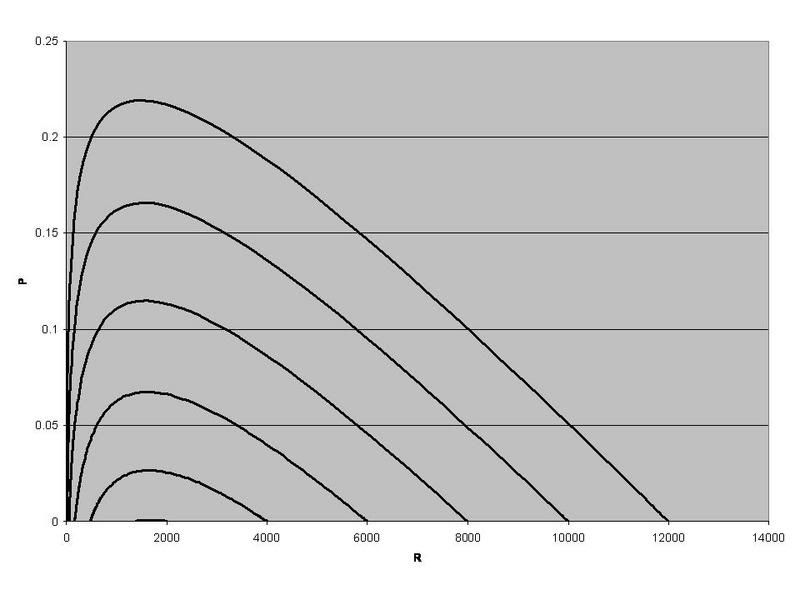
Here is an R vs P trajectory plot for a=0.00003; b=0.05; so that (b/a) = 1666. Easy to see here how a larger starting R results in a smaller ending R.

Image
User avatar
jimk
Peat
Peat
 
Posts: 90
Joined: Sun 12 Feb 2006, 04:00:00
Location: New York State, USA

Re: Logistic equation model for collapse, or?

Unread postby jimk » Fri 08 Jun 2007, 23:21:34

$this->bbcode_second_pass_quote('ElijahJones', ' ') We don't need precise numbers to know that peak oil will happen within a window between 2002 to 2020.


This is a major part of why I am interested more in dynamic models rather than curve fitting. The point really is to be able to steer somehow.

There is always a question of the system boundary. Who is steering what? We could say that humanity is steering the global ecology. Or we can put most of humanity into the system and maybe say that the government is steering the ecology + citizenry system. Or we can toss the government into the system and say maybe our little club / think tank is steering the government + citizenry + ecology system. Or I can put the whole rest of the world into the system and just leave individual me doing whatever steering. Or maybe I would like to toss my body into the system and say my mind is steering the whole lot. Or maybe even some components of my mind should enter into the dynamics. I think these are all legitimate and potentially useful perspectives.

Another way to think about these models is that really there are three components, an environment that just evolves according to some fixed pattern, an actor who is free to choose from some set of possible steering inputs, and the dynamic system that responds to all these forces.

Some of the climate change debate hinges on these modeling choices. What I hear sometimes from some in the Bush camp is something like: the global climate is evolving according to some fixed pattern, it is not part of the dynamic system that we can possibly steer. Whereas folks like Chancellor Merkl seem to be saying: we can steer and we are steering therefore we have the responsibility to steer consciously and wisely.

This toy R/P model of course is far too simple to provide any precise guidance for steering! But at least it goes one little step beyond the logistic equation, and I think starts to open up a broader perspective on the dynamics.

I think the best way to go at this model business is not to focus on one measurement history like production. If we want to model the real dynamics and go beyond curve fitting, we should look at other measurements, e.g. world population. I can imagine adding in production rates for other resources like iron and copper. Perhaps also food production. Economic measurements like prices and interest rates of course can be added in.

Maybe there are three levels of outputs one can hope for from such models:

1) the most likely future trajectory.

2) a probability distribution over future trajectories, i.e. the top 20 most likely trajectories.

3) the key choice points where some intervention is possible to choose among the possible trajectories.
User avatar
jimk
Peat
Peat
 
Posts: 90
Joined: Sun 12 Feb 2006, 04:00:00
Location: New York State, USA
Top

Re: Logistic equation model for collapse, or?

Unread postby WebHubbleTelescope » Tue 12 Jun 2007, 02:11:02

Would you agree the finite ending R is due to a "giving up" factor which occurs at the predator population can't sustain itself? I use "giving up" rather than "dying off" to keep it from devolving purely into population dynamics.
User avatar
WebHubbleTelescope
Tar Sands
Tar Sands
 
Posts: 950
Joined: Thu 08 Jul 2004, 03:00:00

Re: Logistic equation model for collapse, or?

Unread postby jimk » Tue 12 Jun 2007, 03:56:04

$this->bbcode_second_pass_quote('WebHubbleTelescope', 'W')ould you agree the finite ending R is due to a "giving up" factor which occurs at the predator population can't sustain itself?


Yeah, I think that's just right. For example, the income from petroleum sales has to cover the labor cost to maintain the machinery. When the flow of petroleum is so reduced that the income can't cover that maintenance cost, the oil well will be shut down.

The fundamental question is not one of money - money is just how the accounting gets done. Maintenance is a matter of human time and effort as well as materials. If the energy generated by the oil produced can't be used to support that labor and materials plus a litle profit, then oil production has become a losing proposition.
User avatar
jimk
Peat
Peat
 
Posts: 90
Joined: Sun 12 Feb 2006, 04:00:00
Location: New York State, USA
Top

Re: Logistic equation model for collapse, or?

Unread postby Doly » Tue 12 Jun 2007, 10:38:40

$this->bbcode_second_pass_quote('jimk', 'I')f the energy generated by the oil produced can't be used to support that labor and materials plus a litle profit, then oil production has become a losing proposition.


Realistically, things fall apart much before that. A lot of what's called "economies of scale" depend on easy transport. The biggest and most classic example of economies of scale is the auto industry. The more expensive oil is, you get into a negative feedback loop that ends up defeating the purpose of getting oil in the first place.
User avatar
Doly
Expert
Expert
 
Posts: 4370
Joined: Fri 03 Dec 2004, 04:00:00
Top

Re: Logistic equation model for collapse, or?

Unread postby jimk » Tue 12 Jun 2007, 14:05:54

$this->bbcode_second_pass_quote('Doly', ' ')"economies of scale" depend on easy transport.


Yeah, I find it easier to think of R and P as densities, petroleum and extraction facilities per square mile, rather than as global totals. Of course the density really isn't uniform, and that makes WebHubble Telescope's shock / depletion model especially interesting.

But "extraction facilities" doesn't mean just what's on site. It needs to include the whole industry - the steel mill that makes the drilling and pumping structures, the transportation network that makes it all work together, etc. When the resource density gets too low, it could well be that the increasing transportation costs are a key factor in why/how the extraction project gets abandoned.
User avatar
jimk
Peat
Peat
 
Posts: 90
Joined: Sun 12 Feb 2006, 04:00:00
Location: New York State, USA
Top

Previous

Return to Peak oil studies, reports & models

Who is online

Users browsing this forum: No registered users and 0 guests

cron