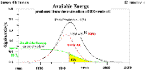
The world’s oil supply is expanding. It is possible to meet increase in global demand comfortably with new reserves and new technologies. For example, the newly discovered oil reserves in the Gulf of Mexico that may contain 3-15 billion barrels will relieve production demands.
:: A slowdown has begun in global demand. High oil prices and slowdown in growth rates have brought about a decline in demand. This year, the demand of both Europe and the United States won’t increase significantly. The increase in demand in China, which was at 900,000 barrels a day in 2004, will recede to 500,000 this year.
:: It will be easier for producers to meet demands. The increase in global oil production is 2,7 million barrels a day. After Saudis start oil production in Khursaniye in 2007, this figure will be 4.5 million barrels daily.
:: If the elections in Nigeria decrease the tension among the groups around the Niger River, a total of 500,000 barrels will also be marketed daily. Even if the other countries restrict production by preferring quality Niger oil, the daily supply will be around five million barrels.
:: Companies do not invest in any projects as long as they don’t see a profit of $40 per barrel, despite high prices in the past two years. If companies believe that prices would remain high, they would allocate most of their profits for research and drilling work. Shareholders of ExxonMobil and BP will be paid $40 billion this year.
:: The OPEC members’ restriction on oil production will not stop the fall in prices, either.
more at
link
also is
Traders are discussing the future of oil prices after crude oil dropped to $55.26 per barrel, the lowest level in 17 months.
Some experts claim prices will decline even further.
In an interview with Forbes magazine, Michael C. Lynch, president of Strategic Energy & Economic Research in Amherst, Massachusetts, said prices would regress.
Lynch, known for his optimistic analysis in energy issues, asserted that new supplies would amply meet growing demand.
He did not expect price hikes even if an economic embargo was imposed on Iran, which produces 3.75 million barrel per day (bpd).
Lynch said oil disruptions, nuclear threats, wars, terrorism, tornados and pipeline decay affected oil prices with a $20-per barrel risk premium.
According to Lynch, prices might fall to $25 per barrel if risks were eliminated.
that's at
link
and also
Oil's price collapse, more or less
Are we heading back to $40 a barrel, and is talk of $100 crude now silly?
that one's at
link
wow!



PeakOil is You
Why Oil Prices will Fall possibly to $25!!
Why Oil Prices will Fall possibly to $25!!
 by KevO » Sun 19 Nov 2006, 19:04:40
Last edited by KevO on Sun 19 Nov 2006, 21:01:35, edited 1 time in total.
- KevO
- Expert

- Posts: 2775
- Joined: Tue 24 May 2005, 03:00:00
- Location: CT USA
Re: Why Oil Prices will Fall
by emersonbiggins » Sun 19 Nov 2006, 19:15:59
Where does one start with this? I'll just pick one and go.
$this->bbcode_second_pass_quote('', 'I')f companies believe that prices would remain high, they would allocate most of their profits for research and drilling work.
$this->bbcode_second_pass_quote('', 'I')f companies believe that prices would remain high, they would allocate most of their profits for research and drilling work.
This statement stands out amongst others as based on specious reasoning. While it certainly could be true, increased funding for R&D might not be worthwhile with a steadily decreasing ROI, as the GOM find will certainly turn out to be.
"It's called the American Dream because you'd have to be asleep to believe it."
George Carlin
George Carlin
-

emersonbiggins - Expert
- Posts: 5150
- Joined: Sun 10 Jul 2005, 03:00:00
- Location: Dallas
by OZ_DOC » Sun 19 Nov 2006, 20:30:07
Hang on theres a problem with this logic. I agree we have seen some demand growth reductions and new production investments recently with high oil prices. However these patterns are BECAUSE of high oil prices and RELY ON CONTINUED HIGH OIL PRICES TO BE ECONOMICAL.
If Oil prices return to low levels then the majority of projects eg the very deep water GOM discoveries will be put on the shelf till they are economical again. Also any demand growth reduction will rapidly be reversed when its only trigger (high prices) is no longer present.
If you agree with this article can you please explain how in one article they associate high prices with demand destruction and production increases, yet deny that sudden drops in prices will have any reverse effects?
If Oil prices return to low levels then the majority of projects eg the very deep water GOM discoveries will be put on the shelf till they are economical again. Also any demand growth reduction will rapidly be reversed when its only trigger (high prices) is no longer present.
If you agree with this article can you please explain how in one article they associate high prices with demand destruction and production increases, yet deny that sudden drops in prices will have any reverse effects?
-

OZ_DOC - Peat

- Posts: 118
- Joined: Wed 14 Sep 2005, 03:00:00
Re: Why Oil Prices will Fall
by joewp » Sun 19 Nov 2006, 20:41:06
My turn!
$this->bbcode_second_pass_quote('that article', 'T')he world’s oil supply is expanding. It is possible to meet increase in global demand comfortably with new reserves and new technologies. For example, the newly discovered oil reserves in the Gulf of Mexico that may contain 3-15 billion barrels will relieve production demands.
$this->bbcode_second_pass_quote('that article', 'T')he world’s oil supply is expanding. It is possible to meet increase in global demand comfortably with new reserves and new technologies. For example, the newly discovered oil reserves in the Gulf of Mexico that may contain 3-15 billion barrels will relieve production demands.
MAY contain, and won't see the light of day for at least 4 years and, as po.com readers know, isn't really new.
Haven't people been saying that the price of oil is coming down for about 3 years now? Haven't they been wrong?
I nominate this article for the 2006 Michael Lynch Award for Oil Price Prognostication. Seconds anyone?
Joe P. joeparente.com
"Only when the last tree is cut; only when the last river is polluted; only when the last fish is caught; only then will they realize that you cannot eat money." - Cree Indian Proverb
"Only when the last tree is cut; only when the last river is polluted; only when the last fish is caught; only then will they realize that you cannot eat money." - Cree Indian Proverb
-

joewp - Intermediate Crude

- Posts: 2054
- Joined: Tue 05 Apr 2005, 03:00:00
- Location: Keeping dry in South Florida
Re: Why Oil Prices will Fall
by OZ_DOC » Sun 19 Nov 2006, 20:42:53
My belief personally is were seeing the first dip of the undulating plateau, prices went too high, demand was destructed investment was triggered. Next prices fall too low demand surges investment is stifled so prices rise too high and on we go with the merry go round that is the peak oil plateau. However I believe that the plateau will be undulating with an overall upward trend, each round of new investment will be more costly than the last, and as we've seen already the sheeple will become more and more accustomed to high prices. Meaning even higher prices will be required over time to achieve the same demand destruction effect (wow its amazing how similar this process is to the increasing substance demands of a drug addict developing drug tolerance)
So basically prices will dive up and down with the whole lot gradually drifting upwards over time. IMHO.
So basically prices will dive up and down with the whole lot gradually drifting upwards over time. IMHO.
-
OZ_DOC - Peat
- Posts: 118
- Joined: Wed 14 Sep 2005, 03:00:00
Re: Why Oil Prices will Fall
by KevO » Sun 19 Nov 2006, 20:57:59
$this->bbcode_second_pass_quote('joewp', 'M')y turn!
[
Haven't people been saying that the price of oil is coming down for about 3 years now? Haven't they been wrong?
[
Haven't people been saying that the price of oil is coming down for about 3 years now? Haven't they been wrong?
Well, not really.
They closed Friday at a 2 year low didn't they?
or was it a 1 year low?
anyway, they've dropped $22 in 6 months. That, in my book, is a 'coming down'

- KevO
- Expert
- Posts: 2775
- Joined: Tue 24 May 2005, 03:00:00
- Location: CT USA
Re: Why Oil Prices will Fall possibly to $25!!
by KevO » Sun 19 Nov 2006, 21:04:13
Japan's Stocks Fall; Energy-Related Shares Drop on Crude Prices
and
US economic slowdown feared on oil drops
and
US economic slowdown feared on oil drops
Last edited by KevO on Sun 19 Nov 2006, 21:09:03, edited 1 time in total.
- KevO
- Expert
- Posts: 2775
- Joined: Tue 24 May 2005, 03:00:00
- Location: CT USA
Re: Why Oil Prices will Fall
by snowhope » Sun 19 Nov 2006, 21:05:01
$this->bbcode_second_pass_quote('KevO', '')$this->bbcode_second_pass_quote('joewp', 'M')y turn!
[
Haven't people been saying that the price of oil is coming down for about 3 years now? Haven't they been wrong?
[
Haven't people been saying that the price of oil is coming down for about 3 years now? Haven't they been wrong?
Well, not really.
They closed Friday at a 2 year low didn't they?
or was it a 1 year low?
anyway, they've dropped $22 in 6 months. That, in my book, is a 'coming down'
Hmmmm, I think that is a little unfair Kevin. They hit a peak of $78 in July - 4 months ago. Granted they have come down since then.
But for the previous 2 years as the price started to reach high levels, various pundits kept repeatedly predicting the price would drop back, yet it rose inexorably until July this year. So for a long period they did get it very wrong.
I am of the opinion that prices will gradually rise again as the winter hits proper, bar any geo-political events that could still cause the price to rocket again.
-

snowhope - Peat
- Posts: 56
- Joined: Fri 20 May 2005, 03:00:00
- Location: United Kingdom