Donate Bitcoin

Donate Paypal


PeakOil is You

PeakOil is You

THE Department of Energy (DOE) Thread (merged)

General discussions of the systemic, societal and civilisational effects of depletion.

Re: U.S Energy Secretary pronounces "energy crisis"

Unread postby SoothSayer » Tue 02 May 2006, 05:40:39

>> I rest my case.

... but oil isn't like any other product ... it is part of almost everything.

Even sitting at home unemployed you are using some every day, in many different direct & indirect ways.

You have to eat, you need water, you need electricity, you need heating ... and then there's clothing, travel, toothpaste etc etc.

Surely the net economic & social effect of oil shortages and/or high prices is going to be VERY complex ....
User avatar
SoothSayer
Heavy Crude
Heavy Crude
 
Posts: 1167
Joined: Thu 02 Mar 2006, 04:00:00
Location: England

Re: U.S Energy Secretary pronounces "energy crisis"

Unread postby Doly » Tue 02 May 2006, 05:47:06

$this->bbcode_second_pass_quote('ohanian', '
')Hence there is less need for oil in the manufacturing which in turn causes the oil price to finally go downwards.


It all depends on how much less oil is needed and how much less supply there is. You could, at least in theory, have a situation where oil declines faster than the economy, couldn't you?
User avatar
Doly
Expert
Expert
 
Posts: 4370
Joined: Fri 03 Dec 2004, 04:00:00

DOE predicts gasoline shortages

Unread postby Graeme » Fri 25 Aug 2006, 05:49:30

DOE predicts gasoline shortages

$this->bbcode_second_pass_quote('', 'G')asoline shortages and even higher prices loom, a new government report says, and it will take decades and trillions of dollars to replace American dependence on foreign oil.

The U.S. Department of Energy report directly addressed the concept of peak oil and how to deal with it. Peak oil means oil production is maximized and supply goes down from that point forward. Coupled with a surge in demand from countries like China and India, some energy experts say this could be a problem for America's economy.

"The world is consuming more oil than it is finding, and at some point within the next decade or two, world production of conventional oil will likely peak," the report says.

The July report was written by Robert Hirsch of Science Applications International Corp., and Roger Bezdek and Robert Wendling of Management Information Services Inc., based in Washington, D.C.

The report analyzed four options to produce large amounts of liquid fuels in the U.S.: increasing vehicle efficiency; creating petroleum from coal, called coal liquefaction; oil shale, which is rock that can be distilled to produce oil; and enhanced oil recovery, which means better ways to get oil from existing fields.


freenewmexican
Human history becomes more and more a race between education and catastrophe. H. G. Wells.
Fatih Birol's motto: leave oil before it leaves us.
User avatar
Graeme
Fusion
Fusion
 
Posts: 13258
Joined: Fri 04 Mar 2005, 04:00:00
Location: New Zealand

Re: DOE predicts gasoline shortages

Unread postby Graeme » Fri 25 Aug 2006, 06:29:41

This report was also posted as a news item on the 23rd August by Leanan, and can be accessed in the EnergyBulletin in this paragraph:

$this->bbcode_second_pass_quote('', 'T')he problem with transport is a liquid fuels problem, and is to do with what it is that you have to put in in order to get clean liquid fuels out. The new study, “Economic Impacts of Liquid Fuel Mitigation Option” is due out soon (it has since emerged, and is available here). It only looks at the US, and at the cost of mitigation, with increased vehicle efficiency surprisingly being the most expensive. Our forecast is that this programme would require 1 trillion per year. (Hirsch’s presentation was full of figures and graphs and charts which I failed to note down in time, so for the rest you’d be best to check out his Powerpoint, but that is the essence of it).
Human history becomes more and more a race between education and catastrophe. H. G. Wells.
Fatih Birol's motto: leave oil before it leaves us.
User avatar
Graeme
Fusion
Fusion
 
Posts: 13258
Joined: Fri 04 Mar 2005, 04:00:00
Location: New Zealand

Re: DOE predicts gasoline shortages

Unread postby Zardoz » Fri 25 Aug 2006, 09:25:51

From the Energy Bulletin article:

$this->bbcode_second_pass_quote('', 'I') confess to being flabbergasted at the insanity of this proposal. Climate change wasn’t mentioned once in his talk, the fact that his choices of fuel are the most climatically destructive possible choices possible (a car running on petrol made from coal is responsible for 30-40 percent more CO2 than one running on ordinary petrol) wasn’t mentioned. This is utterly crackers. What the hell gives the US, the nation responsible for the lion’s share of contributions to climate change, the right to finish off life on Earth in exchange for a few more years motoring?

We're damned if we do, and damned if we don't.
"Thank you for attending the oil age. We're going to scrape what we can out of these tar pits in Alberta and then shut down the machines and turn out the lights. Goodnight." - seldom_seen
User avatar
Zardoz
Expert
Expert
 
Posts: 6323
Joined: Fri 02 Dec 2005, 04:00:00
Location: Oil-addicted Southern Californucopia

Re: DOE predicts gasoline shortages

Unread postby rwwff » Fri 25 Aug 2006, 10:29:53

I think I've said it before; whether you guys like it or not, we are going to find any and every way possible to turn every last gram of diggable coal into power and liquid fuel, and it will all be burned.
abundance fleeting
men falling like hungry leaves
decay masters all
User avatar
rwwff
Intermediate Crude
Intermediate Crude
 
Posts: 2601
Joined: Fri 28 Apr 2006, 03:00:00
Location: East Texas

Re: DOE predicts gasoline shortages

Unread postby emersonbiggins » Fri 25 Aug 2006, 10:37:23

$this->bbcode_second_pass_quote('rwwff', 'I') think I've said it before; whether you guys like it or not, we are going to find any and every way possible to turn every last gram of diggable coal into power and liquid fuel, and it will all be burned.


I agree. The economics of any alternatives to oil will always trump the environmental concerns of using those alternatives. Environmentalism and capitalism, IMHO, could only have coexisted at a unique period in time where sufficient capital and resources could be diverted towards environmentally benign causes. We are certainly entering a time where the surplus economy will no longer exist, and the resources that remain will go towards maintenance of the status quo, simply because we have no choice at this point. Most humans will more than likely share the interest of self-preservation rather than the interests of humanity at large. It's human nature, unfortunately.

:(
"It's called the American Dream because you'd have to be asleep to believe it."

George Carlin
User avatar
emersonbiggins
Expert
Expert
 
Posts: 5150
Joined: Sun 10 Jul 2005, 03:00:00
Location: Dallas
Top

Re: DOE predicts gasoline shortages

Unread postby TT » Fri 25 Aug 2006, 10:39:45

$this->bbcode_second_pass_quote('rwwff', 'I') think I've said it before; whether you guys like it or not, we are going to find any and every way possible to turn every last gram of diggable coal into power and liquid fuel, and it will all be burned.


Yep. And while we're doing that we'll also be turning every grain of wheat and every cob of corn into ethanol.
User avatar
TT
Lignite
Lignite
 
Posts: 278
Joined: Mon 12 Sep 2005, 03:00:00
Location: Victoria, Australia
Top

Re: DOE predicts gasoline shortages

Unread postby NEOPO » Fri 25 Aug 2006, 10:49:09

Yeah and by not changing our lifestyles we will be saying "yes" to every last bit and saying "no" to the environment.

The choice is ours.

Now to get the rest of the nation/world to understand this....doh!

You have said this before? Hell this has been on everyones mind since we got here (peakoil.com).

The children are insane.
It is easier to enslave a people that wish to remain free then it is to free a people who wish to remain enslaved.
User avatar
NEOPO
Permanently Banned
 
Posts: 3588
Joined: Sun 15 May 2005, 03:00:00
Location: THE MATRIX

Re: DOE predicts gasoline shortages

Unread postby rwwff » Fri 25 Aug 2006, 12:15:44

$this->bbcode_second_pass_quote('NEOPO', 'Y')eah and by not changing our lifestyles we will be saying "yes" to every last bit and saying "no" to the environment.
The choice is ours.


Available energy gets used, either by you, or by the idgit down the street. If the collective US turns off the air conditioners, the price will drop, it'll make a line in the newspaper, Joe Idgit down the street will then turn his thermostat from 76F down to 72F and praise the power companies and/or regulators for reducing his bill.

$this->bbcode_second_pass_quote('', 'N')ow to get the rest of the nation/world to understand this....doh!
You have said this before? Hell this has been on everyones mind since we got here (peakoil.com).
The children are insane.


But many of the contributors to this board still cling to the fantasy that by the magic wave of a divine/gaian wand, people will look at some store of available energy, and not burn it.

And no, the children are not insane, they are gluttonous.
abundance fleeting
men falling like hungry leaves
decay masters all
User avatar
rwwff
Intermediate Crude
Intermediate Crude
 
Posts: 2601
Joined: Fri 28 Apr 2006, 03:00:00
Location: East Texas
Top

Re: DOE predicts gasoline shortages

Unread postby Ludi » Fri 25 Aug 2006, 12:42:56

The only hope it seems is that the new forms of liquid fuel are so expensive and so impossible to produce in a failing economy that the US simply can't continue to be an energy hog, due to economic collapse. I really hate to say it, because I don't wish hardship on anyone, but it just seems the only hope to avoid even worse global climate change is for the US to have a major economic collapse as soon as possible. That means I'll be poor and probably not live very long, but, oh well. Me and a bunch of other folks. But really, what chance is there we will as a society suddenly change our way of life? The chance is remote.
Ludi
 

Re: DOE predicts gasoline shortages

Unread postby lorenzo » Fri 25 Aug 2006, 12:52:28

So was this report written by the DOE and 'endorsed' by it or was it merely written for the DOE?
I don't know how this works in the US, but the EU for example commissions thousands of reports on hundreds of topics each day, but only a few of them get the official stamp of an EU agency, after which they become "important". The other reports are just background noise that is put in the archives after two days. Mainly meant to keep consultants and lobbyists happy.

So can the document be found on the official DOE website?
The Beginning is Near!
User avatar
lorenzo
Intermediate Crude
Intermediate Crude
 
Posts: 2184
Joined: Sat 01 Jan 2005, 04:00:00

Re: DOE predicts gasoline shortages

Unread postby dukey » Fri 25 Aug 2006, 13:16:54

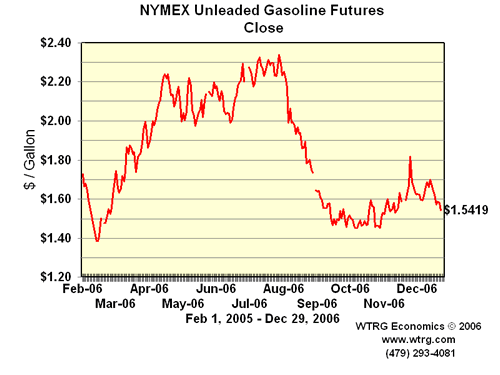
meanwhile the price of gasoline is doing this
Image
User avatar
dukey
Intermediate Crude
Intermediate Crude
 
Posts: 2248
Joined: Sun 20 Feb 2005, 04:00:00

Re: DOE predicts gasoline shortages

Unread postby Leanan » Fri 25 Aug 2006, 13:34:12

$this->bbcode_second_pass_quote('lorenzo', 'S')o can the document be found on the official DOE website?


Yes, it can:
DOE.gov
"The problems of today will not be solved by the same thinking that produced the problems in the first place." - Albert Einstein
User avatar
Leanan
News Editor
News Editor
 
Posts: 4582
Joined: Thu 20 May 2004, 03:00:00
Top

Re: DOE predicts gasoline shortages

Unread postby greenworm » Fri 25 Aug 2006, 13:35:16

Are you talking about the 2037 DOE? :lol: :lol: :lol: :lol: :lol: :lol:

What on earth made them change their minds?
User avatar
greenworm
Tar Sands
Tar Sands
 
Posts: 862
Joined: Fri 27 Jan 2006, 04:00:00

Re: DOE predicts gasoline shortages

Unread postby Sgs-Cruz » Fri 25 Aug 2006, 14:20:24

$this->bbcode_second_pass_quote('rwwff', 'I') think I've said it before; whether you guys like it or not, we are going to find any and every way possible to turn every last gram of diggable coal into power and liquid fuel, and it will all be burned.


Fully agree. Environmentalism only exists currently because we have the luxury of caring for others. It'll disappear off most people's radar screens pretty quick if they can't keep the lights on.
User avatar
Sgs-Cruz
Lignite
Lignite
 
Posts: 238
Joined: Wed 23 Feb 2005, 04:00:00
Location: Kingston, ON, Canada
Top

Re: DOE predicts gasoline shortages

Unread postby FatherOfTwo » Fri 25 Aug 2006, 16:51:26

$this->bbcode_second_pass_quote('Leanan', '')$this->bbcode_second_pass_quote('lorenzo', 'S')o can the document be found on the official DOE website?
Yes, it can: DOE.gov

But it isn't truly a DOE produced report. It is identical to Hirsch's first report... Hirsch approached the DOE with the idea of researching it and they funded it. (Hirsch even personally told me this, and said that after he provided it to them many within the DOE didn't know what to do with it.)

Note the big disclaimer in the report on the second page: DOE is not the author. (However, maybe this is just the way some people in the DOE who want to get peak oil related information out, but do it in an "underhanded" manor for political reasons.. I mean, look at what happens to EPA employees who challenge the official Administration line..)
User avatar
FatherOfTwo
Tar Sands
Tar Sands
 
Posts: 960
Joined: Thu 11 Nov 2004, 04:00:00
Location: Heart of Canada's Oil Country
Top

Re: DOE predicts gasoline shortages

Unread postby lorenzo » Fri 25 Aug 2006, 22:44:05

$this->bbcode_second_pass_quote('FatherOfTwo', '')$this->bbcode_second_pass_quote('Leanan', '')$this->bbcode_second_pass_quote('lorenzo', 'S')o can the document be found on the official DOE website?


Yes, it can:
DOE.gov


But it isn't truly a DOE produced report. It is identical to Hirsch's first report... Hirsch approached the DOE with the idea of researching it and they funded it. (Hirsch even personally told me this, and said that after he provided it to them many within the DOE didn't know what to do with it.)

Note the big disclaimer in the report on the second page: DOE is not the author.


Thx for this info. It's quite important, I think.

$this->bbcode_second_pass_quote('FatherOfTwo', '
')(However, maybe this is just the way some people in the DOE who want to get peak oil related information out, but do it in an "underhanded" manor for political reasons.. I mean, look at what happens to EPA employees who challenge the official Administration line..)


Interesting observation. *If* the DOE and other traditionally anti-PO institutions were to become convinced that PO is gradually arriving, or sooner than they ever predicted, then they might indeed consider giving signals this way. Just hire a 'useful idiot', so to speak.

They will never openly admit their error themselves, because that would ruin their reputation even to those for who the DOE still has some credibility left.

So maybe this Hirsch paper isn't so much important because of its content, but more because of the signal it sends out.
The Beginning is Near!
User avatar
lorenzo
Intermediate Crude
Intermediate Crude
 
Posts: 2184
Joined: Sat 01 Jan 2005, 04:00:00
Top

Re: DOE predicts gasoline shortages

Unread postby kjmclark » Fri 25 Aug 2006, 23:01:17

$this->bbcode_second_pass_quote('', 'W')e are certainly entering a time where the surplus economy will no longer exist, and the resources that remain will go towards maintenance of the status quo, simply because we have no choice at this point.


This assumes that the status quo and voluntary powerdown are the only options, doesn't it? I can think of at least a dozen ways that we could end up with an involuntary, or only partially voluntary powerdown. When I think about it, I can't think of a single example where CTL was sufficient to allow the status quo to continue. Can you?

Frankly, I think most people misunderstand the concept of demand destruction. In the 70s-early 80s there was some short-term, minor demand destruction in the US, mostly by a shift to more fuel-efficient motor vehicles and a change in power generation. In the 80s there was significant demand destruction - in the Soviet Union. We have a great deal of demand that can be "destroyed" before we need to build up CTL and it isn't clear we have time to build that many CTL plants anyway.

This Hirsch report starts with the assumption that we want to, and will be able to, continue motoring as we do now. Based on that assumption, what would we have to do to mitigate a decline in world oil production? There was explicitly no consideration given to motoring less, or differently, than we do now, or to whether the US will be financially able to continue a heavily automobile-dependent lifestyle. They asked specific questions, that may not match reality, and narrowly answered those questions. That's the proper way to do this kind of analysis, but that doesn't mean that the specific question was the right one or that other alternatives are impossible or even unlikely.
User avatar
kjmclark
Coal
Coal
 
Posts: 428
Joined: Fri 09 Dec 2005, 04:00:00
Top

Re: DOE predicts gasoline shortages

Unread postby BW » Sat 26 Aug 2006, 00:09:11

This guy on the oildrum addresses the DOE/SAIC/Hirsch report and it's convenient omission of increased rail usage to reduce liquid fuel use.

http://www.theoildrum.com/story/2006/8/25/91113/9720#55

The recent Peak Oil mitigation study, Economic Impacts of U.S. Liquid Fuel Mitigation Options prepared by Hirsch, Bezdek and Wendling for the Department of Energy overlooked the "best" solution. This overlooked approach can have a quicker and larger impact than any one of the proposed mitigations; and quite possibly more than all production orientated approachs together. In extremis, it is technically and socially possible (see historical precedents below) for this one solution plus declining US domestic production to provide all of our transportation needs without resorting to coal-to-liquids, oil shale or accelerated enhanced oil recovery. And do so in an environmentally positive way without any significant environmental obstacles to slow implementation.


The first of the two linked, and overlooked, approaches is to electrify our inter-city freight railroads (with some enhancements) and promote inter-modal transfers with free market and other incentives (such as Interstate Highway tolls). The DoE study states "...trains... simply have no ready alternative to liquid fuels". This is clearly untrue for this particular mode for the time scales of the study. The only existing capital good affected, diesel-electric locomotives, can be easily rebuilt or replaced with cheaper electric locomotives for a "trivial" expenditure.

The other overlooked approach is to build Urban Rail on a scale at least comparable to (or more intensely than) the Interstate Highway system.
A conservative estimate, based on a major but not a crash effort, is that these two approaches can save 10% of US Oil use in ten to twelve years. (See attached paper). A crash effort could do more today than the "Peak Streetcar" building era from 1897 to 1916. As a nation of less than 100 million people, a majority still rural, with a GNP (inflation adjusted) of just ~3% of today and quite primitive technology, the United States built 500 streetcar systems. Most towns of 25,000 and larger got electrified transportation. Clearly the United States has the technology and resources to do much more today than a century ago.

In addition, electric trolley buses and enhanced transportation bicycling can provide vital links in a non-oil transportation system. Electric assisted "tricycles" can service a broad spectrum of the population with a non-oil alternative for local travel, such as to the closest electric rail stop or neighborhood grocery.

The changes in the urban form brought about by an abundance of electrified Urban Rail and a paucity of liquid transportation fuels would be of the magnitude of the changes brought about by deliberate federal policy from 1950 to 1970; when almost all downtown shopping and business districts died, most established neighborhoods declined and suburbia and shopping malls boomed.

We did it once, we can do it again !

Oil, or "Liquid Transportation Fuels", are not required to support an advanced Western industrial society with a vibrant democracy and a decent quality of life. A premier example is Switzerland of WW II. Due to strategic decisions made in the 1920s, and subsequent investments, they were able to function with 1/400th of current US per capita oil use in 1945. Three years later, they were still at 7% of current US oil use, a level that would allow the United States of today to join OPEC as the 3rd or 4th largest oil exporter.

In a more recent strategic decision, Swiss voters approved in 1998 a twenty year, 31 billion Swiss franc program to improve their already excellent electric rail system. Adjusted for population and currency, this is equivalent to the United States voting $1 trillion ! The dominant goal, of several goals, is to move all heavy freight by electric rail and not truck. Semi-high speed passenger service, improved rural access and quieter rail cars are other Swiss goals.

The Swiss are not alone in taking strongly pro-active actions to get off oil today. The Thais have budgeted 550 billion baht (~US$14 billion) for mass transit, are building a 95% renewable electricity grid and developing small scale rural bio-gas. All from a Third World economy of 60 million people ! And the French are in the midst of adding one tram line to every town of 150,000 and two tram lines to every city of 250,000 as well as finishing their renowned TGV system. Sweden and Finland are setting goals and deadlines for an oil-less society. Even Russia is rapidly electrifying their railroads. All of the above are working towards solutions that significantly reduce Global Warming emissions as well as significantly reducing oil dependence.

Electric rail and associated changes in development have, unlike the production alternatives studied in the report, a negative feedback relationship with tight oil supplies and an ability to scale up very quickly.

The more expensive oil becomes, the more effective Urban Rail and electrified freight railroad will become; thereby dampening the social and economic impact of Peak Oil. Of the approaches studied, this is true of only increased vehicle efficiency. And in a sudden oil supply interruption, both Urban Rail and electrified freight can be scaled up by 50% to 100% in a week if prior preparations have been made. This is not true of any other alternative proposed.

Coal-to-Liquids and Canadian tar sands use similar, and scarce, speciality industrial products and scarce personnel. Several key industrial products and personnel are bottlenecks today in the limited expansion of Canadian tar sands production. These existing shortages, with associated cost over-runs and delays, call into question the extremely aggressive schedule in the DoE paper. Enhanced Oil Recovery likewise competes with conventional oil and natural gas production for critically scarce resources.

By contrast, there is a large and robust international industrial base supporting the very large installed base of electrified rail. This international support can easily supplement any domestic shortfalls and allow massive implementation quickly.

Electric rail, Urban & Inter-city, vehicle efficiency, electric trolley buses and transportation bicycling are the best alternatives available and can, by themselves, potentially deal with the consequences of Peak Oil. All of these approaches are better environmentally, economically, socially and for strategic security; they can be scaled up faster and will not suffer as much from industrial and personnel shortages. There is no technological risk with electrified rail, unlike the extreme risks associated with oil shale and substantial technological risks with large scale CTL and EOR.

By every reasonable metric, the first alternatives listed are "better" than CTL and oil shale production.

The DoE study has one very large, unrealistic and unstated assumption; "More than doubling US transportation carbon emissions will have minimal political opposition and will not slow implementation". One reading of the political tea leaves is that CTL and Oil Shales will only be pursued if they are carbon neutral. One political strategy is to balance carbon positive CTL & Oil Shale recovery with carbon negative Urban Rail and railroad electrification (both with ~20 to 1 energy efficiency gains) in a carbon neutral program. This may be the only politically possible program that involves CTL and Oil Shales.

The crisis of Peak Oil may require that all alternatives, the best and the sub-optimal, be aggressively pursued. But the best alternatives should be pursued first, most aggressively and most complete l
User avatar
BW
Wood
Wood
 
Posts: 15
Joined: Fri 19 Nov 2004, 04:00:00
Location: WA state

PreviousNext

Return to Peak Oil Discussion

Who is online

Users browsing this forum: No registered users and 24 guests

cron