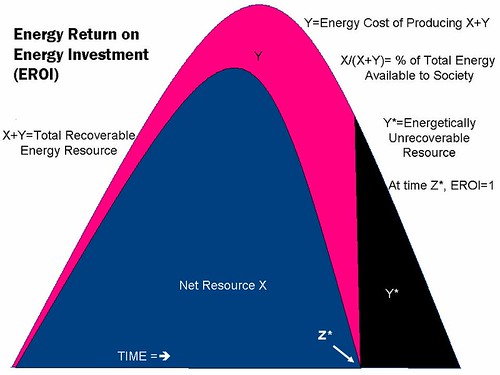
I was asked to give a talk on energy to a group of army engineers next week.
This is the talk I am going to give
www.globalvision.ie/oil.ppt
I would appreciate any comments people have on this.
Warning: the file is 3.5 megabytes, so may take time to load up.
Thanks,
Madpaddy



PeakOil is You
A Powerpoint presentation on Peak Oil
A Powerpoint presentation on Peak Oil
 by Madpaddy » Sat 03 Jun 2006, 14:18:32
-

Madpaddy - Expert

- Posts: 2043
- Joined: Fri 25 Jun 2004, 03:00:00
Re: An Energy presentation I was asked to give next week.
by Marklar » Sat 03 Jun 2006, 14:51:17
great presentation and very easy to follow and understand.
Not sure about the resource wars section. May not be something to bring up in the first presentation. May not take you serious
Not sure about the resource wars section. May not be something to bring up in the first presentation. May not take you serious
-

Marklar - Peat

- Posts: 75
- Joined: Wed 17 Aug 2005, 03:00:00
Re: An Energy presentation I was asked to give next week.
by killJOY » Sat 03 Jun 2006, 14:58:27
Very impressive. I might only check the publication date of Manning's article "The Oil We Eat." I believe it came out in 2004, not 2005.
Also professional-looking. When I give talks, I use a big notepad and a chalk board!
Also professional-looking. When I give talks, I use a big notepad and a chalk board!
Peak oil = comet Kohoutek.
-

killJOY - Intermediate Crude

- Posts: 2220
- Joined: Mon 21 Feb 2005, 04:00:00
- Location: ^NNE^
Re: An Energy presentation I was asked to give next week.
by Madpaddy » Sat 03 Jun 2006, 15:04:38
Thanks guys,
I apreciate the positive feedback. Wasn't sure about the resource wars myself but you have to remember most of my audience have served with the UN in the Middle East and would be familiar with the effect of US foreign policy there. As well as that, the current US administration is about as popular in Ireland as Oliver Cromwell so anything that makes him look bad will go down well.
I apreciate the positive feedback. Wasn't sure about the resource wars myself but you have to remember most of my audience have served with the UN in the Middle East and would be familiar with the effect of US foreign policy there. As well as that, the current US administration is about as popular in Ireland as Oliver Cromwell so anything that makes him look bad will go down well.
-
Madpaddy - Expert
- Posts: 2043
- Joined: Fri 25 Jun 2004, 03:00:00
Re: A Powerpoint presentation on Peak Oil
by XOVERX » Sat 03 Jun 2006, 15:14:51
For accuracy, the first oil well was dug in 1854 in Poland.
The PA will was the first US oil well.
The PA will was the first US oil well.
-

XOVERX - Peat
- Posts: 196
- Joined: Tue 18 Apr 2006, 03:00:00
Re: A Powerpoint presentation on Peak Oil
by nero » Sat 03 Jun 2006, 16:23:26
Hi Madpaddy,
I took the time to jot down some notes about your presentation while reading it, here goes my response. If I sound too critical understand that I appreciate we have different view points on some issues, I am simply stating my leaving my view point unvarnished.
Slide 3: "oil originated from the CHEMICAL decomposition" Decomposition that we usually think of is caused by the action of biological agents eating our remains. I think it is important to also state that the oil then migrates from the source rock to accumulate in geological traps.
Slide 4. Oil is very slowly being produced even as we speak. It is formed on a geological time scale not a human time scale
Slide 5 Nature produced alot more oil than 2Trillion barrels. That is just a (low) estimate of the ultimate recoverable, The OOIP original oil in place is usually said to be about 3-4 times that.
Slide 7 Not necessarily pumped out slowly, Initially it flows very quickly under it's own pressure. I like the sponge analogy.
Slide 7 oil does not travel from a high to low concentration, it flows from high pressure area to low pressure area.
Slide 10 is important it should deserve a couple of slides. Even more important it needs the backing of more examples, eg, texas, lower 48, north sea. In general I like to emphasize that the shape of the curve is not determined by geology but by economics.
slide 12 he didn't use any complex mathematical models in 1956, It was simply based on the estimate of the EUR and then engineering judgement.
slide 14 graph is lower 48
slide 19 I would suggest that you emphasize that these numbers are very hard to estimate but that there is no doubt that it is going down
Part II Consequences: The population decrease is an indirect consequence don't lead off with it. Lead off with a graph of the recent history of the oil price. That is the direct consequence of peak oil. Second consequence is renationalization of oil resources (lots of evidence for this). Third consequence is that oil will no longer be fungible (importing countries will seak to secure long term contracts instead of relying on the "open market".) We are already seeing chinese examples of this. Fourth consequence is resource wars. Then "perhaps" you can link in a possible fifth population consequence. For sure there is a connection between PO and GW but you are missing any mention of the key link: COAL.
slide 35. The link between GDP and oil is in my opinion not a causally directed one. An increase in oil use did not cause the increase in GDP. Similarly an increase in GDP did not cause the increase in oil consumption. There are counter examples where GDP increased without an increase in oil use.
slide 36. Supply and demand have to equal to each other, cause we aren't increasing our stocks significantly. I hate the misuse of these terms what you're really saying is that the price will increase. Just say that and stop abusing the terms supply and demand. (Sorry Madpaddy, I don't mean to target you with the imperative tense here, that's for the general audience)
slide 47, hockey stick graph is discreditied you shouldn't use it
slide 51 climate roblems will not disappear there is always coal
I took the time to jot down some notes about your presentation while reading it, here goes my response. If I sound too critical understand that I appreciate we have different view points on some issues, I am simply stating my leaving my view point unvarnished.
Slide 3: "oil originated from the CHEMICAL decomposition" Decomposition that we usually think of is caused by the action of biological agents eating our remains. I think it is important to also state that the oil then migrates from the source rock to accumulate in geological traps.
Slide 4. Oil is very slowly being produced even as we speak. It is formed on a geological time scale not a human time scale
Slide 5 Nature produced alot more oil than 2Trillion barrels. That is just a (low) estimate of the ultimate recoverable, The OOIP original oil in place is usually said to be about 3-4 times that.
Slide 7 Not necessarily pumped out slowly, Initially it flows very quickly under it's own pressure. I like the sponge analogy.
Slide 7 oil does not travel from a high to low concentration, it flows from high pressure area to low pressure area.
Slide 10 is important it should deserve a couple of slides. Even more important it needs the backing of more examples, eg, texas, lower 48, north sea. In general I like to emphasize that the shape of the curve is not determined by geology but by economics.
slide 12 he didn't use any complex mathematical models in 1956, It was simply based on the estimate of the EUR and then engineering judgement.
slide 14 graph is lower 48
slide 19 I would suggest that you emphasize that these numbers are very hard to estimate but that there is no doubt that it is going down
Part II Consequences: The population decrease is an indirect consequence don't lead off with it. Lead off with a graph of the recent history of the oil price. That is the direct consequence of peak oil. Second consequence is renationalization of oil resources (lots of evidence for this). Third consequence is that oil will no longer be fungible (importing countries will seak to secure long term contracts instead of relying on the "open market".) We are already seeing chinese examples of this. Fourth consequence is resource wars. Then "perhaps" you can link in a possible fifth population consequence. For sure there is a connection between PO and GW but you are missing any mention of the key link: COAL.
slide 35. The link between GDP and oil is in my opinion not a causally directed one. An increase in oil use did not cause the increase in GDP. Similarly an increase in GDP did not cause the increase in oil consumption. There are counter examples where GDP increased without an increase in oil use.
slide 36. Supply and demand have to equal to each other, cause we aren't increasing our stocks significantly. I hate the misuse of these terms what you're really saying is that the price will increase. Just say that and stop abusing the terms supply and demand. (Sorry Madpaddy, I don't mean to target you with the imperative tense here, that's for the general audience)
slide 47, hockey stick graph is discreditied you shouldn't use it
slide 51 climate roblems will not disappear there is always coal
Biofuels: The "What else we got to burn?" answer to peak oil.
-

nero - Heavy Crude

- Posts: 1433
- Joined: Sat 22 May 2004, 03:00:00
- Location: Ottawa, Ontario
Re: A Powerpoint presentation on Peak Oil
by Jack » Sat 03 Jun 2006, 16:34:38
Very nice! I don't suppose you'd consider posting a link to the final version?
![[smilie=new_popcornsmiley.gif]](https://udev.peakoil.com/forums/images/smilies/new_popcornsmiley.gif "new_popcornsmiley")
- Jack
- Light Sweet Crude

- Posts: 4929
- Joined: Wed 11 Aug 2004, 03:00:00
Re: A Powerpoint presentation on Peak Oil
by Madpaddy » Sat 03 Jun 2006, 18:25:26
Thanks again,
Nero,
Your points are appreciated and noted. I'm wondering if you read the speakers notes with respect to consequences. I do mention that increased GW will be the result of increased coal burning.
I reckon I gave slide 10 as much as I could because of time constraints.
In slide 14, it says lower 48 on the graph but it is indistinct - will change.
Slide 3,4 &5 & 7. - you are correct and right - will change
Jack,
Feel free to use the link - I will update the final version soon.
Nero,
Your points are appreciated and noted. I'm wondering if you read the speakers notes with respect to consequences. I do mention that increased GW will be the result of increased coal burning.
I reckon I gave slide 10 as much as I could because of time constraints.
In slide 14, it says lower 48 on the graph but it is indistinct - will change.
Slide 3,4 &5 & 7. - you are correct and right - will change
Jack,
Feel free to use the link - I will update the final version soon.
-
Madpaddy - Expert
- Posts: 2043
- Joined: Fri 25 Jun 2004, 03:00:00
by egoldstein » Sat 03 Jun 2006, 22:34:00
I would really like to show this presentation around, if okay with you? A really great summary.
Hope you won´t mind if I suggest a few things about the points in the "Priorities (Ireland)" slide...
(After typing for an hour or so, I realise this is more than "a few things"... please forgive me for the obnoxious length of the post - I think your pp presentation is great even if you completely ignore what I say)
- Tackle population growth:
No disrespect intended; I appreciate that many people (including myself) have genuine concerns relating to population growth, however, there are a few reasons why I am deeply concerned both with the manner in which it is articulated, and its Irish relevance or context.
The growth in population in itself is not inherently bad. There are two related aspects which can cause trouble however:
a) The "Externalisation" of costs, in Econo-speak; as an example, the pollution and unsustainable use of common-resources e.g. using the air and oceans as dumping grounds, without cost to the producers but with collective cost to us all; or the depletion of freshwater sources (lakes, watertables etc.) upon which we all depend. This is also known as "the tragedy of the commons", but should really be called "the tragedy of the Unmanaged commons."
Globally, we can see also that developed countries can Externalise their social costs of living (for their "non-negotiable" way of life, to quote Cheney) on to the developing and Third-World countries. Actually, also onto the developed countires own domestic populations even (the lower economic classes).
b) Among desperately poor people, the "Time preference" horizon is radically shortened; people who dony´t know if they´ll be alive or dead in 6 months, are less likely to be concerned on how they will survive with a baby in 9 months. The social and personal costs of having children are not as likely to be considered by them as by people who have the material and economic stability to reflect on the future. "Population control" can be seen as an attempt to address symptoms rather than causes (especially when it is advocated by people at the top of the world social-ladder, so to speak) - as a rule of thumb, the wealthier the population, the less likely it is to have very large families. "Wealthier" does not necessarily mean "Rich", only economically and materially more stable. This means that the costs of raising children, and having more people around, are factored into society and families.
c) The Irish Famine is sometimes used as a Malthusian case-study, but remember that it happened with a population about twice that of Ireland now - and while Ireland was a food exporter, at a time when scientific agricultural practice and chemical fertilisers did not exist. Not only were people capable of feeding themselves, but the political and social system externalised all costs of a highly exploitative system onto the lower class, catostrophically. I think this is why mentioning population as a priority might not be either relevant or appropriate in an Irish context (please excuse my obnoxiously long-winded way of getting to that point).
- Impose very high levels of energy efficiency for cars and houses;
That´s certainly a way of preparing for oil-shocks on the supply-side; One thing I might add is that on the demand-side, the cost of fossil-fuels and their energy derivatives should not be lessened, but that other alternative energy sources should be untaxed. In other words: the demand is for energy, not specifically fossil-fuels; a key way of both rationing non-sustainable energy use, and of encouraging efficiency in energy production and use in general, is through the price mechanism. Tax on fossil-fuels can be justified both for the social costs they impose (e.g. not just regarding pollution, but for transportation infrastructure usage-fees and maintenance costs, congenstion costs on society etc.) and as a method of mitigating price swings, or of encouraging greater efficiency in use through higher cost. Taxes on alternative energy supplies are less justifiable - especially if they are carbon-neutral. Likewise for technology that decreases energy wastage.
- Less money on roads and more on RE programs and DECENT pub. transport system.
This is not a criticism, but actually the money spent on roads could be justified, if the people (specifically the vehicles) who used-occupied the roads paid for them. Toll-booths are one way, tax on the fuel used - especially fossil fuels - is another way (the more on-road petrol you are using, suggests that you are using the roads more). But there ought to be a direct funding connection made between such a tax and road use and production - currently all tax goes into a general fund, and then it is doled out according to political whim. Also: the change in law regarding blood-alcohol levels in Ireland has led to a flowering of private night-time mini-bus services all over; showing that if costs of a certain behaviour are raised, society can creatively adapt; people still go to pubs, but they go in collective transportation.
- Grants for domestic electricity generation;
Again, I don´t mean this as a criticism: in actual fact, grants are less important and may not even be necessary. The chief stumbling block in Ireland is that the ESB is constantly putting up artificial barriers. It is possible elsewhere to have reverse-metering - where electricity you generate and feed into the grid lessens or reduces the bill you pay. Another problem is that the ESB chooses to price inputs of energy into the grid as though it were a private proft-maximising company, when it is a public utility, producing a public good, supposedly for the publc benefit. Although the grid is technically run by a seperate company, this is pure labelling in practice. It is effectively a state-monopoly run for the benefit of its employees, rather than the public (That "alternative energy levee" on your bill goes to subsdise peat-stations); this isn´t an argument for privatisation, either, just that the public service function be followed.
- Reasoned debate on use of Nuke power;
Which is fair enough - but I´m going to get my retaliation in now (!) by saying that Nuclear power may very well only excacerbate problems, since ne of the biggest sources of uranium is in Iran (Surrr-PRISE!!), and the potential peak of uranium production may occur in 20 years (And nuclear waste is effectively forever).
- Greater use of arable land for biofuels;
There is a report by Davy´s Stockbrokers in Dublin doing the rounds (perhaps Tom Atkins at www.organiccollege.com and also the folks at peakoil.ie may have a copy) with a very interesting take on this (and also on developing fresh-water shortages worldwide - and we thought oil was a problem). In order for the UK to replace its current petroleum transport usage with biofuels, it would take a land-area 4 times the size of the UK to grow it. Biofuels should certainly play a part, but inevitably there will be conflicts between food and fuel production, if fuel use is not curtailed (And this doesn´t mean less people will travel on roads, only that the type of transport may change - e.g. the mini-bus to the pub example).
- Buy locally produced goods where possible;
If oil prices continue to trend upwards, this will become more of an economic imperative, rather than simply a personal lifestyle choice, a point worth emphasizing. There are two sides to the coin of modern agriculture:
1. Most of the (now very much diminishing) returns of agricultural production comes from -
a) Fertilisers, herbicides, pesticides;
b) High-bred crops;
c) Heavy Irrigation.
Chemical Fertilisers, herbicides and pesticides, are almost entirely-hydrocarbon based; Fertilisers for example, are about 90% composed of natural gas - itself undergoing its own peak at the moment, leading some Irish farmers to rent more land, rather than spread more fertiliser, to try and sustain yields and avoid the ever higher prices of fertiliser.
High-bred crops, rather than being a saviour, actually impose extra costs - a farmer does not actually own the seed he buys to sow, he licences it the same way you licence software. This means farmers cannot save seed to plant next year - to do so would be a breach of the law - but must purchase more each year. High-bred varieties, while giving technically higher yields, also require more inputs (fertiliser, herbicides, and pesticides) since they are not naturally reslient. GMO´s will only tighten and accelerate this process, something which seems to be overlooked by anti-GM people constantly; whatever about the debatable safety effects, the social, economic and legal effects are much less open to debate. The effect is collective vertical monopolisation of the human food-supply world-wide.
Irrigation is not seen as a cost in Ireland, but this is a deviation from the norm world-wide - and in fact it means that we have an endowment from nature that is currently completely undervalued. The Davy´s report explains that irrigation and fresh water supply is increasingly a matter of grave concern world-wide, especially for China and India. Aquifiers, which took millenia to form, are being depleted at perhaps twice the speed of replenishment.
2. Cheap transportation plays the second huge part in reducing costs of food - for supermarket purchase and distribution networks e.g. - and of course this is founded upon cheap oil.
Okay, now that I´ve inflicted all that on you, I´ll just shut up.
Thanks for the powerpoint, the best of luck to you.
Hope you won´t mind if I suggest a few things about the points in the "Priorities (Ireland)" slide...
(After typing for an hour or so, I realise this is more than "a few things"... please forgive me for the obnoxious length of the post - I think your pp presentation is great even if you completely ignore what I say)
- Tackle population growth:
No disrespect intended; I appreciate that many people (including myself) have genuine concerns relating to population growth, however, there are a few reasons why I am deeply concerned both with the manner in which it is articulated, and its Irish relevance or context.
The growth in population in itself is not inherently bad. There are two related aspects which can cause trouble however:
a) The "Externalisation" of costs, in Econo-speak; as an example, the pollution and unsustainable use of common-resources e.g. using the air and oceans as dumping grounds, without cost to the producers but with collective cost to us all; or the depletion of freshwater sources (lakes, watertables etc.) upon which we all depend. This is also known as "the tragedy of the commons", but should really be called "the tragedy of the Unmanaged commons."
Globally, we can see also that developed countries can Externalise their social costs of living (for their "non-negotiable" way of life, to quote Cheney) on to the developing and Third-World countries. Actually, also onto the developed countires own domestic populations even (the lower economic classes).
b) Among desperately poor people, the "Time preference" horizon is radically shortened; people who dony´t know if they´ll be alive or dead in 6 months, are less likely to be concerned on how they will survive with a baby in 9 months. The social and personal costs of having children are not as likely to be considered by them as by people who have the material and economic stability to reflect on the future. "Population control" can be seen as an attempt to address symptoms rather than causes (especially when it is advocated by people at the top of the world social-ladder, so to speak) - as a rule of thumb, the wealthier the population, the less likely it is to have very large families. "Wealthier" does not necessarily mean "Rich", only economically and materially more stable. This means that the costs of raising children, and having more people around, are factored into society and families.
c) The Irish Famine is sometimes used as a Malthusian case-study, but remember that it happened with a population about twice that of Ireland now - and while Ireland was a food exporter, at a time when scientific agricultural practice and chemical fertilisers did not exist. Not only were people capable of feeding themselves, but the political and social system externalised all costs of a highly exploitative system onto the lower class, catostrophically. I think this is why mentioning population as a priority might not be either relevant or appropriate in an Irish context (please excuse my obnoxiously long-winded way of getting to that point).
- Impose very high levels of energy efficiency for cars and houses;
That´s certainly a way of preparing for oil-shocks on the supply-side; One thing I might add is that on the demand-side, the cost of fossil-fuels and their energy derivatives should not be lessened, but that other alternative energy sources should be untaxed. In other words: the demand is for energy, not specifically fossil-fuels; a key way of both rationing non-sustainable energy use, and of encouraging efficiency in energy production and use in general, is through the price mechanism. Tax on fossil-fuels can be justified both for the social costs they impose (e.g. not just regarding pollution, but for transportation infrastructure usage-fees and maintenance costs, congenstion costs on society etc.) and as a method of mitigating price swings, or of encouraging greater efficiency in use through higher cost. Taxes on alternative energy supplies are less justifiable - especially if they are carbon-neutral. Likewise for technology that decreases energy wastage.
- Less money on roads and more on RE programs and DECENT pub. transport system.
This is not a criticism, but actually the money spent on roads could be justified, if the people (specifically the vehicles) who used-occupied the roads paid for them. Toll-booths are one way, tax on the fuel used - especially fossil fuels - is another way (the more on-road petrol you are using, suggests that you are using the roads more). But there ought to be a direct funding connection made between such a tax and road use and production - currently all tax goes into a general fund, and then it is doled out according to political whim. Also: the change in law regarding blood-alcohol levels in Ireland has led to a flowering of private night-time mini-bus services all over; showing that if costs of a certain behaviour are raised, society can creatively adapt; people still go to pubs, but they go in collective transportation.
- Grants for domestic electricity generation;
Again, I don´t mean this as a criticism: in actual fact, grants are less important and may not even be necessary. The chief stumbling block in Ireland is that the ESB is constantly putting up artificial barriers. It is possible elsewhere to have reverse-metering - where electricity you generate and feed into the grid lessens or reduces the bill you pay. Another problem is that the ESB chooses to price inputs of energy into the grid as though it were a private proft-maximising company, when it is a public utility, producing a public good, supposedly for the publc benefit. Although the grid is technically run by a seperate company, this is pure labelling in practice. It is effectively a state-monopoly run for the benefit of its employees, rather than the public (That "alternative energy levee" on your bill goes to subsdise peat-stations); this isn´t an argument for privatisation, either, just that the public service function be followed.
- Reasoned debate on use of Nuke power;
Which is fair enough - but I´m going to get my retaliation in now (!) by saying that Nuclear power may very well only excacerbate problems, since ne of the biggest sources of uranium is in Iran (Surrr-PRISE!!), and the potential peak of uranium production may occur in 20 years (And nuclear waste is effectively forever).
- Greater use of arable land for biofuels;
There is a report by Davy´s Stockbrokers in Dublin doing the rounds (perhaps Tom Atkins at www.organiccollege.com and also the folks at peakoil.ie may have a copy) with a very interesting take on this (and also on developing fresh-water shortages worldwide - and we thought oil was a problem). In order for the UK to replace its current petroleum transport usage with biofuels, it would take a land-area 4 times the size of the UK to grow it. Biofuels should certainly play a part, but inevitably there will be conflicts between food and fuel production, if fuel use is not curtailed (And this doesn´t mean less people will travel on roads, only that the type of transport may change - e.g. the mini-bus to the pub example).
- Buy locally produced goods where possible;
If oil prices continue to trend upwards, this will become more of an economic imperative, rather than simply a personal lifestyle choice, a point worth emphasizing. There are two sides to the coin of modern agriculture:
1. Most of the (now very much diminishing) returns of agricultural production comes from -
a) Fertilisers, herbicides, pesticides;
b) High-bred crops;
c) Heavy Irrigation.
Chemical Fertilisers, herbicides and pesticides, are almost entirely-hydrocarbon based; Fertilisers for example, are about 90% composed of natural gas - itself undergoing its own peak at the moment, leading some Irish farmers to rent more land, rather than spread more fertiliser, to try and sustain yields and avoid the ever higher prices of fertiliser.
High-bred crops, rather than being a saviour, actually impose extra costs - a farmer does not actually own the seed he buys to sow, he licences it the same way you licence software. This means farmers cannot save seed to plant next year - to do so would be a breach of the law - but must purchase more each year. High-bred varieties, while giving technically higher yields, also require more inputs (fertiliser, herbicides, and pesticides) since they are not naturally reslient. GMO´s will only tighten and accelerate this process, something which seems to be overlooked by anti-GM people constantly; whatever about the debatable safety effects, the social, economic and legal effects are much less open to debate. The effect is collective vertical monopolisation of the human food-supply world-wide.
Irrigation is not seen as a cost in Ireland, but this is a deviation from the norm world-wide - and in fact it means that we have an endowment from nature that is currently completely undervalued. The Davy´s report explains that irrigation and fresh water supply is increasingly a matter of grave concern world-wide, especially for China and India. Aquifiers, which took millenia to form, are being depleted at perhaps twice the speed of replenishment.
2. Cheap transportation plays the second huge part in reducing costs of food - for supermarket purchase and distribution networks e.g. - and of course this is founded upon cheap oil.
Okay, now that I´ve inflicted all that on you, I´ll just shut up.
Thanks for the powerpoint, the best of luck to you.
"Blessed are the meek: for they shall inherit the earth..."
- Matthew 5:5
"... but not its mineral rights."
- J. Paul Getty
- Matthew 5:5
"... but not its mineral rights."
- J. Paul Getty
-

egoldstein - Wood
- Posts: 18
- Joined: Thu 11 Aug 2005, 03:00:00
- Location: Anglospheria: AirstripTwo. Refuelling stopover on way to liberate heathen oil supplies.
Re: A Powerpoint presentation on Peak Oil
by simontay78 » Sat 03 Jun 2006, 23:53:26
I found a Video-Slide Presentation from the internet (Torrent) and it's have very nice presentation Not As much information as yours but brought across very professionally in the speech.
File Name: Richard_Heinberg_-_Peak_Oil_-_Powerdown_-_11-12-2004
File Size 94Mb
Anyone wants one...PM me i forward u via MSN
File Name: Richard_Heinberg_-_Peak_Oil_-_Powerdown_-_11-12-2004
File Size 94Mb
Anyone wants one...PM me i forward u via MSN
- simontay78
- Peat
- Posts: 191
- Joined: Mon 01 May 2006, 03:00:00
- Location: SG
Re: A Powerpoint presentation on Peak Oil
by Madpaddy » Sun 04 Jun 2006, 02:30:34
Jeez,
I had written a long post to egoldstein and the server crashed when I posted it.
Anyway, thanks for the comments. Good points but I would comment that Ireland with an 8 million population, dependent on one food crop in 1841 did not end too well and the standard of living was appalling.
$this->bbcode_second_pass_quote('', 'I')n order for the UK to replace its current petroleum transport usage with biofuels, it would take a land-area 4 times the size of the UK to grow it. Biofuels should certainly play a part, but inevitably there will be conflicts between food and fuel production,
I had written a long post to egoldstein and the server crashed when I posted it.
Anyway, thanks for the comments. Good points but I would comment that Ireland with an 8 million population, dependent on one food crop in 1841 did not end too well and the standard of living was appalling.
$this->bbcode_second_pass_quote('', 'I')n order for the UK to replace its current petroleum transport usage with biofuels, it would take a land-area 4 times the size of the UK to grow it. Biofuels should certainly play a part, but inevitably there will be conflicts between food and fuel production,
I would see only 25% of the current car population on the road or about 300,000 vehicles. Fuel priority to school buses, ambulances and politicians cars (joke).
-
Madpaddy - Expert
- Posts: 2043
- Joined: Fri 25 Jun 2004, 03:00:00
Re: A Powerpoint presentation on Peak Oil
by SoothSayer » Sun 04 Jun 2006, 03:02:32
$this->bbcode_second_pass_quote('simontay78', 'I') found a Video-Slide Presentation from the internet (Torrent) and it's have very nice presentation Not As much information as yours but brought across very professionally in the speech.
File Name: Richard_Heinberg_-_Peak_Oil_-_Powerdown_-_11-12-2004
File Size 94Mb
Anyone wants one...PM me i forward u via MSN
File Name: Richard_Heinberg_-_Peak_Oil_-_Powerdown_-_11-12-2004
File Size 94Mb
Anyone wants one...PM me i forward u via MSN
Hi - you may find a Real Media version - here
(There are a stack of excellent videos & audios at that Sydney Peak Oil site)
Technology will save us!
-

SoothSayer - Heavy Crude
- Posts: 1167
- Joined: Thu 02 Mar 2006, 04:00:00
- Location: England
Re: A Powerpoint presentation on Peak Oil
by EnergySpin » Sun 04 Jun 2006, 05:16:56
$this->bbcode_second_pass_quote('Madpaddy', '
')I would see only 25% of the current car population on the road or about 300,000 vehicles. Fuel priority to school buses, ambulances and politicians cars (joke).
')I would see only 25% of the current car population on the road or about 300,000 vehicles. Fuel priority to school buses, ambulances and politicians cars (joke).
You might want to search to contact the Max Planck Institute. They have done an assessment of the European BF potential and have come to the conclusion that 25-30% of the current liquid fuel needs of Europe may be satisfied by BF.
If you want to use the number they could probably provide you with the actual reference.
Put a couple more pics to show examples of what should NOT be encouraged. For example, Kork has been developing in the wrong direction (I visited the city for business purposes in 2003 and 2006 so I could spot the difference). A couple of pics demonstrating the wrong change will do wonders.
Since you are addressing engineers, they will need to hear more about the solutions especially efficiency.... doing more with less is a principle that is well understood in the military (or at least it is in the Navy, I cannot speak about the other "losers"). In fact military concerns have driven both the Fuel Cell (silent subs, large operating range) and the nuclear sector (icebreakers, subs, carriers) so a couple of slides that demonstrate that the military experience can be used as a leverage will keep your audience engaged.
I have noticed that there you have placed a small but considerable focus on population .... I am not aware of the cultural norms in Ireland that developed out of the famine and the immigration experience or your military background but It is general a very bad idea to bring up such issues in the presence of military personnel.
The psychopaths among them will start creaming about gather-em-up-shoot-em-up solutions, whereas the protect-and-serve-die-for-the-flag types will develop a very visceral reaction to what you are trying to tell them.
Other points:
a) the use of hydrocarbons for plastics/medicines is the easiest to replace. PO or not PO many prominent chemists do expect this to be replaced within the next 2 decades as a result of genetic engineering of micro-organisms. You might consider addressing this point in a positive rather than negative manner.
b) I would avoid the reference to Heinberg in the presentation. I have been an outspoke critic of Heinberg (the guy is a deliberate liar), but mentioning a musician as a source in a room full of army engineers will lead to trouble. For one thing, people with technical education do not react well to the concept of a musician telling them what to do (especially when he is a lying bastard
 ); furthermore military personnel do not react well to musician professors of fringe Californian colleges period. I do know that if such a reference was ever brought up in the ship I served there would be a ceremonial beating followed by a bath of cheap petroluem products,engine lubricants and waste water from the enginer room. I have no doubt that Irishmen are more civilized , but if anyone in the audience knwos that Prince Charles and Heinberg are friends ... they might decide to re-enact the ceremonies of tarring+feathering. In any case, if you want the presentation to stick in their heads ... resort to bona fide technical references to support any numbers you might want to use.
c) The reference to R Duncan is also a bad idea. Any sane engineer will dismiss the OT without further consideration due to the extremely bad science, reliance on correlation metrics, and the simple fact that this "theory" is simply immigration policy in disguise. Again, I do not know if the cultural norms in Ireland are tolerant of Malthusian (or neo-Malthusian) references considering the history of the isle but you are the one from Ireland not me

d) The EROEI figure references ... track the EROEI references to the original technical publications. Do not rely on a single source for such numbers (esp Heinberg); engineers will want to look at the actual methodology that was used to determine these numbers, and Heinberd is at best a second hand source of information.
"Nuclear power has long been to the Left what embryonic-stem-cell research is to the Right--irredeemably wrong and a signifier of moral weakness."Esquire Magazine,12/05
The genetic code is commaless and so are my posts.
The genetic code is commaless and so are my posts.
-

EnergySpin - Intermediate Crude
- Posts: 2248
- Joined: Sat 25 Jun 2005, 03:00:00
Re: A Powerpoint presentation on Peak Oil
by julianj » Sun 04 Jun 2006, 06:09:45
Hi Madpaddy,
Overall I thought your ppt was an excellent overview. Congratulations.
Although I think you should ensure your facts are right (noting the points raised by people above), I think you should beware of getting bogged down in arguments over details - I think we here know how one can go on about reserves and recovery rates etc till the cows come home.
I think your presentation is pretty good as it stands - you have to hammer home the bigger picture, as you are obviously aware.
Having too many slides with too much information will confuse your audience (medically this is termed Skrebowski's Syndrome )- they will undoubtedly have questions and hopefully do their own research.
Good luck with it!
Overall I thought your ppt was an excellent overview. Congratulations.
Although I think you should ensure your facts are right (noting the points raised by people above), I think you should beware of getting bogged down in arguments over details - I think we here know how one can go on about reserves and recovery rates etc till the cows come home.
I think your presentation is pretty good as it stands - you have to hammer home the bigger picture, as you are obviously aware.
Having too many slides with too much information will confuse your audience (medically this is termed Skrebowski's Syndrome
)- they will undoubtedly have questions and hopefully do their own research.
Good luck with it!
The other place that believes completely in the right to keep and bear arms, particularly to use against foreign invaders and tyrants is: Afghanistan.
- julianj
- Tar Sands

- Posts: 913
- Joined: Thu 30 Sep 2004, 03:00:00
- Location: On one of the blades of the fan
Re: A Powerpoint presentation on Peak Oil
by Madpaddy » Sun 04 Jun 2006, 08:49:14
Hi Julian,
My thoughts exactly. I just don't have the time to back up every source I have and the general point is what I am trying to get across. I have changed some of the things Nero brought up on my presentation version. I spent about 25 minutes alone yesterday trying to find out ireland's rank among oil dependent countries. I plan on breaking the thing up into 8 or 10 presentations with much more and factual detail and give a night class i it.
Energyspin,
Good feedback - just to let you know. I am a civil engineer (army corps of engineers) serving in the Navy (go figure) and these guys and women are my peers so I can explain my methodology to them before I begin. None of them will have heard of heinberg anyway...
Thanks again,
MP
My thoughts exactly. I just don't have the time to back up every source I have and the general point is what I am trying to get across. I have changed some of the things Nero brought up on my presentation version. I spent about 25 minutes alone yesterday trying to find out ireland's rank among oil dependent countries. I plan on breaking the thing up into 8 or 10 presentations with much more and factual detail and give a night class i it.
Energyspin,
Good feedback - just to let you know. I am a civil engineer (army corps of engineers) serving in the Navy (go figure) and these guys and women are my peers so I can explain my methodology to them before I begin. None of them will have heard of heinberg anyway...
Thanks again,
MP
-
Madpaddy - Expert
- Posts: 2043
- Joined: Fri 25 Jun 2004, 03:00:00
Re: A Powerpoint presentation on Peak Oil
by EnergySpin » Sun 04 Jun 2006, 09:19:05
$this->bbcode_second_pass_quote('Madpaddy', '
')
Energyspin,
Good feedback - just to let you know. I am a civil engineer (army corps of engineers) serving in the Navy (go figure) and these guys and women are my peers so I can explain my methodology to them before I begin. None of them will have heard of heinberg anyway...
Thanks again,
MP
')
Energyspin,
Good feedback - just to let you know. I am a civil engineer (army corps of engineers) serving in the Navy (go figure) and these guys and women are my peers so I can explain my methodology to them before I begin. None of them will have heard of heinberg anyway...
Thanks again,
MP
A couple more points that you could add to the presentation ... (don't know how much time you will have to express yourslef so...)
a) emphasize the shitload of money that will be made (and lost) during the transition and the implications for national and international security (you make the point indirectly when you speak about a putative 20TB discovery).
b) Address the Irish housing bubble; IIRC (or that's what my hosts told me) a significant % of the recent GDP growth is due to the house building activity which has resulted in a rather US-like sprawl-vaganza (Kork is a pretty good example of such a development)
c) The resource war stuff will probably have to be qualified somewhat. It takes no genious in military history to understand that resource wars/occupations are not viable in the long run and ALL members of the military know about it.
d) Regarding the plastics/chem feedstock stuff, I posted in another thread an article from C&EN from a year ago. Irrespective of PO the industry will move towards non-petroleum based products because of 1) ability to patent new processes 2) lower cost 3) more favourable chemistry 4) much higher number of degrees of freedom.
There was a piece in C&EN from 1 year ago that concerned this particular topic, so you could use material from that article:
http://pubs.acs.org/cen/science/83/8312sci1.html
e) it is wrong to assume that PO = end of GW. Campbell was the first person who made this claim but he is WRONG. A switch to coal (or even NG) might actually result in higher emissions.
"Nuclear power has long been to the Left what embryonic-stem-cell research is to the Right--irredeemably wrong and a signifier of moral weakness."Esquire Magazine,12/05
The genetic code is commaless and so are my posts.
The genetic code is commaless and so are my posts.
-
EnergySpin - Intermediate Crude
- Posts: 2248
- Joined: Sat 25 Jun 2005, 03:00:00