
article online:
http://www.raygirvan.co.uk/apoth/udo.htm
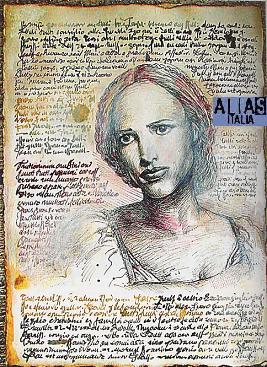
Udo of Aachen occupied a sideline in the history books as a minor poet, copyist and theological essayist.

The first clue to Udo's undiscovered skills was found by mathematician Bob Schipke, a retired professor of combinatorics. On a holiday visit to Aachen cathedral, the burial place of Charlemagne, Schipke saw something that amazed him. In a tiny nativity scene illuminating the manuscript of a 13th century carol, O froehliche Weihnacht, he noticed that the Star of Bethlehem looked odd. On examining it in detail, he saw that the gilded image seemed to be a representation of the Mandelbrot set, one of the icons of the computer age.
Discovered in 1976 by IBM researcher Benoit Mandelbrot, the Mandelbrot set is the most famous fractal (a mathematical object with the property of infinite detail). Only the advent of fast computers made feasible the repeated calculations involved - or so it was thought.
"I was stunned," Schipke says. "It was like finding a picture of Bill Gates in the Dead Sea Scrolls. The colophon [the title page] named the copyist as Udo of Aachen, and I just had to find out more about this guy."

Initially, Udo's aim was to devise a method for determining who would reach heaven. He assumed each person's soul was composed of independent parts he called "profanus" (profane) and "animi" (spiritual), and represented these parts by a pair of numbers. Then he devised rules for drawing and manipulating these number pairs. In effect, he devised the rules for complex arithmetic, the spiritual and profane parts corresponding to the real and imaginary numbers of modern mathematics.
In Salus, Udo describes how he used these numbers: "Each person's soul undergoes trials through each of the threescore years and ten of allotted life, [encompassing?] its own nature and diminished or elevated in stature by others [it] encounters, wavering between good and evil until [it is] either cast into outer darkness or drawn forever to God."
When Schipke saw the translation, at once he saw it for what it was: an allegorical description of the iterative process for calculating the Mandelbrot. In mathematical terms, Udo's system was to start with a complex number z, then iterate it up to 70 times by the rule z -> z*z + c, until z either diverged or was caught in an orbit.
"It tends to be taken for granted," Schipke says, "That the Mandelbrot is too calculation-intensive to be done without computers. What we have to remember is the sheer devotion of the monastic life. This was a labour of faith, and Udo was prepared to work for years. Some slowly-converging pixels must have taken weeks."

Below the description was drawn the first crude plot of the Mandelbrot, which Udo called the "Divinitas" ("Godhead"). He set it out in a 120x120 frame he termed a "columbarium" (i.e. a dovecote, which has a similar grid of niches) and records that it took him nine years to calculate, even with the newly imported technique of ‘algorism', calculation with Arabic numerals rather than abacus.
Bob Schipke comments: "It's a pity that personal differences ended research that could have moved mathematics forward by centuries. But fortunately, Udo couldn't leave the subject alone. By dropping clues into the Cantiones profanae and the manuscripts he illuminated later in his life, he ensured that we were able to recover his work and give him the recognition that he deserves."