Novus,
(EROI - 1) / EROI = Amount of energy used in each iteration
Example:
(2 - 1) / 2 = 1/2 of the produced energy was used to produce it
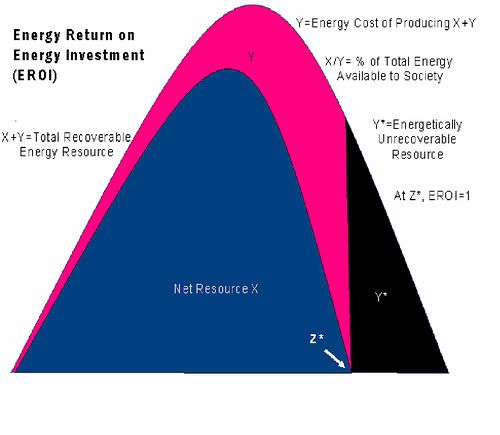
URR is how much you can produce, regardless of how much energy investment it requires. It is an
estimate based on how fast you think EROI will fall. The reason you can't produce more than the URR is because EROI is dropping to 1.
If
ER = Energy Returned/Recovered
EI = Energy Invested
ES = Energy Start (the kick start energy)
then
SUM ER = URR = Ultimate Energy Returned
SUM EI = Total Energy Invested
Net Oil = Net URR = SUM ER - [(SUM EI) - ES]
Example:
In this example we will reinvest all the energy gained in a well that loses EROI really fast (since we are really greedy and dumb).
Total Oil in Place = 1,500 barrels
Starting EROI = 1.9
1: 100 -> 'A' -> 190
EROI = 1.5
2: 190 -> 'A' -> 285
EROI = 1.1
3: 285 -> 'A' -> 313.5
On the next iteration EROI would less than or equal to 1.
SUM ER = URR = 190 + 285 + 313.5 = 788.5
SUM EI = 100 + 190 + 285 = 575
Average EROI = SUM ER / SUM EI ~1.37
To calculate Net Oil, leave out the "kick start" energy and find the difference.
Net Oil = Net URR = 788.5 - (575 - 100) = 313.5
With EROI > 1:
% of total produced = 788.5 / 1500 = 52.56%
% of URR reinvested = 475 / 788.5 = 60.24%
% of URR that is Net = 313.5 / 788.5 = 39.76%
Check out
this page. They have a great interest analogy, as well as some cool graphics.
Edit: made some corrections. Forgot to take out the "kick start" energy
"If you are a real seeker after truth, it's necessary that at least once in your life you doubt all things as far as possible"-Rene Descartes
"When you have excluded the impossible, whatever remains however improbable must be the truth"-Sherlock Holmes




 2. As several others pointed out, your math is off. The problem with your business analogy is that you started the day with nothing, paid all your bills, and still had $90 left over. That $90 doesn't have to be reinvested. You can use it to buy dinner, pay your rent, whatever. Tomorrow you just show up and get another $90.




![[smilie=icon_scratch.gif]](https://udev.peakoil.com/forums/images/smilies/icon_scratch.gif "icon_scratch")


