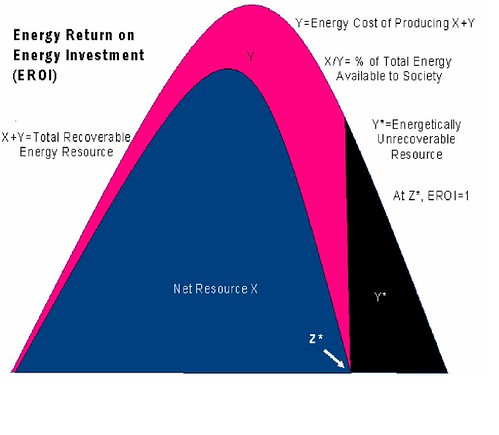
Novus, you are spot on to highlight this. I've been trying to raise discussion of this issue here and over at TOD. If I knew how, I'd insert my latest spreadsheet so folks could play around with the assumptions and perhaps someone adept could generate a graphic. It wouldn't look pretty. One can assume decline from Fields in Production of, say 1%-12%. New production will make up for some portion of that, yielding net decline. My best guess is net decline of 2.5-4%. Then, factor in declining EROEI and increasing population to get the big picture. Today, we have 85 MBD at 15:1, leaving 79 MBD net for 6.6 billion people, or 4.4 barrels/person/year. Ten years hence, using my 2.5-4% decline, and EROEI in the 10:1-7:1 range, and population of 7.5 billion, we'll have only about2.5 barrels/person/year. So we'll each have to get by with about 60% less oil. Of course the falloff won't be distributed evenly. Some people (perhaps in China?) will be using more oil than they do today, some will have none available. But any way you cut it, energy intense culture will be feeling a major squeeze, to say the least. If the move to deep water, polar, heavy and tar/shale oil takes overall EROEI below that 7:1 level, it's much worse, as that's about the level where EROEI really begins to bite:
EROEI % Net
15:1 93%
10:1 90%
9:1 89%
8:1 88%
7:1 86%
6:1 83%
5:1 80%
4:1 75%
3:1 67%
2:1 50%
1.5:1 33%
1.33:1 25%
1.25:1 20%



PeakOil is You
Net Oil: Situation Worse than we thought.
Re: Net Oil: Situation Worse than we thought.
 by clifman » Sat 08 Apr 2006, 13:07:42
The generations of the 20th & early 21st centuries have decided to burn it all and leave nothing but charred remains for those who (may) follow - without apology.
Read William Catton, Derrick Jensen, Paul Chefurka, Daniel Quinn, Alexis Ziegler, Kevin Anderson, Jennifer Francis, Guy Mac...
Read William Catton, Derrick Jensen, Paul Chefurka, Daniel Quinn, Alexis Ziegler, Kevin Anderson, Jennifer Francis, Guy Mac...
-

clifman - Wood

- Posts: 45
- Joined: Wed 28 Sep 2005, 03:00:00
- Location: Virginia Blue Ridge, USA
Re: Net Oil: Situation Worse than we thought.
by venky » Sat 08 Apr 2006, 13:10:03
Maybe I dont understand you correctly, but it seems to me there might be a flaw in your logic. Your interpretation of EROEI seems to be that it takes oil to produce oil, hence the concept of 'net oil'.
However, in the case of the tar sands for instance, the input energy is mostly natural gas, which I have read can be replaced by electricity. So if we produce 5 mbd from the tar sands all 5 mbd will be available to us, the input energy being in the form of natural gas. Ofcourse natural gas production is constrained and there are other issues.
So while declining EROEI is a concern, it doesn't seem to me to be the catastrophe that you make out.
However, in the case of the tar sands for instance, the input energy is mostly natural gas, which I have read can be replaced by electricity. So if we produce 5 mbd from the tar sands all 5 mbd will be available to us, the input energy being in the form of natural gas. Ofcourse natural gas production is constrained and there are other issues.
So while declining EROEI is a concern, it doesn't seem to me to be the catastrophe that you make out.
- venky
- Tar Sands

- Posts: 819
- Joined: Sun 13 Mar 2005, 04:00:00
Re: Net Oil: Situation Worse then we thought.
by coyote » Sat 08 Apr 2006, 13:21:55
$this->bbcode_second_pass_quote('MonteQuest', 'P')eak oil is the end of cheap energy in any form.
I agree completely -- the fact that the Hirsch report called Peak Oil a 'liquid fuels crisis' and definitively not an 'energy crisis' has led to some confusion I think. When oil peaks, the overall amount of energy available will be seriously impacted, and the price of all alternatives will skyrocket right along with oil.
Guys, you should read the linked post that Monte provided (EROEI: Energy Returned on Energy Invested). The logic is inescapable: When the EROEI of oil becomes 1:1, it ceases to be an energy source -- even if you're using a different form of energy to maintain production.
Doesn't mean we'll stop pumping, because oil still might be useful for petrochemicals etc., and as long as someone's making money, they'll keep right on doing it. But when the energy reaches parity, then we're not talking about production, but substitution. Then oil becomes merely an energy carrier, like electricity or hydrogen, instead of the valuable energy source it is right now.
Monte, over and over your posts have helped me clarify. Props and thanks.
![[smilie=notworthy.gif]](https://udev.peakoil.com/forums/images/smilies/notworthy.gif "notworthy")
Lord, here comes the flood
We'll say goodbye to flesh and blood
If again the seas are silent in any still alive
It'll be those who gave their island to survive...
We'll say goodbye to flesh and blood
If again the seas are silent in any still alive
It'll be those who gave their island to survive...
-

coyote - News Editor

- Posts: 1979
- Joined: Sun 23 Oct 2005, 03:00:00
- Location: East of Eden
Re: Net Oil: Situation Worse than we thought.
by arocoun » Sat 08 Apr 2006, 13:28:13
Well, it may not be as big of a catastrophe as described, but it still seems like a catastrophe of some sort. Instead of getting less oil per unit of oil, we get less oil per unit of energy. Basically, it's about as bad, especially considering that most of our current sources of energy are non-renewables with production peaks and deminishing returns of their own.
EDIT: It seems I was a little slow to the response, so to clarify, this post is in response to Venky's.
EDIT: It seems I was a little slow to the response, so to clarify, this post is in response to Venky's.
The Origin of Patriotic Philosophy
--We are Greek.
--The barbarians are not Greek.
--Therefore, we must conquer, exploit, and kill the barbarians.
--We are Greek.
--The barbarians are not Greek.
--Therefore, we must conquer, exploit, and kill the barbarians.
-
arocoun - Lignite
- Posts: 212
- Joined: Fri 15 Oct 2004, 03:00:00
- Location: Illinois, USA
Re: Net Oil: Situation Worse than we thought.
by seahorse » Sat 08 Apr 2006, 17:12:31
Whether we call it "net oil" or EROI it doesn't matter to me. Its a fact of life that the world is starting to realize. This is what French oil company Total was saying just a couple of days ago when it said the world will never produce 120 mbpd, bc it costs too damn much to do it.
This board has hit this topic many times from many different angles, whether it be EROI, or the topic Peak oil = Peak Refinery Capacity, or now net oil, its all the same. For this reason, KD is right and the world has already passed peak. IF the world was serious about overcoming the net energy issue, it would be building many new refineries to process the heavy oils that are left, or building nuclear reactors in Canada to heat the tar sands instead of using natural gas which is estimated to be depleted in 8 years. We're not doing those things, so, we are at the end of cheap energy, the Russian gas is quickly depleting, they are shutting it off to the Ukraine, Georgia, there is fighting in Iraq and Afghanistan, the US is openly developing a bigger nuclear arsenal, prices keep rising although Lynch thinks otherwise. Assuming money could resolve the problem, Klare was right, the world has opted to settle depleting energy through resource wars. No cites, bc I'm too tired of having to prove anything to anyone, just look at the gas prices at your local station and ask why.
This board has hit this topic many times from many different angles, whether it be EROI, or the topic Peak oil = Peak Refinery Capacity, or now net oil, its all the same. For this reason, KD is right and the world has already passed peak. IF the world was serious about overcoming the net energy issue, it would be building many new refineries to process the heavy oils that are left, or building nuclear reactors in Canada to heat the tar sands instead of using natural gas which is estimated to be depleted in 8 years. We're not doing those things, so, we are at the end of cheap energy, the Russian gas is quickly depleting, they are shutting it off to the Ukraine, Georgia, there is fighting in Iraq and Afghanistan, the US is openly developing a bigger nuclear arsenal, prices keep rising although Lynch thinks otherwise. Assuming money could resolve the problem, Klare was right, the world has opted to settle depleting energy through resource wars. No cites, bc I'm too tired of having to prove anything to anyone, just look at the gas prices at your local station and ask why.
-
seahorse - Expert

- Posts: 2275
- Joined: Fri 15 Oct 2004, 03:00:00
- Location: Arkansas
Re: Net Oil: Situation Worse than we thought.
by MonteQuest » Sat 08 Apr 2006, 22:50:46
$this->bbcode_second_pass_quote('venky', 'M')aybe I dont understand you correctly, but it seems to me there might be a flaw in your logic. Your interpretation of EROEI seems to be that it takes oil to produce oil, hence the concept of 'net oil'.
However, in the case of the tar sands for instance, the input energy is mostly natural gas, which I have read can be replaced by electricity. So if we produce 5 mbd from the tar sands all 5 mbd will be available to us, the input energy being in the form of natural gas. Ofcourse natural gas production is constrained and there are other issues.
So while declining EROEI is a concern, it doesn't seem to me to be the catastrophe that you make out.
However, in the case of the tar sands for instance, the input energy is mostly natural gas, which I have read can be replaced by electricity. So if we produce 5 mbd from the tar sands all 5 mbd will be available to us, the input energy being in the form of natural gas. Ofcourse natural gas production is constrained and there are other issues.
So while declining EROEI is a concern, it doesn't seem to me to be the catastrophe that you make out.
No, his interpretation says that it takes energy of some sort to produce oil. If you use more than you get, it becomes an energy consumer
And since when was "electricity" a source of energy?
A Saudi saying, "My father rode a camel. I drive a car. My son flies a jet-plane. His son will ride a camel."
-

MonteQuest - Expert
- Posts: 16593
- Joined: Mon 06 Sep 2004, 03:00:00
- Location: Westboro, MO
Re: Net Oil: Situation Worse than we thought.
by pup55 » Sat 08 Apr 2006, 23:32:03

A couple of minor points: Here is a slightly revised graph. The data above represents the mideast "internal consumption" divided by the total production. Per the BP review, the middle east only exports about 20% of its refinery production outside the region. For this graph I have added to this figure the natural gas usage, converted to BOE. The mideast actually consumes 90% of the natural gas it is currently producing.
Since about 1985 the ratio of production to consumption has gone up by only about 5%. At this rate of increase, they will still be able to pump oil for a long time. However, this rate of increase will almost certainly not be linear. As they approach the maximum production rate, there will be a discontinuity, no doubt.
The growth rate of natural gas consumption in the middle east is about 7.5%. This is a doubling every 10 years. 90% of the natural gas produced in the middle east is used internally in the middle east. At this rate of increase, the currently stated reserves of natural gas in the middle east will run out in about 2048. I suppose they will hit "peak gas" and go into decline before then. So, presumably, if they are indeed using most of their natural gas to generate power to provide the energy for oil production, this will at some point be a big problem This will probably be the source of the discontinuity.
Thirdly, I am not ready to say that this consumption of energy is necessarily directly related to the pumping of that oil, but I don't think it is necessarily important for this to be the case. The amount of energy those guys are consuming is the amount it is taking to run their society in some orderly way, and take care of the population to a sufficient extent so they can produce oil. Think of it as the "overhead" involved in oil production. You can make the argument that it is going to take an increasing amount of energy to keep the people happy enough to keep the stuff running, and that is equally important if not more so than whatever amount they use to run the actual pumps and drilling rigs. This is especially true in light of the population increase in some of these areas.
Fourthly, I agree with whoever said that these guys will run their equipment even though EROEI is negative, as long as they pump oil, for critical petrochemicals and non-energy usage. At that point, you will have to compute it based on "money returned on money invested".
But. to return to the original point: It is clear that at some point, the internal usage in these places will be sufficiently large so as to not allow them to continue to export. This will be especially true if they start to go into decline. The data at hand at the moment do not allow us to figure out exactly what that point will be. Seahorse is probably right, though, we will be able to tell by reading the numbers on the gas pump.
-
pup55 - Light Sweet Crude

- Posts: 5249
- Joined: Wed 26 May 2004, 03:00:00
Re: Net Oil: Situation Worse then we thought.
by Antimatter » Sun 09 Apr 2006, 01:32:47
$this->bbcode_second_pass_quote('Novus', '')$this->bbcode_second_pass_quote('Antimatter', '')$this->bbcode_second_pass_quote('', 'A')verage EROEI has been falling for years and right now is around 15.
Source? It stands to reason that EROEI has been gradually falling, but why should it suddenly take a dive now, other than the fact you expect peak oil to happen about now?
My source is Richard Heinberg's the Party is Over. In the foot notes he references Colin Campbell so it is essentially it is an ASPO number. The sudden dive in EROEI is being caused by "market forces." Low EROEI Oil was not pumped durning the age of cheap oil but now as prices rise the oil companies go to long lengths to extract it because it is profitable to do so from a monetary standpoint. From an energy standpoint the amount of oil being brought on line now is small.
Hmm, I wonder where Campbell got that figure from, if Heinberg is citing accurately and not just making it up. I don't know of any serious attempts to quanitfy world EROEI. Cleveland and Culter did a few for the US, their most recent one gave an EROEI of about 10 for US oil and gas, down from about 15 in the 1960s. The website at oilanalytics.org is down and got taken over by a porn site but an archive is here, though the relevant image in the results isn't accessible. Given that average US field sizes are on the order of 500,000 barrels white the rest of the world averages about 40 million barrels (source IHS energy) and drilling density is much lower, world EROEI is probably quite a bit higher. Though I would be interested to know how much oil is burnt in the supertankers lugging it around the world.
"Production of useful work is limited by the laws of thermodynamics, but the production of useless work seems to be unlimited."
-

Antimatter - Tar Sands
- Posts: 587
- Joined: Tue 04 Jan 2005, 04:00:00
- Location: Australia