Donate Bitcoin

Donate Paypal


PeakOil is You

PeakOil is You

I'm confused. How do you calculate and model this data?

Discuss research and forecasts regarding hydrocarbon depletion.

Re: I'm confused. How do you calculate and model this data?

Postby WebHubbleTelescope » Sat 21 Jan 2006, 12:32:32

$this->bbcode_second_pass_quote('ReserveGrowthRulz', '
')You assume the same thing Campbell does, and he's already been wrong how many times? And is there any reason why you assuming the same wrong facts should lead to a CORRECT conclusion this time around?

I provided a perfect example as to why your theory on bean counting is wrong, myself, I would think that the fact that bean counters can't DO reserves is itself a giveaway...under your faulty scenario the accountants should just add up all their barrels and mcf's and go home happy....it doesn't happen that way and claiming it over and over while pretending to be clueless about examples which show why it doesn't does nothing except prove my point, amateurs should just stay home and play with their weeji boards.



Campbell uses numbers that get supplied from the oil companies as conservative estimates and then accuse him of being wrong?

There is a psychological term for this. It is called projection. Simply put, the patient that suffers from this malady "projects" his/her inadequacies onto someone else, thus displacing the blame for their own undoing. If the projectionist does this early enough, it serves to innoculuate or vaccinate theselves against somebody else coming along and accusing them of the same failures they accuse others of. So Campbell gets accused of being wrong, this fact gets echoed over and over, while no one bothers to look at the man behind the curtain running the projection machine.
User avatar
WebHubbleTelescope
Tar Sands
Tar Sands
 
Posts: 950
Joined: Thu 08 Jul 2004, 03:00:00

Re: I'm confused. How do you calculate and model this data?

Postby ReserveGrowthRulz » Sat 21 Jan 2006, 18:59:44

$this->bbcode_second_pass_quote('WebHubbleTelescope', '
')Campbell uses numbers that get supplied from the oil companies as conservative estimates and then accuse him of being wrong?


I don't suppose you've even actually READ anything Campbell has published over the years?

And pointing out that he is wrong in his published predictions is hardly an accusation, it just IS. Pick up a book and pay attention already, some of this is so obvious I'm amazed I can use it as a bludgeon on people who should know better.

Oh...PetroConsultants isn't an oil company...maybe you should include some credit for them when referencing where Campbells estimates of WHATEVER come from.
User avatar
ReserveGrowthRulz
Permanently Banned
 
Posts: 813
Joined: Fri 30 Dec 2005, 04:00:00

Re: I'm confused. How do you calculate and model this data?

Postby WebHubbleTelescope » Sat 21 Jan 2006, 19:49:43

Here is something to think about when we, the dirty masses, try to make objective sense out of the reams of crap laid down on us. This post from Glenn Greenwald speaks volumes if you replace "journalists" with "professional oilers" and "politics" with "oil depletion" ...
$this->bbcode_second_pass_quote('', ' ')Invasion of the dirty masses

The principal benefit from the emergence of the blogosphere is that it has opened up our political discourse to a much wider and more diverse group of participants. Previously, establishment journalists and their hand-picked commentators were the sole vehicle for the dissemination of political opinions. The only commentators and opinions which received any real attention were the ones which establishment journalists deemed worthy of attention. Those who were outside of the club of established journalists were ignored and unable to have their opinions heard.

All of that has changed with the blogosphere. The blogosphere is a hard-core and pure meritocracy. It doesn’t matter who you are or what your pedigree is. You either produce persuasive arguments and do so with credibility, or you don’t. Whether someone has influence in the blogosphere has nothing to do with their institutionalized credentials and everything to do with the substance of what they produce. That is why even those who maintain their anonymity can be among the most popular, entertaining and influential voices. The blogosphere has exploded open the gates of influence which were previously guarded so jealously by the establishment journalists.

For precisely that reason, many establishment journalists have raging contempt for the blogosphere. It is a contempt grounded in the fallacy of credentialism and a pseudo-elitist belief that only the approved and admitted members of their little elite journalist club can be trusted to enlighten the masses. Many of them see blogs as a distasteful and anarchic sewer, where uncredentialed and irresponsible people who are totally unqualified to articulate opinions are running around spewing all sorts of uninformed trash. And these journalistic gate-keepers become especially angry when blogospheric criticism is directed towards other establishment journalists, who previously were immune from any real public accountability.

The irony, though, is that many of these establishment journalists have been forced to accommodate the growing influence of the blogosphere by starting blogs of their own. And the unedited and immediate format of blogging means that they sometimes unintentionally reveal their real mindset, and one can see it in the light of day.


So unless you can address the merits or shortcomings of a model objectively, you don't have a chance to halt the flow of ideas, whatever your credentials may be.
User avatar
WebHubbleTelescope
Tar Sands
Tar Sands
 
Posts: 950
Joined: Thu 08 Jul 2004, 03:00:00

Re: I'm confused. How do you calculate and model this data?

Postby 128shot » Sat 21 Jan 2006, 20:17:32

Thanks everyone for your help.


The real bump in the road, as you could say, for me at least, is I have to have a form of calculation, since I have to present that as well. I can't just give a speech without some kind of data, calculated by myself or otherwise.


Otherwise this task would be a hell of alot easier..
User avatar
128shot
Lignite
Lignite
 
Posts: 303
Joined: Wed 18 Jan 2006, 04:00:00

Re: I'm confused. How do you calculate and model this data?

Postby ReserveGrowthRulz » Sat 21 Jan 2006, 20:50:04

$this->bbcode_second_pass_quote('WebHubbleTelescope', '
')So unless you can address the merits or shortcomings of a model objectively, you don't have a chance to halt the flow of ideas, whatever your credentials may be.


Oh...thats all you want? Sure....Campbell called the first peak when? Late 80's? Early 90's?

And it didn't happen. Objective fact #1.

Campbell says reserve growth CAN'T happen when you backdate reserves to discovery point of a field. He then backdates reserves and quantifies those numbers. Years later, he then alters them upward. Presto....reserve growth from the guy who says there isn't any. Objective fact #2.

I ask again, have you ever READ anything this guy has published, or do you just enjoy PRETENDING to know what he has published?
User avatar
ReserveGrowthRulz
Permanently Banned
 
Posts: 813
Joined: Fri 30 Dec 2005, 04:00:00

Re: I'm confused. How do you calculate and model this data?

Postby pup55 » Sat 21 Jan 2006, 21:04:37

OK

Try using the verhulst function. It is considered to be too simple by some on this board, but for your purposes should be fine.

[web]http://arts.bev.net/roperldavid/minerals/crudeoil.htm[/web]

ref: the "peak mart" thread on this forum where we did this awhile back.

$this->bbcode_second_pass_quote('', ' ')

The formula for the symmetrical model is:

Q(sub-t)=1/2 Q(inf) *(1-tanh(t-t (sub 1/2)/2*tau))

where Q (sub-t) is the remaining quantity for a given year
Q-inf is the ultimate recoverable quantity
t is the year
t (sub 1/2) is the guesstimate of the peak year
and tau=1/k where k is the "fudge factor" for the curve fatness.


For the "updated" model we did last year, we used the following:

n 0.149454128
qinf 2,461.82
t(1/2) 106.8467633
k 0.039628337

So the way this works is that you want to compute Q-sub t, which is the quantity of oil remaining in the ground for any given year t. So, for the first year, T=1.

You put in the above constants into the equation and it computes a Q-sub-t amount. You then do the same thing for t=2. That gives you the second year's quantity of oil remaining in the ground. You subtract the first Q sub t from the second Q-sub-t and that gives you the first year's pumping.

You repeat for t=2, etc. etc. and compute all of the individual years by subtraction from the following year's amount left. If you know how to run a spreadsheet program, no problem getting this to happen all at once.

Q-inf is the "ultmate remaining reserves" estimate. reservegrowthrulz will tell you that this number is not really a constant--it shifts over time, depending on new discoveries, etc. but for now, we will pretend it is a constant so you can get your assignment done.

t-1/2 is a "guesstimate" of the peak year. In this case, it's 106 years after year 1, which is 1900 therefore it's 2006 for the purpose of the model.

The other numbers, k and n, are just fudge factors. when I did the original calculation I used MS-Excel to compute it. Once you have your spreadsheet set up, you can experiment with different n and k values, and see how it changes the shape of the curve.

When I do these, I do one step at a time per cell when setting up the spreadsheet. It is uglier, but less chance to screw up.
User avatar
pup55
Light Sweet Crude
Light Sweet Crude
 
Posts: 5249
Joined: Wed 26 May 2004, 03:00:00
Top

Re: I'm confused. How do you calculate and model this data?

Postby WebHubbleTelescope » Sat 21 Jan 2006, 21:29:21

This narrative describes the virtual flow of oil through the system from discovery to production, providing a problem domain description to how an oil peak occurs.

Precondition: Oil sits in the ground, undiscovered.
Invariant: The amount of oil in each of its states cumulatively sums to a constant.

The states of the oil in the ground are fallow, construction, maturation, and extraction.

1. A discovery is made and an estimate of the quantity extractable is made.

2. The oil sits in the fallow state until a decision is made or negotiated as to what to do with it. Claims must be made, etc. This time constant we call t1, and we assume this is an average time with standard deviation equal to the average. This becomes a maximum entropy estimate, made with the minimal knowledge available.

3. A stochastic fraction of the discovery flows out of this fallow state with rate 1/t1. Once out of this state, it is ready for the next stage (and state).

4. The oil next sits in the build state as the necessary rigs and platforms are constructed. This time constant we call t2, and has the once again an average time with standard deviation equal to the average.

5. A stochastic fraction of the fallow oil flows out of the build state with rate 1/t2. Once out of this state, it is ready for the next stage.

6. The oil sits in the maturation state once the rigs are completed. The maximum flow can not be achieved initially as the necessary transport, pipelines, and other logistics are not 100% ready. This time constant we call t3.

7. A stochastic fraction of the built rig's virtual oil flows out of the maturation state with rate 1/t3. Once out of this virtual state, it is ready for the next stage of sustained extraction.

8. The oil sits in the ready-to-extract state once the oil well is mature.

9. The oil starts getting pumped with stochastic extraction rate 1/t4. The amount extracted per unit time is proportional to the amount in the previous maturation state.

Post-condition: All oil eventually gets extracted at time=infinity. But because of the proportionality extraction rate assumed, this decline only asymptotically approaches zero at long time periods. Also, the cumulative amount extracted at time=infinity equals the total discovered. However, since we never achieve infinite time, cumulative extraction never matches cumulative discoveries.

Each one of these states can be considered as a reservoir with a capacitive time lag associated with the time constant set for each stage. In stochastic terminology the flow approximates a Markovian Process.

The extraction from the final stage gives the average production level. Since Markov processes have well-behaved linear properties and are conditionally independent of past states, an entire set of discoveries can be applied as forcing functions to this process flow and the result will be a convolution of the individually forced solutions.

The final production profile over time approximates the classic Hubbert curve. This narrative explains in very basic terms how and why the peak gets shifted well away from the discovery peak. However it is not symmetric, as the nature of time causality rules long negative tails out.

Equations here:
http://mobjectivist.blogspot.com/2006/0 ... place.html
User avatar
WebHubbleTelescope
Tar Sands
Tar Sands
 
Posts: 950
Joined: Thu 08 Jul 2004, 03:00:00

Re: I'm confused. How do you calculate and model this data?

Postby WebHubbleTelescope » Sat 21 Jan 2006, 21:53:26

$this->bbcode_second_pass_quote('ReserveGrowthRulz', 'P')resto....reserve growth from the guy who says there isn't any. Objective fact #2.


Yes, and the oil companies refer to it with the euphemism "reserve growth" instead of the more correct "badly made estimates revised upwards". In politics, that is called framing the issue. So who made the bad estimates in the first place? Ever heard of the expression GIGO?

Give us non-garbage input and we will make hay. Remember, this is just an exercise in bean-counting. I suppose you can denigrate Campbell as being a misguided bean-counter, but eventually someone will take his place that understands how the "yanking of the chain" occurs, and can argue his way out of a paper bag when faces with the continuously revised bad data courtesy of the oil companies.

The current framing is this : "Campbell is wrong because he ignores the magical property of reserve growth"

As if reserve growth is some intrinsic property of an oil field, instead of errors compounded by the humans behind the wheel.

The correct counter-framing should be: "The oil companies continuously provide bad estimates of discovery yield, making it hard for anyone to predict oil depletion"
User avatar
WebHubbleTelescope
Tar Sands
Tar Sands
 
Posts: 950
Joined: Thu 08 Jul 2004, 03:00:00
Top

Re: I'm confused. How do you calculate and model this data?

Postby ReserveGrowthRulz » Sat 21 Jan 2006, 23:11:11

$this->bbcode_second_pass_quote('WebHubbleTelescope', '
')The current framing is this : "Campbell is wrong because he ignores the magical property of reserve growth"

As if reserve growth is some intrinsic property of an oil field, instead of errors compounded by the humans behind the wheel.

The correct counter-framing should be: "The oil companies continuously provide bad estimates of discovery yield, making it hard for anyone to predict oil depletion"


I have no problem equating reserve growth with "continuous bad estimates of discovery yield" because really, thats what it is.

Myself, I don't care what you call it, what I care about is it exists all over the place, its net positive, its a big amount of addition to reserves relative to new discoveries, and Colin hasn't even been able to guess at the correct numbers 10 years in the PAST yet.....so what kind of incompetence is that? 10 years after the fact and he STILL doesn't know what the size of the discovery is. Yup...I'm sure them accountants could do alot better....

Now that you won't even admit to having read anything Colin has written, I don't suppose you are familiar with Arringtons work? Attansai and Root at the USGS, particularly the Enigma paper in 1995?

And pup, those were some really nice graphs you provided. I like'em. Seems like it makes the point better than I ever could that trying to fit Hubberts curve to production data is a pretty useless exercise.
User avatar
ReserveGrowthRulz
Permanently Banned
 
Posts: 813
Joined: Fri 30 Dec 2005, 04:00:00
Top

Re: I'm confused. How do you calculate and model this data?

Postby WebHubbleTelescope » Sat 21 Jan 2006, 23:12:10

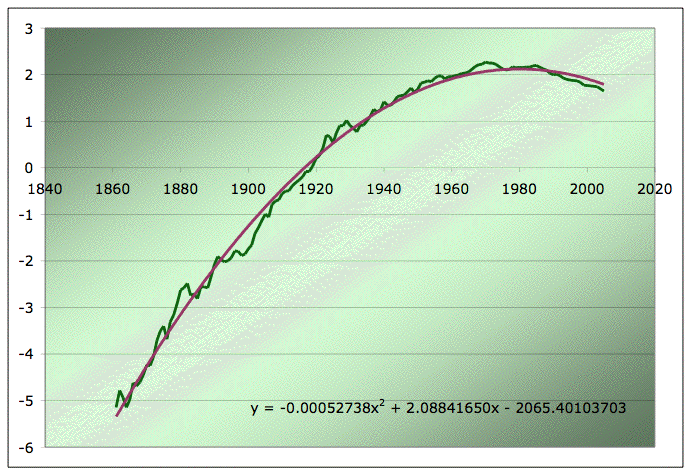
Regarding the US crude oil production curves, Staniford was able to make a very good fit over a few orders of magnitude using a gaussian:
http://www.theoildrum.com/story/2006/1/8/25235/83999
Image

As for temporal properties of this curve over time, as SS noted it has the property that
$this->bbcode_second_pass_code('', 'dP/dt = K * (t0-t) * P(t)')

where t0=PeakTime. This relationship reads that the production increase slows down over time linearly, but also scaled by the amount of production at that time. At t=t0, the production increase turns into a production decrease.
User avatar
WebHubbleTelescope
Tar Sands
Tar Sands
 
Posts: 950
Joined: Thu 08 Jul 2004, 03:00:00

Re: I'm confused. How do you calculate and model this data?

Postby WebHubbleTelescope » Sat 21 Jan 2006, 23:38:34

$this->bbcode_second_pass_quote('ReserveGrowthRulz', '
')Now that you won't even admit to having read anything Colin has written, I don't suppose you are familiar with Arringtons work? Attansai and Root at the USGS, particularly the Enigma paper in 1995?


You seem to presume a lot. I indeed have read work on the "enigma" of reserve growth. As proof:
http://mobjectivist.blogspot.com/2006/0 ... rowth.html

What troubles me is that they sometimes give reserve growth in the 1000% range and other times at less than 100%. I can understand the former if these were estimates from 100 years ago. I can understand the latter as standard conservative engineering estimates of a factor of 2.
User avatar
WebHubbleTelescope
Tar Sands
Tar Sands
 
Posts: 950
Joined: Thu 08 Jul 2004, 03:00:00
Top

Re: I'm confused. How do you calculate and model this data?

Postby ReserveGrowthRulz » Sun 22 Jan 2006, 15:21:28

$this->bbcode_second_pass_quote('WebHubbleTelescope', '')$this->bbcode_second_pass_quote('ReserveGrowthRulz', '
')Now that you won't even admit to having read anything Colin has written, I don't suppose you are familiar with Arringtons work? Attansai and Root at the USGS, particularly the Enigma paper in 1995?


You seem to presume a lot. I indeed have read work on the "enigma" of reserve growth. As proof:
http://mobjectivist.blogspot.com/2006/0 ... rowth.html


Lets start with just the basics of your inaccuracies, shall we? While blogging away in ignorance, apparently it escaped you that Root and Attansai aren't Canadians, and they aren't consultants.

A reasonable explanation for reserve growth which isn't limited to "petroleum engineers just lie because I don't understand the reference to California oilfields" is here...

http://pubs.usgs.gov/fs/fs-202-96/FS-202-96.html

Now....since blogging in mediocrity is something you are apparently very familiar with, let me help you from NOT doing it again.

On the link provided, check out the about the fifth reference, I'll point it out to you since apparently you aren't familiar with it..not a surprise, its one of those researchy type works which affects lots of those which come after and which aren't usually noticed by the amateur ranks in their pursuit of conspiracy theories....here....I'll copy and paste it for you so it won't be so difficult to find.


"Attanasi, E.D., and Root, D.H., 1994, The enigma of oil and gas field growth: American Association of Petroleum Geologists Bulletin, v. 78, no. 3, p. 321-332."

Now, it is best to go to your local library and actually READ something referenced rather than pretending you are familiar with the "enigma" paper, and when finished then maybe you can blog something without looking like standard "me make models but know nothing" amateur type.

You'll like the paper, the guy has data which you whine about not being able to get, provides it, plus he has a MODEL! He models around a little, and then comes up with a conclusion. It pretty much disintergrates the idea of reserve growth being something which can be dispatched out of hand as a "bad guess"...if it were...engineers are smart enough to guess better the NEXT time...which we do...and guess what? Reserve growth is still there! Tricky thing, reserve growth ( what amateurs call "bad guesses").

Now run along and do your homework, and try not to blog in such an inaccurate and silly manner next time.

$this->bbcode_second_pass_quote('WebHubbleTelescope', '
')What troubles me is that they sometimes give reserve growth in the 1000% range and other times at less than 100%. I can understand the former if these were estimates from 100 years ago. I can understand the latter as standard conservative engineering estimates of a factor of 2.


Doubling the intial reserves estimates of the California fields wouldn't have covered their reserve growth by an order of magnitude. So pretending to use alleged "standard conservative engineering estimates" simply means you aren't familiar with them in the petroleum industry, which also helps explain your fundamental misunderstanding of the entire issue in the first place. Want me to reference some of the original reserve growth papers? Arrington, whom you didn't mention, did his original studies in the 50's I think....considering you can't find a paper 10 years old, I'm not surprised you didn't even mention him. M. Verma has a recent work published in some natural resource bulletin or another using Arringtons original method, modified a little, want to pretend you've read that one as well?
User avatar
ReserveGrowthRulz
Permanently Banned
 
Posts: 813
Joined: Fri 30 Dec 2005, 04:00:00
Top

Re: I'm confused. How do you calculate and model this data?

Postby coyote » Sun 22 Jan 2006, 19:11:41

You know, ReserveGrowthRulz, I don't know anything about modeling; but repeatedly, in different threads, I've seen posts from you that are insulting, sarcastic, snotty, overbearing and downright inappropriate. I don't think you've given 128shot a very good first impression of this forum. The other posters in this thread have done a very good job of keeping their cool, even with all the insults you're throwing around. Even if everything you're saying is 100% correct, you're still acting like a child. Doesn't help your cause.
Lord, here comes the flood
We'll say goodbye to flesh and blood
If again the seas are silent in any still alive
It'll be those who gave their island to survive...
User avatar
coyote
News Editor
News Editor
 
Posts: 1979
Joined: Sun 23 Oct 2005, 03:00:00
Location: East of Eden

Re: I'm confused. How do you calculate and model this data?

Postby ReserveGrowthRulz » Sun 22 Jan 2006, 19:31:20

$this->bbcode_second_pass_quote('coyote', 'Y')ou know, ReserveGrowthRulz, I don't know anything about modeling; but repeatedly, in different threads, I've seen posts from you that are insulting, sarcastic, snotty, overbearing and downright inappropriate. I don't think you've given 128shot a very good first impression of this forum. The other posters in this thread have done a very good job of keeping their cool, even with all the insults you're throwing around. Even if everything you're saying is 100% correct, you're still acting like a child. Doesn't help your cause.


I didn't realize I was insulting anyone.....the sarcasm I am familiar with, but when people want to PRETEND they know something when in fact they don't, sarcasm strikes me as a completely reasonable response.

As for helping my cause...unlike some of the more zealot Peakers, I could care less. Unlike a Peaker "cause" groupie, I simply am a proponent of the marketplace solving marketplace problems, and commodity shortages aren't much more than a marketplace problem, no matter how badly a merry band of Peakers wants to turn it into the end of the world.

If a dissenting view is unwelcome, it is unfortunate that the Peaker view can't stand up to a single voice in dissent. Myself I consider the idea itself slightly more robust than what you are implying, without drawing quite the "end of the world" conclusions which appear so popular around here.
User avatar
ReserveGrowthRulz
Permanently Banned
 
Posts: 813
Joined: Fri 30 Dec 2005, 04:00:00
Top

Re: I'm confused. How do you calculate and model this data?

Postby 128shot » Sun 22 Jan 2006, 22:00:32

I thank everyone again, and my first impressions have been good-I expect to be weary jumping into a place like this. :-D


Tensions run high, particulary with doomsayers :)


Still, I'm confused on how to get some kind of data representation I can present in 3 weeks...this has to be as scientifical as possible..
User avatar
128shot
Lignite
Lignite
 
Posts: 303
Joined: Wed 18 Jan 2006, 04:00:00

Re: I'm confused. How do you calculate and model this data?

Postby WebHubbleTelescope » Sun 22 Jan 2006, 22:40:33

$this->bbcode_second_pass_quote('ReserveGrowthRulz', '
')"Attanasi, E.D., and Root, D.H., 1994, The enigma of oil and gas field growth: American Association of Petroleum Geologists Bulletin, v. 78, no. 3, p. 321-332."


Note the above paper. The authors are from the USGS. I am about to do a complete deconstruction of the paper based on my knowledge of how people can misuse statistical methods.

First of all, the authors put the following curve front and center. This shows how "reserve growth" mutiplies from an initial estimate to some huge correction that seems absurd on the face of it. But 15X ?
Image

Second, the estimates only start in the year 1977, so all the data points prior to this are extrapolations (for example, when they go back anywhere from 20 to 90 years, no discovery estimates are supplied for that year).

Third, the data that they extrapolate from, discoveries made since 1977, only account for around 3% of the data (around 4500 mbls). You may be able to estimate an election from exit polls of 3% of the population (maybe not with Bush :)) but the authors did not make the argument that discovery estimation follows a stationary process. Just like exit polling, the sampling has to be evenly distributed, in this case over a 100 year span, for them to extrapolate like this.

Fourth, of the discoveries made between 1977 and 1991, the bulk of the estimation correction occurred within 2 years of the initial estimate. Why not wait 2 years to establish the initial estimate for that year? For all we know, discoveries could be made in the month of December, a quick note entered, while within a few months, but in the next calendar year, an update was made that doubles the estimate. I say so what, wait a year or two. These corrections are amplified by bad intial estimates, much like a chaotic system. Filter, I say, filter.

Of the discoveries starting in 1977, most of the big estimation errors are corrected within the first two years. If you look at the year 1983 in fact, the reserve correction went down from 1985 to 1991. I suppose you can call this a statistical artifact but I would come back and say the extrapolated curves are statistical artifices arriving from just plain bad assumptions on sample size and stationarity.

Above all, nowhere in the data do I see reserve growths of 15X occurring in any data. Perhaps extrapolated in some weird way the math comes out like that (their "model" amounts to a strict monotonic increase but at a reduced rate of increase of reserve growth per year), but I see only estimates going up by a factor of between 1 and 2, after settling within the first few years. It really seems odd that the discovery estimate has this kind of priority to be made in a year or two. Like I said before, I would think that the initial estimate is conservative to allow the decision for business profits to be made objectively. After that, when rigs are constructed within the next five years (at the late end for offshore in particular), a much better estimate can be made. However, if you look at the discoveries between 1975 and 1991 with this viewpoint, the "reserve growth" is much less dramatic. Which is what the update to the "enigma" paper made by Canadian authors showed here.

The sad thing about this, is that these are US scientists and engineers (presumably) employed by the USGS. The rest of the world looks up to these guys as the best that a good education can buy. So what does a country like Saudi Arabia or Kuwait do? They see what the US geologists say about the possibilities of reserve growth. And then apply it to their own reserves. So they multiply their numbers by the Anastassi and Root correction factor. The good old USA can't be wrong? Can they?

If we did this out of some political agenda, shame on us. I guess we are getting the payback we deserve.
User avatar
WebHubbleTelescope
Tar Sands
Tar Sands
 
Posts: 950
Joined: Thu 08 Jul 2004, 03:00:00
Top

Re: I'm confused. How do you calculate and model this data?

Postby WebHubbleTelescope » Mon 23 Jan 2006, 00:06:44

$this->bbcode_second_pass_quote('128shot', '
')Tensions run high, particulary with doomsayers :)


Still, I'm confused on how to get some kind of data representation I can present in 3 weeks...this has to be as scientifical as possible..


For a minute there, I thought I recalled a Bushism. But then I looked it up and yes indeed scientifical is a word. It means scientific. Which I am for, BTW.
User avatar
WebHubbleTelescope
Tar Sands
Tar Sands
 
Posts: 950
Joined: Thu 08 Jul 2004, 03:00:00
Top

Re: I'm confused. How do you calculate and model this data?

Postby ReserveGrowthRulz » Mon 23 Jan 2006, 01:09:50

$this->bbcode_second_pass_quote('WebHubbleTelescope', '')$this->bbcode_second_pass_quote('ReserveGrowthRulz', '
')"Attanasi, E.D., and Root, D.H., 1994, The enigma of oil and gas field growth: American Association of Petroleum Geologists Bulletin, v. 78, no. 3, p. 321-332."


Note the above paper. The authors are from the USGS. I am about to do a complete deconstruction of the paper based on my knowledge of how people can misuse statistical methods.


Cool. But first you have to find any statistics in the paper....I don't recall any offhand, but it was a year ago I first read the paper, they may have squeaked one in there somewhere.

I'll find Verma's paper tomorrow and get its printed location out, he used the original Arrington method with a slight modification rather than what Root and Attanasi did. Similar method, no statistics, and better yet, he included the equations for his model for both oil and gas. I think one of his points was that his ultimate growth curves were slightly lower than what Root and Attanasi came up with.
User avatar
ReserveGrowthRulz
Permanently Banned
 
Posts: 813
Joined: Fri 30 Dec 2005, 04:00:00
Top

Re: I'm confused. How do you calculate and model this data?

Postby WebHubbleTelescope » Mon 23 Jan 2006, 01:24:38

$this->bbcode_second_pass_quote('ReserveGrowthRulz', '')$this->bbcode_second_pass_quote('WebHubbleTelescope', '')$this->bbcode_second_pass_quote('ReserveGrowthRulz', '
')"Attanasi, E.D., and Root, D.H., 1994, The enigma of oil and gas field growth: American Association of Petroleum Geologists Bulletin, v. 78, no. 3, p. 321-332."


Note the above paper. The authors are from the USGS. I am about to do a complete deconstruction of the paper based on my knowledge of how people can misuse statistical methods.


Cool. But first you have to find any statistics in the paper....I don't recall any offhand, but it was a year ago I first read the paper, they may have squeaked one in there somewhere.

I'll find Verma's paper tomorrow and get its printed location out, he used the original Arrington method with a slight modification rather than what Root and Attanasi did. Similar method, no statistics, and better yet, he included the equations for his model for both oil and gas. I think one of his points was that his ultimate growth curves were slightly lower than what Root and Attanasi came up with.


There are four dense pages of tables in the paper. Two pages for oil and two pages for NG. I will do a scan and use word-recognition software to convert it into a spreadsheet. I have definite ideas on how to analyze the data. It will be extremely interesting if I can come up with an independent eval of the data.

As Winston Churchill once said, "It is a riddle wrapped in a mystery inside an enigma."
User avatar
WebHubbleTelescope
Tar Sands
Tar Sands
 
Posts: 950
Joined: Thu 08 Jul 2004, 03:00:00
Top

PreviousNext

Return to Peak oil studies, reports & models

Who is online

Users browsing this forum: No registered users and 1 guest

cron