



Personally, I think of "conventional oil" like this:
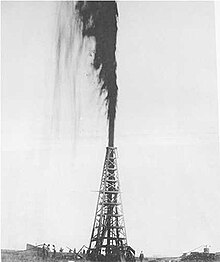
...land based, low tech, vertical wells into a big fat pool of pressurized, lightweight, low sulfur almost-unleaded. The cheap stuff our economy was built on and of course the kind that is going away. Unconventional to me has come to mean anything that is put forth as a substitute for cheap oil.
Here are some descriptions from UNDERSTANDING UNCONVENTIONAL OIL by Deborah Gordon, a good recent paper from Carnegie Endowment,
$this->bbcode_second_pass_quote('', 'T')he International Energy Agency defines conventional oil in its 2011 World Energy Outlook as “a mixture of hydrocarbons that exist in liquid phase under normal surface conditions.” Unconventional oils are defined as those oils obtained by unconventional production techniques because they cannot be recovered through pumping in their natural state from an ordinary production well without being heated or diluted.
The U.S. Department of Energy divides unconventional oil into four types: heavy oil, extra heavy oil, bitumen, and oil shale. Some analysts also include gas-to-liquids (GTL) processes for converting natural gas to oil and coal-to-liquids (CTL) processes for converting coal to oil in the unconventional oil category. These unconventional oil-processing techniques broaden the feedstock of unconventional oils to include unconventional natural gas, such as tight gas, shale gas, coal-bed methane, and methane hydrates.
GTL processing entails converting natural gas and other simple gaseous hydrocarbons into more complex petroleum products. Methane-rich gases are converted into liquid synthetic fuels through direct conversion or through syngas as an intermediate using the Fischer Tropsch or Mobil processes.
CTL processing entails liquefaction of solid coal. This can be done directly by dissolving coal in a solvent at high temperature and pressure and then refining these liquids to yield high-grade fuel characteristics. Indirect liquefaction gasifies the coal into a mixture of hydrogen and carbon monoxide (syngas), condensing this over a catalyst and using the GTL processes to produce liquid petroleum products.


