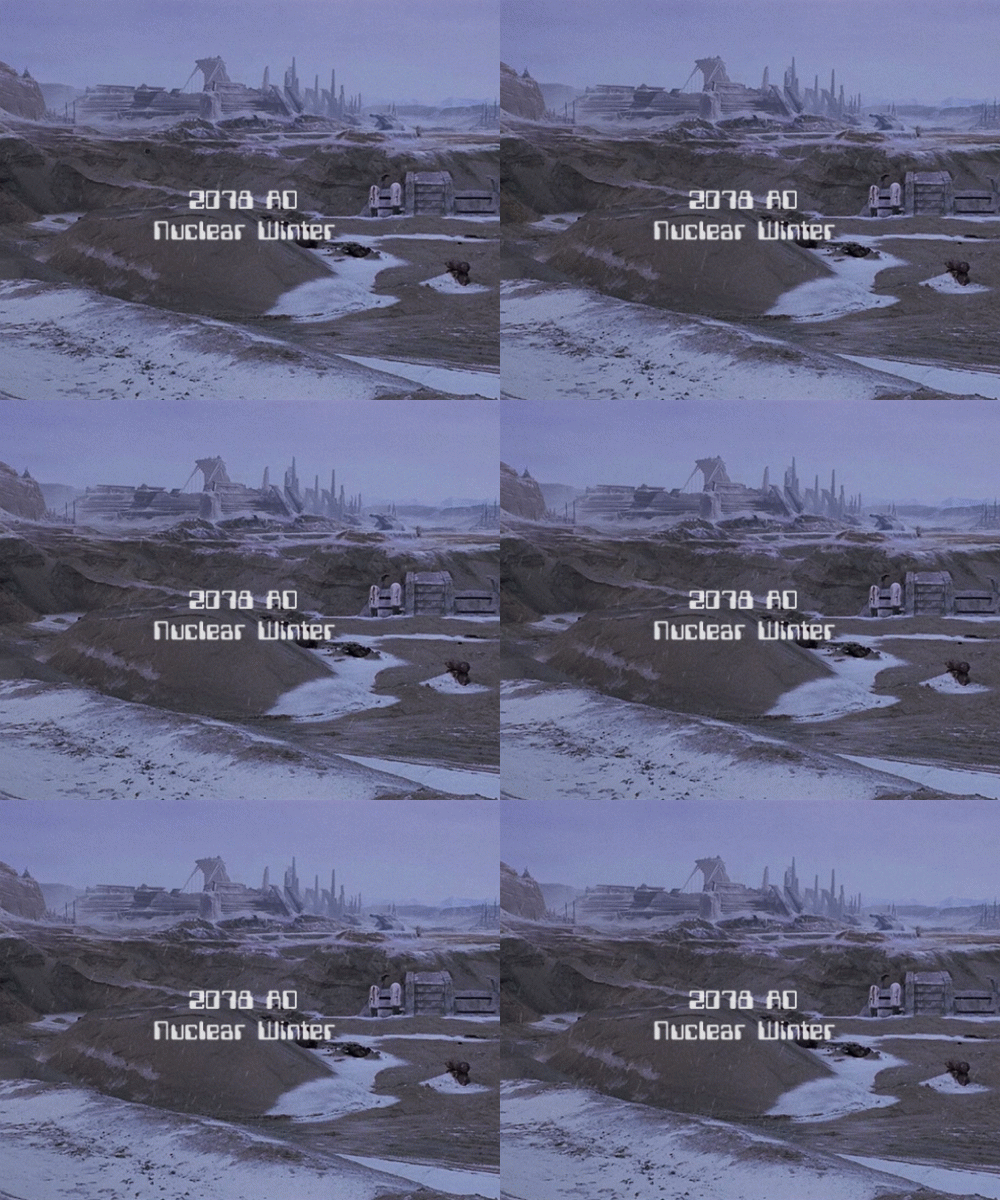
Seriously guys - the Isaac Arthur below is awesome! Here's the teaser headline to give a vibe of the humour:-
$this->bbcode_second_pass_quote('', 'C')ivilisation has collapsed. The only rational way forward is to cover your dune buggy with spikes, craft some leather, S&M armour, and resort to cannibalism. Mohawks are optional.
https://youtu.be/QWmEgu1iP_E


PeakOil is You
A Critical Discussion the Limits to Renewable Energy Pt 3
Re: A Critical Discussion the Limits to Renewable Energy Pt
 by eclipse » Tue 24 May 2022, 21:19:34
Dr James Hansen recommends breeder reactors that convert nuclear 'waste' into 1000 years of clean energy for America, and can charge all our light vehicles and generate "Blue Crude" for heavy vehicles.
https://eclipsenow.wordpress.com/recharge/
https://eclipsenow.wordpress.com/recharge/
-

eclipse - Coal

- Posts: 468
- Joined: Fri 04 Feb 2005, 04:00:00
- Location: Sydney
Re: A Critical Discussion the Limits to Renewable Energy Pt
by theluckycountry » Sat 11 Jun 2022, 16:40:45
$this->bbcode_second_pass_quote('eclipse', 'S')eriously guys - the Isaac Arthur below is awesome! Here's the teaser headline to give a vibe of the humour:-
Yeah, it's a good vid. Blows most of the preconceptions about surviving the apocalypse out of the water. In a hundred years it'll be leather coats and little villages no doubt.
We're 17 years past the peak now and the 3rd World is going hungry and dark. We'll be next, we're well on the way in fact.
- theluckycountry
- Light Sweet Crude

- Posts: 5254
- Joined: Tue 20 Jul 2021, 18:08:48
- Location: Australia
Re: A Critical Discussion the Limits to Renewable Energy Pt
by eclipse » Sat 11 Jun 2022, 19:57:42
If we nuked ourselves today, in 100 years I personally think the population would be back to like 7 or 8 billion, and we'd have modern cities but without the car dependent suburbia (because there wouldn't be the easy oil to drive all that.) There's just so much we could scavenge so fast that we'd bounce back. Fast.
Dr James Hansen recommends breeder reactors that convert nuclear 'waste' into 1000 years of clean energy for America, and can charge all our light vehicles and generate "Blue Crude" for heavy vehicles.
https://eclipsenow.wordpress.com/recharge/
https://eclipsenow.wordpress.com/recharge/
-
eclipse - Coal
- Posts: 468
- Joined: Fri 04 Feb 2005, 04:00:00
- Location: Sydney
Re: A Critical Discussion the Limits to Renewable Energy Pt
by Plantagenet » Sat 11 Jun 2022, 20:32:34
$this->bbcode_second_pass_quote('eclipse', 'I')f we nuked ourselves today, in 100 years I personally think the population would be back to like 7 or 8 billion, and we'd have modern cities but without the car dependent suburbia (because there wouldn't be the easy oil to drive all that.) There's just so much we could scavenge so fast that we'd bounce back. Fast.
Thats certainly a possibility.........recent computer model runs show the global effects of even a small limited nuclear war include a global nuclear winter-----a global climate change that results in crop failure and mass famine affecting the entire planet for a year or two.
But after that it might be possible to farm again, and rebuild cities, and try to get civilization back on course.

Is it safe to come out now?
Sure........thats a positive spin on a terrible global catastrophe. Why not?
Never underestimate the ability of Joe Biden to f#@% things up---Barack Obama
-----------------------------------------------------------
Keep running between the raindrops.
-----------------------------------------------------------
Keep running between the raindrops.
-

Plantagenet - Expert

- Posts: 26765
- Joined: Mon 09 Apr 2007, 03:00:00
- Location: Alaska (its much bigger than Texas).
Re: A Critical Discussion the Limits to Renewable Energy Pt
by eclipse » Sat 11 Jun 2022, 23:50:26
The nuclear winter scientists are retracting their work.
Even a large nuclear war couldn't really touch the likes of Mt Pinotubo.
https://youtu.be/KzpIsjgapAk
Even a large nuclear war couldn't really touch the likes of Mt Pinotubo.
https://youtu.be/KzpIsjgapAk
Dr James Hansen recommends breeder reactors that convert nuclear 'waste' into 1000 years of clean energy for America, and can charge all our light vehicles and generate "Blue Crude" for heavy vehicles.
https://eclipsenow.wordpress.com/recharge/
https://eclipsenow.wordpress.com/recharge/
-
eclipse - Coal
- Posts: 468
- Joined: Fri 04 Feb 2005, 04:00:00
- Location: Sydney
Re: A Critical Discussion the Limits to Renewable Energy Pt
by Plantagenet » Sun 12 Jun 2022, 01:08:44
$this->bbcode_second_pass_quote('eclipse', 'T')he nuclear winter scientists are retracting their work.
No they are not. This is some disagreement about the details of the models between various scientists but the conclusions of the modeling showing that nuclear war would create a nuclear winter isn't seriously doubted. I suggest you read the link I provided with my comment.
$this->bbcode_second_pass_quote('eclipse', 'E')ven a large nuclear war couldn't really touch the likes of Mt Pinotubo.
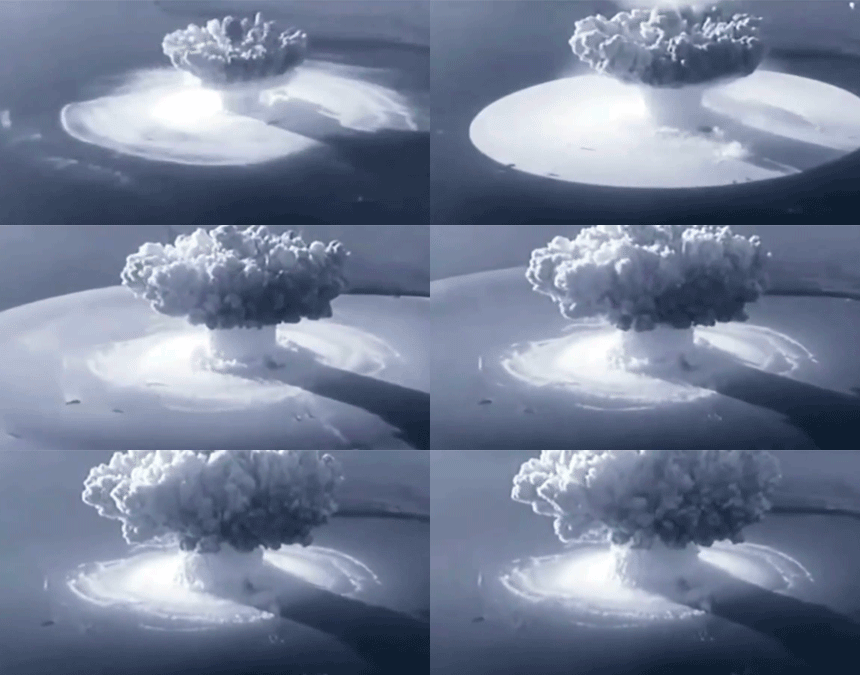
Actually a nuclear war would release far far far more energy then Mt. Pinatubo or other comparable eruptions. For instance, the most recent large well-studied eruption was the huge explosion in Tonga last winter. It is estimated to be equivalent to about a 10 Megaton explosion......thats just a fraction of the energy released by a single 50 megaton hydrogen bomb detonation.....and a nuclear war would ilikely involve more than a single nuclear bomb detonation.....perhaps many more.
Cheers!
Never underestimate the ability of Joe Biden to f#@% things up---Barack Obama
-----------------------------------------------------------
Keep running between the raindrops.
-----------------------------------------------------------
Keep running between the raindrops.
-
Plantagenet - Expert
- Posts: 26765
- Joined: Mon 09 Apr 2007, 03:00:00
- Location: Alaska (its much bigger than Texas).