One way to support your mental health is to give your brain everything it needs to fix itself, and then stimulate your brain with light, electricity, exercise, and dragging your body out to the woods and walking around.
Grass fed meat, wild caught fish, organic vegetables, mineral water, fish oil in abundance, vitamins of all kinds in meaningful doses, lithium orotate.
Take time off work and do nothing.
Use neurofeedback. That helps your brain talk to itself and figure out how to use neuroplasticity to fix itself.
Orthomolecular psychiatry can be a useful tool. It's very open-source and available for free.
Use a sauna to detox your body from all the chemicals we're swimming in. I have a far infrared, but supposedly the three-spectrum ones are the best.



PeakOil is You
Mental health in this brave new world
Re: Mental health in this brave new world
 by Ayoob » Fri 24 Feb 2017, 00:35:21
-

Ayoob - Expert

- Posts: 1520
- Joined: Thu 15 Jul 2004, 03:00:00
Re: Mental health in this brave new world
by onlooker » Sun 26 Mar 2017, 17:32:22
https://www.washingtonpost.com/news/won ... 843b4fd8f2
$this->bbcode_second_pass_quote('', 'S')o the theory comes back to despair. Case and Deaton believe that white Americans may be suffering from a lack of hope. The pain in their bodies might reflect a “spiritual” pain caused by “cumulative distress, and the failure of life to turn out as expected.” If they're right, then the problem will be much harder to solve. Politicians can pass laws to keep opioids out of people's hands or require insurers to cover mental health costs, but they can't turn back the clock to 1955.]
$this->bbcode_second_pass_quote('', 'S')o the theory comes back to despair. Case and Deaton believe that white Americans may be suffering from a lack of hope. The pain in their bodies might reflect a “spiritual” pain caused by “cumulative distress, and the failure of life to turn out as expected.” If they're right, then the problem will be much harder to solve. Politicians can pass laws to keep opioids out of people's hands or require insurers to cover mental health costs, but they can't turn back the clock to 1955.]
And so some truth that those in entitled rich countries especially the US have the farthest to fall and this is part of the effects now being felt
Edit Onlooker please try and be more careful, this is the fifth message today you posted with a broken quote. Take a few extra seconds and make sure you get it right please, it would save me a lot of wasted effort.
Last edited by Tanada on Sun 26 Mar 2017, 22:46:08, edited 1 time in total.
Reason: fixed broken quote
Reason: fixed broken quote
"We are mortal beings doomed to die
-

onlooker - Fission

- Posts: 10957
- Joined: Sun 10 Nov 2013, 13:49:04
- Location: NY, USA
Re: Mental health in this brave new world
by vox_mundi » Thu 09 Aug 2018, 12:02:20
Neuroscientists Get At the Roots of Pessimism
$this->bbcode_second_pass_quote('', '[')b]... Graybiel's laboratory has previously identified a neural circuit that underlies a specific kind of decision-making known as approach-avoidance conflict. These types of decisions, which require weighing options with both positive and negative elements, tend to provoke a great deal of anxiety. Her lab has also shown that chronic stress dramatically affects this kind of decision-making: More stress usually leads animals to choose high-risk, high-payoff options.
In the new study, the researchers wanted to see if they could reproduce an effect that is often seen in people with depression, anxiety, or obsessive-compulsive disorder. These patients tend to engage in ritualistic behaviors designed to combat negative thoughts, and to place more weight on the potential negative outcome of a given situation. This kind of negative thinking, the researchers suspected, could influence approach-avoidance decision-making.
To test this hypothesis, the researchers stimulated the caudate nucleus, a brain region linked to emotional decision-making, with a small electrical current as animals were offered a reward (juice) paired with an unpleasant stimulus (a puff of air to the face). In each trial, the ratio of reward to aversive stimuli was different, and the animals could choose whether to accept or not.
This kind of decision-making requires cost-benefit analysis. If the reward is high enough to balance out the puff of air, the animals will choose to accept it, but when that ratio is too low, they reject it. When the researchers stimulated the caudate nucleus, the cost-benefit calculation became skewed, and the animals began to avoid combinations that they previously would have accepted. This continued even after the stimulation ended, and could also be seen the following day, after which point it gradually disappeared.
This result suggests that the animals began to devalue the reward that they previously wanted, and focused more on the cost of the aversive stimulus. "This state we've mimicked has an overestimation of cost relative to benefit," Graybiel says.

The caudate nucleus has within it regions that are connected with the limbic system, which regulates mood, and it sends input to motor areas of the brain as well as dopamine-producing regions. Graybiel and Amemori believe that the abnormal activity seen in the caudate nucleus in this study could be somehow disrupting dopamine activity.
The researchers also found that brainwave activity in the caudate nucleus was altered when decision-making patterns changed. This change, discovered by Amemori, is in the beta frequency and might serve as a biomarker to monitor whether animals or patients respond to drug treatment, Graybiel says.
"There must be many circuits involved," she says. "But apparently we are so delicately balanced that just throwing the system off a little bit can rapidly change behavior."
$this->bbcode_second_pass_quote('', '[')b]... Graybiel's laboratory has previously identified a neural circuit that underlies a specific kind of decision-making known as approach-avoidance conflict. These types of decisions, which require weighing options with both positive and negative elements, tend to provoke a great deal of anxiety. Her lab has also shown that chronic stress dramatically affects this kind of decision-making: More stress usually leads animals to choose high-risk, high-payoff options.
In the new study, the researchers wanted to see if they could reproduce an effect that is often seen in people with depression, anxiety, or obsessive-compulsive disorder. These patients tend to engage in ritualistic behaviors designed to combat negative thoughts, and to place more weight on the potential negative outcome of a given situation. This kind of negative thinking, the researchers suspected, could influence approach-avoidance decision-making.
To test this hypothesis, the researchers stimulated the caudate nucleus, a brain region linked to emotional decision-making, with a small electrical current as animals were offered a reward (juice) paired with an unpleasant stimulus (a puff of air to the face). In each trial, the ratio of reward to aversive stimuli was different, and the animals could choose whether to accept or not.
This kind of decision-making requires cost-benefit analysis. If the reward is high enough to balance out the puff of air, the animals will choose to accept it, but when that ratio is too low, they reject it. When the researchers stimulated the caudate nucleus, the cost-benefit calculation became skewed, and the animals began to avoid combinations that they previously would have accepted. This continued even after the stimulation ended, and could also be seen the following day, after which point it gradually disappeared.
This result suggests that the animals began to devalue the reward that they previously wanted, and focused more on the cost of the aversive stimulus. "This state we've mimicked has an overestimation of cost relative to benefit," Graybiel says.
The caudate nucleus has within it regions that are connected with the limbic system, which regulates mood, and it sends input to motor areas of the brain as well as dopamine-producing regions. Graybiel and Amemori believe that the abnormal activity seen in the caudate nucleus in this study could be somehow disrupting dopamine activity.
The researchers also found that brainwave activity in the caudate nucleus was altered when decision-making patterns changed. This change, discovered by Amemori, is in the beta frequency and might serve as a biomarker to monitor whether animals or patients respond to drug treatment, Graybiel says.
"There must be many circuits involved," she says. "But apparently we are so delicately balanced that just throwing the system off a little bit can rapidly change behavior."
Pessimism may be redirected ...
Binaural Beats and How they Work?
$this->bbcode_second_pass_quote('', '[')b]Research has shown that brain waves will mimic the observed frequency and alter mood when a person listens to binaural beats.
https://knowingneurons.com/2017/12/21/binaural-beats/
Researchers believe these changes occur because the binaural beats activate specific systems within the brain. An electroencephalogram (EEG) that recorded the electrical brain activity of people listening to binaural beats showed that the effect on a person's body varied according to the frequency pattern used.
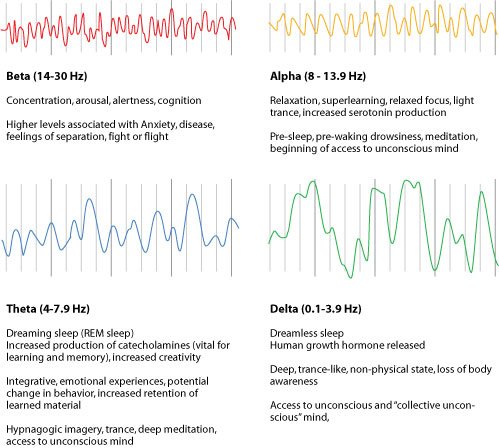
... Beta waves in particular are the dominant brainwave pattern during waking hours; our cognitive function frequency runs between 12 and 38 Hz.
The rule of thumb is the more complex the cognitive process, the higher the frequency. When we are engaged in complex problem solving, it’s the beta wave.
The beta state is also the underlying frequency to states of anxiety and high-level stress, often referred to as the “fight or flight state, a state when the body rapidly produces a lot of energy in order to cope with threats to survival.
This occurs in the higher end of the beta scale, and is the reason why you don’t often find recordings produced using frequencies over 25hz – because extensive exposure to such frequencies can trigger the release of stress hormones and symptoms such as a rapid heart beat and faster breathing.
At the lower end of the beta scale, however, we are able to produce recordings that stimulate the brain and trigger positive benefits such as improved learning ability, increased physical energy and general higher awareness and sharpness.
https://en.wikipedia.org/wiki/Brainwave_entrainment
https://en.wikipedia.org/wiki/Beta_wave
A 2015 review of the available literature summarized several studies on the effect of binaural beats on memory, creativity, attention, anxiety, mood and vigilance. The authors concluded that for most of these applications, findings are either contradictory or only supported by a single study. The only consistent finding was that several studies reported that binaural beat stimulation reduces anxiety levels.
“There are three classes of people: those who see. Those who see when they are shown. Those who do not see.” ― Leonardo da Vinci
Insensible before the wave so soon released by callous fate. Affected most, they understand the least, and understanding, when it comes, invariably arrives too late.
Insensible before the wave so soon released by callous fate. Affected most, they understand the least, and understanding, when it comes, invariably arrives too late.
-

vox_mundi - Intermediate Crude

- Posts: 3939
- Joined: Wed 27 Sep 2006, 03:00:00
Re: Mental health in this brave new world
by onlooker » Thu 09 Aug 2018, 12:51:41
Very interesting Vox. Thanks for posting. I would say though that the bio-chemical responses in these and other situations seem to be ALWAYS dependent on the environmental stimuli. In other words consistent with I believe the latest Science, though our brain has great flexibility and adaptability, we exhibit all (with a healthy brain) similar behavioral/mental patterns in accordance with both the acute and chronic environmental stimuli we are exposed to. In short, it in my opinion is always the environment/upbringing that is the dominant catalyst in behavior rather than our preset evolutionary makeup. So, this preset evolutionary makeup is like the Menu for our range of behavioral responses but the Environment is the final arbiter by inducing a choice from the menu
"We are mortal beings doomed to die
-
onlooker - Fission
- Posts: 10957
- Joined: Sun 10 Nov 2013, 13:49:04
- Location: NY, USA
Re: Mental health in this brave new world
by Newfie » Thu 09 Aug 2018, 13:51:02
Onlooker,
That may be predominantly so, but not always. I’ve watched traits transfer in 4 generations of my exWifes family. Without providing TMI it’s a very real things, at least sometimes.
That may be predominantly so, but not always. I’ve watched traits transfer in 4 generations of my exWifes family. Without providing TMI it’s a very real things, at least sometimes.
-

Newfie - Forum Moderator

- Posts: 18651
- Joined: Thu 15 Nov 2007, 04:00:00
- Location: Between Canada and Carribean
Re: Mental health in this brave new world
by onlooker » Thu 09 Aug 2018, 14:06:27
$this->bbcode_second_pass_quote('Newfie', 'O')nlooker,
That may be predominantly so, but not always. I’ve watched traits transfer in 4 generations of my exWifes family. Without providing TMI it’s a very real things, at least sometimes.
That may be predominantly so, but not always. I’ve watched traits transfer in 4 generations of my exWifes family. Without providing TMI it’s a very real things, at least sometimes.
Newfie, I know you tend to be more on the Nature side of the Nature vs Nurture argument but I am much more on the Nurture not because I done extensive reading on this but it makes much more sense to me especially given our wide range of possible responses and advanced information processing capabilities
"We are mortal beings doomed to die
-
onlooker - Fission
- Posts: 10957
- Joined: Sun 10 Nov 2013, 13:49:04
- Location: NY, USA