Donate Bitcoin

Donate Paypal


PeakOil is You

PeakOil is You

RIP Jay Hanson of Dieoff.

What's on your mind?
General interest discussions, not necessarily related to depletion.

RIP Jay Hanson of Dieoff.

Unread postby Revi » Mon 08 Apr 2019, 15:07:46

Jay Hanson was an amazing person who wrote Dieoff, which was my intro to peak oil. He will be missed!
http://www.dieoff.org/

Please let us know your experiences with his site! I first checked it out at the suggestion of a student of mine.

My mind was blown, but then I went back to consuming fossil fuel.

It nagged at me, and finally I succumbed and started my journey down the rabbit hole of peak oil.
Deep in the mud and slime of things, even there, something sings.
User avatar
Revi
Light Sweet Crude
Light Sweet Crude
 
Posts: 7417
Joined: Mon 25 Apr 2005, 03:00:00
Location: Maine

Re: RIP Jay Hanson of Dieoff.

Unread postby Revi » Tue 09 Apr 2019, 14:08:14

He will be remembered, by me at least...
Deep in the mud and slime of things, even there, something sings.
User avatar
Revi
Light Sweet Crude
Light Sweet Crude
 
Posts: 7417
Joined: Mon 25 Apr 2005, 03:00:00
Location: Maine

Re: RIP Jay Hanson of Dieoff.

Unread postby Revi » Wed 10 Apr 2019, 10:37:38

Does nobody on here remember him? Or is this just a place for trollbots?
Deep in the mud and slime of things, even there, something sings.
User avatar
Revi
Light Sweet Crude
Light Sweet Crude
 
Posts: 7417
Joined: Mon 25 Apr 2005, 03:00:00
Location: Maine

Re: RIP Jay Hanson of Dieoff.

Unread postby jedrider » Wed 10 Apr 2019, 13:19:44

"The destruction of the natural world is not the result of global capitalism, industrialisation, “Western civilisation” or any flaw in human institutions. It is a consequence of the evolutionary success of an exceptionally rapacious primate. Throughout all of history and prehistory, human advance has coincided with ecological devastation. — John Gray, STRAW DOGS"

As the serpent eats it's own tail. It was a squandering of resources certainly, just so that I could be typing this message on this keyboard. :-D
User avatar
jedrider
Intermediate Crude
Intermediate Crude
 
Posts: 3107
Joined: Thu 28 May 2009, 10:10:44

Re: RIP Jay Hanson of Dieoff.

Unread postby Revi » Thu 11 Apr 2019, 08:30:47

$this->bbcode_second_pass_quote('jedrider', '&')quot;The destruction of the natural world is not the result of global capitalism, industrialisation, “Western civilisation” or any flaw in human institutions. It is a consequence of the evolutionary success of an exceptionally rapacious primate. Throughout all of history and prehistory, human advance has coincided with ecological devastation. — John Gray, STRAW DOGS"

As the serpent eats it's own tail. It was a squandering of resources certainly, just so that I could be typing this message on this keyboard. :-D


Yes. We are a dissipative creature. We are taking out all of the resources, burning and scattering them. Like any heat engine we'll stop moving when the fuel runs out. It's great to re-read some of his writings and see that he was right. It would be nice to live in the world that we were told would last forever, but we don't. Scary times ahead!

http://dieoff.com/synopsis.htm
Deep in the mud and slime of things, even there, something sings.
User avatar
Revi
Light Sweet Crude
Light Sweet Crude
 
Posts: 7417
Joined: Mon 25 Apr 2005, 03:00:00
Location: Maine

Re: RIP Jay Hanson of Dieoff.

Unread postby Revi » Thu 11 Apr 2019, 08:47:49

Deep in the mud and slime of things, even there, something sings.
User avatar
Revi
Light Sweet Crude
Light Sweet Crude
 
Posts: 7417
Joined: Mon 25 Apr 2005, 03:00:00
Location: Maine

Re: RIP Jay Hanson of Dieoff.

Unread postby Revi » Thu 11 Apr 2019, 09:31:35

Here's a short synopsis of his overall thesis on peak oil:
https://www.youtube.com/watch?v=J621FuN5zQ0
Deep in the mud and slime of things, even there, something sings.
User avatar
Revi
Light Sweet Crude
Light Sweet Crude
 
Posts: 7417
Joined: Mon 25 Apr 2005, 03:00:00
Location: Maine

Re: RIP Jay Hanson of Dieoff.

Unread postby EnergyUnlimited » Tue 24 Sep 2019, 16:29:40

$this->bbcode_second_pass_quote('Revi', 'J')ay Hanson was an amazing person who wrote Dieoff, which was my intro to peak oil. He will be missed!
http://www.dieoff.org/

Please let us know your experiences with his site!

Go and check this site *now*.
User avatar
EnergyUnlimited
Light Sweet Crude
Light Sweet Crude
 
Posts: 7537
Joined: Mon 15 May 2006, 03:00:00

Re: RIP Jay Hanson of Dieoff.

Unread postby Newfie » Tue 24 Sep 2019, 16:32:25

I don’t follow the gurus.

So what I’m taking from that link is someone emptied all content?
User avatar
Newfie
Forum Moderator
Forum Moderator
 
Posts: 18651
Joined: Thu 15 Nov 2007, 04:00:00
Location: Between Canada and Carribean

Re: RIP Jay Hanson of Dieoff.

Unread postby EnergyUnlimited » Tue 24 Sep 2019, 16:37:48

$this->bbcode_second_pass_quote('Newfie', 'I') don’t follow the gurus.

So what I’m taking from that link is someone emptied all content?

Now they are advertising steroids there.
User avatar
EnergyUnlimited
Light Sweet Crude
Light Sweet Crude
 
Posts: 7537
Joined: Mon 15 May 2006, 03:00:00

Re: RIP Jay Hanson of Dieoff.

Unread postby Pops » Tue 24 Sep 2019, 17:14:10

I had not seen this. Hanson was my guru for a long while before PO.com. I think I picked him up on the old TB2k or maybe Frugal Squirrel survivalist pages in the '90s. He was big into Limits to Growth. His site was where I first saw Richard Duncan's Olduvai theory, the reason I plotted energy per capita for years on this site.

I may have downloaded his entire archive at one point, it was a big PDF. Here are a couple of places to find dieoff the PDF download link is dead now.

Here is the first crawl of dieoff on the wayback machine

Here is his personal post dieoff page

Ah! Here is dieoff.COM
The legitimate object of government, is to do for a community of people, whatever they need to have done, but can not do, at all, or can not, so well do, for themselves -- in their separate, and individual capacities.
-- Abraham Lincoln, Fragment on Government (July 1, 1854)
User avatar
Pops
Elite
Elite
 
Posts: 19746
Joined: Sat 03 Apr 2004, 04:00:00
Location: QuikSac for a 6-Pac

Re: RIP Jay Hanson of Dieoff.

Unread postby Revi » Thu 26 Sep 2019, 13:57:18

He was very influential to a lot of us. Once we went down the rabbit hole things were never the same. I realize that not one person in a thousand knows how the world really works. It's good to be enlightened, but sometimes I wish I didn't know...
Deep in the mud and slime of things, even there, something sings.
User avatar
Revi
Light Sweet Crude
Light Sweet Crude
 
Posts: 7417
Joined: Mon 25 Apr 2005, 03:00:00
Location: Maine

Re: RIP Jay Hanson of Dieoff.

Unread postby theluckycountry » Fri 21 Jun 2024, 19:15:21

$this->bbcode_second_pass_quote('Revi', 'H')e was very influential to a lot of us. Once we went down the rabbit hole things were never the same. I realize that not one person in a thousand knows how the world really works.


Ahhh Revi, you were before my time, and now you're gone, like ships passing in the night. I think we might have had some good conversations if we had connected. I remember clearly when I discovered dieoff.org, I was living in a flood zone, oblivious to that risk, I owned two V8's and my biggest concern then was choosing a new bicycle to replace the one I'd worn out and what pizza I was going to have for dinner. That day I was surfing the web, for something, and accidentally landed on dieoff.org. I read, and this is what I read.

$this->bbcode_second_pass_quote('', ' ') "If a path to the better there be, it begins with a full look at the worst."
-- Thomas Hardy

Petroleum geologists have known for 50 years that global oil production would "peak" and begin its inevitable decline within a decade of the year 2000. Moreover, no renewable energy systems have the potential to generate more than a fraction of the power now being generated by fossil fuels.

In short, the transition to declining energy availability signals a transition in civilization as we know it.

The human species may be seen as having evolved in the service of entropy, and it cannot be expected to outlast the dense accumulations of energy that have helped define its niche. Human beings like to believe they are in control of their destiny, but when the history of life on Earth is seen in perspective, the evolution of Homo sapiens is merely a transient episode that acts to redress the planet's energy balance.
--David Price

Energy has always been the basis of cultural complexity and it always will be. The past clarifies potential paths to the future. One often-discussed path is cultural and economic simplicity and lower energy costs. This could come about through the "crash" that many fear -- a genuine collapse over a period of one or two generations, with much violence, starvation, and loss of population. The alternative is the "soft landing" that many people hope for - a voluntary change to solar energy and green fuels, energy-conserving technologies, and less overall consumption. This is a utopian alternative that, as suggested above, will come about only if severe, prolonged hardship in industrial nations makes it attractive, and if economic growth and consumerism can be removed from the realm of ideology. --Joseph A. Tainter


I will post more of these pages of Jay's as the days pass, it's really the only thing worth reading on this site now, such as it is, full of the bones of the broken dreams that many have sought as a 'fix' for the inevitability of Hanson's and others predictions. There never was a solution to oil depletion that would save us from dieoff. Not solar or wind or fusion or EV cars. It's quite apt that the first issue dealt with by Hanson on his main page was never to be solved by these even if they had have lived up to popular expectations, namely: FOOD, LAND, WATER AND POPULATION. But more on that later.

I read the pages, I lost track of time, what I was reading was so far outside of common accepted wisdom I was gobsmacked. It helped me that I had already disconnected from the TV set, the voting circus and had a deep distrust of all things government and corporate, Hanson's pages simply explained to me why that was so. My subconscious had long told me that the world I lived in was a collective confidence game full of hucksters and swindlers at every level, and because of that the truth about our civilizations had been hidden under a mire of corporate and governmental manipulation. We weren't citizens or even humans to the people controlling these entities. We were simply a resource like coal in the ground, like cattle on a hillside. You don't tell cattle you're about to butcher them, you don't explain to coal that its purpose is to be thrown on a fire to power homes and factories.

Similarly our function was to work our entire lives for the lowest wage negotiable so others need not work, but live in the lap of luxury non the less. This is common knowledge in and of itself and so is much of the scamming that occurs in our societies. But what is not common knowledge is the extent of the matrix of lies created to bury the truth that Hanson so conclusively pointed out. If the general population knew the truth there is no way in hell they would waste their precious resources, money basically, on all the crap that actually enriches these people at the top. They would instead invest in real things for the future, and only when they and their children were secure would they perhaps partake of overseas holidays and expensive new cars. Instead they fill their homes and lives with consumables with no though of the future. "My private pension will be there when I want to retire." Yeah, good luck with that promise.

Yesterday I heard a couple bragging about a planned trip to Japan. They are not debt free, they run a successful small business but their home and both expensive cars belong in part to the bank. Why Japan? Because that's the current destination de jure, Everyone talks about a holiday there now, at lest the wannabe jet-set. A friend and his wife just came back from there, two decades ago it was India, one decade ago it was a cruise up the coast of north west America and a stop at Yellowstone. These people just follow each other like sheep consuming a field of grass, they believe that the future will be much like the past and if there is a problem then technology will fix it. They are like sheep that can't see beyond the paddock they are grazing in. At least they believe that while they still have a decent income.
We're 17 years past the peak now and the 3rd World is going hungry and dark. We'll be next, we're well on the way in fact.
theluckycountry
Light Sweet Crude
Light Sweet Crude
 
Posts: 5254
Joined: Tue 20 Jul 2021, 18:08:48
Location: Australia
Top

Re: RIP Jay Hanson of Dieoff.

Unread postby theluckycountry » Fri 21 Jun 2024, 19:44:53

$this->bbcode_second_pass_quote('', '
')ECONOMIC THEORY

The members of the American economics profession, as Arnold contended, performed a vital practical role in maintaining this unique system of corporate socialism American style. It was their role to prevent the American public from achieving a correct understanding of the actual workings of the American economic system. Economists instead were assigned the task to dispense priestly blessings that would allow business to operate independent of damaging political manipulation.

They accomplished this task by means of their message of 'laissez faire religion, based on a conception of a society composed of competing individuals.' However false as a description of the actual U.S. economy, this vision in the mind of the American public was in practice 'transferred automatically to industrial organizations with nation-wide power and dictatorial forms of government.' Even though the arguments of economists were misleading and largely fictional, the practical -- and beneficial -- result of their deception was to throw a 'mantle of protection ... over corporate government' from various forms of outside interference.

Admittedly, as the economic 'symbolism got farther and farther from reality, it required more and more ceremony to keep it up.' But as long as this arrangement worked and there could be maintained 'the little pictures in the back of the head of the ordinary man,' the effect was salutary -- 'the great [corporate] organization was secure in its freedom and independence.' It was this very freedom and independence of business professionals to pursue the correct scientific answer -- the efficient answer -- on which the economic progress of the United States depended. -- Robert H. Nelson in http://dieoff.com/page235.htm


Lie: Shale oil has extended the peak of oil.
Proof: Standards of living for American's have continued to decline all throughout the resurgence in production.
Rational: If you use two million barrels of oil to mine and transport mountains of sand, produce untold tankers full of chemicals, drill endless holes across the countryside sleeving them all with steel pipe, then truck out two million barrels of oil to a distant refinery you are left with four million barrels of oil recorded as the total for that production period. This is basically what's happening give or take wages and profits and bank interest on loans etc.

Economics and GDP manipulation is very good at hiding this reality but what cannot be hidden is the obvious increase in poverty across a nation.
We're 17 years past the peak now and the 3rd World is going hungry and dark. We'll be next, we're well on the way in fact.
theluckycountry
Light Sweet Crude
Light Sweet Crude
 
Posts: 5254
Joined: Tue 20 Jul 2021, 18:08:48
Location: Australia
Top

Re: RIP Jay Hanson of Dieoff.

Unread postby theluckycountry » Sat 22 Jun 2024, 18:21:19

The following excerpt from a paper by Hanson (it's quite long) explains why it's futile to vote in elections because the course of a nation's progress, it's policies and spending etc, have already been decided. The last thing those in power will permit is a group of average people interfering with their plans. Of course this goes counter to all we have been told about the electoral process, but then, who instructed us about how that process works? The politicians themselves of course.

$this->bbcode_second_pass_quote('', '
') "The Foulest of Them All"
By Jay Hanson,
First Quarter 1999 Issue

The human species may be seen as having evolved in the service of entropy, and it cannot be expected to outlast the dense accumulations of energy that have helped define its niche. Human beings like to believe they are in control of their destiny, but when the history of life on Earth is seen in perspective, the evolution of Homo sapiens is merely a transient episode that acts to redress the planet's energy balance.
— David Price [1]

Energy has always been the basis of cultural complexity and it always will be. the past clarifies potential paths to the future. One often-discussed path is cultural and economic simplicity and lower energy costs. This could come about through the "crash" that many fear — a genuine collapse over a period of one or two generations, with much violence, starvation, and loss of population. The alternative is the "soft landing" that many people hope for – a voluntary change to solar energy and green fuels, energy-conserving technologies, and less overall consumption. This is a utopian alternative that, as suggested above, will come about only if severe, prolonged hardship in industrial nations makes it attractive, and if economic growth and consumerism can be removed from the realm of ideology.
— Joseph A. Tainter [2]

When I use "politics" or "political" in this paper, I simply mean "one coercing another" in the broadest sense. To "coerce" is to compel one to act in a certain way — either by reward or punishment.

In 1997, the Chinese lobbyist Johnny Chung observed: "I see the White House is like a subway — you have to put in coins to open the gates." [3] Millions of Americans have made the same observation: American politics is based on money — one dollar, one vote. Why is American politics based on money? The surprising answer is because the Founding Fathers intended it that way.

We have all heard economists recite endless economic arguments for laissez-faire ("let things alone") policy — which are essentially arguments for "money-based politics". But in this paper, I will point out the hidden political arguments for money-based politics, highlight capitalism's inherent "limits to growth", anticipate global social collapse within the first few decades of the coming century, and propose a new society to mitigate the coming nightmare.

SOCIETY OF AVARICE
In numerous treatises on the passions that appeared in the seventeenth century, no change whatever can be found in the assessment of avarice as the "foulest of them all" or in its position as the deadliest Deadly Sin that it had come to occupy toward the end of the Middle Ages.
— Albert O. Hirschman [4]

As all those who write about civic matters show and as all history proves by a multitude of examples, whoever organizes a state and establishes its laws must assume that all men are wicked and will act wickedly whenever they have the chance to do so. He must also assume that whenever their wicknedess remains hidden for a time there is a hidden reason for it which remains unknown for want of occasion to make it manifest. But time, which is called the father of all truth. uncovers it.
— Niccolò Machiavelli, Discourses

Niccolò Machiavelli (1469-1527) may be considered the founder of modern money-based politics. Machiavelli wrote The Prince as Italy was emerging from a state of rampant anarchy. His masterpiece was designed as a guidebook for a single, forceful leader who would eventually unify the country.

Machiavelli called for rational "interest" (calculation) [5] instead of irrational "passion" (e.g., love, hate or honesty) in matters involving public policy:

Nor did a prince ever lack legitimate reasons by which to color his bad faith. One could cite a host of modern examples and list the many peace treaties, the many promises that were made null and void by princes who broke faith, with the advantage going to the one who best knew how to play the fox. But one must know how to mask this nature skillfully and be a great dissembler. Men are so simple and so much inclined to obey immediate needs that a deceiver will never lack victims for his deceptions. [The Prince]

It's not surprising that practical men are still driven to his ideas during social crisis because Machiavelli believed "the ends justify the means":

A corrupt and disorderly multitude can be spoken to by some worthy person and can easily be brought around to the right way, but a bad prince can not be spoken to by anyone, and the only remedy for his case is cold steel. [Discourses]

A feeling arose in the Renaissance — and crystallized by the seventeenth century — that moralizing and preaching religious doctrine could no longer be trusted to restrain the destructive passions of men. [6] A new means of control had to be found.

The most obvious solution was repression and coercion. Repression had been the choice of St. Augustine as early as the fifth century and of Calvin in the sixteenth century. But the repressive solution was beset by a seemingly insurmountable problem: quis custodiet ipsos custodes (who will guard the guards)? Suppose the sovereign turned out to be excessively lenient, cruel, or had some other failing? What then?

Bernard Mandeville (1670?-1733) rejected repression and suggested that a society based on the deadliest of the seven deadly sins [7] — "avarice" — would create common Machiavellian interests and suppress irrational passions. Mandeville's ideal society was one where the unwitting cooperation of individuals, each working for his or her own interest would result in the greatest benefit to society at large. Mandeville anticipated laissez-faire economic theory, which promoted self-interest, competition, and little government interference in the workings of the economy.

PSEUDO DEMOCRACY
"Democracy" is defined as "government by the people". But our Founding Fathers never intended for "the people" to govern themselves — governance was reserved for the moneyed class. Two political theorists had great influence on the framers and creation of the Constitution. John Locke (1632-1704) made the greatest impact through his Second Treatise of Government. Locke pioneered the ideas of natural rights and private property, as well as the concept of "separation of powers" to keep any one segment of government from gaining too much power. The French writer Baron de Montesquieu (1689-1755), the second major intellectual influence on the Constitution, further developed the concept of a separation of powers and taught that "invisible wealth which could be sent everywhere" would force governments to govern with greater "wisdom". In other words, here we find the political argument for free trade:

and through this means commerce could elude violence, and maintain itself everywhere; for the richest trader had only invisible wealth which could be sent everywhere without leaving any trace In this manner we owe.., to the avarice of rulers the establishment of a contrivance which somehow lifts commerce right out of their grip.

Since that time, the rulers have been compelled to govern with greater wisdom than they themselves might have intended; for, owing to these events, the great and sudden arbitrary actions of the sovereign (les grands coups d'autorité) have been proven to be ineffective and … only good government brings prosperity [to the prince]. [8]

Adam Smith (1723-1790), like so many others in his time, believed that free trade and commerce led to good government and peace. In his Wealth of Nations, Smith established powerful economic arguments for laissez-faire, but the attentive reader can find the hidden political arguments here as well:

commerce and manufactures gradually introduced order and good government, and with them, the liberty and security of individuals, among the inhabitants of the country, who had before lived in almost in a continual state of war with their neighbors, and of servile dependency upon their superiors. [9]

James Madison (1751-1836) — "the father of the U.S. Constitution" [10] — was born into a community of self-made Lockean Virginians to whom property rights were both natural and civil. Madison studied Smith carefully, hoping to discover "the true principles of political economy [which] are everywhere needed more so in our young country than in some old ones." [11]

Madison's primary political concern centered on the maintenance of social stability by the political and social control of competing factions; control by government itself was a secondary consideration. The framers crafted an elaborate political system:

Where "first object of government" (highest priority) was "the faculties" of acquiring property. [12]
Where the struggle of classes and passions (e.g., religious conflict) was replaced with the struggle of interests in the economic sphere.
Where the political system was extremely resistant to change.
Where political power was reserved for a white male minority while projecting the illusion of self-government to the majority. Madison scholar Richard K. Matthews explains:

By consciously denying virtually all but a handful of citizens any role in a governmental structure that, by design, was to be run by an elite of superior ability (who nonetheless would have to check and balance each other), Madison left [economic struggle] as the prime avenue for humanity to search for meaning. [13]

Madison even went so far as to boast that "the true distinction" between ancient regimes and the proposed experiment in government "lies in the total exclusion of the people in their collective capacity." [14] Matthews continues:

These passages all too neatly anticipate Madison's conception of citizenship: do not give "the people" any power when they are assembled; allow some of the white males, acting in isolation, the fleeting participation of voting for their representatives and restrict the right for as long as politically possible to one branch of the legislature. Beyond this minimalist approach to politics, ask little else of the people, except under extraordinary conditions. [15]

That's the theory, here is how it works:

In 1884, one of the wealthiest men of his time, Henry B. Payne, wanted to become the next United States senator from Ohio. Payne's son Oliver, the treasurer of Standard Oil, did his best to help. Just before the election for Ohio's seat, son Oliver "sat at a desk in a Columbus hotel with a stack of bills in front of him, paying for the votes of the state legislators," who then elected U.S. senators. [16]

ELABORATE DECOYS
Americans have never had democracy, and politicians are nothing but elaborate decoys. Like the great Wizard of Oz pulling the levers behind the curtain, secrecy and anonymity are critical to maintaining power. No matter how hard Joe Six-pack tries to influence the elected government, the government behind the curtain — the moneyed class — will always pull the levers of power: one dollar, one vote.

Our overall social structure is something like this (this is not a "model", it's a "heuristic"):

The rich minority determine the "logic of profit":
America's laws and trade agreements regulate the overall workings of society at a highly aggregate level. (The rich rule the poor by virtue of the First and Fifth Amendments.)

Large corporations:
Large corporations are autonomous technical structures (machines) that follow the "logic of profit" inherent in their design. Those that don't, are cancelled by bankruptcy.

Media:
Corporations hire media to program the "consumers".

Consumers:
Consumers do as they have been programmed: consume their own life-support system and elect the "traitors".

Elected traitors:
Traitors do what they were elected to do: sell the commons to corporations for personal gain. Those who don't, are cancelled by campaign advertising.

As we have seen, America's government was designed to be corrupt because the moneyed class was thought to be more rational (calculating) than either elected officials or the general public! Thus, the "Society of Avarice" was conceived as a means to keep governments and men "self-interested" (rational). Capital would flow towards governments and men who embraced Machiavellian "self-interest" (rational, calculating) and away from those who were "passionate" (irrational).

Why didn't the Founding Fathers choose democracy? Because they knew it was inherently unstable. Modern evolutionary scientists can now explain why democracy is unstable: Natural selection and genetic development created a human tendency for dominance, submission, hierarchy, and obedience, as opposed to equality and democracy. As one political scientist recently put it:

[ Evolutionary scientists ] Somit and Peterson provide an informative account of the evolutionary basis for our historical (and current) opposition to democracy. For many, this will be an unwelcome message — like being told that one's fly is unzipped. But after a brief bout of anger, we tend to thank the messenger for sparing us further embarrassment. [17]


As confronting as these concepts are they fully explain why healthcare in the United states is the most expensive in the world and why nearly everyone has faith in modern medicine. Even as they grow sicker and sicker by the year (pharmaceutical profits). It explains why there are endless wars and all the people are typically behind these wars, at least at the outset (Military Industrial profits). It explains why the typical meal is composed of processed muck devoid of nutrients, loaded with sugars (Industrial farming and food preparation profits... (Cargill for example, the huge privately owned global octopus that states it's aims thus: Cargill is a family company providing food, ingredients, agricultural solutions and industrial products to nourish the world. ).

You can explain nearly any other gripe the average person has, like the high home and land prices (bank profits) by looking at our political system in this light. It's obvious that an elite "monied class" as Hanson puts it is in control of government. How else could these oppressive conditions exist otherwise?
We're 17 years past the peak now and the 3rd World is going hungry and dark. We'll be next, we're well on the way in fact.
theluckycountry
Light Sweet Crude
Light Sweet Crude
 
Posts: 5254
Joined: Tue 20 Jul 2021, 18:08:48
Location: Australia
Top

Re: RIP Jay Hanson of Dieoff.

Unread postby Plantagenet » Sun 23 Jun 2024, 15:38:14

$this->bbcode_second_pass_quote('JayHanson', '
')Why didn't the Founding Fathers choose democracy? Because they knew it was inherently unstable.


Yes, the Founding Fathers of the US intentionally modeled the USA on the Roman Republic rather then the older Greek democracies of Athens etc because they knew from history that pure democracies are inherently unstable.

Unfortunately many modern Americans think the USA actually is a democracy. They are mostly ignorant of the original premise that the USA was established as a Democratic REPUBLIC

Image
OH....so the USA will be a REPUBLIC! Oh, thats awesome!!!!!

Cheers!
Never underestimate the ability of Joe Biden to f#@% things up---Barack Obama
-----------------------------------------------------------
Keep running between the raindrops.
User avatar
Plantagenet
Expert
Expert
 
Posts: 26765
Joined: Mon 09 Apr 2007, 03:00:00
Location: Alaska (its much bigger than Texas).
Top

Re: RIP Jay Hanson of Dieoff.

Unread postby ralfy » Sun 23 Jun 2024, 22:19:35

$this->bbcode_second_pass_quote('', 'T')he executive of the modern state is nothing but a committee for managing the common affairs of the whole bourgeoisie.
User avatar
ralfy
Light Sweet Crude
Light Sweet Crude
 
Posts: 5651
Joined: Sat 28 Mar 2009, 11:36:38
Location: The Wasteland
Top

Re: RIP Jay Hanson of Dieoff.

Unread postby theluckycountry » Mon 24 Jun 2024, 09:21:14

A MEANS OF CONTROL
The Last Scheduled BRAIN FOOD
by Jay Hanson, 01/01/2000

Funny to think that while we were all partying in the new millennium, Hanson was sitting at his keyboard publishing these dire facts about our civilization. In the months leading up to it was of course the Y2K swindle, where billions of dollars of old computers were sold at the old inflated prices, only to be followed by 50% and 60% drops in the early 00's. All such products of course go through these drops as economies of scale and competition comes into play. But this was the first time that I can ever recall that the people were all "forced" to update with the old, just before the drop in price.

The similarities between the Y2K scare and the Covid Vaxx scare campaigns are quite stark. Generate a perceived crisis and then step in with a logical solution, making Billions out of it.

$this->bbcode_second_pass_quote('', '[')b]THE UTOPIAN AGENDA HAS FAILED -- AGAIN!

The prerequisite for a global self-regulating market system is peace, which in turn requires ever increasing standards-of-living:

"War analyst Stanislav Andreski concluded that the trigger for most wars is hunger, or even 'a mere drop from the customary standard of living.' Anthropologists Carol and Melvin Ember spent six years studying war in the late 1980s among 186 preindustrial societies. They focused on precontact times in hopes of collecting the 'cleanest, least distorted' data. Andreski, it seems, was right. War's most common cause, the Embers found, was fear of deprivation. The victors in the wars they studied almost always took territory, food, and/or other critical resources from their enemies. Moreover, unpredictable disasters-droughts, blights, floods, and freezes -- which led to severe hardships, spurred more wars than did chronic shortages.

"This also holds true among modern nations. In 1993, political scientists Thomas E Homer-Dixon, Jeffrey H. Boutwell, and George W. Rathjens examined the roots of recent global conflicts and concluded, 'There are significant causal links between scarcities of renewable resources and violence.'

"In short, many wars seem to be a mass, communal robbery of another social group's life-support resources." [[31]]

Ever increasing standards-of-living require ever increasing per-capita energy use: "If one considers the last one hundred years of the U.S. experience, fuel use and economic output are highly correlated."

Global energy-use per capita increased during the sub-interval from 1850 to 1909 by a strong 3.88%. Then -- despite World War I, the Great Depression, and World War II -- energy-use per capita from 1909 to 1945 still managed to increase by 0.92%. Next came the exuberant post-war years from 1945 to 1973 when energy-use per capita grew by a remarkable 3.51%. Then strong growth ended abruptly in 1973. Thereafter, world energy-use per capita peaked in 1978 and then went into an irregular decline, averaging 0.36 % per year from the peak in 1978 through 1997.

Although global energy use per capita has been declining at an average of 0.36% per year since 1978, energy use in the US has increased an average of 0.7 % per year since 1983: The near-term "peak" in global oil production will make it physically impossible -- thus economically impossible -- for the so-called "developing" countries to ever "develop":

What becomes of the surplus of human life? It is either, 1st. destroyed by infanticide, as among the Chinese and Lacedemonians; or 2d. it is stifled or starved, as among other nations whose population is commensurate to its food; or 3d. it is consumed by wars and endemic diseases; or 4th. it overflows, by emigration, to places where a surplus of food is attainable.
-- James Madison, 1791

Worldwide, more than 10 million hectares of agricultural land are abandoned annually because of serious soil degradation. During the last 40 years, about 30 percent of total world arable land was abandoned because it was no longer productive. About half of the current arable land now in cultivation will be unsuitable for food production by the middle of the twenty-first century. [[34]]

Within the first decade of the 21'st century, industrial activity will rise high enough for it to seriously degrade land fertility. This will occur because of contamination by heavy metals and persistent chemicals, climate change, salinization, topsoil loss, falling water tables, and increased levels of ultraviolet radiation from a diminished ozone layer.

Global oil production will peak soon and the spike in oil prices will quickly exacerbate other major problems facing industrial agriculture. Food grains produced with modern, high-yield methods (including packaging and delivery) now contain between four and ten calories of fossil fuel for every calorie of solar energy. It has been estimated that about four percent of the nation's energy budget is used to grow food, while about 10 to 13 percent is needed to put it on our plates. In other words, a staggering total of 17 percent of America's energy budget is consumed by agriculture! [[35]]

By 2040, we would need to triple the global food supply in order to meet the basic food needs of the eleven billion people who are expected to be alive. But doing so would require a 1,000 percent increase in the total energy expended in food production. But the depletion of oil will make it physically impossible -- thus economically impossible -- to provide enough net energy to agriculture: "A recent review of the future prospects of all alternatives has been published. The summary conclusion reached is that there is no known complete substitute for petroleum in its many and varied uses."

Global food production will drop to a fraction of today’s numbers: "If the fertilizers, partial irrigation [in part provided by oil energy], and pesticides were withdrawn, corn yields, for example, would drop from 130 bushels per acre to about 30 bushels." Obviously, death certificates have already been issued for billions of unsuspecting people.

The dependence of industrial agriculture on fossil fuels, the declining fertility of the land, and the positive feedbacks imposed by declining net energy will force the economy to divert much more investment into the agriculture and energy sectors as part of a desperate attempt to maintain agricultural output. Government budgets must also decline in real terms as greater and greater fractions of the economy are diverted into the resource sectors.

As resource quality and land fertility continue to fall, society will be forced to allocate more and more capital to the agriculture and resource sectors, otherwise the scarcity of food, materials, and fuels would restrict production still more -- it's circular, there is no way to avoid the positive feedback. Ultimately, industrial capacity will decline rapidly taking with it the service and agricultural sectors, which depend upon industrial inputs.

Constrained by the laws of thermodynamics, the availability of life-supporting resources will go into a permanent, steep decline.

We're 17 years past the peak now and the 3rd World is going hungry and dark. We'll be next, we're well on the way in fact.
theluckycountry
Light Sweet Crude
Light Sweet Crude
 
Posts: 5254
Joined: Tue 20 Jul 2021, 18:08:48
Location: Australia
Top

Re: RIP Jay Hanson of Dieoff.

Unread postby jato0072 » Mon 24 Jun 2024, 10:31:35

Reality Report; Jason Bradford interviews Jay Hanson.

Link to webpage circa 2008

MP3 file download
"On a long enough time line, the survival rate for everyone drops to zero."
User avatar
jato0072
Lignite
Lignite
 
Posts: 335
Joined: Wed 04 Aug 2021, 16:47:30
Location: NV

Re: RIP Jay Hanson of Dieoff.

Unread postby theluckycountry » Mon 24 Jun 2024, 19:09:36

$this->bbcode_second_pass_quote('jato0072', 'R')eality Report; Jason Bradford interviews Jay Hanson.

Link to webpage circa 2008

MP3 file download


I went to download it to my Podcasts folder Jato and it's already there. I don't think there are many pods of Hanson's out there, he was active in an era where people still read avidly, then people insisted on pods, now they want vids. No one reads now and what they write is more like a phone txt. Unfortunate for them because writing, even on a keyboard helps your mental processes. Reading does likewise of course.

I like how he explains the reason why he called the site dieoff, when you think about it that's the main issue, and the reason he called it thus. All the evidence he compiles only points in one direction and there are no exit ramps for the average man. The though of a "Dieoff" of humanity is not something we can get our head around, or want to get our head around, but it's the logical outcome.

From the webpage
$this->bbcode_second_pass_quote('', 'F')or you old-timers this should be a memory lane treat, and for you young’uns this will be an introduction to the one who started it all: Jay Hanson.

Jay Hanson hosted the first online discussion bulletin board for overshoot issues like peak oil and climate change. He devoted a large portion of his life to researching the genetic human behaviors that have caused our severe state of overshoot. Here is a nice overview of his work by Kurt Cobb.

As an aside, a few years ago I tried to introduce Hanson to Varki’s Mind Over Reality Transition (MORT) theory but was saddened when Hanson aggressively and unscientifically rejected the theory before understanding it.


Lol. I followed the link trail and read about that MORT theory, what a crock of shit. No wonder hanson rejected it out of hand, it's more philosophy than science, with no evidence to back it up but the postulater's conceptions of why we are the only intelligent species.

Normally I wouldn't even mention a segway like this but I wanted to point out a simple fact about research. Namely, when someone or some group hits the nail on the head and gets popular acclaim there will always be others that follow along trying to cash in on it by adding their own crackpot theories. This muddies the water and before long the original truth is lost in a sea of garbage. The peakoil movement suffered from this, idiots and bona fide mental cases like Michael Ruppert from the wilderness come along with their crystal balls and lead the movement away into a fantasy land. That's how we ended up with all the delusions about renewable energy and EV transitions. But Hanson's main focus, at least to my eye, was FOOD.

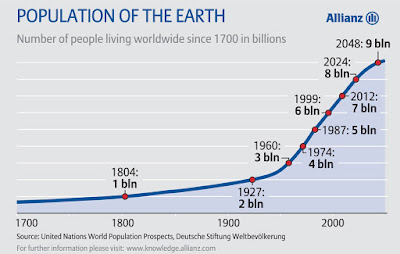
The Limits to Growth suffered from this muddying of the water, the seminal work of Strauss and Howe on generations and generational turning likewise. Hanson predicted that about 90% of the people on Earth will suffer an untimely death. Which is totally plausible if you simply look at a chart of global population growth, then remove the fossil fuels from the equation.

Image

Food production, modern medicine,including hospitals and ambulance transport, the heating of homes to prevent disease in winter. And it's not like ALL the fossil fuels have to vanish for these systems to collapse either. The systems are all interdependent and breaks in the chain lead to collapses migrating outward like Tsunami from and earthquake. But Food is the key resource that keeps us alive day by day and not only is the total now highly dependent on oil and Gas inputs but the arable land is vanishing like snow in spring. It's not hard to see how a major break in the supply of Nitrogen fertilizers could trigger a mass starvation.

Guano, Bird shit, that was the big resource back before modern fertilizers.

$this->bbcode_second_pass_quote('', 'G')uano is the accumulated excrement of seabirds or bats. Guano is a highly effective fertilizer due to the high content of nitrogen, phosphate, and potassium, all key nutrients essential for plant growth. The 19th-century seabird guano trade played a pivotal role in the development of modern input-intensive farming. The demand for guano spurred the human colonization of remote bird islands in many parts of the world. Demand for guano rapidly declined after 1910 with the development of the Haber–Bosch process for extracting nitrogen from the atmosphere.


So like the Whale oil trade we can't go back because we looted all those islands of thousands of years worth of fertilizer. Look at the population chart once again. At the beginning of the 19th century the population was 1 Billion. Then we revolutionized farming with Guano... Now add in a nuclear war, even a small exchange and you have a billion dead and supply chains wrecked and starvation rampant. That would be the quick dieoff scenario I'd imagine. Either way it's coming unless we can start farming Mars. Which we can't.
We're 17 years past the peak now and the 3rd World is going hungry and dark. We'll be next, we're well on the way in fact.
theluckycountry
Light Sweet Crude
Light Sweet Crude
 
Posts: 5254
Joined: Tue 20 Jul 2021, 18:08:48
Location: Australia
Top

Next

Return to Open Topic Discussion

Who is online

Users browsing this forum: No registered users and 1 guest

cron