
PeakOil is You
Is EROEI Important Pt. 5
Re: Is EROEI Important Pt. 5
 by Yoshua » Mon 18 Mar 2019, 12:05:30
The falling EROEI of coal and natural gas is of course just going to make everything so much worse.
- Yoshua
- Heavy Crude

- Posts: 1977
- Joined: Sat 28 May 2016, 06:45:42
Re: Is EROEI Important Pt. 5
by marmico » Mon 18 Mar 2019, 12:17:42
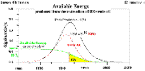
Your EROI graph is bull shit, ETP Bozo. EROI was not 80 in 1960 nor is it 10 in 2020.The only energy starvation is those morons who need to express net energy supply in EROI terms.
A decline in net energy supply from EROI 40 to EROI 20 is the equivalent of a percentage decline from 92.5% to 90%. That is not even noticeable in the grand scheme.
AFAIK there is not a single EROI academic that can empirically demonstrate that the EROI of oil from the well head to the gasoline tank has declined between 1968 and 2018. If there is, produce the paper.
A decline in net energy supply from EROI 40 to EROI 20 is the equivalent of a percentage decline from 92.5% to 90%. That is not even noticeable in the grand scheme.
AFAIK there is not a single EROI academic that can empirically demonstrate that the EROI of oil from the well head to the gasoline tank has declined between 1968 and 2018. If there is, produce the paper.
- marmico
- Heavy Crude
- Posts: 1112
- Joined: Mon 28 Jul 2014, 14:46:35
Re: Is EROEI Important Pt. 5
by shortonoil » Mon 18 Mar 2019, 12:24:50
$this->bbcode_second_pass_quote('', 'T')he falling EROEI of coal and natural gas is of course just going to make everything so much worse.
An economy that will continue to deteriorate is a forgone conclusion. Once that becomes widely appreciated the monetary/ financial system will go into paralyzes.
-
shortonoil - False ETP Prophet

- Posts: 7132
- Joined: Thu 02 Dec 2004, 04:00:00
- Location: VA USA
Re: Is EROEI Important Pt. 5
by shortonoil » Mon 18 Mar 2019, 16:42:31
ERoEI closely mapped the price of oil until reaching the 2012 energy half way point. After 2012 the correlation between petroleum production and world GDP began breaking down. It appears that the energy delivery of petroleum has now fallen too low for it to act as a control on the value of the dollar. Without the necessary control factor the value of the dollar is now undefined. It is at the mercy of the political expediencies of the central banks, and is no longer acting as a reliable, and independent mechanism for true price discovery.
click to enlarge
click to enlarge
You do not have the required permissions to view the files attached to this post.
-
shortonoil - False ETP Prophet
- Posts: 7132
- Joined: Thu 02 Dec 2004, 04:00:00
- Location: VA USA
Re: Is EROEI Important Pt. 5
by Yoshua » Tue 19 Mar 2019, 10:06:55
OPEC is worried about rising inventories in the U.S and Europe. But there are reports of a massive petroleum products glut in China. Officially everything is of course humming along nicely in Communist China. But with lot of numbers tanking by 20 percent in a Chinese hard landing...the glut is probably massive.
- Yoshua
- Heavy Crude
- Posts: 1977
- Joined: Sat 28 May 2016, 06:45:42
Re: Is EROEI Important Pt. 5
by shortonoil » Tue 19 Mar 2019, 14:58:14
$this->bbcode_second_pass_quote('', 'B')ut with lot of numbers tanking by 20 percent in a Chinese hard landing...the glut is probably massive.
A 1% decline in world GDP would reduce consumption by 275 mb/ yr (750 k/day). The price would collapse, and the Middle East would blow up in a year. A 2% decline in world GDP would put a significant portion of the industry out of business from the price fall. A barrel of oil no longer delivers enough energy to the economy to power growth. It no longer even delivers enough energy to power the economy that is presently functioning. We have reached Peak as the result of that energy deficiency, and it is falling at a rate of 2.2% a year.

-
shortonoil - False ETP Prophet
- Posts: 7132
- Joined: Thu 02 Dec 2004, 04:00:00
- Location: VA USA
Re: Is EROEI Important Pt. 5
by Yoshua » Wed 20 Mar 2019, 10:14:01
- Yoshua
- Heavy Crude
- Posts: 1977
- Joined: Sat 28 May 2016, 06:45:42
Re: Is EROEI Important Pt. 5
by asg70 » Wed 20 Mar 2019, 11:33:43
Short, if you're going to spam this board with that stupid pic of yours can you at least learn to trim the bottom off so we don't have a ton of useless whitespace to scroll through?

BOLD PREDICTIONS
-Billions are on the verge of starvation as the lockdown continues. (yoshua, 5/20/20)
HALL OF SHAME:
-Short welched on a bet and should be shunned.
-Frequent-flyers should not cry crocodile-tears over climate-change.
- asg70
- Permanently Banned
- Posts: 4289
- Joined: Sun 05 Feb 2017, 14:17:28
Re: Is EROEI Important Pt. 5
by shortonoil » Wed 20 Mar 2019, 15:20:23
$this->bbcode_second_pass_quote('', 'W')orld trade in goods peaked in 2014.
https://data.worldbank.org/indicator/BX ... view=chart
https://data.worldbank.org/indicator/BX ... view=chart
Since 2008 the data has become very erratic, much like this data set started bouncing around in 2012. The upcoming melt down has been in progress for quit a few years; it has only been CB manipulation that has been disguising it. They are now caught in a liquidity trap with no place to go. The White Knight has turned out to be some shrimp hiding behind the curtain.
"Signature characteristics of a liquidity trap are short-term interest rates that are near zero and fluctuations in the monetary base that fail to translate into fluctuations in general price levels.”

-
shortonoil - False ETP Prophet
- Posts: 7132
- Joined: Thu 02 Dec 2004, 04:00:00
- Location: VA USA
Re: Is EROEI Important Pt. 5
by EdwinSm » Thu 21 Mar 2019, 02:46:35
Short, this is a comment about your last graph about the GDP disconnecting from oil production.
Could there be a factor in causing the disconnect that represents the unexpectedly (by major forecasters) fast rise of renewable energy? I know that the starting base-% is low so that in early years this could be ignored, but at some stage as the energy mix transforms linking GDP to just one source of energy is bound to bring distortions.
So looking that the chart you are saying there is disaster in store, whereas I can look at it as wonder if the transformation from oil is working (and showing up in the charts
  ).
).
Could there be a factor in causing the disconnect that represents the unexpectedly (by major forecasters) fast rise of renewable energy? I know that the starting base-% is low so that in early years this could be ignored, but at some stage as the energy mix transforms linking GDP to just one source of energy is bound to bring distortions.
So looking that the chart you are saying there is disaster in store, whereas I can look at it as wonder if the transformation from oil is working
(and showing up in the charts ).- EdwinSm
- Tar Sands

- Posts: 601
- Joined: Thu 07 Jun 2012, 04:23:59
Re: Is EROEI Important Pt. 5
by shortonoil » Thu 21 Mar 2019, 11:28:05
$this->bbcode_second_pass_quote('', 'S')hort, this is a comment about your last graph about the GDP disconnecting from oil production.
Could there be a factor in causing the disconnect that represents the unexpectedly (by major forecasters) fast rise of renewable energy? I know that the starting base-% is low so that in early years this could be ignored, but at some stage as the energy mix transforms linking GDP to just one source of energy is bound to bring distortions.
So looking that the chart you are saying there is disaster in store, whereas I can look at it as wonder if the transformation from oil is working (and showing up in the charts)
Could there be a factor in causing the disconnect that represents the unexpectedly (by major forecasters) fast rise of renewable energy? I know that the starting base-% is low so that in early years this could be ignored, but at some stage as the energy mix transforms linking GDP to just one source of energy is bound to bring distortions.
So looking that the chart you are saying there is disaster in store, whereas I can look at it as wonder if the transformation from oil is working (and showing up in the charts)
HI Ed, thanks for your comment.
According to the EIA in 2015 12% of world marketable energy production came from renewables; that has been a 6 fold increase since 1960. World renewable energy production has grown from 2% of total consumption to 12% in 66 years. During that same 66 year period total extractable petroleum reserves have fallen from 80% of URR to 15%. If renewable are going to replace petroleum before it reaches 0% of URR, they will have to grow much, much faster than they have historically.
The question then: "I can look at it as wonder if the transformation from oil is working" is implying that perhaps renewables are replacing oil production? If that were the case it would require fewer barrels to produce the same GDP. The points on the graph of chart 139a would be moving to the left of the curve; instead they are moving to the right (2012 to 2016 anomaly). It seems more likely that the monetary base has changed, or that it is requiring more oil to generate the same GDP.
The major change in our relationship with oil has come from technological advances. The computer revolution that began in the 60' has changed how much we travel, to where, and why. Petroleum is still what powers the vast majority of the world's transportation fleet, but computer technology now allows us to accomplish digitally what once required travel. It has also made what travel that is necessary more efficient; the modern vehicle has now become a computer with a steering wheel attached. TCMs, ECMs and half a dozen other computer systems in modern vehicles produce high efficiencies for operations and maintenance, but most of all they allow the burning of the ever lower quality fuels coming to the market. Those fuels are made in a refinery that is run, and could only be run by a very advanced computer system.
Other technologies have had a significant impact on our relationship with petroleum. Material science advances have revolutionized architecture, transportation, communications, and health care to name just a few. We can hope that ongoing advances can take some of the bite out of the 2030 "dead state" event. But hope is a piss poor strategy to base an entire civilization upon.
Like Siamese twins modern civilization is still bound head, and shoulders to oil.

-
shortonoil - False ETP Prophet
- Posts: 7132
- Joined: Thu 02 Dec 2004, 04:00:00
- Location: VA USA

 ] It looks like I misread the chart with it bending the wrong way! Short, thanks for taking the time for a good reply.