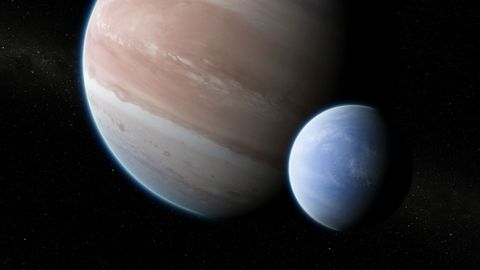
Could 'Oumuamua Be an Extraterrestrial Solar Sail?$this->bbcode_second_pass_quote('', '[')img]https://www.centauri-dreams.org/wp-content/uploads/2018/10/Path-of-Oumuamua.jpg[/img]
... as it began to leave the solar system, the Hubble Space Telescope snapped some final images of 'Oumuamua that revealed some unexpected behavior. After examining the images, another international research team discovered that 'Oumuamua had increased in velocity, rather than slowing down as expected. The most likely explanation, they claimed, was that 'Oumuamua was venting material from its surface due to solar heating (aka. outgassing). The release of this material, which is consistent with how a comet behaves, would give 'Oumuamua the steady push it needed to achieve this boost in velocity.
To this, Bialy and Loeb offer a counter-explanation. If 'Oumuamua were in fact a comet, why then did it not experience outgassing when it was closest to our sun? In addition, they cite other research that showed that if outgassing were responsible for the acceleration, it would have also caused a rapid evolution in 'Oumuamua's spin (which was not observed).
Basically,
Bialy and Loeb consider the possibility that 'Oumuamua could in fact be a light sail, a form of spacecraft that relies on radiation pressure to generate propulsion – similar to what Breakthrough Starshot is working on. Similar to what is planned for Starshot, this light sail may been sent from another civilization to study our solar system and look for signs of life.
 As for what an extra-terrestrial light sail would be doing in our solar system, Bialy and Loeb offer some possible explanations for that. First, they suggest that the probe may actually be a defunct sail floating under the influence of gravity and stellar radiation, similar to debris from ship wrecks floating in the ocean. This would help explain why Breakthrough Listen found no evidence of radio transmissions.
Loeb further illustrated this idea in a recent article he penned for Scientific American, where he suggested that 'Oumuamua could be the first known case of an artificial relic which floated into our solar system from interstellar space. What's more, he notes that lightsails with similar dimensions have been designed and constructed by humans, including the Japanese-designed IKAROS project and the Starshot Initiative with which he is involved.
"This opportunity establishes a potential foundation for a new frontier of space archaeology, namely the study of relics from past civilizations in space," Loeb wrote. "
Finding evidence for space junk of artificial origin would provide an affirmative answer to the age-old question "Are we alone?". This would have a dramatic impact on our culture and add a new cosmic perspective to the significance of human activity."
On the other hand, as Loeb told Universe Today, 'Oumuamua could be an active piece of alien technology that came to explore our solar system, the same way we hope to explore Alpha Centauri using Starshot and similar technologies:... According to Loeb, then there's also the fact that 'Oumuamua's orbit brought it to within 0.25 AU of the sun, which is a good orbit for intercepting Earth without experiencing too much solar irradiation. In addition, it came to within 0.15 AU of Earth, which could have been the result of orbital corrections designed to facilitate a flyby.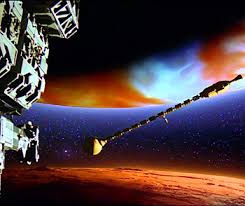
Shmuel Bialy and Abraham Loeb.
Could Solar Radiation Pressure Explain 'Oumuamua's Peculiar Acceleration? arXiv:1810.11490 [astro-ph.EP]