PeakOil is You
THE ENERGY CLIFF APPROACHES
Re: THE ENERGY CLIFF APPROACHES
 by rockdoc123 » Wed 04 Jul 2018, 00:54:57
$this->bbcode_second_pass_quote('', 'W')hat nonsense, rockteacherofthefrosh. Your continual point is that failing discoveries mean little, because all past reserve estimates were short . . . so we don't really need new oil. But the paper you quote to defend that position says that peak will occur before 2020. That paper almost a decade old. Today is 2018 1/2.
Are you illiterate or do you just not bother to read? I pointed to that paper because of it’s discussion regarding reserve growth and for no other reason, obviously you should go back and read your own posts or do I have to repost it all again. This was in response to your idiotic comments that suggested somehow reserve growth wasn’t real. There are countless papers over the years that have outlined the statistics in support of this and the USGS now uses it in their own assessment. Are you arguing that the one paper I referenced did not say reserve growth was real? Do I need to reference a bunch more including the USGS?
Your suggestion that I am making some sort of argument I never did is pathetic. And BTW 2012 to 2018 is 6 years which is not “almost a decade old” unless you skipped grade school math.

-

rockdoc123 - Expert

- Posts: 7685
- Joined: Mon 16 May 2005, 03:00:00
Re: THE ENERGY CLIFF APPROACHES
by Outcast_Searcher » Wed 04 Jul 2018, 01:48:52
$this->bbcode_second_pass_quote('pstarr', 'Y')our beloved paper also concluded that peak oil is here. Sorry for you. No chance to round out the CV.
sad
sad
If peak oil "is here" why do global oil production volumes keep increasing?
Try making such claims AFTER global oil production volumes have fallen for a few years, so you aren't wrong as soon as you say it.
Given the track record of the perma-doomer blogs, I wouldn't bet a fast crash doomer's money on their predictions.
-

Outcast_Searcher - COB

- Posts: 10142
- Joined: Sat 27 Jun 2009, 21:26:42
- Location: Central KY
Re: THE ENERGY CLIFF APPROACHES
by Sys1 » Wed 04 Jul 2018, 04:02:31
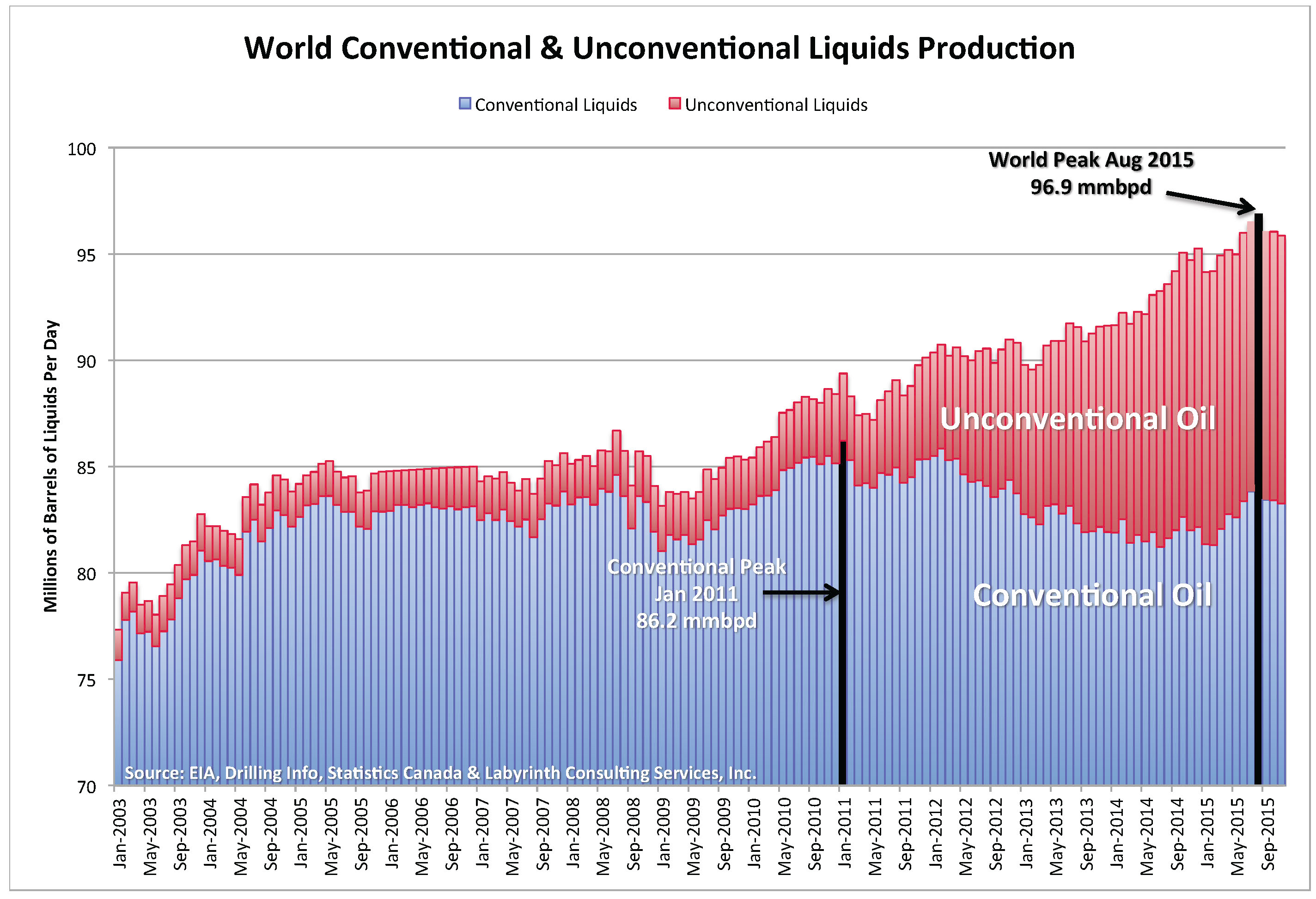
From this chart, peak conventional oil was in 2011 at 86mbpd.
https://www.google.com/search?safe=off&biw=1920&bih=947&tbm=isch&sa=1&ei=m3w8W4m7EMi7UYnlt_AL&q=conventional+oil+collapse+global&oq=conventional+oil+collapse+global&gs_l=img.3...49622.50518.0.50709.7.7.0.0.0.0.74.377.7.7.0....0...1c.1.64.img..0.0.0....0.CINPSkOLvKs#imgrc=XeVxkwZnkPq76M:
Shorter Link http://www.resilience.org/wp-content/up ... .png?w=650
For the dirty and hard to get oil, we don't know, as total liquid production is still growing. But!
But actually, with process like coal's liquefaction, total peak oil is quite pointless to get how close we are from energy cliff.
But we are certain that :
- We are more and more dependant on unconventional oil, around 15% in 2015 from the same chart. Unconventional production collapses far faster than conventional, it means that those 15% still growing in proportion to all production are weak and need to be replaced fast in order just to maintain production... and we are supposed to increase it forever, thanks to growth paradigm.
- For the moment, conventional oil production decreases slowly, but as unconventional techniques are now applyed on conventional oil rigs, aka water injection, there are some serious chances that the decrease will at a certain point looks like a Seneca cliff .
https://www.google.com/search?safe=off&biw=1920&bih=947&tbm=isch&sa=1&ei=m3w8W4m7EMi7UYnlt_AL&q=conventional+oil+collapse+global&oq=conventional+oil+collapse+global&gs_l=img.3...49622.50518.0.50709.7.7.0.0.0.0.74.377.7.7.0....0...1c.1.64.img..0.0.0....0.CINPSkOLvKs#imgrc=XeVxkwZnkPq76M:
Shorter Link http://www.resilience.org/wp-content/up ... .png?w=650
For the dirty and hard to get oil, we don't know, as total liquid production is still growing. But!
But actually, with process like coal's liquefaction, total peak oil is quite pointless to get how close we are from energy cliff.
But we are certain that :
- We are more and more dependant on unconventional oil, around 15% in 2015 from the same chart. Unconventional production collapses far faster than conventional, it means that those 15% still growing in proportion to all production are weak and need to be replaced fast in order just to maintain production... and we are supposed to increase it forever, thanks to growth paradigm.
- For the moment, conventional oil production decreases slowly, but as unconventional techniques are now applyed on conventional oil rigs, aka water injection, there are some serious chances that the decrease will at a certain point looks like a Seneca cliff .
Last edited by Tanada on Wed 04 Jul 2018, 10:13:59, edited 1 time in total.
Reason: Added shorter image link
Reason: Added shorter image link
-

Sys1 - Tar Sands

- Posts: 983
- Joined: Fri 25 Feb 2005, 04:00:00
Re: THE ENERGY CLIFF APPROACHES
by rockdoc123 » Wed 04 Jul 2018, 11:26:51
As has been pointed out many times here there is no such thing as "conventional oil". There are conventional and unconventional reservoirs and there is a wide range of oil viscosities that complicate matters. Much of the LTO being produced from basin centres in the US currently is almost identical, both from a chemical and rheologic perspective to Brent and other oils like Bonny Light. There is low gravity oil with low viscosity that produces on its own energy and there is low gravity oil with high viscosity that needs energy inputs (heat, chemicals etc).
Trying to separate out the two is at best a mug's game, especially since included in that so-called "conventional peak" is oil produced from many reservoirs that would be considered unconventional (eg: Austin Chalk, Deep Basin Fields in Alberta, oil produced from fractured basement in Egypt, SE Asia and FSU). IT is easy to take out production from oil sands in Canada and Venezuela and production of LTO in US from shale basins but there are is lot of historical production that is actually from unconventional reservoirs but lumped in as being conventional.
There is really no reason to separate the two. The actual cost/bbl to produce LTO in the US is cheaper than much of the worlds offshore oil that is considered conventional. Refineries in the US actually require the oil sands production so they can blend with lighter oils to get to refinery specs. Contrary to popular belief held on this site the world did not suddenly switch to chasing heavy oil because we were running out of light oil. Companies were full on drilling in the various oil sands areas of Canada (McMurray, Cold Lake, Wabasca etc) in the mid-1970's.
The bottom line is Outcast_searcher is correct, one has to look at total oil production, there is no rational reason to try and subdivide it when talking about Peak Oil, especially when the produced hydrocarbons are essentially fungible (when blended) as far as refineries are concerned.
Trying to separate out the two is at best a mug's game, especially since included in that so-called "conventional peak" is oil produced from many reservoirs that would be considered unconventional (eg: Austin Chalk, Deep Basin Fields in Alberta, oil produced from fractured basement in Egypt, SE Asia and FSU). IT is easy to take out production from oil sands in Canada and Venezuela and production of LTO in US from shale basins but there are is lot of historical production that is actually from unconventional reservoirs but lumped in as being conventional.
There is really no reason to separate the two. The actual cost/bbl to produce LTO in the US is cheaper than much of the worlds offshore oil that is considered conventional. Refineries in the US actually require the oil sands production so they can blend with lighter oils to get to refinery specs. Contrary to popular belief held on this site the world did not suddenly switch to chasing heavy oil because we were running out of light oil. Companies were full on drilling in the various oil sands areas of Canada (McMurray, Cold Lake, Wabasca etc) in the mid-1970's.
The bottom line is Outcast_searcher is correct, one has to look at total oil production, there is no rational reason to try and subdivide it when talking about Peak Oil, especially when the produced hydrocarbons are essentially fungible (when blended) as far as refineries are concerned.
-
rockdoc123 - Expert
- Posts: 7685
- Joined: Mon 16 May 2005, 03:00:00
Re: THE ENERGY CLIFF APPROACHES
by Plantagenet » Wed 04 Jul 2018, 13:03:04
$this->bbcode_second_pass_quote('rockdoc123', 'A')s has been pointed out many times here there is no such thing as "conventional oil". There are conventional and unconventional reservoirs....
Obviously when Pstarr or other people at this site discuss conventional or unconventional oil, they are talking about the oil obtained from conventional and unconventional reservoirs, respectively.
It saves to time to write "unconventional oil" instead of "oil from unconventional reservoirs." This kind of usage is very common in the English language. For instance, we talk about "business men" instead of "men who work in a business" or about "crime writers" instead of "writers who specialize in books about crime." The use of these kinds of short-hand descriptive terms are very basic to the way our language works, and I'm sure you are the only person who didn't get what Pstarr meant when he was discussing "unconventional oil" as opposed to "conventional oil" in the context of global oil markets. For almost all people the meaning is obvious from the context of the usage, and I'm fact I'm surprised that the erroneous conclusion that there was something unconventional about the oil itself ever occurred to you.
I hope this explanation helps and you get the meaning now?

Cheers!
Never underestimate the ability of Joe Biden to f#@% things up---Barack Obama
-----------------------------------------------------------
Keep running between the raindrops.
-----------------------------------------------------------
Keep running between the raindrops.
-

Plantagenet - Expert
- Posts: 26765
- Joined: Mon 09 Apr 2007, 03:00:00
- Location: Alaska (its much bigger than Texas).
Re: THE ENERGY CLIFF APPROACHES
by rockdoc123 » Wed 04 Jul 2018, 13:36:20
$this->bbcode_second_pass_quote('', 'I') hope this explanation helps and you get the meaning now?
Don't be an ass with the word games. The definitions are clear, use or don't at your own peril.
My point....as was outlined above is there is basically no difference between the oil produced in LTO and what is produced from many of what are classified as conventional reservoirs such as Brent and Bonny light. They are also less expensive to produce on a per bbl or per boe basis than many of the conventional reservoirs. As a consequence, there is zero reason to separate them apart in terms of inclusion in the idea of Peak Oil. And, as I mentioned above there are already oils produced from unconventional reservoirs that are included in the diagram posted from the EIA, hence it is a meaningless analysis.
-
rockdoc123 - Expert
- Posts: 7685
- Joined: Mon 16 May 2005, 03:00:00