On Natural Gas the shale gas estimates of the USGS
https://energy.usgs.gov/OilGas/Assessme ... dates.aspxsuggest about 960 TCF of undiscovered shale gas (F50 estimate), also there are about 324 TCF of proved natural gas reserves (December 2015 estimate) so a total of 1284 TCF.
Through the end of 2015 the US had produced 1449 TCF of natural gas so a rough URR estimate would be 2733 TCF, typically peak is around the half way point which would imply at 1400 TCF, so a peak in natural gas output may be imminent in the US. Note that 2016 output was slightly less than 2015 natural gas output.
We could focus instead on shale gas only where we have 176 TCF of reserves for a total of (176+960) 1136 TCF. About 70 TCF had been produced at the end of 2015 (cumulative output from 2007-2015). So potentially a URR of 1206 TCF of shale gas, half of this would be 600 TCF (peak typically is near the 50% point or earlier).
Shale gas output has grown at 15% per year from 2011 to 2015. We assume a 10% growth rate until present US natural gas output levels are reached (33 TCF/year) in 2024. After that we assume a 2% growth in shale gas output. The 600 TCF cumulative shale gas output level is reached in 2033 in this scenario.
Where the US natural gas peak will fall will depend on the decline rate of conventional natural gas output relative to the shale gas output increase, but the peak is unlikely to be after 2034 if the USGS estimates are correct.
A switch to natural gas for transportation would be a short term solution.
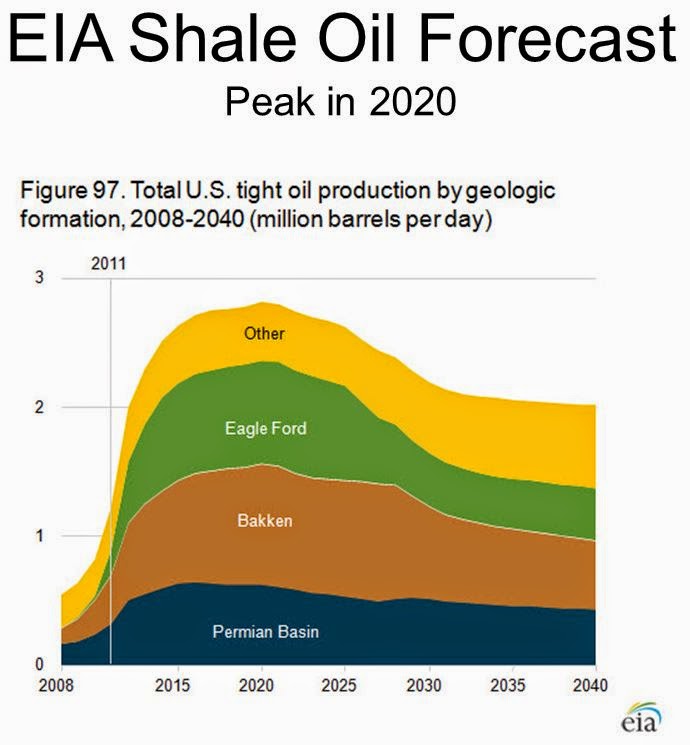
Note also that the USGS f50 estimate for tight oil is about 36 Gb, 2P reserves are about 15 Gb or so and URR for tight oil is likely to be about 50 Gb (probably a 50% probability it will be between 40 and 60 Gb).
I think US tight oil will peak between 2025 and 2030 at roughly 7.25 Mb/d, but much will depend on oil prices. World C+C output might reach 87.5 Mb/d, also in the 2025-2030 time frame, but may decline fairly rapidly after tight oil output peaks, possibly at 2.5% per year or higher for a few years. It is doubtful that OPEC, oil sands, or deepwater output can be ramped up quickly enough to mitigate this rapid decline in C+C output.
Possibly ride sharing and EVs will help mitigate any transportation bottleneck.