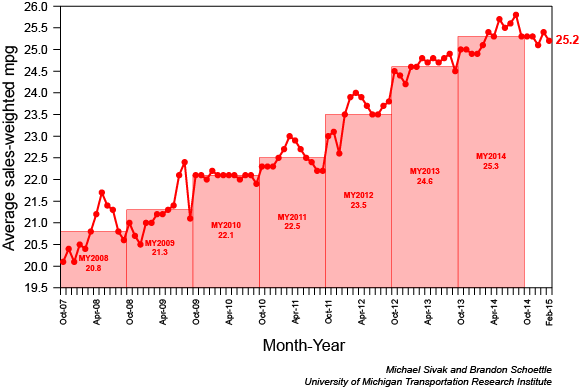
I'd drive the same if it was 10 cents or 10 dollars a gallon but, yes cheaper gas means people do it more in general. And also pointed out that SUV and truck sales are up.
How do they get the vehicle miles driven statistic ? Some sort of sampling I imagine, but is it from traffic counts or polls or what ? Anyone know?



PeakOil is You
Gasoline Demand (merged)
Re: US road travel surges 5 pct in Dec lifted by cheap gasol
 by dinopello » Fri 13 Mar 2015, 12:38:51
-

dinopello - Light Sweet Crude

- Posts: 6088
- Joined: Fri 13 May 2005, 03:00:00
- Location: The Urban Village
Re: US road travel surges 5 pct in Dec lifted by cheap gasol
by ROCKMAN » Fri 13 Mar 2015, 13:00:33
Pops - "Lots of oil...work great at $30/bbl." You mean like my 400 bopd that cost me $2/bbl to produce and not much more energy consumed by your average 1,600 sq ft home? As you point out once a well is drilled and completed EROEI is no longer a pertinent factor. The well might never return all the monies invested. In fact it might have an extremely low EROEI with regards to what it took to drill it. But during the production phase it might be returning 25X the product costs with an EROEI over 100. Just like sunk cost there's sunk EROEI.
-

ROCKMAN - Expert

- Posts: 11397
- Joined: Tue 27 May 2008, 03:00:00
- Location: TEXAS
Re: US road travel surges 5 pct in Dec lifted by cheap gasol
by Pops » Fri 13 Mar 2015, 13:06:39
$this->bbcode_second_pass_quote('ROCKMAN', 'J')ust like sunk cost there's sunk EROEI.
Good! good brain model.
The legitimate object of government, is to do for a community of people, whatever they need to have done, but can not do, at all, or can not, so well do, for themselves -- in their separate, and individual capacities.
-- Abraham Lincoln, Fragment on Government (July 1, 1854)
-- Abraham Lincoln, Fragment on Government (July 1, 1854)
-

Pops - Elite
- Posts: 19746
- Joined: Sat 03 Apr 2004, 04:00:00
- Location: QuikSac for a 6-Pac
Re: US road travel surges 5 pct in Dec lifted by cheap gasol
by Pops » Fri 13 Mar 2015, 13:09:33
$this->bbcode_second_pass_quote('', 'T')raffic Volume Trends is a monthly report based on hourly traffic count data reported by the States. These data are collected at approximately 4,000 continuous traffic counting locations nationwide and are used to estimate the percent change in traffic for the current month compared with the same month in the previous year. Estimates are re-adjusted annually to match the vehicle miles of travel from the Highway Performance Monitoring System and are continually updated with additional data.
http://www.fhwa.dot.gov/policyinformati ... ng/tvt.cfm
FAQs
The legitimate object of government, is to do for a community of people, whatever they need to have done, but can not do, at all, or can not, so well do, for themselves -- in their separate, and individual capacities.
-- Abraham Lincoln, Fragment on Government (July 1, 1854)
-- Abraham Lincoln, Fragment on Government (July 1, 1854)
-
Pops - Elite
- Posts: 19746
- Joined: Sat 03 Apr 2004, 04:00:00
- Location: QuikSac for a 6-Pac
Re: US road travel surges 5 pct in Dec lifted by cheap gasol
by Outcast_Searcher » Fri 13 Mar 2015, 13:10:06
$this->bbcode_second_pass_quote('frankthetank', '
')With airfare so expensive, I'm sure some just drove to their destination. I know for my family if i was to go to Florida...airplane tickets probably $400 or more x 5..i could drive there for a few hundred and not have to rent a vehicle when i got there.
')With airfare so expensive, I'm sure some just drove to their destination. I know for my family if i was to go to Florida...airplane tickets probably $400 or more x 5..i could drive there for a few hundred and not have to rent a vehicle when i got there.
I know a lot of people who would rather drive 6 hours than put up with the hassle and scheduling vagaries the TSA can inflict. With much cheaper gasoline, that only tips the scale further in the direction of driving for anyone leaning that way.
Given the track record of the perma-doomer blogs, I wouldn't bet a fast crash doomer's money on their predictions.
-

Outcast_Searcher - COB

- Posts: 10142
- Joined: Sat 27 Jun 2009, 21:26:42
- Location: Central KY
Re: US road travel surges 5 pct in Dec lifted by cheap gasol
by Outcast_Searcher » Fri 13 Mar 2015, 13:19:23
$this->bbcode_second_pass_quote('', '(')Reuters) - U.S. motorists took to the roads in record numbers in December, capping the fastest annual increase in miles driven for a decade, federal data showed on Thursday, a surge that analysts attribute to cheap gasoline and uptick in car sales.
He noted that vehicle sales for the November and December were the highest in history for the two months, with nearly 3 million vehicles sold.
"People with new cars like to drive them," he said.......
More: http://in.reuters.com/article/2015/03/1 ... F820150312
He noted that vehicle sales for the November and December were the highest in history for the two months, with nearly 3 million vehicles sold.
"People with new cars like to drive them," he said.......
More: http://in.reuters.com/article/2015/03/1 ... F820150312
It's not just the new cars. It's that so many people will choose a much more muscular car (one can get lots of HP now in a middle class car, not that you need anywhere near all that), or of course the "status" of the big SUV, pickup truck, etc.
If this cheap gasoline lasts for years, we could undo a whole lot of reduced consumption in recent years. How stupid is that?
Of course, that could be fixed with a gas tax to keep the minimum price of gas at some level that discourages such behavior -- and the income could be used for the infrastructure. But the odds of that are negligable in the states. (Not using such a tax to strongly encourage conservation is GALACTICALLY stupid (whether you believe in short term peak oil or not, given AGW), IMO, but clearly lots of voters disagree).
Given the track record of the perma-doomer blogs, I wouldn't bet a fast crash doomer's money on their predictions.
-
Outcast_Searcher - COB
- Posts: 10142
- Joined: Sat 27 Jun 2009, 21:26:42
- Location: Central KY