The Concrete Battery
$this->bbcode_second_pass_quote('', 'M')ost of us would be familiar with how hot pavement can get on a summer’s day – and how long it can store heat. It seems concrete may be key to cheap large scale energy storage in the near future.
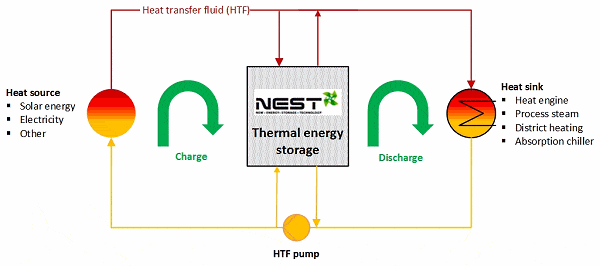
Norwegian company NEST AS has developed a special concrete called Heatcrete to be used for solid-state thermal energy storage (TES). Heatcrete demonstrates superior thermal performance over normal concretes and was developed in partnership with HeidelbergCement.
The full battery system consist of steel heat exchangers cast into Heatcrete cells, with a heat transfer fluid flowing through the exchangers. The heat transfer fluid can be oil, water, steam or gases. Temperature is controlled through various manifolds and a smart valve control algorithm.



PeakOil is You
Prospects for large-scale energy storage
Human history becomes more and more a race between education and catastrophe. H. G. Wells.
Fatih Birol's motto: leave oil before it leaves us.
Fatih Birol's motto: leave oil before it leaves us.
-

Graeme - Fusion

- Posts: 13258
- Joined: Fri 04 Mar 2005, 04:00:00
- Location: New Zealand
Re: Prospects for large-scale energy storage
 by Graeme » Tue 14 Jul 2015, 19:27:44
Yet Another Energy Storage Company Takes On Tesla
$this->bbcode_second_pass_quote('', 'O')XIS Energy certainly isn’t letting any grass grow under its feet. In June, the UK energy storage innovator announced that it will be ready next year to market its super efficient lithium-sulfur battery, and barely a month later, the company has just launched a partnership with Anesco, a leading commercial and home energy storage installer.
$this->bbcode_second_pass_quote('', 'O')XIS Energy certainly isn’t letting any grass grow under its feet. In June, the UK energy storage innovator announced that it will be ready next year to market its super efficient lithium-sulfur battery, and barely a month later, the company has just launched a partnership with Anesco, a leading commercial and home energy storage installer.

$this->bbcode_second_pass_quote('', 'P')owerwall Who?
Yes, that’s lithium-sulfur, and OXIS aims to leverage the low, low cost of sulfur to undercut the market for lithium-ion batteries.
Here’s the explainer from the company:
Sulfur represents a natural cathode partner for metallic Li and, in contrast with conventional lithium-ion cells, the chemicals processes include dissolution from the anode surface during discharge and reverse lithium plating to the anode while charging. As a consequence, Lithium-Sulfur allows for a theoretical specific energy in excess of 2700Wh/kg, which is nearly 5 times higher than that of Li-ion.
cleantechnica
Human history becomes more and more a race between education and catastrophe. H. G. Wells.
Fatih Birol's motto: leave oil before it leaves us.
Fatih Birol's motto: leave oil before it leaves us.
-
Graeme - Fusion
- Posts: 13258
- Joined: Fri 04 Mar 2005, 04:00:00
- Location: New Zealand
Re: Prospects for large-scale energy storage
by Graeme » Mon 20 Jul 2015, 17:40:10
Dramatic Growth of Energy Storage Depends on Natural Gas Prices
$this->bbcode_second_pass_quote('', 'I')ntersolar North America, including ees™, its new dedicated program on energy storage, concluded this week at Moscone Center West in San Francisco. NAATBatt, as part of its growing partnership with the Intersolar family of international renewable energy conferences, participated heavily in the ees program and produced two workshops, one on storage safety, one on solar-storage policy, as part of the larger Intersolar program.
Overall the ees™ program was interesting on a number of levels. It is clear that the subject of storage has arrived in the consciousness of the solar industry. The ees sessions were packed with solar developers and integrators wanting to learn more about storage technology. The NAATBatt booth on the trade show floor, as well as the booths of the other NAATBatt members I spoke with, enjoyed foot traffic beyond expectation. The keynote speech by JB Straubel of Tesla Motors and several of the ees™ program sessions were standing room only.
Still, I was a bit concerned by the number of projections about the storage market that included hockey sticks. The storage market is still small, with less than 0.1% of solar PV projects including a storage component today (according to GTM Research). Yet the projects of almost every prognosticator at the conference showed expected market growth for storage and solar-storage of exponential dimension over the next few decades.
I do not necessarily disagree with hockey stick projections about the storage market. But it would be helpful and ultimately make the industry more credible if the assumptions that underlie those optimistic projections were stated more explicitly.
$this->bbcode_second_pass_quote('', 'I')ntersolar North America, including ees™, its new dedicated program on energy storage, concluded this week at Moscone Center West in San Francisco. NAATBatt, as part of its growing partnership with the Intersolar family of international renewable energy conferences, participated heavily in the ees program and produced two workshops, one on storage safety, one on solar-storage policy, as part of the larger Intersolar program.
Overall the ees™ program was interesting on a number of levels. It is clear that the subject of storage has arrived in the consciousness of the solar industry. The ees sessions were packed with solar developers and integrators wanting to learn more about storage technology. The NAATBatt booth on the trade show floor, as well as the booths of the other NAATBatt members I spoke with, enjoyed foot traffic beyond expectation. The keynote speech by JB Straubel of Tesla Motors and several of the ees™ program sessions were standing room only.
Still, I was a bit concerned by the number of projections about the storage market that included hockey sticks. The storage market is still small, with less than 0.1% of solar PV projects including a storage component today (according to GTM Research). Yet the projects of almost every prognosticator at the conference showed expected market growth for storage and solar-storage of exponential dimension over the next few decades.
I do not necessarily disagree with hockey stick projections about the storage market. But it would be helpful and ultimately make the industry more credible if the assumptions that underlie those optimistic projections were stated more explicitly.
theenergycollective
Human history becomes more and more a race between education and catastrophe. H. G. Wells.
Fatih Birol's motto: leave oil before it leaves us.
Fatih Birol's motto: leave oil before it leaves us.
-
Graeme - Fusion
- Posts: 13258
- Joined: Fri 04 Mar 2005, 04:00:00
- Location: New Zealand
 especially to references to solar and wind possibly supplementing the hydropower]