$this->bbcode_second_pass_quote('baha', 'T')here are countless different types of Lithium batteries. Different chemistries and materials. That's why there are two types of Tesla batteries. One is for daily cycles and the other is for occasional backup. The makeup of these batteries is different.
The daily cycle battery is designed to cycle...if you leave it fully charged for a long period it will be unhappy. It is meant to be used.
The backup battery is designed to wait. If you cycle it every day it will degrade.
So you need to know what you plan to do with it.



PeakOil is You
THE Battery Technology Thread pt 3 (merged)
Re: THE Battery Technology Thread pt 3 (merged)
 by vtsnowedin » Sat 07 Jan 2017, 08:40:56
Would you happen to know off hand how much lithium Tesla's Giga factory will consume per year?
-

vtsnowedin - Fusion

- Posts: 14897
- Joined: Fri 11 Jul 2008, 03:00:00
Re: THE Battery Technology Thread pt 3 (merged)
by vtsnowedin » Sat 07 Jan 2017, 10:13:12
$this->bbcode_second_pass_quote('baha', 'D')on't have a number, I'm sure it's significant...But what you are talking about is more jobs. http://fortune.com/2016/03/29/lithium-t ... ne-nevada/
There will be new infrastructure built and jobs created and who knows what the $ tradeoff will be...but it leads in a sustainable direction. Just like Aluminum, Lithium will be cheaper to recycle than mine. Unlike FFs it will still be in there after the battery is dead.
There will be new infrastructure built and jobs created and who knows what the $ tradeoff will be...but it leads in a sustainable direction. Just like Aluminum, Lithium will be cheaper to recycle than mine. Unlike FFs it will still be in there after the battery is dead.
I was just contemplating the dent that Giga factory would make in the worlds supply.
I've found that current production is about 35,000 tonnes a year and that is expected to more then double shortly. Also from various sources prices can vary from $10,000 to $25,000 per tonne but some of that was stock scam hype.
-
vtsnowedin - Fusion
- Posts: 14897
- Joined: Fri 11 Jul 2008, 03:00:00
Re: THE Battery Technology Thread pt 3 (merged)
by KaiserJeep » Sat 07 Jan 2017, 12:47:22
I will mention that I invested $7500 in the Cape Wind offshore wind farm about a decade ago. Although Obama called it "shovel ready" in 2007 during his first campaign, I have slowly realized that I am never going to see any return on that money.
I have also related the cost of PV electricity here in sunny California in a message in this thread dated May 21, 2016. My grid-attached solar roof produces energy at a cost of $0.31/kWh. In an off-grid situation, the cost with Powerwall batteries would be $0.59/kWh, because I would need more panels plus batteries. I should note that I am a retired Electrical Engineer and I have been monitoring my PV roof for what will be 7 years in July of this year. The cost of Chinese-made PV panels has decreased by about 35% during that same period, but labor costs have increased slightly, today that same solar roof would be implemented at an electricity cost of about $0.28/kWh.
You appear to be confusing the ongoing costs of capital expenditures with fuel costs for power generation. Solar PV has zero fuel costs but very high capital expenditures and these are even higher with battery storage. My 2.8 kVA rooftop solar is both undersized for off-grid usage and lacks battery storage. I am in a near-ideal location for solar power in sunny California and in a near-ideal regulatory environment, with both Federal tax rebates and State of California tax rebates under the CSI (California Solar Initiative), and state-mandated "net metering", which forces the power company to purchase back my piddly little 2.8kW of power at retail electricity rates.
I would not be willing to teach you the mathematics of Capex in this forum, it is a long and involved discussion, and I would recommend an Economics textbook instead. I will summarize what is happening when I say that the Feds and the State of California are overcharging everybody around me for their electricity and rewarding those of us with Solar PV by in effect giving us OPM (other people's money). That $0.28/kWh is expensive electricity for a US state, but the CARB (California Air Resources Board) has increased the cost of electricity in this state with decades of tinkering. The US average cost for grid electricity is about 1/3rd lower than in California, and the wholesale electrical cost is about $0.12/kWh for the "green" electricity that we buy from Texas. (Note that these are burdened costs, not simple cost-of-fuel figures.)
Bottom line is that because of all the government meddling with grid electricity, I have saved about $2200 on my electrical bill in six and a half years. In a state without solar incentives I would be paying a lot less for power, consequently there would also be fewer reasons to add PV panels to my roof.
I have also related the cost of PV electricity here in sunny California in a message in this thread dated May 21, 2016. My grid-attached solar roof produces energy at a cost of $0.31/kWh. In an off-grid situation, the cost with Powerwall batteries would be $0.59/kWh, because I would need more panels plus batteries. I should note that I am a retired Electrical Engineer and I have been monitoring my PV roof for what will be 7 years in July of this year. The cost of Chinese-made PV panels has decreased by about 35% during that same period, but labor costs have increased slightly, today that same solar roof would be implemented at an electricity cost of about $0.28/kWh.
You appear to be confusing the ongoing costs of capital expenditures with fuel costs for power generation. Solar PV has zero fuel costs but very high capital expenditures and these are even higher with battery storage. My 2.8 kVA rooftop solar is both undersized for off-grid usage and lacks battery storage. I am in a near-ideal location for solar power in sunny California and in a near-ideal regulatory environment, with both Federal tax rebates and State of California tax rebates under the CSI (California Solar Initiative), and state-mandated "net metering", which forces the power company to purchase back my piddly little 2.8kW of power at retail electricity rates.
I would not be willing to teach you the mathematics of Capex in this forum, it is a long and involved discussion, and I would recommend an Economics textbook instead. I will summarize what is happening when I say that the Feds and the State of California are overcharging everybody around me for their electricity and rewarding those of us with Solar PV by in effect giving us OPM (other people's money). That $0.28/kWh is expensive electricity for a US state, but the CARB (California Air Resources Board) has increased the cost of electricity in this state with decades of tinkering. The US average cost for grid electricity is about 1/3rd lower than in California, and the wholesale electrical cost is about $0.12/kWh for the "green" electricity that we buy from Texas. (Note that these are burdened costs, not simple cost-of-fuel figures.)
Bottom line is that because of all the government meddling with grid electricity, I have saved about $2200 on my electrical bill in six and a half years. In a state without solar incentives I would be paying a lot less for power, consequently there would also be fewer reasons to add PV panels to my roof.
KaiserJeep 2.0, Neural Subnode 0010 0000 0001 0110 - 1001 0011 0011, Tertiary Adjunct to Unimatrix 0000 0000 0001
Resistance is Futile, YOU will be Assimilated.
Warning: Messages timestamped before April 1, 2016, 06:00 PST were posted by the unmodified human KaiserJeep 1.0
Resistance is Futile, YOU will be Assimilated.
Warning: Messages timestamped before April 1, 2016, 06:00 PST were posted by the unmodified human KaiserJeep 1.0
- KaiserJeep
- Light Sweet Crude

- Posts: 6094
- Joined: Tue 06 Aug 2013, 17:16:32
- Location: Wisconsin's Dreamland
Re: THE Battery Technology Thread pt 3 (merged)
by diemos » Sat 07 Jan 2017, 19:11:53
$this->bbcode_second_pass_quote('KaiserJeep', ' ')I will summarize what is happening when I say that the Feds and the State of California are overcharging everybody around me for their electricity and rewarding those of us with Solar PV by in effect giving us OPM (other people's money).
The grid operators have been putting up with this because it put off the day when they would have to site and build new power lines. An expensive regulatory nightmare.
-
diemos - Heavy Crude

- Posts: 1423
- Joined: Fri 23 Sep 2005, 03:00:00
Re: THE Battery Technology Thread pt 3 (merged)
by KaiserJeep » Sat 07 Jan 2017, 19:33:25
$this->bbcode_second_pass_quote('diemos', '-')snip-
The grid operators have been putting up with this because it put off the day when they would have to site and build new power lines. An expensive regulatory nightmare.
The grid operators have been putting up with this because it put off the day when they would have to site and build new power lines. An expensive regulatory nightmare.
Yes, quite correct. However the present regulatory environment is also much more optimal for implementing renewable energies while taking advantage of an uneven playing field.
In my planned move to Wisconsin and my hoped-for newly-constructed passive home, I hope to have Tesla's solar roofing and Powerwall batteries over both house and garage and a wind turbine which will still be charging on cold Winter nights. The house design we have settled on is a distinct style called Early New England saltbox:
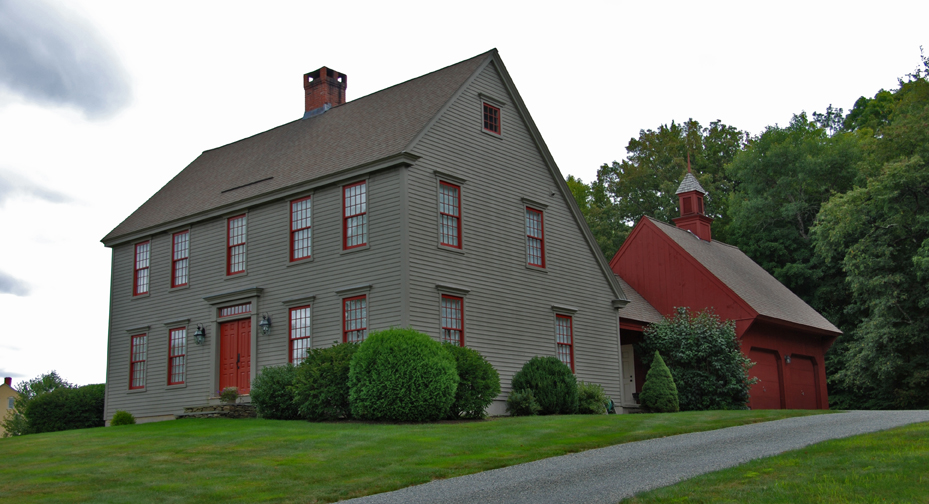
Hopefully, the Tesla roofing will be on the larger roof area, facing S, with perhaps more such solar PV on the garage, since I plan to have at least on longer-ranged EV.
The basic idea is a superinsulated home, all electric, off-grid, energy plus design, that requires no hydrocarbons be burned - not even wood - for HVAC or cooking or other systems. I believe that this can be done for a price premium of +35% over simple building-code-compliant home design.
KaiserJeep 2.0, Neural Subnode 0010 0000 0001 0110 - 1001 0011 0011, Tertiary Adjunct to Unimatrix 0000 0000 0001
Resistance is Futile, YOU will be Assimilated.
Warning: Messages timestamped before April 1, 2016, 06:00 PST were posted by the unmodified human KaiserJeep 1.0
Resistance is Futile, YOU will be Assimilated.
Warning: Messages timestamped before April 1, 2016, 06:00 PST were posted by the unmodified human KaiserJeep 1.0
- KaiserJeep
- Light Sweet Crude
- Posts: 6094
- Joined: Tue 06 Aug 2013, 17:16:32
- Location: Wisconsin's Dreamland