And forget the percentage bullshit. CA, the #1 solar energy producer, generates more then 1,400X the #2 Arizona. And Texas, #1 wind power energy producer, generates more then 2X the #2 Oregon. And Texas produces almost 3X as much wind electricity as CA does solar power. The goal of the wind and solar alts is to reduce the total amount of GHG produced by electricity generation. In that regards Texas and CA beat the sh*t out of all you slackers. LOL.
BTW my dog beats all of you: the panels on his dog house supply him with 100% of his consumption. LOL.



PeakOil is You
Impossible - wind and solar
Re: Impossible - wind and solar
 by ROCKMAN » Mon 26 Dec 2016, 00:09:42
-

ROCKMAN - Expert

- Posts: 11397
- Joined: Tue 27 May 2008, 03:00:00
- Location: TEXAS
Re: Impossible - wind and solar
by kublikhan » Mon 26 Dec 2016, 02:33:26
$this->bbcode_second_pass_quote('ROCKMAN', 'A')nd forget the percentage bullshit. CA, the #1 solar energy producer, generates more then 1,400X the #2 Arizona. And Texas, #1 wind power energy producer, generates more then 2X the #2 Oregon. And Texas produces almost 3X as much wind electricity as CA does solar power.
Texas also has alot bigger budget than Oregon. Texas's budget was more than triple Oregon's budget. Yet Oregon nearly equaled Texas in renewable energy generation: 40,274 Gwh for Oregon vs 47,956 Gwh for Texas. The $7 billion Texas spent on it's grid upgrade is more than Vermont's entire state budget! And Texas is still below the US average on renewable energy generation.$this->bbcode_second_pass_quote('ROCKMAN', 'T')he goal of the wind and solar alts is to reduce the total amount of GHG produced by electricity generation. In that regards Texas and CA beat the sh*t out of all you slackers. LOL.
The oil barrel is half-full.
-

kublikhan - Master Prognosticator

- Posts: 5064
- Joined: Tue 06 Nov 2007, 04:00:00
- Location: Illinois
Re: Impossible - wind and solar
by kublikhan » Mon 26 Dec 2016, 03:02:30
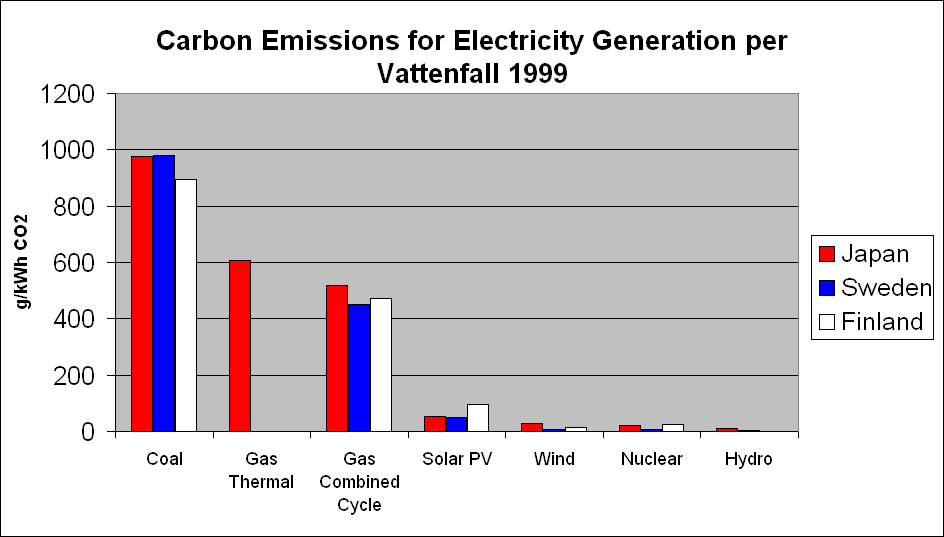
Alts as in alternatives to fossil fuels that generate GHG emissions. Nuclear certainly qualifies:
Carbon emissions for electricity Generation
Carbon emissions for electricity Generation
The oil barrel is half-full.
-
kublikhan - Master Prognosticator
- Posts: 5064
- Joined: Tue 06 Nov 2007, 04:00:00
- Location: Illinois
Re: Impossible - wind and solar
by kiwichick » Mon 26 Dec 2016, 17:45:08
@pstarr...I would have to agree with you about the current nuclear plants not being renewable .....due to the fact that Uranium has to mined and also due to the decommissioning costs
but the others are all definitely renewable.....and as efficiency of solar panels , wind turbines , geothermal systems etc, improve and the increase of the % of power generated by renewables increases , they become increasingly more renewable
but the others are all definitely renewable.....and as efficiency of solar panels , wind turbines , geothermal systems etc, improve and the increase of the % of power generated by renewables increases , they become increasingly more renewable
-
kiwichick - Intermediate Crude

- Posts: 2267
- Joined: Sat 02 Aug 2008, 03:00:00
- Location: Southland New Zealand
Re: Impossible - wind and solar
by Subjectivist » Mon 26 Dec 2016, 19:02:24
$this->bbcode_second_pass_quote('kiwichick', '@')pstarr...I would have to agree with you about the current nuclear plants not being renewable .....due to the fact that Uranium has to mined and also due to the decommissioning costs
but the others are all definitely renewable.....and as efficiency of solar panels , wind turbines , geothermal systems etc, improve and the increase of the % of power generated by renewables increases , they become increasingly more renewable
but the others are all definitely renewable.....and as efficiency of solar panels , wind turbines , geothermal systems etc, improve and the increase of the % of power generated by renewables increases , they become increasingly more renewable
The problem with the theory you are aspousing is all those renewable methodologies also require mining and processing and maintenence.
The EROEI on nuclear fission is so high it easily compensates for all those real world expenses, the same is debateable for wind and very problematic for solar PV.
II Chronicles 7:14 if my people, who are called by my name, will humble themselves and pray and seek my face and turn from their wicked ways, then I will hear from heaven, and I will forgive their sin and will heal their land.
- Subjectivist
- Volunteer
- Posts: 4705
- Joined: Sat 28 Aug 2010, 07:38:26
- Location: Northwest Ohio
Re: Impossible - wind and solar
by Zarquon » Mon 26 Dec 2016, 19:51:22
$this->bbcode_second_pass_quote('onlooker', '
')6: The Best Places For Solar And Wind Are Usually Far Away From Consumers
')6: The Best Places For Solar And Wind Are Usually Far Away From Consumers
That reminds me of an older post on Tom Murphy's blog:
http://physics.ucsd.edu/do-the-math/201 ... ure-trove/
It's a long and nerdy post about how surprisingly small the differences in PV output between the best and the worst US locations are - Alaska and S. California differ by a factor of merely two.
And here's the National Renewable Energy Lab's online PV calculator:
http://pvwatts.nrel.gov/pvwatts.php
Very nice and simple tool. Just enter a city name, leave everything on the next page on default settings (a standard single-family rooftop installation) and here's the results in kwh/a:
Anchorage 3,454
NYC 5,097
Fargo 5,308
Houston 5,356
St. Louis 5,462
San Diego 6,438
So the best place for solar is probably pretty much wherever you happen to live. OK, if you live in Alaska you're screwed, but then if you live in Alaska you already know that.
(edit: Houston gets as much output as Fargo, North Dakota? What is it, your ten-gallon hats shading the roofs or what?)
- Zarquon
- Lignite

- Posts: 321
- Joined: Fri 06 May 2016, 20:53:46