Donate Bitcoin

Donate Paypal


PeakOil is You

PeakOil is You

Resurrection: Peak Oil doesn’t equal energy scarcity

General discussions of the systemic, societal and civilisational effects of depletion.

Unread postby JohnDenver » Tue 12 Jul 2005, 07:18:38

...(Duplicate post, please delete)
Last edited by JohnDenver on Tue 12 Jul 2005, 07:21:14, edited 1 time in total.
JohnDenver
Intermediate Crude
Intermediate Crude
 
Posts: 2145
Joined: Sun 29 Aug 2004, 03:00:00

Unread postby Doly » Tue 12 Jul 2005, 07:20:07

$this->bbcode_second_pass_quote('kochevnik', '
')Complexity is all around us, it's only possible because of cheap energy. When there is no more cheap energy, anything that relies on massive complexity is on very shaky legs.


I really can't see why complexity is supposed to equal cheap energy. Pre-industrial society looks pretty complex to me. We may be even more complex, but I'd blame it as much on easy comms as on easy transport.

$this->bbcode_second_pass_quote('kochevnik', '
')Coal mining is definitely in this category.


Considering that it was pre-industrial societies who started coal mining, I think it's quite definitely not too complex.
User avatar
Doly
Expert
Expert
 
Posts: 4370
Joined: Fri 03 Dec 2004, 04:00:00

Unread postby MD » Tue 12 Jul 2005, 07:24:43

JD,
Whay are you using facts to interrupt a good speculation?
Stop filling dumpsters, as much as you possibly can, and everything will get better.

Just think it through.
It's not hard to do.
User avatar
MD
COB
COB
 
Posts: 4953
Joined: Mon 02 May 2005, 03:00:00
Location: On the ball

Unread postby pip » Tue 12 Jul 2005, 11:20:26

$this->bbcode_second_pass_quote('kochevnik', '
')Not to mention, most of these critical components ARENT MADE HERE IN THE USA any more.

:!:


Critical components are actually likely to still be made in the US. The only other possibilities are Europe or Japan.

At least that's been my experience when quoting engineered equipment for the refining industry.
The road goes on forever and the party never ends - REK
User avatar
pip
Coal
Coal
 
Posts: 480
Joined: Wed 21 Apr 2004, 03:00:00
Location: Republic of Texas

Unread postby Leanan » Tue 12 Jul 2005, 12:34:24

$this->bbcode_second_pass_quote('', 'D')ifficult? – yes. Impossible? Most certainly not.


I agree with you there. If we start right now, we can probably do it. But I don't think we'll start right now. I much fear we will wait until it's too late.

$this->bbcode_second_pass_quote('', ' ')But since peak oil doesn’t equal no oil, by no means is the energy drop necessarily permanent.


There's a small, outside chance that we'll find a new source of energy that's even more concentrated than oil. Maybe there will be a miraculous cold fusion breakthrough. Or someone will discover Tesla's secret. But if we are forced to return to lower-EROEI sources like coal or wood, peak oil is peak energy.

$this->bbcode_second_pass_quote('', ' ')b) you would have to show that there would be no political will to do it (which I think is ridiculous).


Actually, I think this is closest to my view of the future. Though it's more a matter of money than political will. We won't be able to afford it. We're already so deeply in debt that if it weren't for the petrodollar, we'd be facing an Argentina-style economic crisis.

So much of our infrastructure, even government-built infrastructure, was built, not for the betterment of the citizens, but in order to make money for a few individuals or companies. Roads built so GM could sell cars, airports built so PanAm could take off, people herded onto the Internet for the benefit of e-commerce, etc. If there's no money to be made, it won't happen. Or it will happen much more slowly.

Goodstein does thermodynamic analyses of all the alternatives. He points out that a big problem we'll be facing is entropy. If we convert coal to liquid fuel, we'll lose 3/4 of the energy of coal in the process. It takes four BTUs of coal to produce one BTU of liquid fuel. So we're facing something of an uphill battle.

However, his calculations do show that it's theoretically possible to replace all the energy we use today. We, as in the U.S. We'd have to build 10,000 nuclear power plants, each as large as modern engineering allows. There are currently about 500 nuclear plants in the world, so this would be a huge scale-up.

Ten thousand power plants. That's 200 in each state. Do you really think we could afford that? Would we be able to get enough concrete and steel and oil to do it?

And that's just the U.S. Even if we can afford it, much of the rest of the world won't be able to. So energy production would inevitably drop.

$this->bbcode_second_pass_quote('', 'c')) the economy would have to be so shattered and hobbled from peaking oil that the bottlenecks and constraints are insurmountable (I just don't see this)


This is also a possibility. A lot of financial talking heads who don't believe in peak oil are worried that we're on the brink of disaster.

$this->bbcode_second_pass_quote('', 'A')s for your comment about the electricity infrastructure failing, I don’t know where you get that from...the only thing I can think of is you are seeing the blackout in the NE of NA in 2003 as a sign of things to come.


No, that was one symptom of the problem. But I've been aware of our electricity issues long before that blackout.

Basically, the problem is that we've outgrown the existing grid. A lot of it is very old. Parts of it were built in the 1930s! It's also quite inefficient. Congress agrees that it needs to be replaced, or at least upgraded, but the expense is prohibitive. So we keep patching it. Here are a couple of articles:

http://www.cnn.com/2003/US/08/16/nyt.firestone.revkin/

http://www.jsonline.com/bym/news/aug04/251031.asp

$this->bbcode_second_pass_quote('', 'N')ot a whole lot of oil being used, as you can see.

And once again, JD waves around these statistics that only prove that we've offshored all the energy-intensive industry. We're not using a lot of energy for manufacturing in the U.S. Because it's all done overseas, and the finished products shipped here. That will be a liability, not at advantage, in the post-peak world.
User avatar
Leanan
News Editor
News Editor
 
Posts: 4582
Joined: Thu 20 May 2004, 03:00:00
Top

Unread postby SchroedingersCat » Tue 12 Jul 2005, 13:29:28

Of course, if we want to keep mining this stuff we need to address the issue of 'peak tires':

Shortage of Five-Ton Tires Hinders Global Mining Expansions

$this->bbcode_second_pass_quote('', 'W')hat we are seeing at the moment is nothing, it's going to get far worse,'' said Tony Cutler, technical manager at Otraco International Pty, a Perth, Australia-based industry adviser on tires. The tire shortage will last until at least 2008, he said.

Bridgestone, the world's second-biggest tiremaker by volume, is running its mining-tire plants at capacity, Andrew Andreou, the company's sales manager for Australia, said in a June 23 interview. The Tokyo-based company is reviewing production, but hasn't commissioned new plants, he said.
Civilization is a personal choice.
SchroedingersCat
Tar Sands
Tar Sands
 
Posts: 541
Joined: Thu 26 May 2005, 03:00:00
Location: The ragged edge
Top

Unread postby FatherOfTwo » Tue 12 Jul 2005, 16:17:26

$this->bbcode_second_pass_quote('Leanan', 'S')o much of our infrastructure, even government-built infrastructure, was built, not for the betterment of the citizens, but in order to make money for a few individuals or companies. Roads built so GM could sell cars, airports built so PanAm could take off, people herded onto the Internet for the benefit of e-commerce, etc. If there's no money to be made, it won't happen. Or it will happen much more slowly.


I agree that our current infrastructure was built under those circumstances. But just because the companies which have been making money selling goods that take advantage of cheap oil doesn’t mean companies won’t make money taking advantage of expensive oil. Money and capital moves very quickly. There’ll be a massive money infusion (both private and government) to rail for transport (because it is by far the most efficient) to the coal and nuclear industries, everything that transitions us away from oil. Will it be enough, I’m not sure.

$this->bbcode_second_pass_quote('Leanan', 'T')en thousand power plants. That's 200 in each state. Do you really think we could afford that? Would we be able to get enough concrete and steel and oil to do it?


Oh sure, you have to go and dive into the details! :-)
These are the numbers that I’ve found with regards to how much steel is produced globally versus how much steel is used to construct a nuclear plant. Global annual steel production just passed 1 billion tonnes
According to the numbers given at this site one 1GWe nuclear plant requires approximately 65,000 tonnes of re-enforced, stainless and other steels and 450000 tonnes of concrete and cement. If all of the global steel production went to construct nuclear reactors, we could build 15000 reactors per year at current steel production levels. It’s completely unrealistic to say 100% of the steel would go to nuclear power plants, so say 20% was dedicated to nuclear power plant construction, then (without considering concrete requirements) we could construct (globally) 3000 nuclear power plants per year.

But I have to be honest and say I don’t know if even that is feasible. The cynic in me is shouting out that an awful lot of pieces of the puzzle are going to have to fall into place. :(
User avatar
FatherOfTwo
Tar Sands
Tar Sands
 
Posts: 960
Joined: Thu 11 Nov 2004, 04:00:00
Location: Heart of Canada's Oil Country
Top

Unread postby Ludi » Tue 12 Jul 2005, 17:58:02

$this->bbcode_second_pass_quote('FatherOfTwo', ' ')There’ll be a massive money infusion (both private and government) to rail for transport (because it is by far the most efficient) to the coal and nuclear industries, everything that transitions us away from oil.


I keep wondering when this will occur. If it happens after peak, then surely there will be energy scarcity, because the infrastructure for the replacement energy won't be in place, perhaps not in place for several years. Wouldn't that mean scarcity?
Ludi
 
Top

Unread postby JohnDenver » Tue 12 Jul 2005, 21:44:04

$this->bbcode_second_pass_quote('Leanan', 'G')oodstein does thermodynamic analyses of all the alternatives. He points out that a big problem we'll be facing is entropy. If we convert coal to liquid fuel, we'll lose 3/4 of the energy of coal in the process. It takes four BTUs of coal to produce one BTU of liquid fuel.


According to my Source(pdf) this is incorrect. The thermal efficiency given there (P.12, with a beautiful energy flow diagram for the process) is 67% for direct liquefaction. That means we lose 1/3 of the energy of coal in the process. It takes 1.5 BTUs of coal to produce 1 BTU of liquid.

Who is Goodstein?

$this->bbcode_second_pass_quote('', 'A')nd once again, JD waves around these statistics that only prove that we've offshored all the energy-intensive industry. We're not using a lot of energy for manufacturing in the U.S. Because it's all done overseas, and the finished products shipped here.


What are you talking about? According to the International Iron and Steel Institute "World Steel in Figures 2005", the world's top 3 steel producers in 2004 were: China (273 million metric tons), Japan (113 mmt) and the U.S. (99 mmt).

In 1998, the U.S. steel industry used 2.0 quads of energy. For comparison, the petroleum refining (the most energy intensive manufacturing industry in the U.S.) used 7.1 quads in 1998. 2.0 quads is 6.6% of all energy used in the U.S. in 1998.

So let's not be stupid, Leanan. We have not off-shored all the energy-intensive industry. It's not "all done overseas". Massive amounts of steel are produced in the U.S., and massive amounts of energy are used to do it. Virtually none of that energy is supplied by oil, as the statistics show.
JohnDenver
Intermediate Crude
Intermediate Crude
 
Posts: 2145
Joined: Sun 29 Aug 2004, 03:00:00
Top

Unread postby Antimatter » Wed 13 Jul 2005, 01:46:27

$this->bbcode_second_pass_quote('Leanan', 'H')owever, his calculations do show that it's theoretically possible to replace all the energy we use today. We, as in the U.S. We'd have to build 10,000 nuclear power plants, each as large as modern engineering allows. There are currently about 500 nuclear plants in the world, so this would be a huge scale-up.


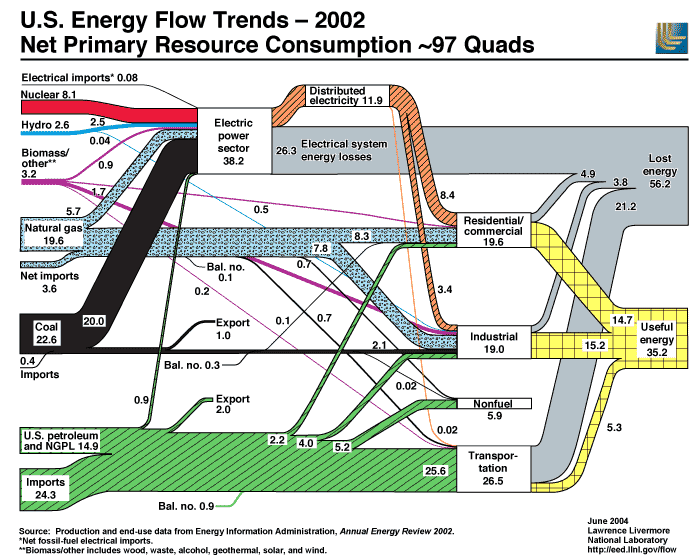
This doesn't pass the smell test. The US has an installed generating capacity of 813 gigawatts (2001 figures, source) and produced 3,836 billion kilowatthours in 2002 at an average of ~440GW. A large nuclear plant is usually over 1GW but we'll go with the 1GW figure for simplicity. Under 1000 reactors would replace the entire US power grid. I find it hard to beleive 10x this much would be needed to replace all the US primary energy consumption.

Image

According to the US energy flow diagram we all know and love, the electric power sector consumed over 2/3 of the primary energy used. I can't be bothered crunching the numbers atm but 3000 reactors would probably more than suffice, and much less if off peak power was utilised ie. they ran flat out all around the clock.
User avatar
Antimatter
Tar Sands
Tar Sands
 
Posts: 587
Joined: Tue 04 Jan 2005, 04:00:00
Location: Australia
Top

Unread postby MonteQuest » Wed 13 Jul 2005, 02:43:32

$this->bbcode_second_pass_quote('kochevnik', 'C')omplexity is all around us, it's only possible because of cheap energy. When there is no more cheap energy, anything that relies on massive complexity is on very shaky legs. Coal mining is definitely in this category.:!:


Spot on, kochevnik. Let's cut the crap. Peak oil means no more cheap energy. Forget about scarcity, think price! I don't care how much energy you come up with, if it isn't as cheap or cheaper than oil has been, as readily available and portable (near to same energy density) then you come up short. And "short" means no growth in a must grow economy.

We could never have built what we have without cheap fossil fuels, but we can maintain this complexity and expand without them? Not at anything close to this standard of living, level of technology, or much less, population level.

Even if we come up with "alternatives" to fill the gap in time, eventually the gap will be too wide to fill.

Where is the new oil going to come from?

The "invisible hand" of the market?
A Saudi saying, "My father rode a camel. I drive a car. My son flies a jet-plane. His son will ride a camel."
User avatar
MonteQuest
Expert
Expert
 
Posts: 16593
Joined: Mon 06 Sep 2004, 03:00:00
Location: Westboro, MO
Top

Unread postby oiless » Wed 13 Jul 2005, 03:02:53

Just a little link on US steel consumption some might find interesting...

http://www.aiis.org/54th_annual/materia ... tement.htm
User avatar
oiless
Lignite
Lignite
 
Posts: 300
Joined: Sat 25 Jun 2005, 03:00:00
Location: British Columbia, Canada

Unread postby Dezakin » Wed 13 Jul 2005, 04:16:09

$this->bbcode_second_pass_quote('', 'E')ven if we come up with "alternatives" to fill the gap in time, eventually the gap will be too wide to fill.

Right. You think that the US economy is so fragile we'll crumble even with cheap oil, dragging down the entire global economy perhaps. Even though economic growth has continued for the past century despite a depression and the odd recession.

$this->bbcode_second_pass_quote('', 'W')here is the new oil going to come from?

The "invisible hand" of the market?


Sure. Markets eventually work, even if they are often sloppy.

Tell you what, where exactly do you envisage the world in 10 and 50 years so we can establish how wrong you are. (Or how wrong I am as you like it.)
User avatar
Dezakin
Heavy Crude
Heavy Crude
 
Posts: 1569
Joined: Wed 09 Feb 2005, 04:00:00
Top

Unread postby JohnDenver » Wed 13 Jul 2005, 04:44:15

$this->bbcode_second_pass_quote('MonteQuest', 'S')pot on, kochevnik. Let's cut the crap. Peak oil means no more cheap energy. Forget about scarcity, think price! I don't care how much energy you come up with, if it isn't as cheap or cheaper than oil has been, as readily available and portable (near to same energy density) then you come up short. And "short" means no growth in a must grow economy.


How much more expensive will the expensive energy be? A lot?
I don't see how increased price is going to be such a devastating problem.
Gasoline is already absurdly expensive in Europe, and they're still functioning just fine.
For that matter, I don't use oil at all. I'm running on electricity and LNG in one of the most expensive cities in the world. My electricity costs about $0.06/kilo-btu, and my natural gas costs $0.04/kilo-btu as compared to U.S. gasoline which costs about $0.02/kilo-btu.
So most of my energy is already 3 times higher than the energy you're buying at the pump. It isn't bothering me much. It's a miniscule fraction of my entire budget.
Maybe you guys in the States are just using too much energy. :lol:
JohnDenver
Intermediate Crude
Intermediate Crude
 
Posts: 2145
Joined: Sun 29 Aug 2004, 03:00:00
Top

Unread postby Sys1 » Wed 13 Jul 2005, 08:08:28

$this->bbcode_second_pass_quote('', 'I') don't see how increased price is going to be such a devastating problem.


JohnDenver, i'm sad to see you don't figure out peak oil after more than 1000 posts. Why the hell do you think prices are going up if it doesn't change a single thing ?
If 100$ oil doesn't change consumption then it will head to 200, 300 ... until you will wake up one morning regarding your SUV with tears in your eyes... Prices will go up until demand destruction.
User avatar
Sys1
Tar Sands
Tar Sands
 
Posts: 983
Joined: Fri 25 Feb 2005, 04:00:00
Top

Unread postby Doly » Wed 13 Jul 2005, 11:26:17

$this->bbcode_second_pass_quote('Sys1', '
')If 100$ oil doesn't change consumption then it will head to 200, 300 ... until you will wake up one morning regarding your SUV with tears in your eyes... Prices will go up until demand destruction.


Not quite right. Market forces mean that, every time that price goes up, there is some amount of demand destruction. If prices are now at $60, it means that there are the same amount of demand at $60 as there is of supply at $60. If oil was cheaper, there would be more demand. Or, looking at it in a different way, somebody who could afford oil at $30 isn't buying oil at $60. Demand destruction is happening now, somewhere. We may not see it around us, maybe because it's happening in poor countries, but basic economy tells us that demand destruction IS HAPPENING.
User avatar
Doly
Expert
Expert
 
Posts: 4370
Joined: Fri 03 Dec 2004, 04:00:00
Top

Unread postby Leanan » Wed 13 Jul 2005, 11:56:13

$this->bbcode_second_pass_quote('', 'I') agree that our current infrastructure was built under those circumstances. But just because the companies which have been making money selling goods that take advantage of cheap oil doesn’t mean companies won’t make money taking advantage of expensive oil. Money and capital moves very quickly. There’ll be a massive money infusion (both private and government) to rail for transport (because it is by far the most efficient) to the coal and nuclear industries, everything that transitions us away from oil.


I'm not so sure about that myself. It's cheap energy that makes capitalism possible. The whole point of capitalism is expansion: more customers, buying more goods, ad infinitum. Each generation living better (or at least buying more stuff) than the generation before. Oil made that possible.

Once that is no longer true, there's no longer any incentive to invest wealth. I think investors and corporations will retrench, rather than risking huge new investments that could go down in flames. If people are only going to get poorer and poorer, what's the point of upgrading your facilities? They won't be able to afford your products anyway.

The government is probably our best bet. But we're so much in debt that I seriously doubt our ability to launch any major new programs. And will there be the political will to do this, rather than just blame the Chinese or the Saudis or the French, and put the money into the military instead?

$this->bbcode_second_pass_quote('', ' ')But I have to be honest and say I don’t know if even that is feasible. The cynic in me is shouting out that an awful lot of pieces of the puzzle are going to have to fall into place.


That is in fact Goodstein's position, too. Possible, yes, but at this point, very difficult. We'd be much better off if we'd started in the '70s, when we got the first warning.

$this->bbcode_second_pass_quote('', 'I') find it hard to beleive 10x this much would be needed to replace all the US primary energy consumption.


Dr. David Goodstein is a physicist at CalTech, and the author of Out of Gas: The End of the Age of Oil. Being a physicist, his take is a thermodynamic one. When he calculates the number of plants we need to build, he subtracts the energy needed to build the plants from the amount they will eventually produce. He also takes into account entropy - the energy lost when you convert one form of energy into another.
User avatar
Leanan
News Editor
News Editor
 
Posts: 4582
Joined: Thu 20 May 2004, 03:00:00
Top

Unread postby DriveElectric » Wed 13 Jul 2005, 12:36:42

$this->bbcode_second_pass_quote('RonMN', 'S')o we'll trade "energy scarcity" for coal pollution, acid rain, & nuclear mishaps.


What nuclear mishaps are you referring to? The overall record seems very safe since 1986.
User avatar
DriveElectric
Tar Sands
Tar Sands
 
Posts: 599
Joined: Sat 12 Mar 2005, 04:00:00
Top

Unread postby Ludi » Wed 13 Jul 2005, 13:51:38

$this->bbcode_second_pass_quote('DriveElectric', '
')
What nuclear mishaps are you referring to? The overall record seems very safe since 1986.


Probably since there are so few plants (at least in the US) and they are so highly regulated. If there is a crash program to build many plants, will there be safety standards and monitoring comparable to the existing plants?
Ludi
 
Top

Unread postby DriveElectric » Wed 13 Jul 2005, 14:05:39

$this->bbcode_second_pass_quote('Ludi', '')$this->bbcode_second_pass_quote('DriveElectric', '
')
What nuclear mishaps are you referring to? The overall record seems very safe since 1986.


Probably since there are so few plants (at least in the US) and they are so highly regulated. If there is a crash program to build many plants, will there be safety standards and monitoring comparable to the existing plants?


Since the newer designs are much more improved and have the experience of years of best practices, it is quite likely that the safety record of newer nuclear power plants will be even better.
User avatar
DriveElectric
Tar Sands
Tar Sands
 
Posts: 599
Joined: Sat 12 Mar 2005, 04:00:00
Top

PreviousNext

Return to Peak Oil Discussion

Who is online

Users browsing this forum: No registered users and 1 guest

cron