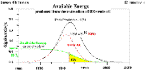
I'm a little tired of all the Hubbert bashing from the peak-oil crowd lately, quite annoyed really, so I barfed it all out onto a pdf:
https://drive.google.com/file/d/0B5ci5zMS_2kZOW1VdGxOUURCdVU/view?usp=sharing
Enjoy!



PeakOil is You
Why Hubbert is right and peak-oil idiots are wrong
Why Hubbert is right and peak-oil idiots are wrong
 by jerry_mcmanus » Tue 20 Sep 2016, 00:41:07
-

jerry_mcmanus - Wood

- Posts: 33
- Joined: Fri 18 Apr 2008, 03:00:00
Re: Why Hubbert is right and peak-oil idiots are wrong
by ROCKMAN » Tue 20 Sep 2016, 01:29:55
Jerry - The Rockman appreciates your motivation. But what I find more interesting is how many folks think it's important to prove or disprove anything Dr. Hubbert postulated. This ain't the 1950's and what anyone thought, rightly or incorrectly, then has no bearing on our future. He was predicting what might happen in the US in the next few decades after he published his paper. But now, 60 years later, his work (which was truly brilliant compared to the industry mindset at the time) has no relevance to what has happened in the last 10 years let alone the future.
It's sort of like the continuous debate about the Etp model. Right? Wrong? Does it really matter: I've yet to hear how anyone is using it to make any significant changes of the energy path we're on. If a model has little or no practical utility being applied I really don't care if it's correct or not.
It's sort of like the continuous debate about the Etp model. Right? Wrong? Does it really matter: I've yet to hear how anyone is using it to make any significant changes of the energy path we're on. If a model has little or no practical utility being applied I really don't care if it's correct or not.
-

ROCKMAN - Expert

- Posts: 11397
- Joined: Tue 27 May 2008, 03:00:00
- Location: TEXAS
Re: Why Hubbert is right and peak-oil idiots are wrong
by SumYunGai » Tue 20 Sep 2016, 01:53:36
$this->bbcode_second_pass_quote('ROCKMAN', 'J')erry - The Rockman appreciates your motivation. But what I find more interesting is how many folks think it's important to prove or disprove anything Dr. Hubbert postulated. This ain't the 1950's and what anyone thought, rightly or incorrectly, then has no bearing on our future. He was predicting what might happen in the US in the next few decades after he published his paper. But now, 60 years later, his work (which was truly brilliant compared to the industry mindset at the time) has no relevance to what has happened in the last 10 years let alone the future.
It's sort of like the continuous debate about the Etp model. Right? Wrong? Does it really matter: I've yet to hear how anyone is using it to make any significant changes of the energy path we're on. If a model has little or no practical utility being applied I really don't care if it's correct or not.
It's sort of like the continuous debate about the Etp model. Right? Wrong? Does it really matter: I've yet to hear how anyone is using it to make any significant changes of the energy path we're on. If a model has little or no practical utility being applied I really don't care if it's correct or not.
The Etp model has a very practical utility. It forecasts that oil prices will continue to decline. You don't like that forecast very much, so you just disregard the Etp model. Poof, no worries.
And what on earth makes you think we can change the energy path we are on? Human will cannot override physics. As a species, we have no control over our thermodynamic destiny. We are like yeast in a vat of grape juice.
-

SumYunGai - Permanently Banned
- Posts: 421
- Joined: Fri 29 Jul 2016, 21:02:21
Re: Why Hubbert is right and peak-oil idiots are wrong
by KaiserJeep » Tue 20 Sep 2016, 02:42:51
To the contrary, you as a modern day consumer have all the choices available to you. You can choose Green energy sources over fossil fuels, you can choose practical electric vehicles over oil burners. You can choose locally sourced organic foods over supermarket packages. You can choose a residence built with Green materials or various petrochemicals.
Yes, it is true that all the planet-saving alternatives cost more than the FF versions. If you were not so thoughtless and you actually could even acknowledge your own responsibility for killing the planet, that would be a start. But you won't or can't admit that your own choices are killing the planet, because you are greedy and want more stuff that you don't actually need to live.
Some of us yeast animals are climbing over the rim of our wine fermentation vat, and going elsewhere and doing other things. It is up to you, everything hinges on the choices made by consumers.
Yes, it is true that all the planet-saving alternatives cost more than the FF versions. If you were not so thoughtless and you actually could even acknowledge your own responsibility for killing the planet, that would be a start. But you won't or can't admit that your own choices are killing the planet, because you are greedy and want more stuff that you don't actually need to live.
Some of us yeast animals are climbing over the rim of our wine fermentation vat, and going elsewhere and doing other things. It is up to you, everything hinges on the choices made by consumers.
KaiserJeep 2.0, Neural Subnode 0010 0000 0001 0110 - 1001 0011 0011, Tertiary Adjunct to Unimatrix 0000 0000 0001
Resistance is Futile, YOU will be Assimilated.
Warning: Messages timestamped before April 1, 2016, 06:00 PST were posted by the unmodified human KaiserJeep 1.0
Resistance is Futile, YOU will be Assimilated.
Warning: Messages timestamped before April 1, 2016, 06:00 PST were posted by the unmodified human KaiserJeep 1.0
- KaiserJeep
- Light Sweet Crude

- Posts: 6094
- Joined: Tue 06 Aug 2013, 17:16:32
- Location: Wisconsin's Dreamland
Re: Why Hubbert is right and peak-oil idiots are wrong
by SumYunGai » Tue 20 Sep 2016, 03:16:18
$this->bbcode_second_pass_quote('KaiserJeep', 'T')o the contrary, you as a modern day consumer have all the choices available to you.
We may currently have some choices as individual "consumers". But as a species, we have no control over our thermodynamic destiny.
$this->bbcode_second_pass_quote('KaiserJeep', 'Y')ou can choose Green energy sources over fossil fuels, you can choose practical electric vehicles over oil burners. You can choose locally sourced organic foods over supermarket packages. You can choose a residence built with Green materials or various petrochemicals.
Unfortunately, there are *WAY* too many people for everyone to choose "green" energy sources, electric vehicles, locally sourced organic foods, and "green" building materials for their residences. Thus, as a species, we are screwed.
$this->bbcode_second_pass_quote('KaiserJeep', 'Y')es, it is true that all the planet-saving alternatives cost more than the FF versions. If you were not so thoughtless and you actually could even acknowledge your own responsibility for killing the planet, that would be a start. But you won't or can't admit that your own choices are killing the planet, because you are greedy and want more stuff that you don't actually need to live.
Twisted. None of us asked to be born into this insane civilization at the worst possible time. The current situation isn't anybody's fault. What possible purpose is served by playing some stupid blame game? As a species, we are all in this thing together.
$this->bbcode_second_pass_quote('KaiserJeep', 'S')ome of us yeast animals are climbing over the rim of our wine fermentation vat, and going elsewhere and doing other things.
Climbing over the rim? You are living in a dream vat! Those choices you are so proud of are all subsidized by fossil fuel use. And most yeast cannot even afford the choices available to the privileged few.
You cannot climb over the rim of the vat, no matter what you might dream. The only reason you can even see the rim is because you climbed on top of so many other yeast. But you can't admit that.
$this->bbcode_second_pass_quote('KaiserJeep', 'I')t is up to you, everything hinges on the choices made by consumers.
Yes, individual outcomes may vary, but as a species...
Last edited by SumYunGai on Tue 20 Sep 2016, 04:24:26, edited 4 times in total.