HI... I'm somewhat uninitiated, and I apologize for my ignorance.
Someone asked me recently if a barrel of oil does more today than it did 50 years ago, and my instinct was "no, not in terms of the liquid's burning efficiency. It does less."
Do I have that completely wrong? Has a barrel of oil always yielded 5.6-5.8 million BTU? Or has it gotten less efficient over time? Any links or charts showing oil's historical efficiency?
If he means "doesn't oil provide more functions today?" then I suppose I misunderstood his question. But I would love to be clearer on all angles before I respond.



PeakOil is You
Has the BTU rate per barrel changed?
Has the BTU rate per barrel changed?
 by SugarSeam » Wed 23 Dec 2015, 17:08:53
Last edited by SugarSeam on Wed 23 Dec 2015, 17:26:04, edited 1 time in total.
- SugarSeam
- Wood

- Posts: 19
- Joined: Sun 26 Apr 2015, 19:08:56
Re: Has the BTU rate per barrel changed?
by Plantagenet » Wed 23 Dec 2015, 17:16:56
Are you trying to get us in trouble with the IRS? OF COURSE the BTUs vary as the quality of the oil varies, but the BTUs in a barrel of oil has been officially set by the IRS, don''t you know? If you want to change the official number then you'll have to go through the IRS to do it.
The barrel of oil equivalent (BOE) is a unit of energy based on the approximate energy released by burning one barrel (42 U.S. gallons or 158.9873 litres) of crude oil. The BOE is used by oil and gas companies in their financial statements as a way of combining oil and natural gas reserves and production into a single measure, although this energy equivalence does not take into account the lower financial value of energy in the form of gas.
The U.S. Internal Revenue Service defines a BOE as equal to 5.8 × 10⁶ BTU.[1] (5.8 × 10⁶ BTU59 °F equals 6.1178632 × 10⁹ J, about 6.1 GJ (HHV), or 1.7 MWh.) The value is necessarily approximate as various grades of oil and gas have slightly different heating values. If one considers the lower heating value instead of the higher heating value, the value for one BOE would be approximately 5.4 GJ (see ton of oil equivalent). Typically 5,800 cubic feet of natural gas or 58 CCF are equivalent to one BOE. The USGS gives a figure of 6,000 cubic feet (170 cubic meters) of typical natural gas.[2]
A commonly used multiple of the BOE is the kilo barrel of oil equivalent (kboe or kBOE), which is 1,000BOE. Other common multiples are the million barrels per day, MMboed (or MMBOED, MMboepd), used to measure daily production and consumption,[3] and the BBOe (also BBOE) or billion barrel of oil equivalent, representing 109 barrels of oil, used to measure petroleum reserves.[4]
Metric users may talk of the tonne of oil equivalent (TOE), or more often million TOE (MTOE). Since this is a measurement of weight, any conversion to barrels of oil equivalent depends on the density of the oil in question, as well as the energy content. Typically 1 tonne of oil has a volume of 6.8-7.5 barrels. The United States EIA suggests 1TOE has an average energy value of 39.68 million Btu.[5]
--from Wikipedia
The barrel of oil equivalent (BOE) is a unit of energy based on the approximate energy released by burning one barrel (42 U.S. gallons or 158.9873 litres) of crude oil. The BOE is used by oil and gas companies in their financial statements as a way of combining oil and natural gas reserves and production into a single measure, although this energy equivalence does not take into account the lower financial value of energy in the form of gas.
The U.S. Internal Revenue Service defines a BOE as equal to 5.8 × 10⁶ BTU.[1] (5.8 × 10⁶ BTU59 °F equals 6.1178632 × 10⁹ J, about 6.1 GJ (HHV), or 1.7 MWh.) The value is necessarily approximate as various grades of oil and gas have slightly different heating values. If one considers the lower heating value instead of the higher heating value, the value for one BOE would be approximately 5.4 GJ (see ton of oil equivalent). Typically 5,800 cubic feet of natural gas or 58 CCF are equivalent to one BOE. The USGS gives a figure of 6,000 cubic feet (170 cubic meters) of typical natural gas.[2]
A commonly used multiple of the BOE is the kilo barrel of oil equivalent (kboe or kBOE), which is 1,000BOE. Other common multiples are the million barrels per day, MMboed (or MMBOED, MMboepd), used to measure daily production and consumption,[3] and the BBOe (also BBOE) or billion barrel of oil equivalent, representing 109 barrels of oil, used to measure petroleum reserves.[4]
Metric users may talk of the tonne of oil equivalent (TOE), or more often million TOE (MTOE). Since this is a measurement of weight, any conversion to barrels of oil equivalent depends on the density of the oil in question, as well as the energy content. Typically 1 tonne of oil has a volume of 6.8-7.5 barrels. The United States EIA suggests 1TOE has an average energy value of 39.68 million Btu.[5]
--from Wikipedia
Never underestimate the ability of Joe Biden to f#@% things up---Barack Obama
-----------------------------------------------------------
Keep running between the raindrops.
-----------------------------------------------------------
Keep running between the raindrops.
-

Plantagenet - Expert

- Posts: 26765
- Joined: Mon 09 Apr 2007, 03:00:00
- Location: Alaska (its much bigger than Texas).
Re: Has the BTU rate per barrel changed?
by Pops » Wed 23 Dec 2015, 18:06:44
Pete has it I think. There are all different kinds of oil and other flammable stuff and they have different properties. Generally though we once upon a time had plenty of just plain old crude that was "fairly" homogenous, some a little lighter with a percent or 2 less BTU, some a little heavier.
Now we have all sorts of stuff from very heavy to very light to ethanol... mainly because the stuff in the middle can't keep up with demand.
Google "Hall EROEI" for some authoritative stuff.
EROEI = energy returned on energy invested
As far as what use we get out of it, vehicles, processes, architecture, manufacturing have all gotten much more efficient since the '70s. But instead of being happy about using less, we drive more and bigger cars, buy more stuff and live in much bigger homes.
The upshot is that between the embargoes and the last recession we became much more efficient but used about the same amount per capita. consumption has fallen in the rich world since the recession, the third world is catching up though.
You can google that too, it's called Jevon's Paradox.
Now we have all sorts of stuff from very heavy to very light to ethanol... mainly because the stuff in the middle can't keep up with demand.
Google "Hall EROEI" for some authoritative stuff.
EROEI = energy returned on energy invested
As far as what use we get out of it, vehicles, processes, architecture, manufacturing have all gotten much more efficient since the '70s. But instead of being happy about using less, we drive more and bigger cars, buy more stuff and live in much bigger homes.
The upshot is that between the embargoes and the last recession we became much more efficient but used about the same amount per capita. consumption has fallen in the rich world since the recession, the third world is catching up though.
You can google that too, it's called Jevon's Paradox.
The legitimate object of government, is to do for a community of people, whatever they need to have done, but can not do, at all, or can not, so well do, for themselves -- in their separate, and individual capacities.
-- Abraham Lincoln, Fragment on Government (July 1, 1854)
-- Abraham Lincoln, Fragment on Government (July 1, 1854)
-

Pops - Elite
- Posts: 19746
- Joined: Sat 03 Apr 2004, 04:00:00
- Location: QuikSac for a 6-Pac
Re: Has the BTU rate per barrel changed?
by shortonoil » Wed 23 Dec 2015, 20:03:43
The exergy content (which is what the EIA publishes) of a liquid hydrocarbon is a property of its molecular structure. It is directly proportional to its API gravity:
http://www.thehillsgroup.org/depletion2_011.htm
According to EIA data, between 2000 and 2005 the average barrel of oil that was processed through US refineries had an API gravity of 35.7°. 35.7° API crude is the standard that we use in our report. 35.7° API crude has an energy content of 140,000 BTU per gallon, or 5.88 million BTU per barrel. In actuality it is 140,075 BTU per gallon, but to make things easier, and the error is very small, we round. Since 2009 the average API of oil processed in US refineries has risen to 39.2°. Which has an exergy of 137,810 BTU/ gallon, or a decline of about 92,000 BTU per barrel. This increase in API gravity has resulted in a 450,000 BTU per barrel decline in the energy delivered to the end user. That is explained further on this page:
http://www.thehillsgroup.org/depletion2_019.htm
Our "Commentaries" sections can help walk the reader through the development of the Etp energy Model.
http://www.thehillsgroup.org/
http://www.thehillsgroup.org/depletion2_011.htm
According to EIA data, between 2000 and 2005 the average barrel of oil that was processed through US refineries had an API gravity of 35.7°. 35.7° API crude is the standard that we use in our report. 35.7° API crude has an energy content of 140,000 BTU per gallon, or 5.88 million BTU per barrel. In actuality it is 140,075 BTU per gallon, but to make things easier, and the error is very small, we round. Since 2009 the average API of oil processed in US refineries has risen to 39.2°. Which has an exergy of 137,810 BTU/ gallon, or a decline of about 92,000 BTU per barrel. This increase in API gravity has resulted in a 450,000 BTU per barrel decline in the energy delivered to the end user. That is explained further on this page:
http://www.thehillsgroup.org/depletion2_019.htm
Our "Commentaries" sections can help walk the reader through the development of the Etp energy Model.
http://www.thehillsgroup.org/
-

shortonoil - False ETP Prophet
- Posts: 7132
- Joined: Thu 02 Dec 2004, 04:00:00
- Location: VA USA
Re: Has the BTU rate per barrel changed?
by SugarSeam » Wed 23 Dec 2015, 20:14:46
$this->bbcode_second_pass_quote('shortonoil', 'T')he exergy content (which is what the EIA publishes) of a liquid hydrocarbon is a property of its molecular structure. It is directly proportional to its API gravity:
http://www.thehillsgroup.org/depletion2_011.htm
According to EIA data, between 2000 and 2005 the average barrel of oil that was processed through US refineries had an API gravity of 35.7°. 35.7° API crude is the standard that we use in our report. 35.7° API crude has an energy content of 140,000 BTU per gallon, or 5.88 million BTU per barrel. In actuality it is 140,075 BTU per gallon, but to make things easier, and the error is very small, we round. Since 2009 the average API of oil processed in US refineries has risen to 39.2°. Which has an exergy of 137,810 BTU/ gallon, or a decline of about 92,000 BTU per barrel. This increase in API gravity has resulted in a 450,000 BTU per barrel decline in the energy delivered to the end user. That is explained further on this page:
http://www.thehillsgroup.org/depletion2_019.htm
Our "Commentaries" sections can help walk the reader through the development of the Etp energy Model.
http://www.thehillsgroup.org/
http://www.thehillsgroup.org/depletion2_011.htm
According to EIA data, between 2000 and 2005 the average barrel of oil that was processed through US refineries had an API gravity of 35.7°. 35.7° API crude is the standard that we use in our report. 35.7° API crude has an energy content of 140,000 BTU per gallon, or 5.88 million BTU per barrel. In actuality it is 140,075 BTU per gallon, but to make things easier, and the error is very small, we round. Since 2009 the average API of oil processed in US refineries has risen to 39.2°. Which has an exergy of 137,810 BTU/ gallon, or a decline of about 92,000 BTU per barrel. This increase in API gravity has resulted in a 450,000 BTU per barrel decline in the energy delivered to the end user. That is explained further on this page:
http://www.thehillsgroup.org/depletion2_019.htm
Our "Commentaries" sections can help walk the reader through the development of the Etp energy Model.
http://www.thehillsgroup.org/
THAT's what I'm lookin for... If you have the data, what was the rate per barrel (or gallon), in say, 1960?
thanks so much
- SugarSeam
- Wood
- Posts: 19
- Joined: Sun 26 Apr 2015, 19:08:56
Re: Has the BTU rate per barrel changed?
by Pops » Wed 23 Dec 2015, 20:53:24
$this->bbcode_second_pass_quote('shortonoil', 'A')ccording to EIA data,
Since Short didn't provide a citation except to his personal page I looked it up on the EIA site, according to this EIA page:
U.S. API Gravity (Weighted Average) of Crude Oil Input to Refineries (Degree)
In 1985 the average Refinery input in the US was 32.46º and last year it was 31.77º so actually a little heavier.
Looks like the heaviest was 30.18º in 2004 and the high (lightest, least heat) was actually in 1985.
The legitimate object of government, is to do for a community of people, whatever they need to have done, but can not do, at all, or can not, so well do, for themselves -- in their separate, and individual capacities.
-- Abraham Lincoln, Fragment on Government (July 1, 1854)
-- Abraham Lincoln, Fragment on Government (July 1, 1854)
-
Pops - Elite
- Posts: 19746
- Joined: Sat 03 Apr 2004, 04:00:00
- Location: QuikSac for a 6-Pac
Re: Has the BTU rate per barrel changed?
by Plantagenet » Wed 23 Dec 2015, 21:11:55
APIs reported for crude oil are actually averages of all the stuff coming up out of the well. A typical barrel of "oil" produced at the well head might include some condensates with high API, some light oil with a medium API, and some heavy oil with lower API numbers.
Putting a single "API" number on that barrel of oil is an oversimplification.
api-gravities-of-major-us-fields

Putting a single "API" number on that barrel of oil is an oversimplification.
api-gravities-of-major-us-fields
-
Plantagenet - Expert
- Posts: 26765
- Joined: Mon 09 Apr 2007, 03:00:00
- Location: Alaska (its much bigger than Texas).
Re: Has the BTU rate per barrel changed?
by Keith_McClary » Thu 24 Dec 2015, 00:15:12
$this->bbcode_second_pass_quote('', 'T')he barrel of oil equivalent (BOE) is a unit of energy ...
When the companies and agencies report "barrels" do they mean BOE or the barrel volume measure?
Facebook knows you're a dog.
-

Keith_McClary - Light Sweet Crude

- Posts: 7344
- Joined: Wed 21 Jul 2004, 03:00:00
- Location: Suburban tar sands
Re: Has the BTU rate per barrel changed?
by Pops » Thu 24 Dec 2015, 09:53:21
I think if it doesn't say BOE then it is crude.
--
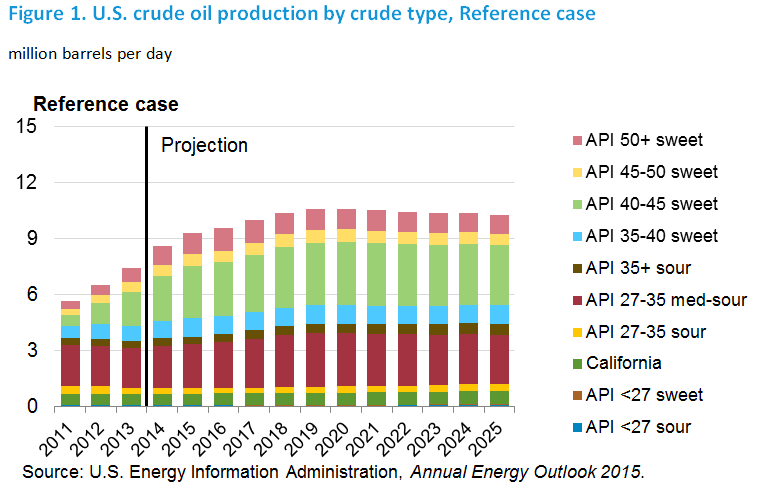
Yeah, talking about the average API misses the one big point, running shy of middle distillates.
The stuff coming out of most wells contains a variety of different length carbon hydrogen molecules. If a well or region produces crude with proportionally more long chain molecules (into the hundreds of carbon atoms I guess) that makes the oil denser so it is called "heavy" - long enough and it is a solid. More short chain molecules make it less dense "light" oil - all the way to single carbon natural gas.
When refined by factional distilling, the different length chains are separated and certain lengths go to certain uses. Very light stuff is chemical feedstock for plastics and whatnot; the middle distillates are fuels; the heaviest are lubes, asphalt and petroleum coke.
The problem is we are running short of that good old crude with the nice mixture of molecules in the middle (5-20 carbons) of which we have become accustomed. Trying to increase the flow (and avoid peak oil) we are using unconventionally produced oilish stuff that is different in composition. Specifically it is deficient in those middle distillates, the part we use for fuels.
On one end of the scale is tar sand, crude that has been exposed and eroded so the light and middle factions are gone. X-Heavy oil like that from venezuela is nearly as heavy. "Light Tight Oil" from long horizontally drilled and "hydro fractured" wells on the other hand is crude trapped in formations so tight only the shortest length, lightest part can be sucked out (I think).
So, mix very heavy and very light together and you can get an average that appears peachy but has proportionally fewer of the 5-20 carbon molecule stuff we use for fuel. You can get them by cooking to split apart the very long chains down to the right length for fuels or maybe catalise short ones together but that takes more energy.
So like I said, it is not a simple bumper sticker answer, and I'm just an amateur
.
--
Yeah, talking about the average API misses the one big point, running shy of middle distillates.
The stuff coming out of most wells contains a variety of different length carbon hydrogen molecules. If a well or region produces crude with proportionally more long chain molecules (into the hundreds of carbon atoms I guess) that makes the oil denser so it is called "heavy" - long enough and it is a solid. More short chain molecules make it less dense "light" oil - all the way to single carbon natural gas.
When refined by factional distilling, the different length chains are separated and certain lengths go to certain uses. Very light stuff is chemical feedstock for plastics and whatnot; the middle distillates are fuels; the heaviest are lubes, asphalt and petroleum coke.
The problem is we are running short of that good old crude with the nice mixture of molecules in the middle (5-20 carbons) of which we have become accustomed. Trying to increase the flow (and avoid peak oil) we are using unconventionally produced oilish stuff that is different in composition. Specifically it is deficient in those middle distillates, the part we use for fuels.
On one end of the scale is tar sand, crude that has been exposed and eroded so the light and middle factions are gone. X-Heavy oil like that from venezuela is nearly as heavy. "Light Tight Oil" from long horizontally drilled and "hydro fractured" wells on the other hand is crude trapped in formations so tight only the shortest length, lightest part can be sucked out (I think).
So, mix very heavy and very light together and you can get an average that appears peachy but has proportionally fewer of the 5-20 carbon molecule stuff we use for fuel. You can get them by cooking to split apart the very long chains down to the right length for fuels or maybe catalise short ones together but that takes more energy.
So like I said, it is not a simple bumper sticker answer, and I'm just an amateur
.
The legitimate object of government, is to do for a community of people, whatever they need to have done, but can not do, at all, or can not, so well do, for themselves -- in their separate, and individual capacities.
-- Abraham Lincoln, Fragment on Government (July 1, 1854)
-- Abraham Lincoln, Fragment on Government (July 1, 1854)
-
Pops - Elite
- Posts: 19746
- Joined: Sat 03 Apr 2004, 04:00:00
- Location: QuikSac for a 6-Pac
Re: Has the BTU rate per barrel changed?
by shortonoil » Thu 24 Dec 2015, 09:55:04
Pops said:
"Since Short didn't provide a citation except to his personal page I looked it up on the EIA site, according to this EIA page:"
What the EIA is reporting in the graph shown above is the average blend of crude processed in US refiners. You will note that it is a "weighted average". Refineries need a specific viscosity range to operate, so they add lighter, or heavier fractions to bring the crude that they are processing into that range. It is a matter of getting the crude to flow through the pipes. Since on a volumetric bases lighter crude has a lower energy content than heavier fractions, to get energy content, the API viscosity must be adjusted accordingly. Note the 5.88 million BTU per barrel reference from the IRS above. 5.88 million BTU per barrel is an API of 37.5° crude. We are interested in energy, not volume. The volumetric input is of no significances without a corresponding energy metric. The only parties for which volume is significant is the petroleum industry; that is because they sell oil by the barrel. The rest of the world is only interested in the energy derived from it. The consumer wants to get from point A to point B, and that requires X amount of energy. The volume used that came from a well is a side issue, and varies according to the crude.
http://www.thehillsgroup.org/
"Since Short didn't provide a citation except to his personal page I looked it up on the EIA site, according to this EIA page:"
What the EIA is reporting in the graph shown above is the average blend of crude processed in US refiners. You will note that it is a "weighted average". Refineries need a specific viscosity range to operate, so they add lighter, or heavier fractions to bring the crude that they are processing into that range. It is a matter of getting the crude to flow through the pipes. Since on a volumetric bases lighter crude has a lower energy content than heavier fractions, to get energy content, the API viscosity must be adjusted accordingly. Note the 5.88 million BTU per barrel reference from the IRS above. 5.88 million BTU per barrel is an API of 37.5° crude. We are interested in energy, not volume. The volumetric input is of no significances without a corresponding energy metric. The only parties for which volume is significant is the petroleum industry; that is because they sell oil by the barrel. The rest of the world is only interested in the energy derived from it. The consumer wants to get from point A to point B, and that requires X amount of energy. The volume used that came from a well is a side issue, and varies according to the crude.
http://www.thehillsgroup.org/
-
shortonoil - False ETP Prophet
- Posts: 7132
- Joined: Thu 02 Dec 2004, 04:00:00
- Location: VA USA
Re: Has the BTU rate per barrel changed?
by Pops » Thu 24 Dec 2015, 10:08:11
$this->bbcode_second_pass_quote('shortonoil', 'N')ote the 5.88 million BTU per barrel reference from the IRS above.
I see no link
The legitimate object of government, is to do for a community of people, whatever they need to have done, but can not do, at all, or can not, so well do, for themselves -- in their separate, and individual capacities.
-- Abraham Lincoln, Fragment on Government (July 1, 1854)
-- Abraham Lincoln, Fragment on Government (July 1, 1854)
-
Pops - Elite
- Posts: 19746
- Joined: Sat 03 Apr 2004, 04:00:00
- Location: QuikSac for a 6-Pac