General discussions of the systemic, societal and civilisational effects of depletion.
 by tom_s2 » Thu 12 Mar 2015, 03:13:56
Hi ralfy,
$this->bbcode_second_pass_quote('', 'T')he problem is that you are looking at only industrialized countries. You need to look at the global economy, and figure out why even as demand destruction took place for the U.S., EU, and Japan oil consumption rose for the rest of the world.
I'll try again. Why don't people sacrifice discretionary travel rather than food? Anywhere in the world? It is not a response to say "you're looking only at industrialized countries". That does not answer the question.
Again: Why don't people sacrifice discretionary travel rather than food? EVERYWHERE in the world?
$this->bbcode_second_pass_quote('', 'T')hat's why even when oil prices tripled global oil consumption still continued to rise.
In that case, oil production still increased, so they didn't have to sacrifice either food or discretionary travel. That is not relevant here. In a scenario where they
have to choose, why don't they sacrifice discretionary travel rather than food?
$this->bbcode_second_pass_quote('', 'T')hey don't because of several reasons: markets operate using price mechanisms that emphasize profits, increased credit levels, and low energy returns from alternatives.
What? How would "increased credit levels" cause people to choose discretionary travel over food? Will people say "credit has gone up, so I may as well drive more and starve to death"?
Also, how will low energy returns from alternatives cause people to choose discretionary travel over food?
$this->bbcode_second_pass_quote('', 'A')ctually, it is, as more problems make matters worse. That's why current predicaments do not only involve peak oil.
That's changing the topic again. You are positing
another doomsday theory, which is fine, but you've not answered the objections to the first one.
$this->bbcode_second_pass_quote('', 'I')n short, the U.S. bought oil from other countries.
No. The amount of oil that the US bought from other countries
declined, because the middle east
curtailed exports. That was what caused the oil crisis in the late 1970s.
The question is (again): why did food production increase despite
reductions in total oil consumption in the USA, from 1979-1995?
$this->bbcode_second_pass_quote('', 'u')nless you can claim that electric cars, etc., can be manufactured easily without using oil
NO. I am claiming that electric cars have
lower total oil consumption but not
zero.
I ask again: why do you think that the adjustment is not happening quickly enough? Oil usage doesn't have to fall to ZERO immediately, for it to happen quickly enough.
$this->bbcode_second_pass_quote('', 'Y')our evidence counters your argument and supports mine. See for yourself: read Point 12 of the transcript.
There is no Point 12 of the transcript I provided.
$this->bbcode_second_pass_quote('', 'G')o over the various threads and see for yourself...Go over the various threads and see for yourself.
I have repeatedly asked you to provide specific references and not vague pseudo-references such as "my point is supported on a thread somewhere". Once again: it is up to you to provide references for your own points.
$this->bbcode_second_pass_quote('', 'N')o, it's not. Mining, manufacturing, and shipping (not transport) are actually the strongest arguments for my case, not to mention petrochemicals.
Manufacturing overwhelmingly does not use oil as an energy source. Manufacturing uses electricity and gas.
Mining represents less than 1% of all oil usage and there will be enough oil for that purpose 100 years in the future.
If you're referring to plastics, etc. Why don't we sacrifice plastic water bottles before sacrificing anything crucial for civilization?
$this->bbcode_second_pass_quote('', 'B')ecause the transition takes several decades, the IEA argues that it should have started more then a decade ago, and conventional production will face production issues unless strong regulation takes place.
Where does the IEA argue that we must have started more than a decade ago to avoid collapse? When I've read the IEA documents they say no peak oil for decades, and collapse isn't even mentioned. Again, please provide specific references for these claims you're making.
$this->bbcode_second_pass_quote('', '')$this->bbcode_second_pass_quote('', ' ')I almost never see any objections answered in this forum.
Yes, they have, and many times. In fact, every point I raised above has been discussed in other threads.
Ralfy, you have changed the topic again, and you've failed to provide references again!
I am not asking what other threads you participated in. I am asking you to provide a specific reference for where these questions were answered. That should be very straightforward.
$this->bbcode_second_pass_quote('', 'T')here is no "topic changing" involved.
Ralfy, you are blatantly changing the topic over and over again, almost every single sentence. Every time I ask a question, you just flagrantly dodge it.
Again: Why don't people sacrifice discretionary travel rather than food if they can't afford both? Why don't people sacrifice plastic water bottles before anything essential to civilization? How do you know there won't be any inventions during the next 120 years? How do you know Hubbert curves will work this time despite having failed so badly?
I am asking you to answer one of those questions. It is no answer to say "credit levels are high" or "you need to..." or "this issue has been discussed somewhere". I am asking for a specific response to the actual question asked, or for a specific reference (not "somewhere on a forum") in which that question is answered.
-Tom S
-
tom_s2
- Peat

-
- Posts: 111
- Joined: Wed 08 Oct 2014, 15:20:24
-
by tom_s2 » Thu 12 Mar 2015, 03:30:39
Hi ralfy,
$this->bbcode_second_pass_quote('', 'M')eanwhile, feel free to look at the other threads of this forum, where all of these objections have been addressed, some several times.
Once again, I am asking for
specific references. It is up to you to provide references or links for your claims. Again: it is not valid to provide vague pseudo-references such as "this has been addressed in a forum somewhere..."
$this->bbcode_second_pass_quote('', 'I') and others have discussed the IEA 2010
The IEA 2010 report provides no support for what you are saying. It does not mention the collapse of civilization even as a possibility. It is uncertain when all liquids will peak and says it could happen between 2020 and 2035 (pp 125), depending upon
demand. It does mention vulnerability to supply disruption and environmental damage, but no possibility of collapse.
$this->bbcode_second_pass_quote('', 'B')asic questions have been answered in other threads.
I'll try again.
It is up to you to provide a specific reference to support your point.
I have read
all of these forums. I
explicitly deny that these questions have ever been answered. Here is your chance to prove me wrong.
-Tom S
-
tom_s2
- Peat
-
- Posts: 111
- Joined: Wed 08 Oct 2014, 15:20:24
-
by dashster » Thu 12 Mar 2015, 04:41:28
$this->bbcode_second_pass_quote('Strummer', '
')$this->bbcode_second_pass_quote('tom_s2', 'H')ow did civilizations such as the Byzantine empire last for millenia while loaning money at interest?
Exploitation of external sources of wealth and resources, mostly. When you have an influx of external wealth, this external wealth fuels your growth. This can be many different things: exploitation of provinces or colonies, transaction fees from trade passing through your territory, creating a war industry for a war outside of your own territory (as was the case for the US in the 40s), etc... In every case, the wealth fueling the growth comes from outside of the economy.
I am with you on the first two, but don't see how a war causes an "influx of external wealth". In fact, I see a war as being an "outflux of internal wealth".
-
dashster
- Lignite
-
- Posts: 385
- Joined: Fri 28 Dec 2012, 08:39:24
- Location: California
-
by dashster » Thu 12 Mar 2015, 04:53:48
$this->bbcode_second_pass_quote('tom_s2', '
')
Why does every single expert in the relevant fields just dismiss this stuff? Are you really smarter and more knowledgeable than them?
M. King Hubbert, Colin Campbell, Jean Lahererre, Kenneth Deffeyes and other petroleum geologists are as much experts in the field as any nameless person on the optimistic side. The names attached to optimistic predictions are the top executives of the organizations, not the experts doing the calculations. And we only get one forecast out of an oil major or government agency, we don't get the viewpoint of each of their internal "experts", so have no idea what they are all thinking. But again, the optimists really aren't making predictions about production, but demand. The assume, and I don't see why given per-country history, that if the reserves are there, then all they have to forecast is demand. I wouldn't be surprised if they had more economists on staff than geologists.
Last edited by
dashster on Thu 12 Mar 2015, 06:00:05, edited 1 time in total.
-
dashster
- Lignite
-
- Posts: 385
- Joined: Fri 28 Dec 2012, 08:39:24
- Location: California
-
by dashster » Thu 12 Mar 2015, 05:58:49
$this->bbcode_second_pass_quote('tom_s2', '
')
The "end of the oil age" is at least 120 years away if we assume a symmetric Hubbert curve of all oil extraction. In the mean time, how do you know people won't invent some alternative, like artificial photosynthesis? Or build windmills to generate anhydrous ammonia which is a liquid and a suitable fuel for internal combustion engines? Or learn to extract methane hydrates? Or switch to electrified transport?
How do you know that they will? At this point optimism doesn't seem any more indicated than pessimism.
$this->bbcode_second_pass_quote('', '
')$this->bbcode_second_pass_quote('', '&')quot;We can always invent something to replace oil" (Even though all evidence shows to the contrary).
You have evidence that something
won't be invented in the next 120 years? What kind of evidence?
There is no evidence that something will be invented and implemented in 120 years to replace oil. So why be optimistic?
$this->bbcode_second_pass_quote('', '
')$this->bbcode_second_pass_quote('', 'p')eak oil will cause the collapse of THE global economy and result in food shortages around the world
Why would peak oil cause food shortages? Wouldn't people sacrifice food last? Won't they divert the remaining oil to food production, first and foremost?
I don't see where he is saying that people will still take vacations and exchange Christmas gifts - while starving to death.
$this->bbcode_second_pass_quote('', '
')$this->bbcode_second_pass_quote('', 'W')hen oil production begins to decline, our monetary system will collapse because it is based on infinite growth.
Our monetary system is based on infinite growth? Did you read that in an actual textbook about our monetary system, or did you get it from Richard Heinberg?
Of the two, which predicted the 2007 financial meltdown - textbooks or Heinberg? I think the answer is neither. So given that the textbook writers and professors (and other mainstream pundits and experts of various stripes) didn't see it, and Heinberg didn't see it, why are the textbook writers better qualified than Heinberg to discuss a monetary collapse from Peak Oil? You should be saying - the "the mainstream wisdom, of which I am a huge proponent, saw nothing wrong with a financial system where we would lend mortgage money to people who they knew could not afford it, and then bundle those mortgages with good mortgages and use derivatives and other risky financial techniques and then sell them to people in Iceland and other parts of the world - therefore, they can't be wrong twice in a row, so they are the ones we should listen to about financial problems during a period of sustained economic de-growth".
$this->bbcode_second_pass_quote('', '
')How did civilizations such as the Byzantine empire last for millenia while loaning money at interest?
I think partial reserve banking is more of a concern than loaning money at interest. What was the "reserve ratio" used by the Byzantinians?
$this->bbcode_second_pass_quote('', '
')Why didn't the USA collapse during the Great Depression when there was contraction for a decade straight?
Did he say that the USA would collapse in 10 years or less? Unemployment got to 25% in that 10 years. Oil production in terminal decline could make things worse for much longer than 10 years. So saying it didn't happen in 10 years, doesn't mean it wouldn't happen in a longer time period.
$this->bbcode_second_pass_quote('', '
')How do you know peak oil is happening right now? Hubbert curves have been just totally wrong in predicting oil production for the last ten years.
I would disagree with the characterization "totally wrong". And I would say more correct than the "non Hubbert curve" government agencies, who overestimated production and saw no price rise above historical average/medians - even out to 2030.
$this->bbcode_second_pass_quote('', '
')Hubbert curves haven't even successfully predicted regular, conventional oil which was supposed to have declined 2-4% per YEAR for the last 10 years.
Conventional oil does not appear to have peaked when the IEA said it did. Or there is disagreement about the definition of conventional oil, at least with regard to deep ocean. At least someone has a graph where they separate out tar sands and fracking from regular pump-it-out crude oil production, and it appears the peak of conventional occurred in 2011 or 2012. And that graph also showed conventional down to 2004 levels in 2014.
And not everyone predicting Peak Oil is using "Hubbert curves" to predict the peak. I think the worst prediction technique of all is the one used by the government agencies that optimists rely on. They don't even try to predict a peak or production limits. They try and forecast demand and assume supply will match demand.
$this->bbcode_second_pass_quote('', '
')If those techniques didn't work before, why would they work now? Do you have some other reason to believe oil declines are imminent? I'm not saying you're wrong (I have no idea when oil will peak) but I'm wondering if you have any reason other than these techniques which have already failed.
They have worked before. Hubbert correctly predicted the US production. And it should be pointed out that he probably had better reserve data for the US than anyone today has with regard to the world.
I am wondering why, given the way oil prices plateaued at the highest inflation-adjusted level ever, and are still historically high - even after collapsing - that you are in favor of optimistic techniques of demand forecasting, when they were demonstrated to have failed in the last 10 years.
-
dashster
- Lignite
-
- Posts: 385
- Joined: Fri 28 Dec 2012, 08:39:24
- Location: California
-
by dashster » Thu 12 Mar 2015, 06:29:51
$this->bbcode_second_pass_quote('tom_s2', '
')
$this->bbcode_second_pass_quote('', 'A')nd what is that "something"
It could be anything. What I'm saying here is there could be multiple reasons for disagreement other than just denial. Perhaps people think that the failures of prediction, over and over again, calls this stuff into question. Maybe they wonder why it's such a fringe thing if the laws of physics so plainly imply it. That's not denial; that's
doubt.
One of the "arguments" that optimists use for the Infinite Oil Theory, is that past predictions of "running out of oil" have been incorrect. And they will go back into the 1800's and quote somebody you never heard of saying that "there's no more oil West of the Mississippi" or something similar. But we aren't concerned with "running out", but peaking. And a peak prediction didn't come into play until Hubbert. And Hubbert predicted 2000 for the world in 1962 and then gave 1995 in 1974. And then Colin Campbell and Jean Lehererre revived the subject in the late 80's and Campbell I think had some predictions for Peak Oil in the 1990's. After the formation of ASPO in 2000 there were books published and more predictions given by more individuals and groups (Hirsch Report, Energy Watch Group). To date we haven't peaked. So predictions that had a date prior to today were wrong. But that is nothing to dance about. For one thing, we haven't seen the status quo in oil. Normally production goes up and prices stay low. We saw production stall for a while and prices soar. The only other time prices soared - 1973 to 1985 - was from oil being purposely pulled out of the marketplace. This time we didn't have an "Oil Shock" and yet we saw prices soar. So while you can crow about "predictions of peak were wrong" they were right about supply problems. And more importantly, a past failed prediction of a peak doesn't mean it won't occur tomorrow. It's a finite quantity that depletes with usage. The "laws of physics" or rather "the laws of geology" support Peak Oil, not Infinite Oil. As does the price rise of the last 10 years - our you could say "the laws of economics" support near term Peak Oil.
$this->bbcode_second_pass_quote('', '
')
$this->bbcode_second_pass_quote('', 'T')he problem isn't the end of oil but production not meeting demand
That's not what Desu said. He said "a significant portion ... will perish at
the end of the oil age because an extra 5 billion plus people exist only because of oil."
If the problem is only supply not meeting demand, then why don't people just take fewer discretionary road trips?
The idea is that there will be problems even after people in certain areas take no discretionary road trips.
$this->bbcode_second_pass_quote('', '
')If there is no evidence, one way or another, about what will be invented in the next 120 years, then there's just no way of knowing what the consequences of peak oil will be. The best we can say is "we don't know what will happen because of peak oil. Maybe it will be a problem, maybe not."
Doesn't seem logical. If you have less oil, then you assume that things will be worse. You can hope for inventions, but you know that absent the inventions you will be worse. So I would say: unless there are inventions we will be worse off.
$this->bbcode_second_pass_quote('', '
')Personally, I would guess there will be significant inventions over the next 120 years. There have been significant inventions over the last 120 years. I don't see any reason why invention would suddenly and totally stop, especially if transportation becomes such a pressing issue. But who knows.
Most inventions are not a response to a critical resource going away. Cars weren't invented because a plague killed all the horses. Cellphones weren't invented because land lines became inoperable due to rabid squirrels eating the wires. Computers weren't invented because people could no longer make calculations in their head.
We are trying to "invent" nuclear fusion. We are trying to invent thorium reactors. Despite the fact that there arose a concern about fossil fuels during the period of attempting, and despite the best efforts of great minds, it hasn't happened in decades of trying.
The world doesn't have to have a fairy tale ending.
$this->bbcode_second_pass_quote('', '
')$this->bbcode_second_pass_quote('', 'T')hey should (sacrifice discrentionary travel for food), but that's not what we are seeing.
Really? We are seeing widespread starvation in industrial countries because people couldn't figure out to sacrifice discretionary travel rather than food? Where are we seeing that?
I believe he was saying that people are not preparing for Peak Oil. It is business as usual. They will not have to respond to Peak Oil - until it hits. But we have a precursor for what will happen. Americans had oil bid away from them in the marketplace by the Chinese and other emerging markets and in fact, did reduce their discretionary travel. So you could say that we did see it - rather than forego things besides discretionary travel as the price of gas went up - they chose to forego some discretionary travel.
$this->bbcode_second_pass_quote('', '
')The USA saw its oil supplies drop absolutely for 20 years, starting in 1979. How many people starved because of that? Why did the population increase?
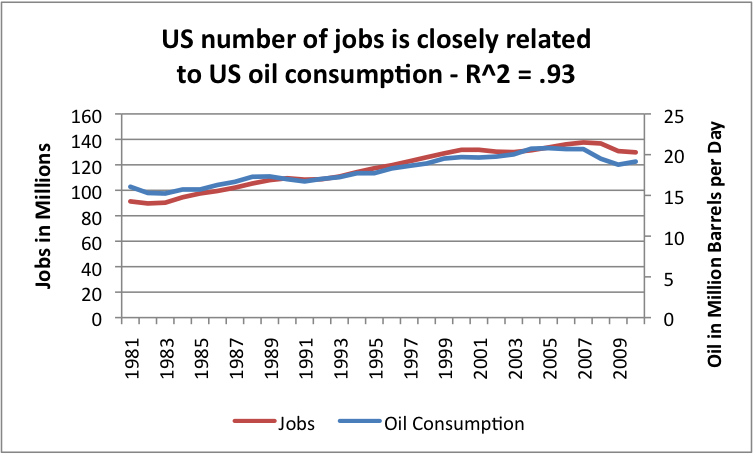
What do you mean by "oil supplies dropping absolutely for 20 years"?
$this->bbcode_second_pass_quote('', '
')$this->bbcode_second_pass_quote('', 'H')ubbert's model uses math formulas and will thus not be able to map actual production.
Then what reason do you have to think that oil declines are imminent? If Hubbert's formulas can't predict declines, then what other formulas are you relying upon?
I think the point being made was any formula used to model the real world will not be an exact reflection of what takes place.
$this->bbcode_second_pass_quote('', '
')$this->bbcode_second_pass_quote('', 'A')lso, oil production per capita peaked back in 1979.
That seems to pose a severe problem for your point of view. If food is dependent on oil, and people can't figure out to sacrifice discretionary travel for food, then why didn't calories per capita decrease along with oil per capita? Why has world population continued increasing?
Our use of oil has become more efficient. But it hasn't become that efficient that we can follow terminal decline down to zero and not skip a beat.
$this->bbcode_second_pass_quote('', '
')$this->bbcode_second_pass_quote('', 'P')revious empires lasted for thousands of years because the type of technologies employed did not allow for the level of production and consumption that we see today. Not even close.
Fine, but that's just beside the point. Desu was making the claim often found in peak oil circles that our monetary system requires infinite growth or it will collapse, because of debt. However, other civilizations had massive debt, high interest rates, and no growth for millennia before collapsing. How?
Which civilization lasted for a millenia with partial reserve banking and what was it's reserve requirements?
$this->bbcode_second_pass_quote('', '
')$this->bbcode_second_pass_quote('', 'B')ecause the global economy involves markets that use price mechanisms. That explains why preparations for peak oil have not taken place.
But the price mechanism implies the opposite of what you are saying. The price mechanism assures that money and resources are devoted to the most important uses, not the least, according to people who are experts on it (economists).
I think you are talking about two different things. I believe Ralfy is referring to expenditures in preparation to peak oil. There can be no expenditures in response to peak oil because it hasn't hit yet.
$this->bbcode_second_pass_quote('', '
')Also, have there really been no preparations for peak oil? Almost every major car manufacturer started designing electric cars many years before any actual declines began. Fuel economy has been increasing every year as prices increased, until recently. Ships built today are twice as fuel efficient as those of 20 years ago. The entire trans Siberian railway has now been electrified, and many other railways too. Some delivery services are switching to natural gas for their trucks. Perhaps these things could even be accelerated once oil starts declining.
I spoke to a Tesla engineer once and when I said "Peak Oil" he said "what's that?". Our conversation was interrupted before I had a chance to explain it. If I remember right he said something about global warming (as Tesla addressed that), but I may have asked if that was the reason the company was started since he hadn't heard of Peak Oil. In any event, I don't think you would hear about Peak Oil were you to look at any electric car brochure or any of the literature of the oil companies. I don't think the word "Peak Oil" was ever used when we implemented CAFE mileage standards or Europe implemented large gas taxes. I think the idea was - oil prices have shot up and its hurting us economically - and we don't control enough oil for our own needs, so we need to respond. In fact, to this day, the mainstream still denies Peak Oil, so how could the mainstream be making preparations for Peak oil. If we truly were doing it because of Peak Oil, then we would have begun a program to electrify our train system - which we have not. We responded to oil issues, including US Peak Oil, but not World Peak Oil. Which will be a much bigger issue than what we have responded to so far.
$this->bbcode_second_pass_quote('', '
')What reason do you have to believe that preparations thus far have been inadequate or that adjustments will be insufficient to offset declines?
Preparations thus far have not been made due to a belief in Peak Oil - the mainstream still does not believe in Peak Oil. If you don't believe something is a problem it is difficult to make adequate preparations for it. Electrifying American railroads is not even considered. Moving to electric cars would put a tremendous strain on our coal and natural gas production - one that it would be unlikely to meet as there are predictions they both will peak in a decade talk with regard to both industries relies on resources, rather than reserves in order to paint a picture of abundance.
The United States does have an ace in the hole that it can use to buy time that other countries don't have as much of - massive single-car commuting. Every single-car commuter in metro areas can be forced to take a bus or a train. Now that would still have huge ramifications because we aren't currently set up to have people all commuting by mass transit. And it would be a huge shakeup for the economy as money moved from autos and auto related expenditures to something else. Expenditures would also change as people gave up cars and changed their weekend and vacation spending habits because of that.
But a decline in production is different than a slowing. And a decline in production will have a worse impact on prices than a slowing has had for the last 10 years.
Last edited by
dashster on Thu 12 Mar 2015, 07:19:23, edited 4 times in total.
-
dashster
- Lignite
-
- Posts: 385
- Joined: Fri 28 Dec 2012, 08:39:24
- Location: California
-
by Strummer » Thu 12 Mar 2015, 07:08:58
$this->bbcode_second_pass_quote('dashster', '')$this->bbcode_second_pass_quote('Strummer', '
')$this->bbcode_second_pass_quote('tom_s2', 'H')ow did civilizations such as the Byzantine empire last for millenia while loaning money at interest?
Exploitation of external sources of wealth and resources, mostly. When you have an influx of external wealth, this external wealth fuels your growth. This can be many different things: exploitation of provinces or colonies, transaction fees from trade passing through your territory, creating a war industry for a war outside of your own territory (as was the case for the US in the 40s), etc... In every case, the wealth fueling the growth comes from outside of the economy.
I am with you on the first two, but don't see how a war causes an "influx of external wealth". In fact, I see a war as being an "outflux of internal wealth".
In the specific case of the USA in the 30s and 40s, it did, due to the unique geographical position. The US was able to remain completely sheltered from the war, while at the same time being a supplier of weapons and war material for the participating parties (and for quite some time for participants on both sides of the conflict). War can be great business, as long as it takes place somewhere else where it does not affect you. The boost to the US economy was immense.
-
Strummer
- Tar Sands

-
- Posts: 691
- Joined: Thu 04 Jul 2013, 04:42:14
-
by ralfy » Thu 12 Mar 2015, 07:13:10
$this->bbcode_second_pass_quote('tom_s2', 'H')i ralfy,
I'll try again. Why don't people sacrifice discretionary travel rather than food? Anywhere in the world? It is not a response to say "you're looking only at industrialized countries". That does not answer the question.
Passenger kilometers decreased for some countries but rose for others:
http://transportblog.co.nz/2013/12/10/h ... o-publish/Overall, I think discretionary spending went up and down for the U.S. but went up for the world economy until recently:
http://ftalphaville.ft.com/2010/11/30/4 ... expansion/$this->bbcode_second_pass_quote('', '
')
Again: Why don't people sacrifice discretionary travel rather than food? EVERYWHERE in the world?
I'm not sure if it's everywhere but for the global average the trend line has been upward. The same goes for food:
http://www.cargill.com/annual-report/$this->bbcode_second_pass_quote('', '
')
In that case, oil production still increased, so they didn't have to sacrifice either food or discretionary travel. That is not relevant here. In a scenario where they
have to choose, why don't they sacrifice discretionary travel rather than food?
Sorry, I was referring to the present scenario, not a future one.
Yes, people will obviously sacrifice if there is less oil available, but that doesn't counter the possibility of collapse. If any, sacrificing is the result of such a threat.
$this->bbcode_second_pass_quote('', '
')
What? How would "increased credit levels" cause people to choose discretionary travel over food? Will people say "credit has gone up, so I may as well drive more and starve to death"?
If there is more money available, then people will spend on both. This might explain why globally both discretionary spending and food purchases kept rising even as both oil and food prices went up.
$this->bbcode_second_pass_quote('', '
')
Also, how will low energy returns from alternatives cause people to choose discretionary travel over food?
It won't, but I am referring to present circumstances, where both have been going up.
$this->bbcode_second_pass_quote('', '
')
That's changing the topic again. You are positing another doomsday theory, which is fine, but you've not answered the objections to the first one.
I answered all of your questions. I think the problem is that several of your assumptions should have been questioned.
$this->bbcode_second_pass_quote('', '
')
No. The amount of oil that the US bought from other countries declined, because the middle east curtailed exports. That was what caused the oil crisis in the late 1970s.
Didn't U.S. imports go up after that, from 1985 to around 2005?
$this->bbcode_second_pass_quote('', '
')
The question is (again): why did food production increase despite reductions in total oil consumption in the USA, from 1979-1995?
Also, did U.S. oil consumption rise from 1985 to 2005?
$this->bbcode_second_pass_quote('', '
')
NO. I am claiming that electric cars have lower total oil consumption but not zero.
I was not talking about oil consumption.
Also, you need to factor in the number of cars that have to be manufactured to meet the needs of a global economy.
$this->bbcode_second_pass_quote('', '
')
I ask again: why do you think that the adjustment is not happening quickly enough? Oil usage doesn't have to fall to ZERO immediately, for it to happen quickly enough.
It will take several decades for a transition to take place, but oil production may start peaking earlier:
http://www.businessinsider.com/131-year ... il-2010-11
The adjustment will also have to take place amidst low energy returns for unconventional production and others:
http://www.theguardian.com/environment/ ... -recession
while meeting the demands of a growing global middle class:
http://www.bbc.com/news/business-22956470
$this->bbcode_second_pass_quote('', '
')
There is no Point 12 of the transcript I provided.
See the "Transcript" section right below the document. Scroll to No. 12.
$this->bbcode_second_pass_quote('', '
')
I have repeatedly asked you to provide specific references and not vague pseudo-references such as "my point is supported on a thread somewhere". Once again: it is up to you to provide references for your own points.
See above as well as the contents of my other posts in this forum. It's too tiring to repost all of them in this thread when you can find them using the search box.
Also, since you mentioned that you are asking "basic questions," then why not read the other threads and see if they have been answered?
10-basic-facts-of-peak-oil-t61588.html
$this->bbcode_second_pass_quote('', '
')Manufacturing overwhelmingly does not use oil as an energy source. Manufacturing uses electricity and gas.
Gas is part of fossil fuels, and together with coal and fuel oil make up around half of energy used for manufacturing. There's also mining which uses heavy equipment and shipping which involves container ships. And then there are petrochemicals.
Overall, around 80 pct of world energy consumption involves fossil fuels.
$this->bbcode_second_pass_quote('', '
')
Mining represents less than 1% of all oil usage and there will be enough oil for that purpose 100 years in the future.
The problem isn't the percentage of oil used for mining but the effect of expensive oil on mining, especially in ore movement:
http://www.miningnews.net/storyView.asp ... =798462543
There's also availability of various minerals:
http://www.sciencearchive.org.au/nova/n ... ns_005.htm
coupled with increasing need for them, fresh water, oil, and others to meet the needs of a growing global middle class:
http://www.bbc.com/news/business-22956470
Obviously, heavy coordination and regulation will be required to ensure sufficient amounts of fossil fuels while then transition takes place, as discussed in this report:
http://www.worldenergyoutlook.org/publi ... /weo-2010/
But how can this be achieved in a global economy where countries have been doing the opposite for decades?
$this->bbcode_second_pass_quote('', '
')
If you're referring to plastics, etc. Why don't we sacrifice plastic water bottles before sacrificing anything crucial for civilization?
Petrochemicals are used for thousands of applications, including several for renewable energy. Indeed, a lot of sacrifices will be made, but our global capitalist economy operates in the opposite direction.
$this->bbcode_second_pass_quote('', '
')
Where does the IEA argue that we must have started more than a decade ago to avoid collapse? When I've read the IEA documents they say no peak oil for decades, and collapse isn't even mentioned. Again, please provide specific references for these claims you're making.
https://www.youtube.com/watch?v=v0ujDVRIzGM
http://www.resilience.org/stories/2010- ... s-peak-oil
These were discussed in the forum years ago.
$this->bbcode_second_pass_quote('', '
')
Ralfy, you have changed the topic again, and you've failed to provide references again!
I don't think I changed the topic. Rather, I answered all of your questions sufficiently. I think the problem is that some of your assumptions are questionable.
Also, if you use the forum search engine, you will discover that most of the links above were shared in this forum several times, some years ago.
$this->bbcode_second_pass_quote('', '
')
I am not asking what other threads you participated in. I am asking you to provide a specific reference for where these questions were answered. That should be very straightforward.
You should be able to find them yourself by using the search box. Also, others answered your questions.
$this->bbcode_second_pass_quote('', '
')
Ralfy, you are blatantly changing the topic over and over again, almost every single sentence. Every time I ask a question, you just flagrantly dodge it.
No, I did not change the topic. I answered all of your questions directly. I did not dodge any of them.
$this->bbcode_second_pass_quote('', '
')
Again: Why don't people sacrifice discretionary travel rather than food if they can't afford both? Why don't people sacrifice plastic water bottles before anything essential to civilization? How do you know there won't be any inventions during the next 120 years? How do you know Hubbert curves will work this time despite having failed so badly?
I answered the first two questions above.
I don't understand the importance of the third question because you can give the opposite of it and still fail to answer it. That is, how do you know that there will?
For the last question, I don't think Hubbert's forecasts for conventional production failed. He got it right for the U.S. and for the world (peak after 1995 + 10 years).
$this->bbcode_second_pass_quote('', '
')
I am asking you to answer one of those questions. It is no answer to say "credit levels are high" or "you need to..." or "this issue has been discussed somewhere". I am asking for a specific response to the actual question asked, or for a specific reference (not "somewhere on a forum") in which that question is answered.
-Tom S
All of your "basic questions" were answered. Several of the references shared above were given in other threads of this forum. There are more.
You need to use the search box and go over the peak oil discussions threads to view them. I will not do that for you.
-

ralfy
- Light Sweet Crude

-
- Posts: 5651
- Joined: Sat 28 Mar 2009, 11:36:38
- Location: The Wasteland
-
by ralfy » Thu 12 Mar 2015, 07:23:30
Also, this is an addition to what the OP wrote. It may also be important to see peak oil in light of other problems, especially given the fact that many of these problems (such as financial crises and global warming) may amplify the effects of peak oil. That's why it's not surprising that the IEA saw peak oil in light of global warming:
http://ourworld.unu.edu/en/world-headed ... change-ieaThus, it's not just peak oil but global warming that will force the world economy to implement "rapid" change.
Finally, it is for this reason that forecasts have to involve not just oil production but multiple factors. Recently, scientists went back to forecasts made in
Limits to Growth and compared them to historical data during the four decades since the book was written. Results are discussed here:
http://www.theguardian.com/commentisfre ... g-collapse
-
ralfy
- Light Sweet Crude
-
- Posts: 5651
- Joined: Sat 28 Mar 2009, 11:36:38
- Location: The Wasteland
-
by tom_s2 » Thu 12 Mar 2015, 13:19:34
Hi ralfy,
$this->bbcode_second_pass_quote('', 'P')assenger kilometers decreased for some countries but rose for others
That does not answer the question. I am asking why people can't sacrifice food rather than discretionary travel when they must choose between the two.
$this->bbcode_second_pass_quote('', 'O')verall, I think discretionary spending went up and down for the U.S. but went up for the world economy until recently
That does not answer the question. I am asking why people can't sacrifice food rather than discretionary travel when they must choose between the two.
$this->bbcode_second_pass_quote('', 'I')'m not sure if it's everywhere but for the global average the trend line has been upward. The same goes for food:
http://www.cargill.com/annual-report/ That does not answer the question. In that circumstance, both of them are going up. If people have to choose, why can't people sacrifice discretionary travel rather than food?
$this->bbcode_second_pass_quote('', 'I')f there is more money available, then people will spend on both. This might explain why globally both discretionary spending and food purchases kept rising even as both oil and food prices went up.
That does not answer the question. In that circumstance, both of them are going up. If people have to choose, why can't people sacrifice discretionary travel rather than food?
$this->bbcode_second_pass_quote('', 'A')lso, since you mentioned that you are asking "basic questions," then why not read the other threads and see if they have been answered? 10-basic-facts-of-peak-oil-t61588.html
I've read the link you posted. It does not answer (or even address) any of these questions.
$this->bbcode_second_pass_quote('', 'A')nd then there are petrochemicals.
That does not answer the question. Why can't people sacrifice plastic water bottles before sacrificing any important petrochemicals?
$this->bbcode_second_pass_quote('', 'O')verall, around 80 pct of world energy consumption involves fossil fuels.
That does not answer the question. Why can't people sacrifice plastic water bottles before sacrificing any important petrochemicals?
$this->bbcode_second_pass_quote('', 'T')here's also availability of various minerals:
That is beside the point. That link is saying we have tight supplies of platinum for catalytic converters. The question was: why can't people sacrifice discretionary travel rather than food?
$this->bbcode_second_pass_quote('', '')$this->bbcode_second_pass_quote('', 'I')f you're referring to plastics, etc. Why don't we sacrifice plastic water bottles before sacrificing anything crucial for civilization?
Petrochemicals are used for thousands of applications, including several for renewable energy.
That does not answer the question. Why can't people sacrifice plastic water bottles before sacrificing any essential petrochemicals?
$this->bbcode_second_pass_quote('', 'A')lso, if you use the forum search engine, you will discover that most of the links above were shared in this forum several times, some years ago.
Those links provide no support for your case. They do not say that civilization is collapsing, or that people will fail to choose food over travel.
You are responsible for providing a reference to support your own case.
$this->bbcode_second_pass_quote('', '')$this->bbcode_second_pass_quote('', 'W')here does the IEA argue that we must have started more than a decade ago to avoid collapse?
http://www.resilience.org/stories/2010- ... s-peak-oil
I read that link you provided. It does not say anything of the sort.
$this->bbcode_second_pass_quote('', 'I') don't understand the importance of the third question because you can give the opposite of it and still fail to answer it. That is, how do you know that there will?
You are answering a question with a question again.
Desu was claiming that there was overwhelming scientific evidence that no inventions are possible. Again: I was asking what that evidence was.
$this->bbcode_second_pass_quote('', 'S')everal of the references shared above were given in other threads of this forum.
Again and again and again, I have asked for specific references and not vague pseudo-references such as "on a forum somewhere". I think I have asked this more than ten times.
$this->bbcode_second_pass_quote('', 'Y')ou need to use the search box and go over the peak oil discussions threads to view them.
I have explicitly denied that these objections have been answered anywhere. It is impossible for me to use the search box to find nothing. I can't search for "nothing".
You are the one claiming that these questions have been answered. You are responsible for finding the reference to support your own case.
This is what I said:
$this->bbcode_second_pass_quote('', 'I')t is up to you to provide a specific reference to support your point... I have read all of these forums. I explicitly deny that these questions have ever been answered. Here is your chance to prove me wrong.
You have not provided any specific reference.
-Tom S
-
tom_s2
- Peat
-
- Posts: 111
- Joined: Wed 08 Oct 2014, 15:20:24
-
by tom_s2 » Thu 12 Mar 2015, 13:41:40
Hi dashster,
$this->bbcode_second_pass_quote('', 'M'). King Hubbert, Colin Campbell, Jean Lahererre, Kenneth Deffeyes and other petroleum geologists are as much experts in the field as any nameless person on the optimistic side.
We were talking about collapse, die-off, and so on. Desu's post claimed that 5 billion people would die when peak oil hit, that no inventions were possible, and so on. Those points are not supported by Jean Lahererre, who won't touch this doomsday stuff with a ten foot pole.
$this->bbcode_second_pass_quote('', 'O')ne of the "arguments" that optimists use for the Infinite Oil Theory,
Where did I claim that oil was infinite? Who is claiming that oil is infinite?
$this->bbcode_second_pass_quote('', 'T')he idea is that there will be problems even after people in certain areas take no discretionary road trips.
Okay. IIRC, more than half of all oil consumption is devoted to discretionary trips. If people just take no discretionary road trips, and do other easy adjustments like switching to Priuses and carpooling in the face of very high gasoline prices, then that will gain us more than 50 years before sacrificing anything important, assuming Hubbert models are correct. Why do you think that is not enough time to transition to (say) battery-electric cars? Why can't people figure out these very easy adjustments?
$this->bbcode_second_pass_quote('', 'I')f you have less oil, then you assume that things will be worse. You can hope for inventions, but you know that absent the inventions you will be worse. So I would say: unless there are inventions we will be worse
Sure, higher gas prices mean things will be worse. Look what happened in 2008; it costed me $60 to fill my tank up. It could get even worse than that.
However, desu was claiming that there would be imminent starvation and collapse once peak oil happened. He was not just saying things would be worse.
$this->bbcode_second_pass_quote('', 'M')ost inventions are not a response to a critical resource going away. Cars weren't invented because a plague killed all the horses. Cellphones weren't invented because land lines became inoperable due to rabid squirrels eating the wires.
That's because inventions have been happening faster than depletion. I am asking why inventions would stop happening when peak oil hits.
There were big concerns in the earlier 20th century about shortages of fertilizer. The Haber-Bosch process was invented as a result. There were big concerns about declining agricultural yields and shortages of farmland. The green revolution was invented as a result. The predicted massive die-off did not occur.
I'm not saying that's guaranteed to happen again. However, Desu was claiming that there could not be any inventions, and I was wondering what his evidence was.
$this->bbcode_second_pass_quote('', 'W')e are trying to invent thorium reactors... despite the best efforts of great minds, it hasn't happened in decades of trying.
Just as an aside, breeder reactors were invented and operational on a pilot scale many decades ago. They were banned because of proliferation concerns. France was in the middle of constructing a 1GW massive breeder reactor until it was shut down because of protest. Breeder reactors are within our current capabilities.
$this->bbcode_second_pass_quote('', 'W')hat do you mean by "oil supplies dropping absolutely for 20 years"?
Perhaps I should clarify that. I meant that oil supply dropped absolutely in the late 1970s and did not recover for 20 years. I did not mean it was continuously dropping the whole time. The graph you posted crops and omits the higher oil consumption in the 1970s.
We have already gone through a sustained period during which oil consumption was much lower than before.
$this->bbcode_second_pass_quote('', 'P')reparations thus far have not been made due to a belief in Peak Oil - the mainstream still does not believe in Peak Oil. If you don't believe something is a problem it is difficult to make adequate preparations for it.
It doesn't matter if the preparations are being made for peak oil or not. Car companies started designing electric cars in anticipation of higher oil prices, years beforehand. People stopped buying huge SUVs because of higher prices, at least a decade before any actual declines. Whether they call it "peak oil" or not, is not the point.
-Tom S
-
tom_s2
- Peat
-
- Posts: 111
- Joined: Wed 08 Oct 2014, 15:20:24
-
by Strummer » Thu 12 Mar 2015, 13:50:35
$this->bbcode_second_pass_quote('tom_s2', 'T')hat does not answer the question. I am asking why people can't sacrifice food rather than discretionary travel when they must choose between the two.
The vast majority of people in the world don't do ANY discretionary travel at all. The fact that you ask these questions show how far disconnected from the global reality you are.
And anyway, you should read up on the collapse of the Western Roman empire. The citizens of Rome didn't starve either during the centuries of the slow collapse of the empire, actually I guess they lived rather comfortably right up to the point when the "barbarians" besieged Rome. Then it was over, fast.
You are a citizen living in the center of the empire. Your world will either not collapse at all, or collapse very suddenly, when the global mechanisms which support your lifestyle break down. There won't be any gradual transition for you, the one you are repeatedly asking about, like there is for people in other parts of the world (who are actually sacrificing discretionary travel for food, right now... but to see that you'd have to leave your ivory tower and visit the real world).
-
Strummer
- Tar Sands
-
- Posts: 691
- Joined: Thu 04 Jul 2013, 04:42:14
-
by tom_s2 » Thu 12 Mar 2015, 14:04:41
Hi strummer,
$this->bbcode_second_pass_quote('', 'T')he vast majority of people in the world don't do ANY discretionary travel at all.
That's beside the point. Desu was claiming that
industrial civilization will collapse. The citizens therein certainly have discretionary travel.
I am asking why industrial civilization will not make elementary adjustments and sacrifice the least important things first in order to avoid collapse.
If you are worried about starvation in sub-Saharan Africa because of higher oil prices, then that is a very legitimate concern. However, in that case Desu and others should stop prepping and have an actual job and send money to Africa.
Also, your claim is untrue. Most people in the world have discretionary travel. Even in Bangladesh, trains are packed full of people. Probably people in sub-Saharan Africa do no discretionary travel, but everywhere else, they do.
$this->bbcode_second_pass_quote('', 'T')he fact that you ask these questions show how far disconnected from the global reality you are... but to see that you'd have to leave your ivory tower and visit the real world
That is the kind of ad-hominem pop psychoanalysis I was talking about.
Regardless of where I reside, I am asking why people in industrial countries do not sacrifice the least important things first to avoid collapse. The question has nothing to do with where I reside.
-Tom S
-
tom_s2
- Peat
-
- Posts: 111
- Joined: Wed 08 Oct 2014, 15:20:24
-
by Strummer » Thu 12 Mar 2015, 14:08:58
$this->bbcode_second_pass_quote('tom_s2', 'I') am asking why people in industrial countries do not sacrifice the least important things first to avoid collapse.
Because they are not faced with that choice. They are the last to be affected, as the mechanisms which support them will be kept going at any costs. Until they suddenly can't. You seem to be assuming that people in industrial countries have much more control over things like food distribution than they really have. They actually don't have any active control over the systems which keep their lives going, thus your questions about "choice" don't make much sense.
-
Strummer
- Tar Sands
-
- Posts: 691
- Joined: Thu 04 Jul 2013, 04:42:14
-
by tom_s2 » Thu 12 Mar 2015, 15:29:17
Hi Strummer,
$this->bbcode_second_pass_quote('', 'B')ecause they are not faced with that choice.
They aren't? It seems to me that a given quantity of oil could be used either for transporting food, or driving a hummer around in doughnuts, or any number of other purposes. Why aren't we faced with that choice?
$this->bbcode_second_pass_quote('', 'T')hey are the last to be affected, as the mechanisms which support them will be kept going at any costs. Until they suddenly can't.
If people in the first world are the last to be affected, and all oil is sacrificed everywhere else first, doesn't that imply that collapse and die off would happen in India decades before it happens here? In which case, collapse and die-off are obviously not imminent here because they haven't even begun in the very poorest countries which are connected to the global economy (such as Bangladesh).
$this->bbcode_second_pass_quote('', 'Y')ou seem to be assuming that people in industrial countries have much more control over things like food distribution than they really have. They actually don't have any active control over the systems which keep their lives going, thus your questions about "choice" don't make much sense.
Don't we live in a market economy? If gasoline gets expensive, and I decide not to buy a Hummer and spend my money on groceries instead, doesn't that transfer at least some money (and oil) away from Hummers and toward supermarkets? Are you saying that has no effect whatsoever? Even if a lot of people do that?
$this->bbcode_second_pass_quote('', 'Y')ou seem to be assuming that people in industrial countries have much more control over things like food distribution than they really have.
Suppose I relocate from Detroit to Phoenix. I stop buying groceries in Detroit, and start buying them in Phoenix. Doesn't that cause any food to be diverted from Detroit, to Phoenix instead? Don't people have any control over it whatsoever?
In fact, there has been a huge migration from Detroit to Phoenix and other places. Why isn't food just piling up in Detroit, with a bunch of dead people in Phoenix from starvation, if people have no control over food distribution?
How do you think the economy determines where the money and oil goes? Does it just use mindless bureaucracy and fail to make any adjustments whatsoever?
-Tom S
-
tom_s2
- Peat
-
- Posts: 111
- Joined: Wed 08 Oct 2014, 15:20:24
-
by tom_s2 » Thu 12 Mar 2015, 23:15:32
Hi guys,
I'm gonna bug out here. We just seem to be going in circles. There's not a lot of point in continuing.
Best,
-Tom S
-
tom_s2
- Peat
-
- Posts: 111
- Joined: Wed 08 Oct 2014, 15:20:24
-
by ralfy » Thu 12 Mar 2015, 23:51:59
$this->bbcode_second_pass_quote('tom_s2', '
')
That does not answer the question. I am asking why people can't sacrifice food rather than discretionary travel when they must choose between the two.
They can't because credit levels are too high. That's why discretionary travel for several countries and global food consumption went up even as oil prices tripled.
$this->bbcode_second_pass_quote('', '
')
That does not answer the question. I am asking why people can't sacrifice food rather than discretionary travel when they must choose between the two.
See above.
However, they went down for the U.S. because spending levels are too high.
$this->bbcode_second_pass_quote('', '
')That does not answer the question. In that circumstance, both of them are going up. If people have to choose, why can't people sacrifice discretionary travel rather than food?
Exactly: both of them went up even as oil prices went up. But the implication of your question is that the first should go down because people will sacrifice it for the second as oil prices went up.
$this->bbcode_second_pass_quote('', '
')
That does not answer the question. In that circumstance, both of them are going up. If people have to choose, why can't people sacrifice discretionary travel rather than food?
See above.
$this->bbcode_second_pass_quote('', '
')I've read the link you posted. It does not answer (or even address) any of these questions.
Feel free to explain why in that thread.
$this->bbcode_second_pass_quote('', '
')
That does not answer the question. Why can't people sacrifice plastic water bottles before sacrificing any important petrochemicals?
But you were not asking that question. You were writing about manufacturing.
$this->bbcode_second_pass_quote('', '
')That does not answer the question. Why can't people sacrifice plastic water bottles before sacrificing any important petrochemicals?
See above.
$this->bbcode_second_pass_quote('', '
')That is beside the point. That link is saying we have tight supplies of platinum for catalytic converters. The question was: why can't people sacrifice discretionary travel rather than food?
But you were not asking that question. You were writing about mining.
$this->bbcode_second_pass_quote('', '
')That does not answer the question. Why can't people sacrifice plastic water bottles before sacrificing any essential petrochemicals?
Petrochemicals are used for thousands of applications, such that it becomes difficult to separate an essential use from a non-essential one. For example, plastic water bottles are not essential for members of the middle class who use it while they exercise, but it is becomes the opposite for people like relief workers in emergency situations. Plastic bottles used to store medicine can also be used to store non-essential items.
$this->bbcode_second_pass_quote('', '
')Those links provide no support for your case. They do not say that civilization is collapsing, or that people will fail to choose food over travel.
They are meant to counter the claim that the IEA argues that there will be "no peak for decades." Also, you were not asking about food over travel.
$this->bbcode_second_pass_quote('', '
')
You are responsible for providing a reference to support your own case.
I already did by mentioning the IEA 2010 report. You can also look at other reports, like those from the U.S. military:
http://www.resilience.org/stories/2010- ... oil-debate
Lloyd's of London and Chatham House:
http://www.theguardian.com/business/201 ... disruption
The German military:
http://www.businessinsider.com/leaked-g ... ios-2010-9
and even an IEA report that looks at peak oil and global warming:
http://www.iea.org/publications/freepub ... e-map.html
Not to mention a recent study that evaluates Limits to Growth which looked at multiple factors:
http://www.theguardian.com/commentisfre ... g-collapse
In terms of this topic, I think the IEA reports and the study of Limits to Growth are helpful, as they look at peak oil in light of multiple crises.
$this->bbcode_second_pass_quote('', '
')I read that link you provided. It does not say anything of the sort.
It's in reference to your second sentence. If you want to read about IEA warnings of collapse, then you need to see peak oil combined with the effects of global warming:
http://www.theguardian.com/environment/ ... ate-change
$this->bbcode_second_pass_quote('', '
')
You are answering a question with a question again.
Desu was claiming that there was overwhelming scientific evidence that no inventions are possible. Again: I was asking what that evidence was.
I don't think there's any evidence that shows that inventions aren't possible.
Now, Is there any evidence showing that inventions are possible?
$this->bbcode_second_pass_quote('', '
')Again and again and again, I have asked for specific references and not vague pseudo-references such as "on a forum somewhere". I think I have asked this more than ten times.
See the reports given above. You don't have to ask further, as they were shared in this forum and discussed, some years ago.
You will find the articles and threads about them using the search box.
$this->bbcode_second_pass_quote('', '
')
I have explicitly denied that these objections have been answered anywhere. It is impossible for me to use the search box to find nothing. I can't search for "nothing".
You can enter key words related to the reports (such as the organization name) in the search box.
$this->bbcode_second_pass_quote('', '
')
You are the one claiming that these questions have been answered. You are responsible for finding the reference to support your own case.
I have several references, but I've been discussing them in other threads. I've repeated a few of them for this message. You will have to use the search box to find more.
Also, I am not the only one who has been answering such questions. By entering the questions or key words you will find threads where other forum members have.
$this->bbcode_second_pass_quote('', '
')
This is what I said:
$this->bbcode_second_pass_quote('', 'I')t is up to you to provide a specific reference to support your point... I have read all of these forums. I explicitly deny that these questions have ever been answered. Here is your chance to prove me wrong.
You have not provided any specific reference.
-Tom S
One specific reference is a study that compares forecasts from Limits to Growth to historical data (see above).
The second is the IEA warning and reports that warns of the effects of climate change in light of peak oil (see above).
There are a few more given above, but I think a study that looks at peak oil in terms of multiple crises is more logical.
Finally, as I said several times, these two references and more have been discussed readily in this forum. You will find them by entering key words, report names, etc., in the search box.
-
ralfy
- Light Sweet Crude
-
- Posts: 5651
- Joined: Sat 28 Mar 2009, 11:36:38
- Location: The Wasteland
-
by ralfy » Fri 13 Mar 2015, 00:03:55
$this->bbcode_second_pass_quote('tom_s2', 'H')i strummer,
$this->bbcode_second_pass_quote('', 'T')he vast majority of people in the world don't do ANY discretionary travel at all.
That's beside the point. Desu was claiming that
industrial civilization will collapse. The citizens therein certainly have discretionary travel.
I am asking why industrial civilization will not make elementary adjustments and sacrifice the least important things first in order to avoid collapse.
If you are worried about starvation in sub-Saharan Africa because of higher oil prices, then that is a very legitimate concern. However, in that case Desu and others should stop prepping and have an actual job and send money to Africa.
Also, your claim is untrue. Most people in the world have discretionary travel. Even in Bangladesh, trains are packed full of people. Probably people in sub-Saharan Africa do no discretionary travel, but everywhere else, they do.
$this->bbcode_second_pass_quote('', 'T')he fact that you ask these questions show how far disconnected from the global reality you are... but to see that you'd have to leave your ivory tower and visit the real world
That is the kind of ad-hominem pop psychoanalysis I was talking about.
Regardless of where I reside, I am asking why people in industrial countries do not sacrifice the least important things first to avoid collapse. The question has nothing to do with where I reside.
-Tom S
When you look at the last few decades, you will see that problems related to collapse, such as world wars, poverty, natural disasters, warnings of catastrophe due to the effects of environmental damage and global warming, and more have taken place, and yet money supply, energy consumption, and material resource use continue to rise globally.
At the same time, ave. ecological footprint has exceeded biocapacity:
https://en.wikipedia.org/wiki/List_of_c ... _footprintand yet not only has discretionary spending increased (see above) but the global middle class continues to grow:
http://www.bbc.com/news/business-22956470Given that, we can ask not just the question of why people can't make adjustments but why they haven't been able to make adjustments. Not only is ave. ecological footprint already in overshoot, but it is expected to increase even as biocapacity is threatened by increasing population, environmental damage, and global warming.
The only answer I can give to that is that many can't make adjustments because the very communities or organizations that they are part of require continuous growth. That is, government wants to earn more tax revenues so that it can provide more services and thus receive more support from households. Households want more money so that it can buy middle class conveniences and thus live more leisurely lives. Businesses want more profits so that they can expand and make more profits. Investors want more returns on their investment and thus rely on governments that support businesses in exchange for tax revenues, businesses that want more profits to ensure better returns on investment, and households that want to buy more so that investors and businesses and governments can earn more. Even the military, in competition with other forces, wants more funds so that it can buy more and better armaments.
In short, industrialized civilization itself, on which much of humanity current thrives, requires more money, energy, and material resources. If there is any sacrificing involved, it will only be superficial and based on the assumption that even more profits can be made.
Finally, I'd like to add this issue has been discussed many times in the forum. One can find them by using the search box.
-
ralfy
- Light Sweet Crude
-
- Posts: 5651
- Joined: Sat 28 Mar 2009, 11:36:38
- Location: The Wasteland
-
by ralfy » Fri 13 Mar 2015, 00:10:21
$this->bbcode_second_pass_quote('tom_s2', 'H')i Strummer,
$this->bbcode_second_pass_quote('', 'B')ecause they are not faced with that choice.
They aren't? It seems to me that a given quantity of oil could be used either for transporting food, or driving a hummer around in doughnuts, or any number of other purposes. Why aren't we faced with that choice?
$this->bbcode_second_pass_quote('', 'T')hey are the last to be affected, as the mechanisms which support them will be kept going at any costs. Until they suddenly can't.
If people in the first world are the last to be affected, and all oil is sacrificed everywhere else first, doesn't that imply that collapse and die off would happen in India decades before it happens here? In which case, collapse and die-off are obviously not imminent here because they haven't even begun in the very poorest countries which are connected to the global economy (such as Bangladesh).
$this->bbcode_second_pass_quote('', 'Y')ou seem to be assuming that people in industrial countries have much more control over things like food distribution than they really have. They actually don't have any active control over the systems which keep their lives going, thus your questions about "choice" don't make much sense.
Don't we live in a market economy? If gasoline gets expensive, and I decide not to buy a Hummer and spend my money on groceries instead, doesn't that transfer at least some money (and oil) away from Hummers and toward supermarkets? Are you saying that has no effect whatsoever? Even if a lot of people do that?
$this->bbcode_second_pass_quote('', 'Y')ou seem to be assuming that people in industrial countries have much more control over things like food distribution than they really have.
Suppose I relocate from Detroit to Phoenix. I stop buying groceries in Detroit, and start buying them in Phoenix. Doesn't that cause any food to be diverted from Detroit, to Phoenix instead? Don't people have any control over it whatsoever?
In fact, there has been a huge migration from Detroit to Phoenix and other places. Why isn't food just piling up in Detroit, with a bunch of dead people in Phoenix from starvation, if people have no control over food distribution?
How do you think the economy determines where the money and oil goes? Does it just use mindless bureaucracy and fail to make any adjustments whatsoever?
-Tom S
Because the global economy operates through market mechanisms and is dominated by a financial elite that wants more profits and better returns on investment:
http://www.newscientist.com/article/mg2 ... world.html
plus a growing global middle class:
http://www.bbc.com/news/business-22956470
and where even the global food industry is dominated by few corporations:
http://www.huffingtonpost.com/2014/08/1 ... 84782.html
then it doesn't become difficult to explain the propensity towards discretionary spending.
In short, industrial civilization is global capitalist, and thus geared towards increasing profits, production, and consumption.
This might provide one answer to the topic thread title.
-
ralfy
- Light Sweet Crude
-
- Posts: 5651
- Joined: Sat 28 Mar 2009, 11:36:38
- Location: The Wasteland
-
by ralfy » Fri 13 Mar 2015, 00:14:23
$this->bbcode_second_pass_quote('tom_s2', 'H')i guys,
I'm gonna bug out here. We just seem to be going in circles. There's not a lot of point in continuing.
Best,
-Tom S
If any, all of the references provided give a very clear picture of what has been taking place: global capitalism which involves increased money supply, energy and material resources use, concentration of financial power coupled with increased discretionary spending from a growing global middle class, all eventually leading to peak oil, global warming coupled with environmental damage, and increasing debt.
Given such, it's not surprising why people not only ignore peak oil but also barely consider global warming and other crises.
-
ralfy
- Light Sweet Crude
-
- Posts: 5651
- Joined: Sat 28 Mar 2009, 11:36:38
- Location: The Wasteland
-
Return to Peak Oil Discussion
Who is online
Users browsing this forum: No registered users and 21 guests