
PeakOil is You
Elon Musk: Killer Robots will eliminate us all in 5-10 Years
Re: Elon Musk: Killer Robots will eliminate us all in 5-10 Y
 by Lore » Sat 31 Jan 2015, 16:57:37
Actually, Bill gates was very involved, in a hands on kind of way, in writing MSDOS.
The things that will destroy America are prosperity-at-any-price, peace-at-any-price, safety-first instead of duty-first, the love of soft living, and the get-rich-quick theory of life.
... Theodore Roosevelt
... Theodore Roosevelt
-

Lore - Fission

- Posts: 9021
- Joined: Fri 26 Aug 2005, 03:00:00
- Location: Fear Of A Blank Planet
Re: Elon Musk: Killer Robots will eliminate us all in 5-10 Y
by dinopello » Sat 31 Jan 2015, 17:35:37
$this->bbcode_second_pass_quote('Sixstrings', '')$this->bbcode_second_pass_quote('dinopello', 'A')dd Bill Gates to the team that is scared of the AI and killer robots.
This thread began with mocking Musk; since then, Stephen Hawking and Bill Gates have said the same thing. So I think Musk is vindicated, at this point.
Bill Gates is actually a very serious thinker; what more do you guys need at this point, a letter from the Pope too?
Like I implied, if Gates is talking about some incompetent or inattentive Microsoft programmer introducing a bug in code that makes an automated Almond picking machine to go haywireand cause damage, injury or death then I think he's right. Or, if he's talking about autonomous weapons either intentionally or due to bugs in the SW killing people then he's right. If he's talking about the software AI becoming 'aware' and deciding there's not room on the planet for the both of us, then he's been drinking something a bit stronger than this.
Microsoft Home-Helper Bot Service Pack IV
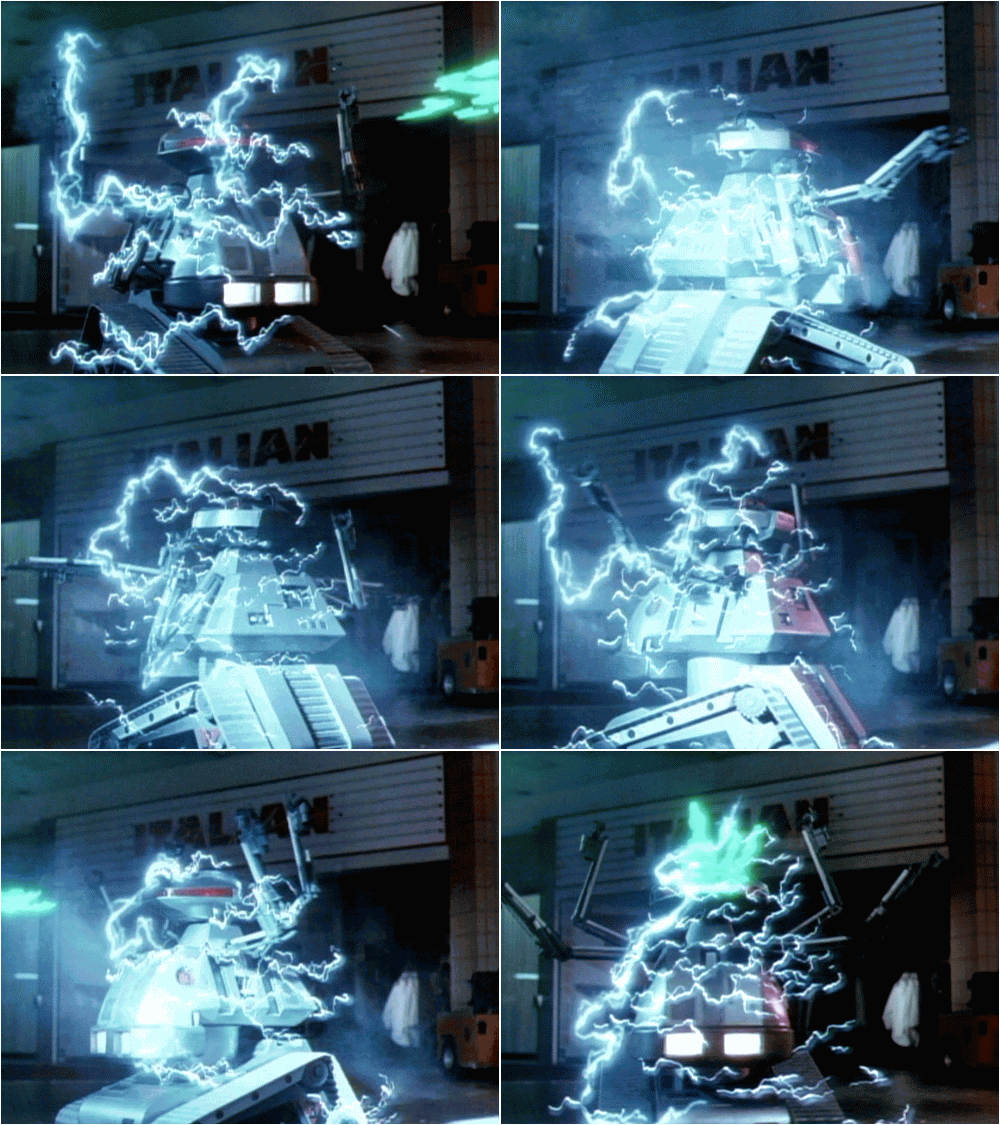
(not UL Listed)
-

dinopello - Light Sweet Crude

- Posts: 6088
- Joined: Fri 13 May 2005, 03:00:00
- Location: The Urban Village
Re: Elon Musk: Killer Robots will eliminate us all in 5-10 Y
by Lore » Sat 31 Jan 2015, 18:05:33
I believe the point of which to make about being a Bill Gates, Steve Jobs, or a Thomas Edison is more of that of the visionary. With the resources to make that vision happen.
AI to the extreme won't happen because the resources won't be there, nor the will. Concentration the latter part of this century will be strictly focused on trying to keep the global poulation from shrinking anymore then it will be.
AI to the extreme won't happen because the resources won't be there, nor the will. Concentration the latter part of this century will be strictly focused on trying to keep the global poulation from shrinking anymore then it will be.
The things that will destroy America are prosperity-at-any-price, peace-at-any-price, safety-first instead of duty-first, the love of soft living, and the get-rich-quick theory of life.
... Theodore Roosevelt
... Theodore Roosevelt
-
Lore - Fission
- Posts: 9021
- Joined: Fri 26 Aug 2005, 03:00:00
- Location: Fear Of A Blank Planet
Re: Elon Musk: Killer Robots will eliminate us all in 5-10 Y
by dinopello » Sat 07 Feb 2015, 17:34:16
-
dinopello - Light Sweet Crude
- Posts: 6088
- Joined: Fri 13 May 2005, 03:00:00
- Location: The Urban Village
Re: Elon Musk: Killer Robots will eliminate us all in 5-10 Y
by vox_mundi » Tue 10 Feb 2015, 15:53:12
Robots replacing human factory workers at faster pace
$this->bbcode_second_pass_quote('', 'T')he Boston Consulting Group predicts that investment in industrial robots will grow 10 percent a year in the world's 25-biggest export nations through 2025, up from 2 percent to 3 percent a year now. The investment will pay off in lower costs and increased efficiency.
Robots will cut labor costs by 33 percent in South Korea, 25 percent in Japan, 24 percent in Canada and 22 percent in the United States and Taiwan. Only 10 percent of jobs that can be automated have already been taken by robots. By 2025, the machines will have more than 23 percent, Boston Consulting forecasts. link
In a separate report, RBC Global Asset Management notes that robots can be reprogrammed far faster and more efficiently than humans can be retrained when products are updated or replaced—a crucial advantage at a time when smartphones and other products quickly fade into obsolescence. link
Increasing automation is likely to change the way companies evaluate where to open and expand factories. Boston Consulting expects that manufacturers will "no longer simply chase cheap labor." Factories will employ fewer people, and those that remain are more likely to be highly skilled.
$this->bbcode_second_pass_quote('', 'T')he Boston Consulting Group predicts that investment in industrial robots will grow 10 percent a year in the world's 25-biggest export nations through 2025, up from 2 percent to 3 percent a year now. The investment will pay off in lower costs and increased efficiency.
Robots will cut labor costs by 33 percent in South Korea, 25 percent in Japan, 24 percent in Canada and 22 percent in the United States and Taiwan. Only 10 percent of jobs that can be automated have already been taken by robots. By 2025, the machines will have more than 23 percent, Boston Consulting forecasts. link
In a separate report, RBC Global Asset Management notes that robots can be reprogrammed far faster and more efficiently than humans can be retrained when products are updated or replaced—a crucial advantage at a time when smartphones and other products quickly fade into obsolescence. link
Increasing automation is likely to change the way companies evaluate where to open and expand factories. Boston Consulting expects that manufacturers will "no longer simply chase cheap labor." Factories will employ fewer people, and those that remain are more likely to be highly skilled.
-

vox_mundi - Intermediate Crude

- Posts: 3939
- Joined: Wed 27 Sep 2006, 03:00:00
Re: Elon Musk: Killer Robots will eliminate us all in 5-10 Y
by Timo » Tue 10 Feb 2015, 16:29:55
$this->bbcode_second_pass_quote('vox_mundi', '[')b]Robots replacing human factory workers at faster pace
$this->bbcode_second_pass_quote('', 'T')he Boston Consulting Group predicts that investment in industrial robots will grow 10 percent a year in the world's 25-biggest export nations through 2025, up from 2 percent to 3 percent a year now. The investment will pay off in lower costs and increased efficiency.
Robots will cut labor costs by 33 percent in South Korea, 25 percent in Japan, 24 percent in Canada and 22 percent in the United States and Taiwan. Only 10 percent of jobs that can be automated have already been taken by robots. By 2025, the machines will have more than 23 percent, Boston Consulting forecasts. link
In a separate report, RBC Global Asset Management notes that robots can be reprogrammed far faster and more efficiently than humans can be retrained when products are updated or replaced—a crucial advantage at a time when smartphones and other products quickly fade into obsolescence. link
Increasing automation is likely to change the way companies evaluate where to open and expand factories. Boston Consulting expects that manufacturers will "no longer simply chase cheap labor." Factories will employ fewer people, and those that remain are more likely to be highly skilled.
$this->bbcode_second_pass_quote('', 'T')he Boston Consulting Group predicts that investment in industrial robots will grow 10 percent a year in the world's 25-biggest export nations through 2025, up from 2 percent to 3 percent a year now. The investment will pay off in lower costs and increased efficiency.
Robots will cut labor costs by 33 percent in South Korea, 25 percent in Japan, 24 percent in Canada and 22 percent in the United States and Taiwan. Only 10 percent of jobs that can be automated have already been taken by robots. By 2025, the machines will have more than 23 percent, Boston Consulting forecasts. link
In a separate report, RBC Global Asset Management notes that robots can be reprogrammed far faster and more efficiently than humans can be retrained when products are updated or replaced—a crucial advantage at a time when smartphones and other products quickly fade into obsolescence. link
Increasing automation is likely to change the way companies evaluate where to open and expand factories. Boston Consulting expects that manufacturers will "no longer simply chase cheap labor." Factories will employ fewer people, and those that remain are more likely to be highly skilled.
I think the robot factory workers will soon unionize, gain more benefits for their work, and accelerate the demise of human labor, altogether. When that happens, AI has officially arrived.
- Timo