Smart Grid Service Revenue To Reach $11.2 Billion By 2023
$this->bbcode_second_pass_quote('', 'S')mart grid as a service (SGaaS) solutions allow utilities with financial constraints to spread the cost of their projects out over a period of several years, and according to new research from Navigant Research will see strong growth over the next 10 years.
According to the Navigant Research report, revenue from SGaaS solutions will grow from $1.7 billion annually in 2014 to $11.2 billion in 2023, attracting IT professionals to utilities with limited budgets and providing managed services to utilities to help in their smart grid initiatives where before only the largest utilities could effectively afford to initiate such a development.
“Traditionally, utilities have shied away from outsourcing operations beyond back-office functions like billing or payroll,” says Richelle Elberg, senior research analyst with Navigant Research. “But the tremendous growth in cloud-based services for business of all types has increased utilities’ awareness of and comfort levels with cloud-based solutions.”
Smart grids, and microgrids specifically, are enjoying a time of impressive investment opportunity lately. Navigant Research released two separate reports earlier this month investigating both initiatives — finding that nearly $600 billion will be spent on smart grid technologies over the next decade, and another $31 billion will be invested into Asia Pacific microgrids by 2023.
Navigant Research outlines several potential advantages for Smart Grid as a Service solutions over conventional, in-house smart grid deployments:


PeakOil is You
Centralised Vs. Decentralised Solar Power
Human history becomes more and more a race between education and catastrophe. H. G. Wells.
Fatih Birol's motto: leave oil before it leaves us.
Fatih Birol's motto: leave oil before it leaves us.
-

Graeme - Fusion

- Posts: 13258
- Joined: Fri 04 Mar 2005, 04:00:00
- Location: New Zealand
Re: Centralised Vs. Decentralised Solar Power
 by Graeme » Sat 30 Aug 2014, 20:47:35
Microgrids Are Coming, and They Could Change the World
$this->bbcode_second_pass_quote('', 'A')s the cost of solar energy has fallen, it has opened up new markets that were once unimaginable in energy. Five years ago, it seemed impossible that a million homes in the U.S. could be powered by solar energy, but that's the goal of just one company -- SolarCity (NASDAQ: SCTY ) -- and it hopes to accomplish this goal by 2018.
As the cost of solar energy falls and new technologies like energy storage, smart meters, and demand response advance, new opportunities open up, like microgrids, which can create a self contained energy ecosystem. If designed right, microgrids can produce more renewable energy, cause less strain on the grid, and even provide technology that could change energy around the world.
What's a microgrid?
A microgrid is an electric grid that is much smaller than a city, state, or national grid and contains both generating assets as well as energy demand sources.
It may contain distributed solar on rooftops, ground mounted wind and solar generation, smart meters, energy storage, and even demand response. The main electric grid would then feed into a central point that would control all points of the system and communicate with the main grid, which would still provide a feed of energy to the microgrid. Below is a graphic from Siemens, a large grid supplier, that shows what a microgrid may look like.
So, how does this change the world?
The revolution of the microgrid will be noticed here in the U.S., but it could also transform impoverished nations with little access to energy worldwide. There are currently 1.3 billion people worldwide who lack power, and most of them live in locations far from a traditional energy plant or electric grid. It's also often infeasible to build a fossil fuel plant or run transmission lines from the central grid to these locations. So, creating a microgrid with local energy sources is a logical solution.
It just so happens that many of these communities in Africa and India are also home to tremendous solar energy potential. If these communities had the ability to build their own grids, produce energy, and store energy, they could improve life immensely. It's possible the improving economics of solar energy, energy storage, and microgrids could improve the lives of billions of people.
$this->bbcode_second_pass_quote('', 'A')s the cost of solar energy has fallen, it has opened up new markets that were once unimaginable in energy. Five years ago, it seemed impossible that a million homes in the U.S. could be powered by solar energy, but that's the goal of just one company -- SolarCity (NASDAQ: SCTY ) -- and it hopes to accomplish this goal by 2018.
As the cost of solar energy falls and new technologies like energy storage, smart meters, and demand response advance, new opportunities open up, like microgrids, which can create a self contained energy ecosystem. If designed right, microgrids can produce more renewable energy, cause less strain on the grid, and even provide technology that could change energy around the world.
What's a microgrid?
A microgrid is an electric grid that is much smaller than a city, state, or national grid and contains both generating assets as well as energy demand sources.
It may contain distributed solar on rooftops, ground mounted wind and solar generation, smart meters, energy storage, and even demand response. The main electric grid would then feed into a central point that would control all points of the system and communicate with the main grid, which would still provide a feed of energy to the microgrid. Below is a graphic from Siemens, a large grid supplier, that shows what a microgrid may look like.
So, how does this change the world?
The revolution of the microgrid will be noticed here in the U.S., but it could also transform impoverished nations with little access to energy worldwide. There are currently 1.3 billion people worldwide who lack power, and most of them live in locations far from a traditional energy plant or electric grid. It's also often infeasible to build a fossil fuel plant or run transmission lines from the central grid to these locations. So, creating a microgrid with local energy sources is a logical solution.
It just so happens that many of these communities in Africa and India are also home to tremendous solar energy potential. If these communities had the ability to build their own grids, produce energy, and store energy, they could improve life immensely. It's possible the improving economics of solar energy, energy storage, and microgrids could improve the lives of billions of people.
fool
Human history becomes more and more a race between education and catastrophe. H. G. Wells.
Fatih Birol's motto: leave oil before it leaves us.
Fatih Birol's motto: leave oil before it leaves us.
-
Graeme - Fusion
- Posts: 13258
- Joined: Fri 04 Mar 2005, 04:00:00
- Location: New Zealand
Re: Centralised Vs. Decentralised Solar Power
by Graeme » Sun 07 Sep 2014, 20:13:55
World Is Moving to Distributed Energy: 165 GW by 2023
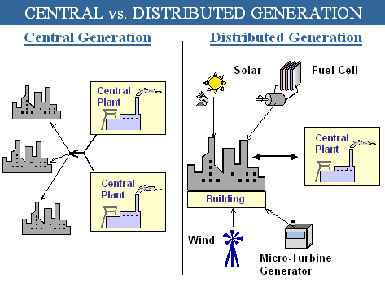
$this->bbcode_second_pass_quote('', 'W')hether utilities, ALEC (and their coal/oil backers) like it or not, the world is moving to decentralized electricity.
Because of Western Europe's supportive renewable energy policies, utilities there have been struggling the most, losing hundreds of billions of dollars in market capitalization. In the US, a battle is underway from the threatened industry trying to hold onto its centralized business model.
But change is underway, with distributed energy installations expected to grow from 87.3 gigawatts (GW) in 2014 to 165.5 GW in 2023, according to Navigant Research, with worldwide revenue growing from $97 billion in 2014 to more than $182 billion by 2023.
"One of the most important issues for the energy industry is striking a balance between distributed generation growth and fairly compensating utilities for the ability to effectively use the existing electrical grid as a backup service for onsite power at higher concentrations in the future," says Dexter Gauntlett, senior research analyst with Navigant Research. "Utilities that proactively engage with their customers to accommodate distributed generation - and even participate in the market themselves - limit their risk and stand to benefit the most."
By 2018, Navigant expects new distributed capacity additions worldwide to surpass new centralized ones, and by 2023, it will eliminate the need for at least 321 GW of new large-scale power plants. Extremely efficient diesel engines will dominate in the short term, followed by solar PV and natural gas.
$this->bbcode_second_pass_quote('', 'W')hether utilities, ALEC (and their coal/oil backers) like it or not, the world is moving to decentralized electricity.
Because of Western Europe's supportive renewable energy policies, utilities there have been struggling the most, losing hundreds of billions of dollars in market capitalization. In the US, a battle is underway from the threatened industry trying to hold onto its centralized business model.
But change is underway, with distributed energy installations expected to grow from 87.3 gigawatts (GW) in 2014 to 165.5 GW in 2023, according to Navigant Research, with worldwide revenue growing from $97 billion in 2014 to more than $182 billion by 2023.
"One of the most important issues for the energy industry is striking a balance between distributed generation growth and fairly compensating utilities for the ability to effectively use the existing electrical grid as a backup service for onsite power at higher concentrations in the future," says Dexter Gauntlett, senior research analyst with Navigant Research. "Utilities that proactively engage with their customers to accommodate distributed generation - and even participate in the market themselves - limit their risk and stand to benefit the most."
By 2018, Navigant expects new distributed capacity additions worldwide to surpass new centralized ones, and by 2023, it will eliminate the need for at least 321 GW of new large-scale power plants. Extremely efficient diesel engines will dominate in the short term, followed by solar PV and natural gas.
sustainablebusiness
Human history becomes more and more a race between education and catastrophe. H. G. Wells.
Fatih Birol's motto: leave oil before it leaves us.
Fatih Birol's motto: leave oil before it leaves us.
-
Graeme - Fusion
- Posts: 13258
- Joined: Fri 04 Mar 2005, 04:00:00
- Location: New Zealand
Re: Centralised Vs. Decentralised Solar Power
by Graeme » Tue 09 Sep 2014, 18:53:26
Transmission Investment Times Five: Will the Grid be Secure?
$this->bbcode_second_pass_quote('', 'T')he Energy Information Administration (EIA) reports that investments in electricity transmission infrastructure have increased by a factor of five since 1997. This is promising because prior to the late nineties, grid infrastructure investments declined for three decades, and electric grid reliability deteriorated along with them.
$this->bbcode_second_pass_quote('', 'T')he Energy Information Administration (EIA) reports that investments in electricity transmission infrastructure have increased by a factor of five since 1997. This is promising because prior to the late nineties, grid infrastructure investments declined for three decades, and electric grid reliability deteriorated along with them.

$this->bbcode_second_pass_quote('', 'T')he boom in transmission investment is necessary (and overdue) for several important reasons. The EIA mentions the need to connect renewable resources to the grid, accommodate changes in electricity demand, and reform electricity markets as some motives for the increased investment. But, at the top of the list of priorities is the need to improve reliability of the grid.
theenergycollective
Using Neural Networks To Better Forecast Renewables
$this->bbcode_second_pass_quote('', 'M')uch has been made of the needs of the electricity grid as more and more renewables with their inherent fluctuations are plugged into the grid. No longer can a certain amount of energy be guaranteed, and with burgeoning populations and energy use the world over, it’s becoming increasingly difficult to predict how much energy is going to be needed as well.
Enter SENN — the Simulation Environment for Neural Networks — forecasting software that is currently used to forecast raw material prices, and the price of electricity over 20 day periods, and has now been turned to forecasting the amount of electricity that will be fed into the grid by renewables such as solar and wind.
The use of SENN in the field of renewables is not breaking news, however Siemens has afforded a lot of column space to the idea of better forecasting for renewables and neural networks in its latest ‘Pictures of the Future‘ magazine that is published twice a year. Pictures of the Future looks at the latest research in Siemens laboratories and investigates the major technology trends currently shaping the world.
cleantechnica
Human history becomes more and more a race between education and catastrophe. H. G. Wells.
Fatih Birol's motto: leave oil before it leaves us.
Fatih Birol's motto: leave oil before it leaves us.