The inevitable demise of the fossil fuel empire
$this->bbcode_second_pass_quote('', 'T')he latest data from the International Energy Agency (IEA) and other sources proves that the oil and gas majors are in deep trouble.
Over the last decade, rising oil prices have been driven primarily by rising production costs. After the release of the IEA's World Energy Outlook last November, Deutsche Bank's former head of energy research Mark Lewis noted that massive levels of investment have corresponded to an ever declining rate of oil supply increase:
"Over the past decade, the oil and gas industry's upstream investments have registered an astronomical increase, but these ever higher levels of capital expenditure have yielded ever smaller increases in the global oil supply. Even these have only been made possible by record high oil prices. This should be a reality check for those now hyping a new age of global oil abundance."
Since 2000, the oil industry's investments have risen by 180% - a threefold increase - but this has translated into a global oil supply increase of just 14%. Two-thirds of this increase has been made-up by unconventional oil and gas. In other words, the primary driver of the cost explosion is the shift to expensive and difficult-to-extract unconventionals due to the peak and plateau in conventional oil production since 2005.
According to Lewis, who now heads up energy transition and climate change research at leading investment firm Kepler Cheuvreux:
"The most straightforward interpretation of this data is that the economics of oil have become completely dislocated from historic norms since 2000 (and especially since 2005), with the industry investing at exponentially higher rates for increasingly small incremental yields of energy."
The IEA's new World Energy Investment Outlook published last week revised the agency's estimates of future oil industry capital expenditures out to 2035 even higher, from $9.4 trillion to $11.3 trillion – an increase of 20%.
Oil prices could in turn increase by $15 per barrel in 2025 if investment does not pick up. Most of the investment increase required would be devoted not to new sources of production, but "to replace lost production from depleting fields," said Lewis.



PeakOil is You
The inevitable demise of the fossil fuel empire
Human history becomes more and more a race between education and catastrophe. H. G. Wells.
Fatih Birol's motto: leave oil before it leaves us.
Fatih Birol's motto: leave oil before it leaves us.
-

Graeme - Fusion

- Posts: 13258
- Joined: Fri 04 Mar 2005, 04:00:00
- Location: New Zealand
Re: The inevitable demise of the fossil fuel empire
 by shortonoil » Sat 19 Jul 2014, 11:02:27
In Richard Heinberg's book, "The End of Growth" he shows a graph that he took from Reuters, Wood Mackenzie Exportation Service (page 110). The graph shows what Reuters calls Oil Discovery Costs, and the Price of Oil. The graph also shows that Oil Discovery Costs have been increasing faster the Price of Oil since 2001. This strongly supports our claim (which is derived from a thermodynamic evaluation of oil production) that the cost of production for the average barrel of oil is now increasing faster than its price, and that this will continue until the two meet. That meeting will occur in the 2030 - 2035 time frame. This is further substantiated by the rapid decline in ROI that the industry has experienced over the last decade. That has amounted to about a 50% decline.
When the cost of producing the average barrel becomes equal to its price, producers will no longer have an incentive to continue production. Because petroleum is the foundation of modern industrial society, its demise would result in the cessation of many of the institutions on which the society is dependent for its continuous. If petroleum prices only increase by $15 between now, and 2025 the industry is going to be in very serious trouble. Our analysis indicates that production costs over that time frame will increase by 26%. $200 per barrel oil by 2025 is a much more likely scenario than $120.
http://www.thehillsgroup.org/
When the cost of producing the average barrel becomes equal to its price, producers will no longer have an incentive to continue production. Because petroleum is the foundation of modern industrial society, its demise would result in the cessation of many of the institutions on which the society is dependent for its continuous. If petroleum prices only increase by $15 between now, and 2025 the industry is going to be in very serious trouble. Our analysis indicates that production costs over that time frame will increase by 26%. $200 per barrel oil by 2025 is a much more likely scenario than $120.
http://www.thehillsgroup.org/
-
shortonoil - False ETP Prophet

- Posts: 7132
- Joined: Thu 02 Dec 2004, 04:00:00
- Location: VA USA
Re: The inevitable demise of the fossil fuel empire
by KaiserJeep » Sat 19 Jul 2014, 13:39:45
I believe anybody who has been around the Forum understands how oil will end. Now we are putting bounds on WHEN oil will end.
Based on your figures, we have a decade of relative normalcy left, and then the cost of vehicle fuels becomes unaffordable for most people, so you best have a nice Electric Vehicle by then.
Likewise any manufacturing of plastics becomes prohibitively expensive when conventional wells are abandoned, so for the second half of that decade, light manufacturing of all types will face bankruptcy at ever higher rates.
The escalating costs for anything that needs fuel to grow it or transport it are already apparent. Hard to generalize here, my personal metric is the cost of my favorite vegetable which is corn. The price last year was 3 ears for one dollar, the prices this year are two ears for a dollar. The average cost of food seems to be 50% higher than a decade ago, here in California we have gone from $8 per grocery bag in 1990 to $12 per bag in 2000, to $20 per bag in 2010 to $30 per bag in 2015. Clearly food has quadrupled in price in three decades, which does not mean much here, but in Africa and South America they are in trouble.
I could go on and on, but that last item is a killer. The underlying cause of the Somali pirates and the flood of South American children over the border is now understood to be the cost of food.
The declining supply and rapidly increasing cost of oil is also destabilizing regimes. Mexican gangs move North in search of income. Vladimir Putin invades the Ukraine in hopes of preserving his political power. Barack Obama plays golf and talks, having learned that he can't even get his own Massachusetts Democrats to back down and support Cape Wind, the proposed offshore wind farm on Cape Cod, which he called "shovel ready" in 2007, during his first campaign for President.
That last is a blessing, by the way. Better to have Obama rather than Putin. King Log is better than King Stork if one is a frog.
Based on your figures, we have a decade of relative normalcy left, and then the cost of vehicle fuels becomes unaffordable for most people, so you best have a nice Electric Vehicle by then.
Likewise any manufacturing of plastics becomes prohibitively expensive when conventional wells are abandoned, so for the second half of that decade, light manufacturing of all types will face bankruptcy at ever higher rates.
The escalating costs for anything that needs fuel to grow it or transport it are already apparent. Hard to generalize here, my personal metric is the cost of my favorite vegetable which is corn. The price last year was 3 ears for one dollar, the prices this year are two ears for a dollar. The average cost of food seems to be 50% higher than a decade ago, here in California we have gone from $8 per grocery bag in 1990 to $12 per bag in 2000, to $20 per bag in 2010 to $30 per bag in 2015. Clearly food has quadrupled in price in three decades, which does not mean much here, but in Africa and South America they are in trouble.
I could go on and on, but that last item is a killer. The underlying cause of the Somali pirates and the flood of South American children over the border is now understood to be the cost of food.
The declining supply and rapidly increasing cost of oil is also destabilizing regimes. Mexican gangs move North in search of income. Vladimir Putin invades the Ukraine in hopes of preserving his political power. Barack Obama plays golf and talks, having learned that he can't even get his own Massachusetts Democrats to back down and support Cape Wind, the proposed offshore wind farm on Cape Cod, which he called "shovel ready" in 2007, during his first campaign for President.
That last is a blessing, by the way. Better to have Obama rather than Putin. King Log is better than King Stork if one is a frog.
KaiserJeep 2.0, Neural Subnode 0010 0000 0001 0110 - 1001 0011 0011, Tertiary Adjunct to Unimatrix 0000 0000 0001
Resistance is Futile, YOU will be Assimilated.
Warning: Messages timestamped before April 1, 2016, 06:00 PST were posted by the unmodified human KaiserJeep 1.0
Resistance is Futile, YOU will be Assimilated.
Warning: Messages timestamped before April 1, 2016, 06:00 PST were posted by the unmodified human KaiserJeep 1.0
- KaiserJeep
- Light Sweet Crude

- Posts: 6094
- Joined: Tue 06 Aug 2013, 17:16:32
- Location: Wisconsin's Dreamland
Re: The inevitable demise of the fossil fuel empire
by Keith_McClary » Sun 20 Jul 2014, 13:11:59
$this->bbcode_second_pass_quote('shortonoil', 'I')n Richard Heinberg's book, "The End of Growth" he shows a graph that he took from Reuters, Wood Mackenzie Exportation Service (page 110). The graph shows what Reuters calls Oil Discovery Costs, and the Price of Oil. The graph also shows that Oil Discovery Costs have been increasing faster the Price of Oil since 2001.

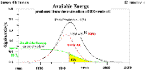
Data to 2009.
Facebook knows you're a dog.
-

Keith_McClary - Light Sweet Crude
- Posts: 7344
- Joined: Wed 21 Jul 2004, 03:00:00
- Location: Suburban tar sands
Re: The inevitable demise of the fossil fuel empire
by ROCKMAN » Sun 20 Jul 2014, 16:20:56
"The latest data from the IEA and other sources proves that the oil and gas majors are in deep trouble." As I've pointed out on numerous occasion Big Oil has been in trouble (and knew it) for at least 40 years. A tad late for everyone else to catch on but better late then never. Too bad the US political system didn't come to this understand when I did in the 70's. Who knows...they might have made some meaningful changes when we still had time.
-

ROCKMAN - Expert

- Posts: 11397
- Joined: Tue 27 May 2008, 03:00:00
- Location: TEXAS
Re: The inevitable demise of the fossil fuel empire
by Pops » Mon 21 Jul 2014, 13:14:27
$this->bbcode_second_pass_quote('', 'O')ver the last decade, rising oil prices have been driven primarily by rising production costs.
Well right off the bat, this is not how markets work.
Fact is, markets don't care what production costs are, they only care what the buyer is willing and able to pay. If cost mattered, KSA might only get $30/bbl while offshore or frackers might get $120.
Since that isn't the way things work, 2 things can happen: producers cut costs (think walmart) or consumers become more efficient.
Oh yeah, we could always frack our way to Nirvana, but that doesn't seem to be happening.
The legitimate object of government, is to do for a community of people, whatever they need to have done, but can not do, at all, or can not, so well do, for themselves -- in their separate, and individual capacities.
-- Abraham Lincoln, Fragment on Government (July 1, 1854)
-- Abraham Lincoln, Fragment on Government (July 1, 1854)
-

Pops - Elite
- Posts: 19746
- Joined: Sat 03 Apr 2004, 04:00:00
- Location: QuikSac for a 6-Pac
Re: The inevitable demise of the fossil fuel empire
by Graeme » Mon 21 Jul 2014, 17:30:12
Oil Abundance? Not So Fast- A Risk Checklist
$this->bbcode_second_pass_quote('', 'E')NERGY, ESPECIALLY OIL, IS KEY TO THE ECONOMY
Nothing gets done without energy. The economy as a measure of real-world activity is based on energy and natural resource use, not finance. Whenever oil prices have risen sharply since the 1940’s, a recession has almost always followed. Attempts to manipulate the economy with fiscal and monetary policy cannot succeed if affordable real resources are not available. In particular, our water supplies and agricultural economy are very dependent on oil and other fossil fuels, while energy production requires a lot of water.
We have two energy systems, not one. Nearly all transportation around the world is powered by petroleum, and most petroleum is used for “transportation energy.” Other sources – coal, natural gas, nuclear, hydropower, wind, and solar – are mostly used for “process energy,” meaning electricity, heat, and manufacturing. Advances in the non-oil sector have done little to satisfy the demand for transportation energy.
High-priced oil tends to reduce other economic activity before slowing oil consumption directly, because there are few substitutes for oil. People do not drive 85% of the way to work, so they have to cut other spending to pay for expensive gas. The economic benefit from a gallon of gasoline or diesel is often greater in China and other developing economies than in the US and Europe, so they can afford to pay more than we can. Our economic growth has slowed when prices have risen rapidly, especially as oil prices exceed $100 per barrel.
Despite large increases in the price of gasoline, American consumption has remained nearly level at about 9 million barrels per day for the last ten years. Diesel consumption, the second largest use of oil, dropped briefly due to the economic slowdown, but has now fully recovered, growing since 2009.
THE COST OF OBTAINING OIL IS RISING
“Energy Return on Energy Invested” (EROEI) is an important concept showing how much energy (not just money) we get for the energy used in the extraction process. During much of the twentieth century, US oil extraction enjoyed an EROEI ratio of 50 or more, which meant that only 2% of the energy was consumed in the production process. Current estimates of oil from fracking and tar sands show an EROEI well below 10, which means we use 10% or more of the energy from that oil simply getting it out of the ground.
Low oil prices tend to reduce oil extraction, because the newest oil sources tend to be the most expensive – tar sands, tight oil, deepwater fields, and so on. If oil prices fall too far, investors will not get the return they need to justify new drilling efforts, so many new projects will be abandoned or delayed.
The rate of growth in conventional oil extraction around the world has slowed markedly since 2005, despite massive ongoing investments by oil companies in exploration and production efforts, because new oil is hard to find and hard to extract. Global oil extraction rates outside of the US grew only 3% in the eight years between 2004 and 2012, even though oil prices tripled during that period.
Another factor has reduced the amount of net exports of oil in world trade and thus contributed to higher prices: oil exporting countries often increase their consumption levels faster than extraction rates, and consumption may continue to rise even if extraction falls. China, Indonesia, Great Britain, Egypt, Vietnam, Argentina, and Malaysia have all changed from exporters to importers in the last twenty years increasing the competition for oil in world trade.
NEW SOURCES OF AFFORDABLE OIL ARE NOT AS ABUNDANT AS IS COMMONLY CLAIMED
$this->bbcode_second_pass_quote('', 'E')NERGY, ESPECIALLY OIL, IS KEY TO THE ECONOMY
Nothing gets done without energy. The economy as a measure of real-world activity is based on energy and natural resource use, not finance. Whenever oil prices have risen sharply since the 1940’s, a recession has almost always followed. Attempts to manipulate the economy with fiscal and monetary policy cannot succeed if affordable real resources are not available. In particular, our water supplies and agricultural economy are very dependent on oil and other fossil fuels, while energy production requires a lot of water.
We have two energy systems, not one. Nearly all transportation around the world is powered by petroleum, and most petroleum is used for “transportation energy.” Other sources – coal, natural gas, nuclear, hydropower, wind, and solar – are mostly used for “process energy,” meaning electricity, heat, and manufacturing. Advances in the non-oil sector have done little to satisfy the demand for transportation energy.
High-priced oil tends to reduce other economic activity before slowing oil consumption directly, because there are few substitutes for oil. People do not drive 85% of the way to work, so they have to cut other spending to pay for expensive gas. The economic benefit from a gallon of gasoline or diesel is often greater in China and other developing economies than in the US and Europe, so they can afford to pay more than we can. Our economic growth has slowed when prices have risen rapidly, especially as oil prices exceed $100 per barrel.
Despite large increases in the price of gasoline, American consumption has remained nearly level at about 9 million barrels per day for the last ten years. Diesel consumption, the second largest use of oil, dropped briefly due to the economic slowdown, but has now fully recovered, growing since 2009.
THE COST OF OBTAINING OIL IS RISING
“Energy Return on Energy Invested” (EROEI) is an important concept showing how much energy (not just money) we get for the energy used in the extraction process. During much of the twentieth century, US oil extraction enjoyed an EROEI ratio of 50 or more, which meant that only 2% of the energy was consumed in the production process. Current estimates of oil from fracking and tar sands show an EROEI well below 10, which means we use 10% or more of the energy from that oil simply getting it out of the ground.
Low oil prices tend to reduce oil extraction, because the newest oil sources tend to be the most expensive – tar sands, tight oil, deepwater fields, and so on. If oil prices fall too far, investors will not get the return they need to justify new drilling efforts, so many new projects will be abandoned or delayed.
The rate of growth in conventional oil extraction around the world has slowed markedly since 2005, despite massive ongoing investments by oil companies in exploration and production efforts, because new oil is hard to find and hard to extract. Global oil extraction rates outside of the US grew only 3% in the eight years between 2004 and 2012, even though oil prices tripled during that period.
Another factor has reduced the amount of net exports of oil in world trade and thus contributed to higher prices: oil exporting countries often increase their consumption levels faster than extraction rates, and consumption may continue to rise even if extraction falls. China, Indonesia, Great Britain, Egypt, Vietnam, Argentina, and Malaysia have all changed from exporters to importers in the last twenty years increasing the competition for oil in world trade.
NEW SOURCES OF AFFORDABLE OIL ARE NOT AS ABUNDANT AS IS COMMONLY CLAIMED
resilience
Human history becomes more and more a race between education and catastrophe. H. G. Wells.
Fatih Birol's motto: leave oil before it leaves us.
Fatih Birol's motto: leave oil before it leaves us.
-
Graeme - Fusion
- Posts: 13258
- Joined: Fri 04 Mar 2005, 04:00:00
- Location: New Zealand