Saudi Arabia announced it will start fracking shale to produce Natural Gas in KSA. It is one of the first countries outside the US to adopt the new technique for producing oil and NG from shale
KSA to start fracking project in shale
KSA plans to use the NG they produce from shale to power their electrical grid, freeing up more oil for the export market.


PeakOil is You
Saudi Arabia starts fracking shale
Saudi Arabia starts fracking shale
 by Plantagenet » Mon 14 Oct 2013, 23:29:08
-

Plantagenet - Expert

- Posts: 26765
- Joined: Mon 09 Apr 2007, 03:00:00
- Location: Alaska (its much bigger than Texas).
Re: Saudi Arabia starts fracking shale
by ROCKMAN » Tue 15 Oct 2013, 12:53:01
The KSA has been doing a good job of not wasting NG produced in association with the oil. I wonder if the announcement of targeting NG that should be very expensive to develop compared to the associated NG they’ve been essentially getting for free is an indication of how they anticipate their oil production to decline. From: http://www.arabianoilandgas.com/article ... l1xBZ0o5WE
“The report records a notable achievement by Saudi Arabia in managing gas flaring. The Kingdom’s master gas system mega-project, which was online in 1982, today gathers almost 100 Bcm per year and is the world’s largest single hydrocarbon network. Approximately half of the gas supply for the system comes from associated gas that was previously flared. Joe Anis, GE Energy’s President & CEO for the Middle East said: “The success achieved by Saudi Arabia is one example in the long journey for the Middle East region towards managing gas flaring more effectively, which has long-term environmental and energy sector impact”.
“The report records a notable achievement by Saudi Arabia in managing gas flaring. The Kingdom’s master gas system mega-project, which was online in 1982, today gathers almost 100 Bcm per year and is the world’s largest single hydrocarbon network. Approximately half of the gas supply for the system comes from associated gas that was previously flared. Joe Anis, GE Energy’s President & CEO for the Middle East said: “The success achieved by Saudi Arabia is one example in the long journey for the Middle East region towards managing gas flaring more effectively, which has long-term environmental and energy sector impact”.
-

ROCKMAN - Expert
- Posts: 11397
- Joined: Tue 27 May 2008, 03:00:00
- Location: TEXAS
Re: Saudi Arabia starts fracking shale
by Plantagenet » Tue 15 Oct 2013, 13:00:57
The main reason I started a thread on this topic is that some have claimed that US-style fracking of shale to produce oil and gas wouldn't catch on overseas, and the huge increases in US oil and NG production could not be duplicated overseas.
Clearly that is wrong. Fracking of shale is going to occur all around the world.
When KSA ---- the largest oil producer in OPEC----starts utilizing fracking techology on shale, you can bet your bippy that the other OPEC producers will also soon be fracking shales. Fracking is also getting started in Australia and South America and the UK and Poland.
Everybody is gonna be fracking.
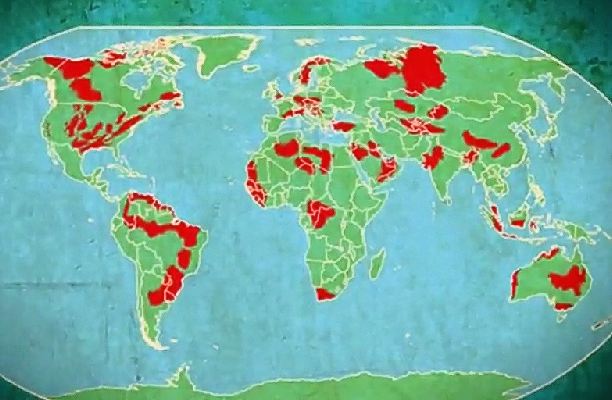
Currently known global distribution of shales thought to have FF resources that can be produced using fracking
Clearly that is wrong. Fracking of shale is going to occur all around the world.
When KSA ---- the largest oil producer in OPEC----starts utilizing fracking techology on shale, you can bet your bippy that the other OPEC producers will also soon be fracking shales. Fracking is also getting started in Australia and South America and the UK and Poland.
Everybody is gonna be fracking.
Currently known global distribution of shales thought to have FF resources that can be produced using fracking
-
Plantagenet - Expert
- Posts: 26765
- Joined: Mon 09 Apr 2007, 03:00:00
- Location: Alaska (its much bigger than Texas).
Re: Saudi Arabia starts fracking shale
by kublikhan » Tue 15 Oct 2013, 13:38:07
From the article:
$this->bbcode_second_pass_quote('', 'R')iyadh - hampered by scarce water and prices fixed far below production costs - is unlikely to produce much shale gas this decade.
Doesn't sound like KSA will be replicating the US's huge increase anytime soon.$this->bbcode_second_pass_quote('', 'R')iyadh - hampered by scarce water and prices fixed far below production costs - is unlikely to produce much shale gas this decade.
The oil barrel is half-full.
-

kublikhan - Master Prognosticator

- Posts: 5064
- Joined: Tue 06 Nov 2007, 04:00:00
- Location: Illinois
Re: Saudi Arabia starts fracking shale
by ROCKMAN » Tue 15 Oct 2013, 13:44:12
k - Time will tell depending on how fast they move. Got to thinking about the price differential between a NG Btu and an oil Btu. Even with the higher cost of international priced LNG you would have thought there was already a hard move away from oil-fired electrical generation. Unless their shale are much more productive then ours I would think LNG imports would make more sense especially given the KSA's close proximity to major LNG exporters. But I would also think they've already looked at those numbers very hard.
-
ROCKMAN - Expert
- Posts: 11397
- Joined: Tue 27 May 2008, 03:00:00
- Location: TEXAS
Re: Saudi Arabia starts fracking shale
by Plantagenet » Tue 15 Oct 2013, 14:04:56
$this->bbcode_second_pass_quote('kublikhan', 'F')rom the article:
$this->bbcode_second_pass_quote('', 'R')iyadh - hampered by scarce water and prices fixed far below production costs - is unlikely to produce much shale gas this decade.
Doesn't sound like KSA will be replicating the US's huge increase anytime soon.$this->bbcode_second_pass_quote('', 'R')iyadh - hampered by scarce water and prices fixed far below production costs - is unlikely to produce much shale gas this decade.
1. Waterless fracking doesn't require water.
2. The current price of NG outside the US doesn't reflect NG production costs anymore than the international price of BRENT oil reflects KSA oil production costs. The NG price is largely driven by Russia's monopoly over NG sales to Europe and has nothing to do with NG production costs in KSA.
3. Fracking shales in the US started about 10 years and current production is enormous. All major energy projects these days have ca. 10 year planning cycles.
4. Only time will tell how much NG the KSA can ultimately produce by fracking shales. I doubt they'd be doing it if the potential for significant NG production wasn't there.
-
Plantagenet - Expert
- Posts: 26765
- Joined: Mon 09 Apr 2007, 03:00:00
- Location: Alaska (its much bigger than Texas).
Re: Saudi Arabia starts fracking shale
by kublikhan » Tue 15 Oct 2013, 14:22:29
$this->bbcode_second_pass_quote('', '2'). The current price of NG outside the US doesn't reflect NG production costs anymore than the international price of BRENT oil reflects KSA oil production costs. The NG price is largely driven by Russia's monopoly over NG sales to Europe and has nothing to do with NG production costs in KSA.
I never said it did? The rigzone article is claiming the fixed low sales prices of natural gas in KSA will act as an impediment to fracking. Here's an article that delves into the subject in more detail if you are interested:$this->bbcode_second_pass_quote('', 'T')he government of Saudi Arabia will lose millions of dollars a day tapping into much-needed new gasfields because of rigidly low domestic prices, according to the International Energy Agency (IEA). Rapidly increasing electricity consumption and industrial development has led Saudi Aramco, the state oil company, to scramble to develop new natural gas reserves - with many significant successes.
But the cost of developing those fields overshadows the revenue the company will receive from selling the gas to power producers and petrochemical outfits at fixed prices, according to new estimates by the IEA. The cost of extracting a million British thermal units (BTUs) of gas from the new offshore Karan gasfield will be about US$3.50 (Dh12.85), the IEA said, while the domestic sales price for that same gas is fixed by the Saudi government at US 75 cents. The cost of producing gas from the more difficult Arabiyah field will be even higher, up to $5.50 per million BTUs, the IEA estimated.
The two fields will together produce 2.8 billion cubic feet per day of gas (cfd), according to Saudi Aramco's forecasts, leading to average daily losses of more than $8 million if consumer prices are not increased and the cost of the field developments is not reduced. In Saudi Arabia and across the region, the IEA said, "there is greater realisation that additional gas deposits are going to come in at costs much higher than in the past, and if domestic prices remain artificially low, a way must be found for the government or the national oil company to bridge the gap"
In a recent exploration round for gas in the country's south-eastern Empty Quarter by foreign companies, "it proved impossible to develop any reserves at a cost anywhere near the Saudi domestic selling price", the IEA noted. The Saudi government has been reluctant to increase gas prices for fear of hurting the international competitiveness of the country's petrochemical industry and the bottom lines of power producers, who sell electricity at fixed prices.
The oil barrel is half-full.
-
kublikhan - Master Prognosticator
- Posts: 5064
- Joined: Tue 06 Nov 2007, 04:00:00
- Location: Illinois


