PeakOil is You
Peak Oil Profits (POPs)
Re: Peak Oil Profits (POPs)
 by Keith_McClary » Thu 27 Feb 2014, 14:18:29
$this->bbcode_second_pass_quote('Pops', 'K')opit points out that in contrast to the EIA, etc who forecast future oil prices and production based on demand, he thinks the correct method is to forecasts the market based on supply.
As I understand him, he is saying that demand based prediction was OK in the past, but the underlying assumptions are no longer valid.Facebook knows you're a dog.
-

Keith_McClary - Light Sweet Crude

- Posts: 7344
- Joined: Wed 21 Jul 2004, 03:00:00
- Location: Suburban tar sands
Re: Peak Oil Profits (POPs)
by Keith_McClary » Thu 27 Feb 2014, 15:07:47
$this->bbcode_second_pass_quote('ROCKMAN', 'â')€œIt has been suggested that PO is when it is more profitable to keep oil in the ground (so as to produce it later for a higher price).” Not saying it has never happened but in 4 decades not once have I seen this down with an oil well with any of the dozens of companies I’ve been involved with.
I was thinking in terms of the owners of the resource.Consider a hypothetical world with a finite resource ("goop") which is owned by the rulers of various countries (so no tax/royalty complications). What is their pricing strategy for selling their portion of goop? I guess you would need to make some other assumptions, like "goop demand starts out low and grows exponentially at first" and "after peak goop, goop gets more expensive to dig up".
The question I am groping towards is, does the pricing strategy change from the early days to the post-peak days? And is this change somehow measurable or predictable?
$this->bbcode_second_pass_quote('ROCKMAN', 'F')olks really do need to accept the absolute importance of Net Present Value for the oil patch…especially the pubcos. For every year a bbl of oil is held back it loses 10 to 15% of its NPV. So even if oil prices were to increase by that rate over time the NPV doesn’t increases. But the company does lose cash flow by holding back. And very few companies don’t give preference to cash flow.
 ). I guess the hypothetical rulers would also consider the NPV of their goop. But that would seem to lead them to sell it as fast as possible, competing against each other and driving the price down.
I need to think more about this. Am I missing an assumption for the hypothetical world?
Facebook knows you're a dog.
-
Keith_McClary - Light Sweet Crude
- Posts: 7344
- Joined: Wed 21 Jul 2004, 03:00:00
- Location: Suburban tar sands
Re: Peak Oil Profits (POPs)
by ROCKMAN » Thu 27 Feb 2014, 16:38:12
Keith - For sure it's a very different world for the NOC's then the private US oils. They are certainly guided by a combination of political and economic dynamics very different the us. When I talk about the oil patch this or the other I'm never thinking about the NOC's. On a variety of levels they really exist in another universe to a fair degree IMHO.
-

ROCKMAN - Expert

- Posts: 11397
- Joined: Tue 27 May 2008, 03:00:00
- Location: TEXAS
Re: Peak Oil Profits (POPs)
by Graeme » Tue 11 Mar 2014, 19:17:08
Driven To Divest: Investor Pressure Could Make 2014 A Busy Year For Oil And Gas M&A
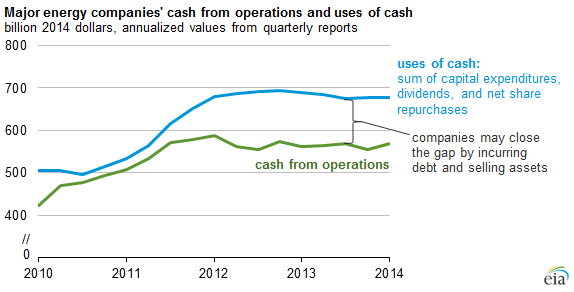
$this->bbcode_second_pass_quote('', 'A')ttending last week’s CERAWeek in Houston, the Davos of energy as some attendees referred to it, one could have easily been mistaken into believing oil and gas are the new masters of the universe. Domestic and international news coverage in the last several years has decidedly become energy-obsessed, both good and bad. Fracking. Shale boom. All-of-the-above strategy. LNG and crude export. TransCanada and crude by rail. Pemex reform, Iranian sanctions, Fukushima. Even the geopolitical machinations taking place in Ukraine have an energy underpinning related to European gas supply.
Strange, then, that coeval with this resurgence, the energy sector’s stock performance has been “lackluster,” said Poppy Allonby, managing director of BlackRock Investment Management (UK), during a CERAWeek panel last week. As of March 7, 2014, the final day of CERAWeek, the US Energy space has provided the second lowest total return of eleven key sectors over the past five- and three-year periods, and only just barely managing to squeeze into third-to-last place in the last year, according to Morningstar data.
The point is emphasized by a string of recent disappointing financial and operational announcements by companies that normally don’t disappoint: Shell, Exxon and Chevron.
Oil and gas companies face “tremendous” pressure to decapitalize, said Jonathan Cox, managing director of natural resources M&A for Morgan Stanley, during the same panel. Companies are pursuing a “shrink to greatness” strategy, noted Peter Gaw, global head of oil, gas and chemicals investment banking for Standard Chartered. Even Asian national oil companies are becoming more disciplined in spending, said Gaw.
When Shell canceled its massive Gulf Coast gas to liquids (GTL) project, the stock went up 2%, Allonby noted. Aside from slowing down or canceling projects, big oil companies will have an “increasing focus” on divestitures, she said. However, Allonby wondered whether the market had capacity to absorb all the assets expected to go on sale.
Private equity may be part of the solution, said Maynard Holt, head of E&P investment banking for Tudor, Pickering, Holt & Co. During comments, Holt noted that in data rooms run by Tudor Pickering, the buyers and sellers have switched roles. In the 2010-2012 era, large oil majors were acquirers and private equity were the sellers. Now PE-backed companies are in buying mode, while big oil companies seek to shed assets, he said. Oil majors are at the beginning of a process of selling that could require them to make “painful” divestitures, said Morgan Stanley’s Cox.
$this->bbcode_second_pass_quote('', 'A')ttending last week’s CERAWeek in Houston, the Davos of energy as some attendees referred to it, one could have easily been mistaken into believing oil and gas are the new masters of the universe. Domestic and international news coverage in the last several years has decidedly become energy-obsessed, both good and bad. Fracking. Shale boom. All-of-the-above strategy. LNG and crude export. TransCanada and crude by rail. Pemex reform, Iranian sanctions, Fukushima. Even the geopolitical machinations taking place in Ukraine have an energy underpinning related to European gas supply.
Strange, then, that coeval with this resurgence, the energy sector’s stock performance has been “lackluster,” said Poppy Allonby, managing director of BlackRock Investment Management (UK), during a CERAWeek panel last week. As of March 7, 2014, the final day of CERAWeek, the US Energy space has provided the second lowest total return of eleven key sectors over the past five- and three-year periods, and only just barely managing to squeeze into third-to-last place in the last year, according to Morningstar data.
The point is emphasized by a string of recent disappointing financial and operational announcements by companies that normally don’t disappoint: Shell, Exxon and Chevron.
Oil and gas companies face “tremendous” pressure to decapitalize, said Jonathan Cox, managing director of natural resources M&A for Morgan Stanley, during the same panel. Companies are pursuing a “shrink to greatness” strategy, noted Peter Gaw, global head of oil, gas and chemicals investment banking for Standard Chartered. Even Asian national oil companies are becoming more disciplined in spending, said Gaw.
When Shell canceled its massive Gulf Coast gas to liquids (GTL) project, the stock went up 2%, Allonby noted. Aside from slowing down or canceling projects, big oil companies will have an “increasing focus” on divestitures, she said. However, Allonby wondered whether the market had capacity to absorb all the assets expected to go on sale.
Private equity may be part of the solution, said Maynard Holt, head of E&P investment banking for Tudor, Pickering, Holt & Co. During comments, Holt noted that in data rooms run by Tudor Pickering, the buyers and sellers have switched roles. In the 2010-2012 era, large oil majors were acquirers and private equity were the sellers. Now PE-backed companies are in buying mode, while big oil companies seek to shed assets, he said. Oil majors are at the beginning of a process of selling that could require them to make “painful” divestitures, said Morgan Stanley’s Cox.
forbes
Human history becomes more and more a race between education and catastrophe. H. G. Wells.
Fatih Birol's motto: leave oil before it leaves us.
Fatih Birol's motto: leave oil before it leaves us.
-

Graeme - Fusion

- Posts: 13258
- Joined: Fri 04 Mar 2005, 04:00:00
- Location: New Zealand