PeakOil is You
Carbon Monoxide as Fuel
Re: Carbon Monoxide as Fuel
 by ROCKMAN » Sun 13 Apr 2014, 09:38:34
Sounds like with exception to circumstances as in Uzbekistan we won't see many new gasification projects as long as we have low NG prices. But that will last only so long, of course.
-

ROCKMAN - Expert

- Posts: 11397
- Joined: Tue 27 May 2008, 03:00:00
- Location: TEXAS
Re: Carbon Monoxide as Fuel
by Subjectivist » Sun 13 Apr 2014, 15:26:01
$this->bbcode_second_pass_quote('Keith_McClary', '[')url=http://phys.org/news/2014-04-scientists-ethanol-corn.html]Scientists discover a novel way to make ethanol without corn or other plants[/url]
PhysOrg Apr 09, 2014$this->bbcode_second_pass_quote('', 'S')tanford University scientists have found a new, highly efficient way to produce liquid ethanol from carbon monoxide gas. This promising discovery could provide an eco-friendly alternative to conventional ethanol production from corn and other crops, say the scientists. Their results are published in the April 9 advanced online edition of the journal Nature.
...
"The oxide-derived copper produced ethanol and acetate with 57 percent faradaic efficiency," Kanan said. "That means 57 percent of the electric current went into producing these two compounds from carbon monoxide.
...
For the process to be carbon neutral, scientists will have to find a new way to make carbon monoxide from renewable energy instead of fossil fuel, the primary source today.
PhysOrg Apr 09, 2014$this->bbcode_second_pass_quote('', 'S')tanford University scientists have found a new, highly efficient way to produce liquid ethanol from carbon monoxide gas. This promising discovery could provide an eco-friendly alternative to conventional ethanol production from corn and other crops, say the scientists. Their results are published in the April 9 advanced online edition of the journal Nature.
...
"The oxide-derived copper produced ethanol and acetate with 57 percent faradaic efficiency," Kanan said. "That means 57 percent of the electric current went into producing these two compounds from carbon monoxide.
...
For the process to be carbon neutral, scientists will have to find a new way to make carbon monoxide from renewable energy instead of fossil fuel, the primary source today.
Interesting, I know China has invested in making Methanol in large volumes from coal and I knew you can convert Methanol to Ethanol but this is the first I have heard of a direct conversion. China is now making a lot of methanol based on
http://www.icis.com/Articles/2013/04/04 ... -take.html
II Chronicles 7:14 if my people, who are called by my name, will humble themselves and pray and seek my face and turn from their wicked ways, then I will hear from heaven, and I will forgive their sin and will heal their land.
- Subjectivist
- Volunteer

- Posts: 4705
- Joined: Sat 28 Aug 2010, 07:38:26
- Location: Northwest Ohio
Re: Carbon Monoxide as Fuel
by steam_cannon » Tue 15 Apr 2014, 18:23:41
$this->bbcode_second_pass_quote('Keith_McClary', '&')quot;The oxide-derived copper produced ethanol and acetate with 57 percent faradaic efficiency," Kanan said. "That means 57 percent of the electric current went into producing these two compounds from carbon monoxide.
I've heard of copper being used as a catalyst (sometimes accidentally) increasing the conversion of gas to alcohols, so I'm not sure how novel that really is but it might be patentable so I can see why they would be pursuing it. $this->bbcode_second_pass_quote('Subjectivist', '
') http://www.theoildrum.com/node/8184
$this->bbcode_second_pass_quote('', 'T')hese cost levels are when averaged equal to or below the present day price of natural gas in the US, EU and Asian markets, as shown in figure 4 below. The lower cost range is on par with today’s coal price on a GJ energy basis.
The following link gives the April 2014 cost of Natural Gas in dollars per GJ.
http://www.directenergyregulatedservice ... rates.aspx
$this->bbcode_second_pass_quote('pstarr', 'I') am in no way a chemist, but this just feels craxy. CO2 is reduced. Entropy. What burns in a gasifier is the H2 and the char, ie the carbon, the C. CO2 is a waste product. How can a waste product be a fuel source?Sounds like perpetual energy to me.
Simplest Wood gasifier
https://www.youtube.com/watch?v=Mgu9BdHeUYg
This can be made in a few hours if you have any mechanical skills at all. Just a closed can full of wood with a burner at one end producing flammable gas and unburnt charcoal. Many simple home charcoal production systems work like this, but vent the flammable gas under the can so it produces charcoal faster.
Wood gasifers for engines have multiple stages for controlling air moving into the pyrolysis chamber, cooling the gas and filtering tar. There are government manuals on how to convert tractors to wood gas in case of war.
http://www.woodgas.net/files/FEMA_emerg ... ssifer.pdf
Wood gas vehicles
http://www.lowtechmagazine.com/2010/01/ ... -cars.html
Ekomobiili wood gas-generator
https://www.youtube.com/watch?v=eUXoQozV3vk
Wood gas car in Helsinki 2012
https://www.youtube.com/watch?v=esqma3ZI4CE
There is a long history of wood gas cars, such as in ww2 Germany.
http://woodgas.wikispaces.com/WWII+Pictures
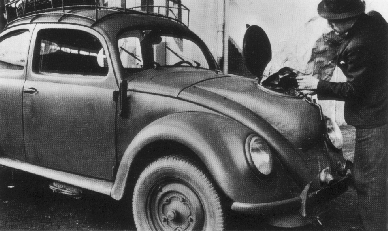
That "hood" you see on the front of old Volkswagen bugs originally contained a wood gas producer to fuel the engine in the back.
http://ww2.whidbey.net/jameslux/bugwood.gif
http://ww2.whidbey.net/jameslux/woodgas.htm
Hobbyists build wood gas systems for home fuel and producing synthetic fuels.
Homemade gasifier uses wood pellets to run generator
https://www.youtube.com/watch?v=a6e3CprVTi8
Teslonian Man Show! Wood stove runs a generator, produces gasoline, runs a fridge and heats hot water at the same time
https://www.youtube.com/watch?v=arbXj9R6ZXw
https://www.youtube.com/watch?v=wP5qbKS_8VY
Also there are "wood gas" type camp stoves people make which are relatively simple as well. People also make very large wood gas stoves for cooking as they burn very cleanly.
https://www.youtube.com/watch?v=BxODae_BS74
Town Gas / Coal Gas / Syn Gas
There's also a long history of gas being used for lighting and heating towns in the 1800's. These gases have a long history of use in chemical production and used to be used for producing gas for towns when many people had gas powered lamps on their walls.
http://en.wikipedia.org/wiki/History_of ... ctured_gas
http://en.wikipedia.org/wiki/Coal_gas
http://en.wikipedia.org/wiki/Syngas
Happy googling!
"The multiplication force of technology on cognitive differences is massive." -Jordan Peterson