PeakOil is You
Conventional Crude Oil Production
Conventional Crude Oil Production
 by dashster » Wed 26 Mar 2014, 20:47:15
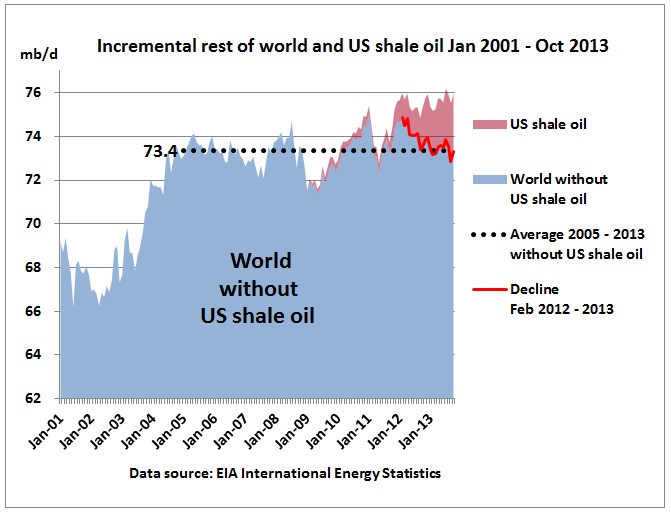
Steven Kopits, of oil field services consulting firm Douglas-Westwood, gave a talk recently in which he stated that conventional crude oil production had peaked in 2005 (he is not including tar sands or tight oil). In the current news item list, they have an article that says crude oil production - not including shale - has fallen back to 2005 levels, and shows EIA graphs supporting that. Why is there a discrepancy? Are tar sands included in the crude oil figures of the EIA?
- dashster
- Lignite

- Posts: 385
- Joined: Fri 28 Dec 2012, 08:39:24
- Location: California
Re: Conventional Crude Oil Production
by sparky » Wed 26 Mar 2014, 20:59:21
.
Here we go again , it doesn't matter what is included in "oil"
if it can be refined and power a jet , a truck or a plastic syntetiser it IS oil
sure the "conventionnal crude is depleting , that's not exactly a surprise
but if the not so good , not so sweet , stuff cut the mustard , it's "oil"
Here we go again , it doesn't matter what is included in "oil"
if it can be refined and power a jet , a truck or a plastic syntetiser it IS oil
sure the "conventionnal crude is depleting , that's not exactly a surprise
but if the not so good , not so sweet , stuff cut the mustard , it's "oil"
-

sparky - Intermediate Crude

- Posts: 3587
- Joined: Mon 09 Apr 2007, 03:00:00
- Location: Sydney , OZ
Re: Conventional Crude Oil Production
by dashster » Wed 26 Mar 2014, 21:54:11
$this->bbcode_second_pass_quote('sparky', '.')
Here we go again , it doesn't matter what is included in "oil"
if it can be refined and power a jet , a truck or a plastic syntetiser it IS oil
sure the "conventionnal crude is depleting , that's not exactly a surprise
but if the not so good , not so sweet , stuff cut the mustard , it's "oil"
Here we go again , it doesn't matter what is included in "oil"
if it can be refined and power a jet , a truck or a plastic syntetiser it IS oil
sure the "conventionnal crude is depleting , that's not exactly a surprise
but if the not so good , not so sweet , stuff cut the mustard , it's "oil"
So you would be willing to pay the same amount for an oil field with 800,000 barrels of oil in reserve as for land filled with bitumen equivalent to 800,000 barrels of oil after processing?
- dashster
- Lignite
- Posts: 385
- Joined: Fri 28 Dec 2012, 08:39:24
- Location: California
Re: Conventional Crude Oil Production
by peterjames » Wed 26 Mar 2014, 23:09:56
$this->bbcode_second_pass_quote('sparky', '.')
Here we go again , it doesn't matter what is included in "oil"
if it can be refined and power a jet , a truck or a plastic syntetiser it IS oil
sure the "conventionnal crude is depleting , that's not exactly a surprise
but if the not so good , not so sweet , stuff cut the mustard , it's "oil"
Here we go again , it doesn't matter what is included in "oil"
if it can be refined and power a jet , a truck or a plastic syntetiser it IS oil
sure the "conventionnal crude is depleting , that's not exactly a surprise
but if the not so good , not so sweet , stuff cut the mustard , it's "oil"
You have left out quite a few steps there. It can be refined, it can also be sent to a market that wants to buy it, but its net value probably runs out by the time the guy who works at the boeing factory, gets to work. He just has to be thankful that conventional oil has produced sufficient net energy for the metal to be dug up to allow said plane to be built.
- peterjames
- Wood
- Posts: 28
- Joined: Sun 16 Feb 2014, 03:46:16
Re: Conventional Crude Oil Production
by AndyA » Wed 26 Mar 2014, 23:16:08
$this->bbcode_second_pass_quote('', ' ')He just has to be thankful that conventional oil has produced sufficient net energy for the metal to be dug up to allow said plane to be built.
Not really, a lot of the energy used in production most likely comes from coal and nat gas.If you want the truth to stand clear before you, never be for or against. The struggle between "for" and "against" is the mind's worst disease. -Sen-ts'an
- AndyA
- Lignite
- Posts: 303
- Joined: Sat 10 Aug 2013, 01:26:33
Re: Conventional Crude Oil Production
by peterjames » Thu 27 Mar 2014, 00:19:23
$this->bbcode_second_pass_quote('AndyA', '')$this->bbcode_second_pass_quote('', ' ')He just has to be thankful that conventional oil has produced sufficient net energy for the metal to be dug up to allow said plane to be built.
Not really, a lot of the energy used in production most likely comes from coal and nat gas.OTHER energy comes from natural gas and coal etc. Those workers driving out to the coal fields, do so in their petrol powered cars. Those bulk ore carriers, ship their products using engines powered by oils. Those workers flying out to the natural gas platforms, do it on oil powered helicopters. Those trucks carrying coal to the surface, are powered by oil.
- peterjames
- Wood
- Posts: 28
- Joined: Sun 16 Feb 2014, 03:46:16