Donate Bitcoin

Donate Paypal


PeakOil is You

PeakOil is You

Global economic future news and discussion

Discussions about the economic and financial ramifications of PEAK OIL

Re: Global economic future news and discussion

Unread postby dissident » Thu 23 Jan 2014, 20:13:38

Mr. Jenkins is completely blind to the endogenous and exogenous shocks that are going to hit the global economy by 2020. The main one is the final appearance of oil production decline as all the touted non-conventional bonanzas show their true performance. This is a show stopper all by itself. The other monster fest will be the 1000 ton chickens coming home to roost from the fictional financial stability and GDP growth propaganda in the media and the printing of money like Pancho Villa could never dream of. The world economy has run past the edge of the cliff and is about to realize there is nothing holding it up.
dissident
Expert
Expert
 
Posts: 6458
Joined: Sat 08 Apr 2006, 03:00:00

Re: Global economic future news and discussion

Unread postby Graeme » Fri 24 Jan 2014, 17:15:47

D, Thanks for your comments. I'm sure many here share your sentiments. As far as I'm aware, PO is not on the agenda. Perhaps a reason for this is because there is just too much oil available at the moment. This could change quite dramatically if the world decides to do a lot more about climate change, which is on the agenda at Davos.

‘This is the year to fight climate change’, World Bank president tells finance world at Davos

$this->bbcode_second_pass_quote('', 'S')peaking at the World Economic Forum in Davos on Thursday afternoon, the president of the World Bank Jim Yong Kim urged financial leaders, from banks to regulators to investors, to take responsibility for the fight against climate change.

At a joint press conference, held with the UN secretary-general Ban Ki-moon and the president of the European commission José Manuel Barroso, Kim told members of the press, ”This is the year to take action on climate change. There are no excuses.”

He spoke of the important role that governments can play, urging them to “put a price on pollution”, and said governments should phase out subsidies for fossil fuels.

“The $1.9 trillion in subsidies can be redirected to investment in clean growth. This challenges the notion that responding to climate change is not affordable”, he said.

However, Kim stressed that financial leaders must also lead sustainability efforts.
“The so called long-term investors must recognise their fiduciary responsibility to future pension holders who will be affected by decisions made today”, he said.
“Corporate leaders should not wait to act until market signals are right and national investment policies are in place. Be the first mover. Use smart due diligence. Rethink what fiduciary responsibility means, in this changing world. It’s simple self interest.”

He added, “Every company, investor and bank that screens new and existing investments for climate risks is simply being pragmatic.”

Kim also called on financial regulators to enforce disclosure of climate risks, requiring companies and financial institutions to assess their exposure to climate related impacts.

“Sooner rather than later, they must address the systemic risks associated with carbon intensive activities in their economy”, he said.

The World Bank president called for the use of green bonds, as described in the Green Bond Principles released this month, to “expand the universe of investors who are investing in green assets”, and called on institutional investors to “commit to purchasing specific significant amounts of green bonds for their portfolios.”


blueandgreentomorrow

I got it wrong, PO is on the agenda!

Davos delegates warned of imminent oil crisis

$this->bbcode_second_pass_quote('', 'A') British businessman will tell world leaders meeting in Switzerland today that it is dangerous to argue that fracking for shale oil and gas can help to avert a global energy crisis.

Jeremy Leggett, a former Greenpeace staff member who founded a successful solar energy company, has been invited to the annual World Economic Forum meeting in Davos from 22 to 25 January. The theme of the meeting is The Reshaping of the World: Consequences for Society, Politics and Business.

Leggett told the Climate News Network: “The WEF likes to deal in big ideas, and last year one of its ideas was to argue that the world can frack its way to prosperity. There are large numbers of would-be frackers in Davos.

“I’m a squeaky wheel within the system. I’m in Davos to put the counter-arguments to Big Energy, and I’ll tell them: ‘You’re in grave danger of repeating the mistakes of the financial services industry in pushing a hyped narrative.”

Leggett says the conventional oil industry is facing an imminent crisis, because existing crude oil reserves are declining fast, it is having to find the money for soaring capital expenditure, and the amount of oil available for export is falling.

“Big Oil is still extremely powerful and well-capitalised”, he says, “but it is fast approaching sunset. The profitability of the big international groups – like Exxon, Shell and BP – is a real worry for investors, and they’ve been largely locked out of the easy oil controlled by national companies – just look at BP and Russia.

“Gas? Unless the price goes up, the whole US shale gas industry is in danger of becoming a bubble, even a Ponzi scheme. All but one of the biggest production regions have peaked already, and losses are piling up. This is an industry that’s in grave danger of committing financial suicide.”

A linked message that Leggett will deliver is that there is a growing danger of a carbon bubble building up in the capital markets. He says investors who think governments may agree stringent and strictly-enforced limits on greenhouse gas emissions might decide their investments in oil and gas are at risk of becoming worthless.

Crunch next year?

There is little sign yet that such limits are likely any time soon. But Leggett says that is to miss the point: “You don’t have to wait until agreement is close, or even probable. You have to believe only that there’s a realistic chance of policymaking which means assets might be stranded.”


rtcc
Human history becomes more and more a race between education and catastrophe. H. G. Wells.
Fatih Birol's motto: leave oil before it leaves us.
User avatar
Graeme
Fusion
Fusion
 
Posts: 13258
Joined: Fri 04 Mar 2005, 04:00:00
Location: New Zealand

Re: Global economic future news and discussion

Unread postby dolanbaker » Fri 24 Jan 2014, 18:11:30

Investor sheep see wolf!

$this->bbcode_second_pass_quote('', '
')http://www.bbc.co.uk/news/business-11900474
(Close) Stocks on Wall Street fell sharply on Friday as jitters in emerging markets spooked investors.

In New York, the Dow Jones fell 318.24 points, just shy of 2%. The Nasdaq fell 2% to 4130.44, while the S&P 500 also dropped 2% to end at 1790.31.

On Thursday, Argentina abandoned efforts to defend the peso, and it fell 11% against the US dollar.

Other emerging market currencies have also fallen, and nerves spread to European stock markets on Friday.

Confidence among investors has also been knocked by a survey from China on Thursday indicating the country's manufacturing sector contracted this month.
Religion is regarded by the common people as true, by the wise as false, and by rulers as useful.:Anonymous
Our whole economy is based on planned obsolescence.
Hungrymoggy "I am now predicting that Europe will NUKE ITSELF sometime in the first week of January"
User avatar
dolanbaker
Intermediate Crude
Intermediate Crude
 
Posts: 3855
Joined: Wed 14 Apr 2010, 10:38:47
Location: Éire

Re: Global economic future news and discussion

Unread postby Graeme » Fri 24 Jan 2014, 18:53:00

DB, Thanks. More here.

Dow plunges 318 points on global fears

$this->bbcode_second_pass_quote('', 'F')ear is back in the market.

Investors are worried about slower economic growth in China, a gloomier outlook for US corporate profits and an end to easy money policies in the United States and Europe. They’re also fretting over country-specific troubles around the world — from economic mismanagement in Argentina to political instability in Turkey.

Those fears converged to start a two-day rout in global markets this week, capped by a 318-point drop in the Dow Jones industrial average Friday. It was the blue-chip index’s worst day since last June. The Dow plunged almost 500 points over the two-day stretch.

The Standard & Poor’s 500 index fell 38 points, or 2.1 percent, to 1,790 Friday. The Nasdaq composite fell 90 points, or 2.2 percent, to 4,128.

Despite the sell-off, US stocks remain near all-time highs after surging 30 percent last year. The S&P 500 is 3 percent below its record high of 1,848 on Jan. 15

US stocks have not endured a correction — a drop of 10 percent or more over time — since October 2011.

In Asia Friday, Japan’s Nikkei 225 slipped 1.9 percent to close at 15,391.56; Hong Kong’s Hang Seng shed 1.2 percent to 22,450.06; and Seoul’s Kospi dropped 0.4 percent to 1,940.56.

The turbulence coincides with a global economic shift: China and other emerging market economies appear to be running into trouble just as the developed economies of the United States and Europe finally show signs of renewed strength nearly five years after the end of the Great Recession.

The trouble began Thursday after a January survey showed a drop in Chinese manufacturing activity. Days earlier, China reported that its economic growth last year matched 2012 for the slowest pace since 1999.
Human history becomes more and more a race between education and catastrophe. H. G. Wells.
Fatih Birol's motto: leave oil before it leaves us.
User avatar
Graeme
Fusion
Fusion
 
Posts: 13258
Joined: Fri 04 Mar 2005, 04:00:00
Location: New Zealand

Re: Global economic future news and discussion

Unread postby Graeme » Sat 25 Jan 2014, 16:56:17

As Fed, China pull back, so do global markets

$this->bbcode_second_pass_quote('', 'T')he global economic crisis may be a receding memory, but investors and businesses around the world took stock this week of two big new potholes on the road to recovery:

Less Fed. Less China.

Fresh evidence that the Chinese economy is slowing triggered a sell-off in global stock markets that capped the worst weekly losses on Wall Street in more than a year. The Dow Jones industrial average and the S&P 500-stock index each declined about 2 percent Friday, with weekly losses of about 3.5 percent and 2.5 percent, respectively.

Markets in Europe and Asia suffered similar declines after a measure of Chinese manufacturing activity fell.

Across a number of developing countries, meanwhile, the adjustment to the slowdown of Federal Reserve monetary stimulus began to accelerate, as traders dumped local currency in Turkey, South Africa and elsewhere — a rout that touched off concerns of a new crisis brewing in one or more of the world’s once-vibrant emerging markets.

The sell-off in the markets, which are down since the start of 2014, follows a dramatic run-up that many analysts said was unlikely to continue, even with the U.S. economy gaining steam.

However, the confluence of events behind it emphasized the tight linkages in the global economy and the uncertain effect that the Federal Reserve’s tapering will have over time.

China has become a major prop of world economic growth, and a slowdown there will show up on the books of virtually every major trading nation and company — affecting orders for metal ores from Indonesia and Brazil, heavy equipment from the United States and Germany, and the flow of money to African nations where China has become a major investor.

Compounding the trouble is a growing fear that China’s massive investment in building and infrastructure in recent years — part of its effort to stoke growth during the 2008 financial crisis — will show up in unsustainable levels of debt and bad loans for local governments and banks.

Officials and analysts downplay the likelihood that China’s troubles will touch off global problems akin to those caused by the U.S. financial system. The country’s capital markets and banks are not as closely interwoven with the rest of the world, and the Chinese government has stashed away trillions of dollars in foreign reserves to use as a buffer.


washingtonpost

Lagarde warns of risks to global economic recovery

$this->bbcode_second_pass_quote('', 'T')he International Monetary Fund's managing director warned Saturday of the risks posed to global economic recovery from the reduction of the U.S. Federal Reserve's monetary stimulus and falling prices in the eurozone.

Despite growing evidence the global economy is faring better than it has for years, Christine Lagarde said policymakers around the world have to be alert to the potential repercussions from the Fed's "tapering," a policy change it decided to embark upon in December.

So far, the move has been minimal — it has reduced the amount of bonds it buys each month by $10 billion to $75 billion — but many economists think that it could end this year if the U.S. economic recovery gains steam.

Over the past few years, the Fed's stimulus, in its various guises has had a big impact on financial markets. As well as shoring up stock markets around the world, the new money created by the stimulus has flown to emerging economies as investors sought out better returns. Currencies, such as the Indian rupee and the Brazilian real, have been beneficiaries. The withdrawal could prompt a reverse in those flows and see their currencies come under pressure.

"This is a new risk on the horizon and really needs to be watched," Lagarde said in a discussion about the global economic outlook at the World Economic Forum.


usnews
Human history becomes more and more a race between education and catastrophe. H. G. Wells.
Fatih Birol's motto: leave oil before it leaves us.
User avatar
Graeme
Fusion
Fusion
 
Posts: 13258
Joined: Fri 04 Mar 2005, 04:00:00
Location: New Zealand
Top

Re: Global economic future news and discussion

Unread postby Graeme » Sun 26 Jan 2014, 18:10:53

Fed in focus after emerging market mauling

$this->bbcode_second_pass_quote('', 'T')he U.S. Federal Reserve will take centre stage in the week ahead with a widely expected cut to its bond-buying stimulus, responding to an improving U.S. economy but also helping fuel a dramatic emerging market sell-off.

Argentina, Turkey and Ukraine felt the full force last week of a global flight from developing world assets as investors grew concerned about slower growth in China and U.S. monetary tightening, as well as the countries' own problems.

Fed policymakers are expected to confirm the tightening trend during their Jan 28-29 meeting, notably also for being Ben Bernanke's last as chairman before vice chair Janet Yellen takes charge.

They are almost certain to make a second $10 billion cut to the bank's monthly purchase of Treasuries and mortgage-backed securities, from $75 billion now to $65 billion.

They are also likely to leave intact their delicately worded promise to keep interest rates low, although sharply falling unemployment has left some to doubt how long into the future that promise will hold.

"The problem is that investors no longer believe the Fed when we hear that proper rate tightening would happen much later in the future," wrote Benoit Anne of Societe Generale.

"Either the Fed will manage to re-establish some credibility on that front, and global emerging markets will probably find some respite in the future, or we are going into a full-blown meltdown," he continued.

Some would argue the meltdown has already begun, with intervention proving ineffective in stemming an exit from emerging equity funds that has totalled almost $4 billion so far this year.


reuters
Human history becomes more and more a race between education and catastrophe. H. G. Wells.
Fatih Birol's motto: leave oil before it leaves us.
User avatar
Graeme
Fusion
Fusion
 
Posts: 13258
Joined: Fri 04 Mar 2005, 04:00:00
Location: New Zealand
Top

Re: Global economic future news and discussion

Unread postby Pops » Sun 26 Jan 2014, 18:46:19

Seems like there are a few big headlines to come.
Emerging Markets Don't
Bakken Is Done
Oil Glut Ain't
Quantitative Easing Didin't
Bull Market Steered
Recovery, Not So Much

On the bright side, at least for the short term, is the oil capacity that is shut in might be opened up: Iraq, Iran, Sudan, Syria, Nigeria, Egypt . . . did I miss any? That could be 3-4 mmbopd.

Another story lurking out there is that American Energy Independence is being exported ASAP, despite the crude oil ban. In fact the Boys are building cracking units to sorta refine crude just enough to get past the ban. If that gets legs . . .


Oh yeah one more - this is the year wealth inequality starts bringing out the pitchforks, bookmark that.
The legitimate object of government, is to do for a community of people, whatever they need to have done, but can not do, at all, or can not, so well do, for themselves -- in their separate, and individual capacities.
-- Abraham Lincoln, Fragment on Government (July 1, 1854)
User avatar
Pops
Elite
Elite
 
Posts: 19746
Joined: Sat 03 Apr 2004, 04:00:00
Location: QuikSac for a 6-Pac

Re: Global economic future news and discussion

Unread postby Tanada » Sun 26 Jan 2014, 19:12:30

Question of the day, if the Dow keeps diving on Monday will the Fed reverse itself and start trying to pump more cash into the system again? Really all they did with their announcement a couple weeks back is say they will run the pump a little slower, not stop it completely. If they get nervous over this drop, and you know every politician up for reelection this fall already is, the Fed is going to be pressured by the politicians to do something before things get worse.
$this->bbcode_second_pass_quote('Alfred Tennyson', 'W')e are not now that strength which in old days
Moved earth and heaven, that which we are, we are;
One equal temper of heroic hearts,
Made weak by time and fate, but strong in will
To strive, to seek, to find, and not to yield.
Tanada
Site Admin
Site Admin
 
Posts: 17094
Joined: Thu 28 Apr 2005, 03:00:00
Location: South West shore Lake Erie, OH, USA
Top

Re: Global economic future news and discussion

Unread postby Graeme » Mon 27 Jan 2014, 17:56:00

Oil price volatility undermines economic growth, says Sir David King

$this->bbcode_second_pass_quote('', 'G')overnments need to deter oil speculators, set aside reserves of crude oil and take steps urgently to reduce their dependence on fossil fuels in order to escape price volatility that undermines stable economic growth, according to a report co-authored by one of Britain's top scientists.

The exploitation of shale oil and gas may mitigate damaging price fluctuations in future but it will be terrible news for the environment and is not a longer term solution to the world's energy needs, said the report co-written by Sir David King, published on Tuesday.

The study for Oxford University by King, Oliver Inderwildi and Zoheir Ebrahim, describes the volatility of crude oil prices, which has characterised this commodity market over the last four decades, as "a fundamental barrier to stability and economic growth" around the world.

King is a former Oxford professor and government chief scientific adviser who, these days, is special climate change representative for the foreign secretary, William Hague. The paper recommends policies to tackle supply and demand in the oil industry, including further action to clamp down on high frequency trading.

"Policy must focus on re-aligning the use of the oil derivative market away from speculation and towards its initial purpose: hedging. Improving derivatives market regulatory systems and working towards international derivatives regulatory standards will be vital in achieving this goal but efforts to curb speculation so far have been lacklustre," says the report, which is called Macroeconomic impacts of oil price volatility: mitigation and resilience, and is published in Frontiers of Energy.

It predicts that the European Commission's proposed Financial Transactions Tax will fail because it will not be high enough – at 0.1% on share trading and 0.01% on derivatives deals – and does not differentiate between speculators and genuine hedgers.

Britain's use of fossil fuels will come under further scrutiny this week when a government-commissioned study will urge ministers to boost North Sea oil and gas production by forcing companies to share infrastructure.

Meanwhile the Oxford study calls for more far-reaching policies to manage demand in a bid to reduce the world's dependence on oil.

"Part of this role will require the politically challenging task of energy subsidy and tax reform to incentivise the consumption of alternative fuels and disincentivise oil consumption, particularly in non-OECD countries where oil price subsidies have been institutionalised," it said. "But a significant opportunity in reducing the demand for oil is also to be found in policies that are aimed at improving energy efficiency such as the adoption of fuel-economy standards and the construction of codes and requirements for greater energy efficiency in various sectors of the economy."


theguardian
Human history becomes more and more a race between education and catastrophe. H. G. Wells.
Fatih Birol's motto: leave oil before it leaves us.
User avatar
Graeme
Fusion
Fusion
 
Posts: 13258
Joined: Fri 04 Mar 2005, 04:00:00
Location: New Zealand
Top

Re: Global economic future news and discussion

Unread postby Plantagenet » Mon 27 Jan 2014, 18:19:00

$this->bbcode_second_pass_quote('Graeme', '.')..the Oxford study calls for more far-reaching policies to manage demand in a bid to reduce the world's dependence on oil.


So the TPTB are giving up on increasing oil supply......they are now going to focus on demand reduction.

Thats means we'll see further impoverishment and destruction of the middle class in the west.

Image
User avatar
Plantagenet
Expert
Expert
 
Posts: 26765
Joined: Mon 09 Apr 2007, 03:00:00
Location: Alaska (its much bigger than Texas).
Top

Re: Global economic future news and discussion

Unread postby Graeme » Mon 27 Jan 2014, 20:31:09

Falling demand has less to do with the TPTB and more to do with oil prices.

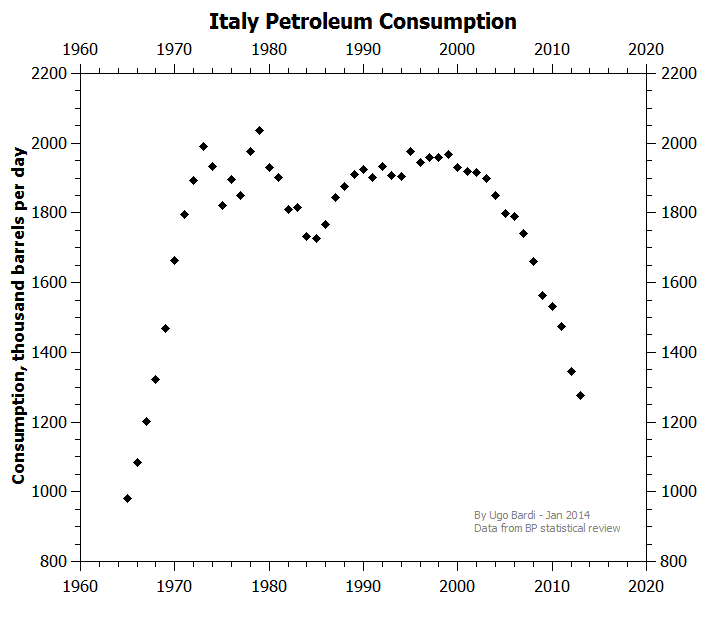
The other side of the peak: Italy's collapse of oil and gas consumption

Image

$this->bbcode_second_pass_quote('', 'S')ometimes, peak oil looks like an intellectual game that people keep playing by arguing whether it has arrived or not. But the point with oil is not how much of it is produced, somewhere, but how much you can afford to use. And, for Italy, the peak of consumption has already arrived, as you can see in the figure above. It is impressive: consumption went down of more than 30% in less than 10 years. Today we are back to the levels of 1967. And, in 1967, Italy's population was around 50 million people, some ten million less than today. We really have reached the other side of the peak and we don't see the bottom of the descent.

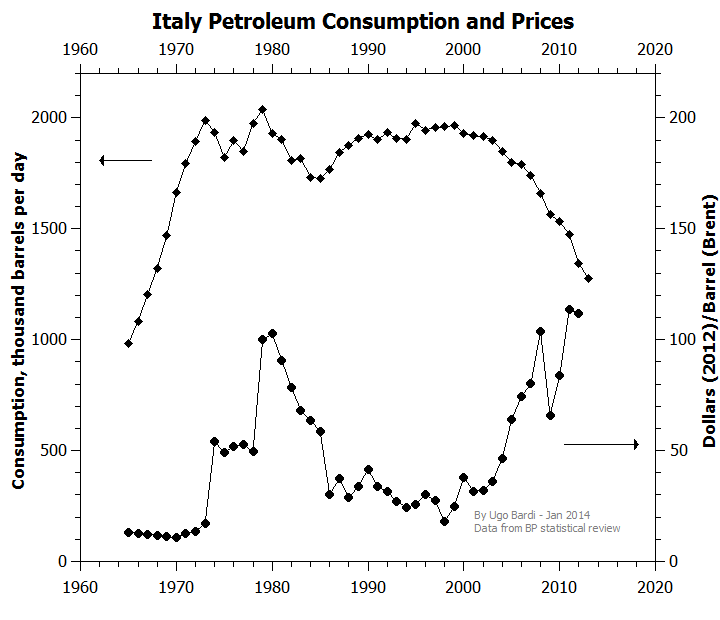
So, why that? Simple: the reduction in oil consumption is directly linked to oil prices, as you can see here:


Image

$this->bbcode_second_pass_quote('', 'I')n short, the Italian economy can afford to grow its oil consumption when oil costs less than about 20 dollars per barrel (in today's dollars), it remains stable as long as oil is at less than ca. 40 dollars per barrel and it collapses when oil prices go above that level.


So, it seems that the main factor in counteracting the decline in oil consumption, up to a certain point, has been an increase in natural gas consumption. That has been a historical trend not just in terms of vehicle fuels, but for a variety of applications. You can see the story in the following figure:


Around 2006, gas consumption peaked and generated "peak hydrocarbons" in Italy. Afterward, consumption has been rapidly declining; much faster than growth. It is a behavior that I termed the "Seneca Collapse". Italy may have the dubious honor of being the first major Western economy to experience this kind of collapse in modern times.


resilience
Human history becomes more and more a race between education and catastrophe. H. G. Wells.
Fatih Birol's motto: leave oil before it leaves us.
User avatar
Graeme
Fusion
Fusion
 
Posts: 13258
Joined: Fri 04 Mar 2005, 04:00:00
Location: New Zealand
Top

Re: Global economic future news and discussion

Unread postby Graeme » Tue 28 Jan 2014, 19:54:50

State of the Union 2014: Excerpts from Obama’s speech

$this->bbcode_second_pass_quote('', '[')i]The White House released these excerpts from President Obama’s 2014 State of the Union address on Tuesday.

“In the coming months, let’s see where else we can make progress together. Let’s make this a year of action. That’s what most Americans want – for all of us in this chamber to focus on their lives, their hopes, their aspirations. And what I believe unites the people of this nation, regardless of race or region or party, young or old, rich or poor, is the simple, profound belief in opportunity for all – the notion that if you work hard and take responsibility, you can get ahead.

Let’s face it: that belief has suffered some serious blows. Over more than three decades, even before the Great Recession hit, massive shifts in technology and global competition had eliminated a lot of good, middle-class jobs, and weakened the economic foundations that families depend on.

Today, after four years of economic growth, corporate profits and stock prices have rarely been higher, and those at the top have never done better. But average wages have barely budged. Inequality has deepened. Upward mobility has stalled. The cold, hard fact is that even in the midst of recovery, too many Americans are working more than ever just to get by – let alone get ahead. And too many still aren’t working at all.

Our job is to reverse these tides. It won’t happen right away, and we won’t agree on everything. But what I offer tonight is a set of concrete, practical proposals to speed up growth, strengthen the middle class, and build new ladders of opportunity into the middle class. Some require Congressional action, and I’m eager to work with all of you. But America does not stand still – and neither will I. So wherever and whenever I can take steps without legislation to expand opportunity for more American families, that’s what I’m going to do.”


washingtonpost
Human history becomes more and more a race between education and catastrophe. H. G. Wells.
Fatih Birol's motto: leave oil before it leaves us.
User avatar
Graeme
Fusion
Fusion
 
Posts: 13258
Joined: Fri 04 Mar 2005, 04:00:00
Location: New Zealand
Top

Re: Global economic future news and discussion

Unread postby Plantagenet » Tue 28 Jan 2014, 21:14:36

$this->bbcode_second_pass_quote('Graeme', '[')b]State of the Union 2014: Excerpts from Obama’s speech

$this->bbcode_second_pass_quote('', '[')i]The White House released these excerpts from President Obama’s 2014 State of the Union address on Tuesday.


Today...Inequality has deepened. Upward mobility has stalled. The cold, hard fact is that even in the midst of recovery, too many Americans are working more than ever just to get by – let alone get ahead. And too many still aren’t working at all.


Five years of Obama's economic policies have just made all these trends worse. Its sad to think we have to endure another three years of O complaining about the results of his own policies, and pretending he gets all the credit whenever there is good news, but somehow deserves none of the blame for the very bad news. 8)
User avatar
Plantagenet
Expert
Expert
 
Posts: 26765
Joined: Mon 09 Apr 2007, 03:00:00
Location: Alaska (its much bigger than Texas).
Top

Re: Global economic future news and discussion

Unread postby Graeme » Wed 29 Jan 2014, 17:43:31

Here's how the Guardian rated Obama's speech:

State of the Union scorecard: Guardian reporters grade Obama's speech

$this->bbcode_second_pass_quote('', 'E')conomy: C+

Obama's take on the current economy is too optimistic, putting a too-positive spin on unemployment, housing, and the chances that CEOs will fix anything. However, his proposals this time are specific and reachable, so that's a big change from previous years. If he fails on any of these, he won't have far to fall.

– Heidi Moore, finance and economics editor

Climate change and energy: C

Obama re-committed to his climate change plan of using the EPA to cut greenhouse gas emissions from power plants and gave a forceful defence of climate science. But he undercut those moves by pushing the expansion of natural gas – which is also a fossil fuel. Recent studies have shown much higher emissions of methane, which is 80 times more powerful than CO2 over 20 years, undercutting its climate benefits. There are also real concerns that pushing natural gas will make it harder for renewables like solar and wind to find a bigger market share.

– Suzanne Goldenberg, environment correspondent


theguardian

Continuing on from the theme I noted above regarding the disconnect between energy and economic growth, I also saw this:

How The U.S. Is Breaking The Link Between Energy Use And Economic Growth

$this->bbcode_second_pass_quote('', 'T')here’s growing evidence the American economy has severed the link between energy use and economic growth, and that energy efficiency efforts are a key part.

While the United States has no uniform national code for how buildings use energy, codes are adopted by state and municipal governments. The most widely used is the International Energy Conservation Code (IECC), which is put together and updated in cycles every few years by a non-profit coalition. The Department of Energy does give input into how the code is updated, and helps coordinate its adoption.
According to the Energy Efficiency Codes Coalition, an advocacy group put together in 2007 to push the IECC in a more ambitious direction, the last two updates improved efficiency in the code by 30 percent:


The Department of Energy called it “the largest, one-step efficiency increase in the history of the national model energy code.”

That’s arguably been a critical part of a remarkable trend the Natural Resources Defense Council noted last year. Up until the late 1970s, energy consumption grew in tandem with the economy. But after that, the two trends split, with economic growth continuing to go up and energy use increasing at a far lower rate.


Image

$this->bbcode_second_pass_quote('', 'A')t this point, America’s energy consumption is well below where it was predicted to be in the 1970s. The Coalition quoted Duke Energy CEO Lynn Good that “improvements in energy efficiency for buildings and appliances appear to have broken the traditional connection between electricity demand and economic growth.”

What this is, in effect, is productivity — doing more with less — applied to how we use energy. And it’s really the holy grail of all economic activity. Greater productivity here means lower energy bills for consumers, less dependence on foreign oil, less extraction of natural resources, and, of course, lower carbon emissions.

And as Brad Plumer recently noted at the Washington Post, there’s also evidence the same thing is happening at the global level — though economists are split on what the data means, and some argue it’s more a change in the nature of the energy being used than an absolute decrease in how much energy is used per unit of global wealth created.


thinkprogress
Human history becomes more and more a race between education and catastrophe. H. G. Wells.
Fatih Birol's motto: leave oil before it leaves us.
User avatar
Graeme
Fusion
Fusion
 
Posts: 13258
Joined: Fri 04 Mar 2005, 04:00:00
Location: New Zealand
Top

Re: Global economic future news and discussion

Unread postby Graeme » Thu 30 Jan 2014, 18:18:45

The State of the Union Speech I Wish Obama Would Deliver

$this->bbcode_second_pass_quote('', 'M')y fellow Americans:

I deliver this address at a time of great distress in our nation. Never before have we faced challenges of such severity as we do today. As I speak, there are hundreds of thousands of our fellow Americans with no shelter, having to survive another night of Arctic temperatures in the open. Many of them will die of exposure before morning. Many of them are veterans of our wars, who have been failed by this government in having their basic needs met.

In 2014, so far there has been an average of one school shooting every other day of the school year. Each day we fail to address both the proliferation of weapons in our country and their accessibility to those with criminal records and histories of mental health conditions. Each day that we fail to curb the growing problem of bullying in our schools, it becomes more likely that more of our children will die at the hands of other children. Soon we will have to ask our elected officials if the endorsement of a certain special interest group in the next election has more value than the lives of schoolchildren.

The war in Afghanistan is now the longest continued war in our nation's history, and there is still no end in sight. Each day, our men and women are suffering long-lasting, debilitating physical and mental injuries that they will have to endure for the rest of their lives, for an objective that seems just as out of reach today as it did when my predecessor first committed troops to Afghanistan. And just as our troops are losing their lives in this war, our nation is rapidly losing billions of tax dollars as we struggle to prop up a regime that has proven to be blatantly corrupt and untrustworthy in the eyes of Afghanistan's own people.

The extent of our national intelligence apparatus continues to be exposed in the media, and Americans are learning each day that their Fourth Amendment rights have eroded almost completely. Millions of Americans are justifiably mistrusting of their own government after having learned that everything from their phone calls, emails, text messages, tweets, Facebook posts and even their scores on Angry Birds are being monitored by their government. Many reports have shown that despite the depth of our surveillance, monitoring citizens' everyday behavior hasn't prevented any terrorist attacks. And in numerous polls, Americans have repeatedly said they value their privacy over security.

Despite working many hours for some of the world's richest companies, working Americans are unable to survive on the current minimum wage, let alone move up the economic ladder. Economists report that simply having a job is no longer sufficient for Americans to make it on their own, or to provide a decent living situation for their families. And despite the fact that a majority of Americans on food stamps are working families with one or more jobs, millionaires in Congress are denying those working families access to food.

Our nation's college students have been trapped by a student debt bubble that has grown past $1 trillion dollars. Smart young women and men are entering an increasingly competitive job market with sometimes five to six figures in student debt that will take them the rest of their adult life to pay off. Faced with crushing debt, these young people are not as likely to take risks like starting families, becoming homeowners, and starting businesses.

The same predatory banks that are burying college students in debt have also rooked millions of American homeowners out of their homes with manipulative lending schemes that have led to foreclosure. This means more and more Americans are having to move their families out onto the street, while the banks continue their bad behavior without fear of accountability. In fact, the only accountability that my Department of Justice has been able to manage for these financial criminals has come in the form of settlements amounting to a few weeks profit for these big banks. That must change.

While the richest among our country have recovered from this recession and the stock market has hit numerous record highs in the last year, vast swaths of our country have been left behind and forgotten as unemployment drags on. Even though the official unemployment rate as measured by the Bureau of Labor Statistics hovers around the 7 percent mark, most new jobs have been low-paying, minimum wage jobs that don't pay a living wage. And those numbers don't adequately portray the millions of Americans who have simply stopped looking for work. Long-term unemployment, too often a death sentence for American workers, makes the job search that much more difficult as the gap of time between jobs grows each day. And despite the clear jobs crisis in this country, Congress has still refused to extend a hand to working families who have been kicked to the ground by the recession.

The American people are also justifiably losing confidence in their government as a whole. The corrupting influence of money in politics is a disease that has eaten away at the legitimacy of this government, as more people see that their needs are ignored in favor of moneyed special interests who donate to campaigns. Ninety-seven percent of Americans polled have said they would like to see new anti-corruption laws on the books. Members of Congress have announced they will not seek re-election, citing endless fundraising as the reason for their retirement. Thirty to seventy percent of Congress's time is devoted to calling wealthy donors for campaign contributions, rather than taking questions from constituents. If this continues to go unaddressed, the federal government will derive no more consent from the governed, which, as our founders have taught us, is the basis for just revolt.

But now is not the time for pointing fingers. Americans need solutions, and I am doing everything in my power as president to take positive steps forward.

I have issued an executive order to demand that all companies receiving contracts with federal tax dollars not only pay employees a minimum of fifteen dollars an hour, but also publicly disclose all campaign contributions. The cycle of corruption can only end when that corruption is revealed to all inquiring minds. We must end the days where campaign checks in federal election years result in new federal contracts in inauguration years.

I will also be using my powers as president to appoint advocates to a new Citizens' Community Commission. This task force comprised of everyday Americans will have the duty of studying the effects of homelessness across America, in all fifty states. The commission will also issue a report containing recommendations on how to alleviate homelessness in America. I plan to appoint members from Occupy Madison, in Wisconsin, whose Tiny Homes project has provided living spaces for those who previously had to sleep out in the cold. I'll also appoint members of Utah's Housing Coalition, which is on track to end homelessness in the state by 2015 by giving homes to the homeless. When there are 6 vacant buildings for every homeless person in America, and in a nation as rich as ours, there is no excuse for anyone in this great nation to not have a roof over their head at night.

West Virginia's water crisis has shown us that fossil fuels are an unreliable and unsustainable source of energy for future generations to depend upon, and I have recommended Congress immediately repeal all subsidies for the oil, coal, and natural gas industries in favor of aggressive new investments in renewable energy. I have invited Angela Merkel of Germany to consult the Department of Energy on how to have all American homes and business convert to solar, wind, and biomass-based energy, so our nation can be on track to draw 80 percent of our energy from renewable resources by 2030.

The polar vortex currently blanketing our nation in Arctic temperatures, from North Dakota to Florida, is proof that climate change is happening and is already having a devastating effect on our way of life. I have ordered the construction of the Keystone XL pipeline to come to a halt, and have established a new Sustainable Energy Development Commission to make recommendations on how we can halt the most drastic effects of climate change with more sensible energy policy.

I'm also appointing citizens to a new Green Jobs Creation Commission on how to revitalize our economy by revamping our nation's energy infrastructure to be connected by a renewable energy grid. We can no longer play the fool as our predecessors have when it comes to buying and burning cheap oil by the billions of barrels. We must now make the vitality of future generations a top priority and ensure that our grandchildren's great-grandchildren will have a beautiful planet to inherit, and that we will always have millions of jobs here at home in the maintenance, upkeep, and expansion of a green energy grid.

As Commander-in-Chief, I'll be issuing an executive order to immediately begin the withdrawal of troops from Afghanistan, with the goal of having everyone home by the end of next year. In my executive budget recommendation, I'll recommend the portion of the Pentagon budget reserved for the Afghan war be reappropriated to green jobs creation. I will also end the F-35 program's history of broken promises and stretched budgets, and will allocate the program's funding instead to provide a free, public college education for all Americans.

As President Dwight D. Eisenhower warned us in his 1961 farewell address, we must be vigilant against the unwarranted influence of military-industrial complex. We failed to do so, and have allowed this complex to morph into a totalitarian surveillance state with its eyes on every American computer screen and mobile phone, as well as the screens and phones of world leaders. I've learned from the outcry of all Americans that our constitutional freedoms must remain strong. I'm demanding Congress repeal the National Security Agency's collection of metadata, as well as the provisions of the Patriot Act that allowed such intrusive surveillance to happen in the first place. Should Congress fail to do so, I encourage you all to look at your representatives' voting records, call 202-224-3121, ask for your congressmen and senators, and demand they respect the constitution.

I've instructed my Department of Justice to indict National Intelligence Director James Clapper for perjury for lying to Congress about the NSA's surveillance capabilities. I've also issued a full pardon to Edward Snowden, and will be awarding him with a Presidential Medal of Freedom upon his return home, for his invaluable efforts to provide the world with the truth about blatant violations of citizens' rights. I'm also pardoning Chelsea Manning, and having her immediately released from Leavenworth. I'll also be issuing her a Presidential Medal of Freedom for truly upholding her oath to protect and defend the constitution from all enemies, foreign AND domestic. I'll pray every day for the Snowden and Manning families' forgiveness for my short-sightedness.

I have instructed new Federal Reserve Chair Janet Yellen to cease the Fed's buying of mortgage-backed securities to the tune of $40 billion per week, funds to instead be used to purchase delinquent student debt so our students can be free to pursue their goals without the specter of default or bad credit. I have also instructed the Federal Reserve Board of Governors to allow students to borrow federal loans at the same 0.75 percent preferential interest rate given to the big banks. I have also invited Richmond, California, Mayor Gayle McLaughlin to consult the Department of Housing and Urban Development on how to use federal eminent domain to seize foreclosed homes from the banks, and refinance underwater mortgages directly with homeowners, so families can keep their homes and our neighborhoods can remain strong.

Chairwoman Yellen will also be tasked with creating a report on how to convert all twelve Federal Reserve branches into public banks by the end of 2015. It's time the states have a reliable place to store their local and state tax dollars that won't lose them in risky gambles in the Wall Street derivatives casino. The states deserve to have their own transparently-run banks that will make loans for capital projects at very low interest rates, and whose leaders are public employees who make realistic salaries, rather than billionaires who shower themselves with extravagant bonuses at the end of the year. Our economy can never truly recover until public funds are safely stored in public banks.

I have recognized the shortcomings of the Affordable Care Act and am working to make healthcare more affordable for all. I am appointing a new Affordable Care Commission to make recommendations on how we can make sure healthcare is seen as a human right in this country, rather than a commodity only the wealthy and upper-middle class can afford. I'll be appointing Vermont governors Howard Dean, Peter Shumlin, and the leaders of Vermont's public sector union to the commission to make recommendations on how Americans can voluntarily buy into Medicare if they so choose. If it works for our seniors, it can work for the rest of our nation as well.

The latest budget agreement out of Congress still failed to address fundamental inequalities in our tax system. In my next executive budget recommendation, I am calling for new tax brackets for incomes over one million, ten million, 100 million, and 1 billion dollars. I'll also be calling for a 5 percent tax on all estates worth more than three million dollars. I'm additionally recommending a 1 percent sales tax on all Wall Street transactions. And I will refuse to sign off on any more cuts to our public services until Congress ends corporate offshore tax haven abuse. With this new infusion of tax dollars, we can start to adequately fund the public services that so many Americans enjoy and use every day, and provide millions of new jobs to out-of-work Americans.

To right the wrongs inherent in our current two-tiered justice system, I have asked the government of Iceland to consult my Department of Justice on how to properly prosecute financial crimes, and properly hold financial criminals accountable. I am also demanding that my Drug Enforcement Administration re-classify marijuana as a Schedule IV drug rather than a Schedule I drug. There's no excuse for Americans to be incarcerated for putting something into their bodies that is less harmful than alcohol. By having a more honest drug policy, we can start to break the prison-industrial complex that has unfairly targeted poor Americans and Americans of color through arcane drug policy.

I am also demanding the Federal Communications Commission reinforce the principle of a free and open internet by fully committing to the preservation of net neutrality. We cannot allow America's richest telecommunications companies to have sole decision over how fast or slow a website runs. The internet must mirror the principles of a democratic society, and continue to be a hub where all Americans can have access to information. Should my FCC commissioners not respect a free and open internet, I will replace them with commissioners who will.

Our nation has a lot of growing to do before we can truly call this the greatest country in the world. But by righting the biggest wrongs first, we can start to blaze a new path for America that will ensure prosperity for all of her children for generations to come. May God bless us all. Thank you.


huffingtonpost
Human history becomes more and more a race between education and catastrophe. H. G. Wells.
Fatih Birol's motto: leave oil before it leaves us.
User avatar
Graeme
Fusion
Fusion
 
Posts: 13258
Joined: Fri 04 Mar 2005, 04:00:00
Location: New Zealand
Top

Re: Global economic future news and discussion

Unread postby Graeme » Mon 03 Feb 2014, 17:09:20

Jack Lew: US could default on debt by 'end of month'

$this->bbcode_second_pass_quote('', 'U')S Treasury Secretary Jack Lew has warned the US may default on its debt by the end of the month if Congress does not raise its borrowing limit.

Mr Lew said he could rely on emergency measures to pay US debts after the limit is reinstated on 7 February.

But he anticipated the treasury's reserves would quickly be exhausted as it issues annual income tax refunds.

Congress suspended the debt limit in October as part of a deal to reopen the federal government after a shutdown.

The $16.7tn (£10.2tn) cap will be reinstated on Friday.

"Without borrowing authority, at some point very soon, it would not be possible to meet all of the obligations of the federal government," Mr Lew said at the Bipartisan Policy Center in Washington on Monday.

The treasury secretary said the US treasury department could resort to accounting mechanisms to avoid breaching the limit until the end of February.

But soon after, the US will only be able to pay its debt and other obligations with cash on hand.

And in the spring, Mr Lew noted, the US issues tax refunds to Americans who overpaid income taxes last year, straining its cash reserves.


bbc
Human history becomes more and more a race between education and catastrophe. H. G. Wells.
Fatih Birol's motto: leave oil before it leaves us.
User avatar
Graeme
Fusion
Fusion
 
Posts: 13258
Joined: Fri 04 Mar 2005, 04:00:00
Location: New Zealand
Top

Re: Global economic future news and discussion

Unread postby Graeme » Tue 04 Feb 2014, 17:47:59

Nationalism could destroy global economy, warns Christine Lagarde

$this->bbcode_second_pass_quote('', 'T')ensions in the global economy risk creating "more frequent and more damaging" crises unless countries put global interests above national gain, Christine Lagarde has warned.

The managing director of the International Monetary Fund (IMF) said there was an increased risk of global discord as the balance of power shifted away from advanced economies towards emerging markets, which will account for two thirds of global output within the next decade, up from half today.

"This will be a more diverse world of increasing demands and more dispersed power, she told the annual Richard Dimbleby lecture in London. "In such a world, it could be much harder to get things done, to reach consensus of global importance."

Ms Lagarde said while closer financial integration had benefited the global economy, the 2008 financial crisis – triggered by the collapse of the US mortgage market – demonstrated countries could collapse like dominos if they did not work together. She said the $1 trillion stimulus package agreed in 2009 by the G20 in London had saved the world from global meltdown.

"When linkages are deep and dense, they become hard to disentangle," she said. "The channels that bring convergence can also bring contagion."


telegraph
Human history becomes more and more a race between education and catastrophe. H. G. Wells.
Fatih Birol's motto: leave oil before it leaves us.
User avatar
Graeme
Fusion
Fusion
 
Posts: 13258
Joined: Fri 04 Mar 2005, 04:00:00
Location: New Zealand
Top

Re: Global economic future news and discussion

Unread postby Graeme » Thu 06 Feb 2014, 17:34:19

The worldwide wobble

$this->bbcode_second_pass_quote('', 'F')OR much of 2013 the world’s big stockmarkets had a magical quality about them. They soared upwards—America’s S&P 500 index rose by 30% last year, and Japan’s Nikkei by 57%—buoyed by monetary stimulus and growing optimism about global growth. Over the past month, the magic has abruptly worn off. More than $3 trillion has been wiped off global share prices since the start of January. The S&P 500 is down by almost 5%, the Nikkei by 14% and the MSCI emerging-market index by almost 9%.

That investors should lock in some profits after such a remarkable surge is hardly surprising (see article). American share prices, in particular, were beginning to look too high: the S&P finished 2013 at a multiple of 25 times ten-year earnings, well above the historical average of 16. A few bits of poor economic news of late are scarcely grounds for panic. It is hard to see a compelling economic reason why one unexpectedly weak report on American manufacturing, for instance, should push Japan’s Nikkei down by more than 4% in a day. Far easier to explain the market gyrations as a necessary correction.


On balance, however, this newspaper’s assessment of the evidence to date is that investors’ gloom is overdone. A handful of disappointing numbers does not mean that America’s underlying recovery is stalling. China’s economy is slowing, but the odds of a sudden slump remain low. Although other emerging markets will indeed grow more slowly in 2014, they are not heading for a broad collapse. And the odds are rising that monetary policy in both Europe and Japan is about to be eased further. Global growth will still probably exceed last year’s pace of 3% (on a purchasing-power parity basis). For now, this looks more like a wobble than a tumble.


Still in need of a spoonful of sugar
If this analysis is correct, the current market pessimism could prove temporary. Investors should recover their nerve as they realise that the bottom is not falling out of the world economy. Our prognosis is a lot better than the outcome markets now fear. But it would not be much to get excited about. The global recovery will be far from healthy: too reliant on America, still at risk from China, and still dependent on the prop of easy monetary policy. In other words, still awfully wobbly.


economist
Human history becomes more and more a race between education and catastrophe. H. G. Wells.
Fatih Birol's motto: leave oil before it leaves us.
User avatar
Graeme
Fusion
Fusion
 
Posts: 13258
Joined: Fri 04 Mar 2005, 04:00:00
Location: New Zealand
Top

Re: Global economic future news and discussion

Unread postby Subjectivist » Thu 06 Feb 2014, 18:36:11

$this->bbcode_second_pass_quote('Graeme', '[')b]Nationalism could destroy global economy, warns Christine Lagarde

$this->bbcode_second_pass_quote('', 'T')ensions in the global economy risk creating "more frequent and more damaging" crises unless countries put global interests above national gain, Christine Lagarde has warned.

The managing director of the International Monetary Fund (IMF) said there was an increased risk of global discord as the balance of power shifted away from advanced economies towards emerging markets, which will account for two thirds of global output within the next decade, up from half today.

"This will be a more diverse world of increasing demands and more dispersed power, she told the annual Richard Dimbleby lecture in London. "In such a world, it could be much harder to get things done, to reach consensus of global importance."

Ms Lagarde said while closer financial integration had benefited the global economy, the 2008 financial crisis – triggered by the collapse of the US mortgage market – demonstrated countries could collapse like dominos if they did not work together. She said the $1 trillion stimulus package agreed in 2009 by the G20 in London had saved the world from global meltdown.

"When linkages are deep and dense, they become hard to disentangle," she said. "The channels that bring convergence can also bring contagion."


telegraph


Boo hoo the mega rich internationalists won't make quite as many billions because globalism is falling apart.
II Chronicles 7:14 if my people, who are called by my name, will humble themselves and pray and seek my face and turn from their wicked ways, then I will hear from heaven, and I will forgive their sin and will heal their land.
Subjectivist
Volunteer
Volunteer
 
Posts: 4705
Joined: Sat 28 Aug 2010, 07:38:26
Location: Northwest Ohio
Top

Re: Global economic future news and discussion

Unread postby Graeme » Fri 07 Feb 2014, 18:19:55

Meet the people that control the global economy

$this->bbcode_second_pass_quote('', 'T')HEY sit behind the scenes pulling the strings, but you probably don't even know they exist.

Officials at the US Federal Reserve hold confidential meetings eight times a year where they pore over economic data from business confidence to building approvals to gauge how the economy is tracking.

What they decide determines monetary policy for the $17 trillion US economy and can trigger changes in interest rates, foreign exchange rates, employment and the price of goods around the world.

Now, with Janet Yellen at the helm - the first female in their 100 year history - the Fed is about to start winding back stimulus measures which could have a massive impact on Australian markets, including everything from how much your mortgage costs to where you go on holiday.

Confused? This is how it works.

The Federal Reserve, as the central bank that regulates the world's biggest economy, is the linchpin of the global financial system.

It's run by a Board of Governors and Federal Open Market Committee (FOMC) responsible for setting monetary policy in the US covering everything from lending rates to reserve requirements and regulation of the banking system.
Their huge scope means what they do impacts every other financial market in the world, ensuring economists hang on their every word and traders make or lose billions by their decisions.

Westpac economist Elliot Clarke said the Fed is the bedrock of the global financial system and their decisions are "very very important" for the Australian economy.

"They're considered a baseline for markets, it's up to market economists to add more colour," he said.

So who are they?
The FOMC is usually made up of 12 people, including seven from the Board of Governors and five from Federal Reserve banks around the country. But at the moment there are just 10 people due to vacancies in certain seats.
These are the 10 members of the FOMC for 2014
• Janet L. Yellen, Board of Governors, Chair: Former economics professor who previously served as vice chair under Bernanke and is said to be keen to tackle unemployment.
• Jerome H. Powell, Board of Governors: Has a law degree and once served as assistant secretary and undersecretary of the treasury for George Bush.
• Sarah Bloom Raskin, Board of Governors: Took office in 2010 after serving as commissioner of financial regulation in Maryland.
• Jeremy C. Stein, Board of Governors: Former Harvard economics professor who has previously been secretary of the treasury and on staff at National Economics Council.
• Daniel K. Tarullo, Board of Governors: Law professor who was President Clinton's assistant on international economic policy.
• William C. Dudley: Sits on the FOMC permanently as president of New York Federal Reserve and was previously managing partner and economist at Goldman Sachs.
• Richard W. Fisher: President of Dallas Reserve Bank who grew up in Mexico and started his own companies before selling controlling interests when he went into government.
• Narayana Kocherlakota: Baltimore native who was economics professor and research economist at Reserve Bank of Minneapolis before rising to become president.
• Sandra Pianalto: Italian-born economist started out as in the research department in 1983 and rose to become boss at the Reserve Bank of Cleveland.
• Charles I. Plosser: Former Stanford professor who worked as a consultant to high profile companies and banks before becoming President of Reserve Bank of Philadelphia.


news
Human history becomes more and more a race between education and catastrophe. H. G. Wells.
Fatih Birol's motto: leave oil before it leaves us.
User avatar
Graeme
Fusion
Fusion
 
Posts: 13258
Joined: Fri 04 Mar 2005, 04:00:00
Location: New Zealand
Top

PreviousNext

Return to Economics & Finance

Who is online

Users browsing this forum: No registered users and 1 guest

cron