
PeakOil is You
Here Comes The Meltdown Pt. 9.2-Double Dip-
Re: Here Comes The Meltdown Pt. 9.2-Double Dip-
 by Strummer » Fri 17 Jan 2014, 14:17:32
$this->bbcode_second_pass_quote('Plantagenet', 'u')nlocked
Newspeak at its finest.
- Strummer
- Tar Sands

- Posts: 691
- Joined: Thu 04 Jul 2013, 04:42:14
Re: Here Comes The Meltdown Pt. 9.2-Double Dip-
by Plantagenet » Fri 17 Jan 2014, 14:20:26
$this->bbcode_second_pass_quote('Strummer', '')$this->bbcode_second_pass_quote('Plantagenet', 'u')nlocked
Newspeak at its finest.
????
"unlocked" is a perfectly clear and conventional word in the English language. It means to release. There is nothing of "newspeak" about the word "unlocked".
-

Plantagenet - Expert

- Posts: 26765
- Joined: Mon 09 Apr 2007, 03:00:00
- Location: Alaska (its much bigger than Texas).
Re: Here Comes The Meltdown Pt. 9.2-Double Dip-
by Plantagenet » Fri 17 Jan 2014, 14:44:41
$this->bbcode_second_pass_quote('pstarr', 'I')s it any wonder a creationist free-market ideologue doesn't understand the "Red Queen" effect?
Is that your deal?---I was wondering why you don't understand this concept.
OK--let me explain it then. The Red Queen concept doesn't say there aren't huge oil reserves remaining in the US, as you claim....the Red Queen concept says you can't produce the billions of barrels of oil in these shales at a high level without constant new drilling.
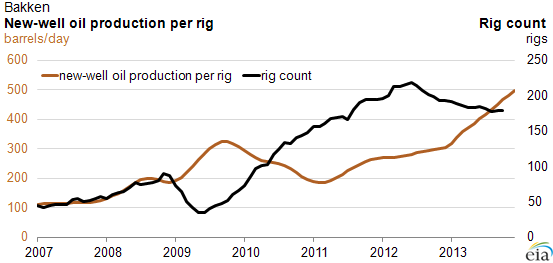
And so thats just what I expect----ongoing high levels of drilling in the Bakken, Eagle Ford etc. to continually drill new wells and replace the oil in rapidly depleting old oil wells. Production in the Bakken is probably near its peak now, and to maintain it theres going to be a heck of lot of new drilling in the years to come as existing wells rapidly deplete. At roughly a million barrels a day, it will take almost 20 years to deplete the ca. 7 billion barrels of oil in the Bakken, for instance.
Get it now?

-
Plantagenet - Expert
- Posts: 26765
- Joined: Mon 09 Apr 2007, 03:00:00
- Location: Alaska (its much bigger than Texas).





 I already posted something like this not long ago.