.
Lawrence Summers , once mentioned to be Fed Chairman
and one of the most eminent establishment economist ,
is throwing a stone into to pond
http://blogs.reuters.com/lawrencesummer ... tagnation/
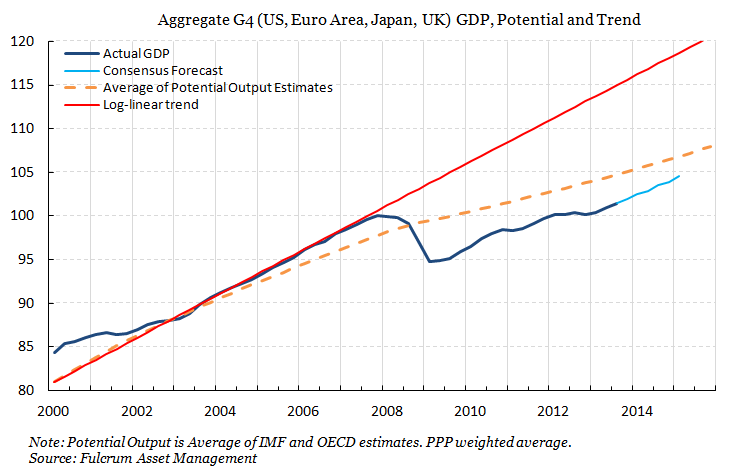
He point out the lack of growth in advanced economies and the futility of
continuing with quantitative easing
"Some have suggested that a belief in secular stagnation implies the desirability of bubbles to support demand. This idea confuses prediction with recommendation. It is of course far better to support demand by supporting productive investment or highly valued consumption than by artificially inflating bubbles. On the other hand, it is only rational to recognize that low interest rates raise asset values and drive investors to take greater risks, making bubbles more likely. The risk of financial instability provides yet another reason why preempting structural stagnation is so profoundly important."



PeakOil is You
Secular stagnation
First unread post • 16 posts
• Page 1 of 1
Secular stagnation
 by sparky » Mon 16 Dec 2013, 15:49:40
-

sparky - Intermediate Crude

- Posts: 3587
- Joined: Mon 09 Apr 2007, 03:00:00
- Location: Sydney , OZ
Re: Secular stagnation
by Pops » Mon 16 Dec 2013, 16:22:21
He talks all sorts of gibberish yet neglects to mention energy costs for the average American have gone from 7-12% of disposable income even with the drop in nat gas and declining miles driven.

http://www.csmonitor.com/USA/2011/0518/ ... ergy-costs

http://www.citibank.com.au/global_docs/ ... sp_aus.htm
http://www.csmonitor.com/USA/2011/0518/ ... ergy-costs
http://www.citibank.com.au/global_docs/ ... sp_aus.htm
The legitimate object of government, is to do for a community of people, whatever they need to have done, but can not do, at all, or can not, so well do, for themselves -- in their separate, and individual capacities.
-- Abraham Lincoln, Fragment on Government (July 1, 1854)
-- Abraham Lincoln, Fragment on Government (July 1, 1854)
-

Pops - Elite

- Posts: 19746
- Joined: Sat 03 Apr 2004, 04:00:00
- Location: QuikSac for a 6-Pac
Re: Secular stagnation
by SeaGypsy » Mon 16 Dec 2013, 17:11:47
+1 on 'gibberish' Pops 
The heading I thought may lead to something interesting- but...
To assume 'Secular stagnation', one would have to assume a thoroughly secular state- something which doesn't actually exist. Our news and our politics are controlled by an oligarchy, we have fake secularism- another personality cult- whilst true secularism only exists, like true democracy- in a scattered form on the internet.
The heading I thought may lead to something interesting- but...
To assume 'Secular stagnation', one would have to assume a thoroughly secular state- something which doesn't actually exist. Our news and our politics are controlled by an oligarchy, we have fake secularism- another personality cult- whilst true secularism only exists, like true democracy- in a scattered form on the internet.
- SeaGypsy
- Master Prognosticator

- Posts: 9285
- Joined: Wed 04 Feb 2009, 04:00:00
Re: Secular stagnation
by sparky » Mon 16 Dec 2013, 19:40:14
.
It's written in code
let me translate , imperfectly
"Some
[ .....Martin Wolf ]
have suggested that a belief in secular stagnation implies the desirability of bubbles to support demand.
[ if you let the market run on its own there will be bubbles which is fine followed by banks bankruptcies
which is bad for the bankers ]
This idea confuses prediction with recommendation.
[ maybe bankers should be more careful and cut the crap ]
It is of course far better to support demand by supporting productive investment or highly valued consumption than by artificially inflating bubbles.
[ throwing money at financial institutions has zero result on making a country run better ]
On the other hand, it is only rational to recognize that low interest rates raise asset values and drive investors to take greater risks, making bubbles more likely.
[ All the free money is not used for factories but for bidding madly in the gambling casino of the stock exchange
The risk of financial instability provides yet another reason why preempting structural stagnation is so profoundly important."
[ Anyone ( Martin Wolf ) who think getting the stock market index up by 50% with ZERO real wealth increase
is building a house of cards sure to collapse ]
It's written in code
let me translate , imperfectly
"Some
[ .....Martin Wolf ]
have suggested that a belief in secular stagnation implies the desirability of bubbles to support demand.
[ if you let the market run on its own there will be bubbles which is fine followed by banks bankruptcies
which is bad for the bankers ]
This idea confuses prediction with recommendation.
[ maybe bankers should be more careful and cut the crap ]
It is of course far better to support demand by supporting productive investment or highly valued consumption than by artificially inflating bubbles.
[ throwing money at financial institutions has zero result on making a country run better ]
On the other hand, it is only rational to recognize that low interest rates raise asset values and drive investors to take greater risks, making bubbles more likely.
[ All the free money is not used for factories but for bidding madly in the gambling casino of the stock exchange
The risk of financial instability provides yet another reason why preempting structural stagnation is so profoundly important."
[ Anyone ( Martin Wolf ) who think getting the stock market index up by 50% with ZERO real wealth increase
is building a house of cards sure to collapse ]
-
sparky - Intermediate Crude
- Posts: 3587
- Joined: Mon 09 Apr 2007, 03:00:00
- Location: Sydney , OZ
Re: Secular stagnation
by Loki » Mon 16 Dec 2013, 23:29:33
SG, the term “secular” in econospeak means long-term, decadal-scale (10-30 years or more). In the OP's article, Summers is putting forth what he calls a “secular stagnation thesis,” i.e., decades of stagnation. This is not all that different from what we here on PO.com call economic decline, and only a small step above what we call economic collapse.
It's interesting to see Summers, about as mainstream a financial/economic policy figure as you get, arguing that we may very well see economic stagnation for decades to come. I know the feminists and leftists have all sorts of issues with this guy, but given the post in the OP's link, maybe he wouldn't have made such a bad Fed chair after all. We could use a few more doomers in high places.
$this->bbcode_second_pass_quote('Summers', 'S')ome time ago speaking at the IMF, I joined others who have invoked the old idea of secular stagnation and raised the possibility that the American and global economies could not rely on normal market mechanisms to assure full employment and strong growth without sustained unconventional policy support
It's interesting to see Summers, about as mainstream a financial/economic policy figure as you get, arguing that we may very well see economic stagnation for decades to come. I know the feminists and leftists have all sorts of issues with this guy, but given the post in the OP's link, maybe he wouldn't have made such a bad Fed chair after all. We could use a few more doomers in high places.
$this->bbcode_second_pass_quote('Summers', 'S')ome time ago speaking at the IMF, I joined others who have invoked the old idea of secular stagnation and raised the possibility that the American and global economies could not rely on normal market mechanisms to assure full employment and strong growth without sustained unconventional policy support
Balls-to-the-walls emergency economic policy actions will be required for the indefinite future if we're to avoid a death spiral.
$this->bbcode_second_pass_quote('', 'F')irst, even though financial repair had largely taken place four years ago, recovery since that time has only kept up with population growth and normal productivity growth in the United States, and has been worse elsewhere in the industrial world.
There has been no recovery despite massive interventions in the market.
$this->bbcode_second_pass_quote('', 'S')econd, manifestly unsustainable bubbles and loosening of credit standards during the middle of the last decade, along with very easy money, were sufficient to drive only moderate economic growth.
Economic growth has been slowing for a long time, even with the overheated housing market prior to the pop of '08.
$this->bbcode_second_pass_quote('', 'T')hird, short-term interest rates are severely constrained by zero lower bound and there is very little scope for further reductions in either term premia or credit spreads, and so real interest rates may not be able to fall far enough to spur enough investment to lead to full employment.
We can't cut interest rates lower than zero. Borrow, damn it, why won't you people just borrow?!?!
$this->bbcode_second_pass_quote('', 'F')ourth, in such a situation falling wages and prices or inflation at slower-than-expected rates is likely to worsen economic performance by encouraging consumers and investors to delay spending, and to redistribute income and wealth from higher spending debtors to lower spending creditors.
Inflation is not the problem, deflation is. People just aren't borrowing and spending enough. This is making the maldistribution of wealth of our society even worse.
$this->bbcode_second_pass_quote('', 'T')he implication of these considerations is that the presumption that runs through most policy discussion — that normal economic and policy conditions will return at some point — cannot be maintained. The point is demonstrated by the Japanese experience,
A return to BAU is fantasy. Japan has paved the way. Decadal-scale stagnation is not only possible, it's been proven.
$this->bbcode_second_pass_quote('', 'O')n the other hand, it is only rational to recognize that low interest rates raise asset values and drive investors to take greater risks, making bubbles more likely. The risk of financial instability provides yet another reason why preempting structural stagnation is so profoundly important.
More bubbles---and associated pops---are likely due to the emergency actions governments and central banks around the world have been taking.
I can't disagree with any of this. I doubt that “preempting structural stagnation” is within our power, but I'd like to read Summers' thoughts on the subject.