Reuters - "Independent U.S. refiner Tesoro Corp has tripled the amount of North Dakota Bakken oil delivered by crude-only trains to its northern California refinery since the first such shipment in September, Chief Executive Greg Goff said on Thursday. He said the 166,000 barrels-per-day (bpd) Golden Eagle refinery in Martinez is running about 350,000 barrels per month from three so-called "unit trains" that carry only crude. The first unit train arrived in September. "It really just started and is just ramping up," Goff said.
However, he said the third-party offloading facility handling the incoming trains is "pretty much maxed out," so deliveries cannot ramp up further until Tesoro's joint-venture $100 million rail-to-barge oil terminal starts up at a port in Washington. Both initiatives are part of Tesoro's overall plan to run more inland U.S. and Canadian heavy crudes, which are cheaper than imports, at its West Coast refineries. Rail is a critical factor in getting those crudes to the West Coast, as no major pipelines move crude to that market. Tesoro already runs 50,000 bpd of Bakken crude at its 120,000 bpd refinery in Anacortes, Washington, where the company started up a crude offloading facility more than a year ago. Phillips 66 and BP Plc also have rail offloading projects in the works to do the same."
It seems rail shipment of oil was an overlooked opportunity until the battle over new pipelines flared up. Both the rail companies and oil producers are developing the economics learning curve needed to expand the process. Inadvertently in appears that opposition to pipelines to haul oil to coastal areas and allow overseas exports has created a process to do so much quicker and with much more flexibility than pipelines would have accomplished. And, in time, if the pipelines are eventually built even more transport capability will exist than if the pipelines would have been built sooner. The combined p/l and rail transport may put sufficient downward pressure on cost so even more marginal reserves may be developed. Perhaps one case of unintended consequences.



PeakOil is You
Oil via rail
Oil via rail
 by ROCKMAN » Sat 09 Nov 2013, 16:16:33
-

ROCKMAN - Expert

- Posts: 11397
- Joined: Tue 27 May 2008, 03:00:00
- Location: TEXAS
Re: Oil via rail
by Synapsid » Sat 09 Nov 2013, 17:02:31
ROCKMAN,
Shell has a proposal going too, also in Anacortes (where the Tesoro refinery is.)
Jumpin' times up here.
Shell has a proposal going too, also in Anacortes (where the Tesoro refinery is.)
Jumpin' times up here.
- Synapsid
- Tar Sands

- Posts: 780
- Joined: Tue 06 Aug 2013, 21:21:50
Re: Oil via rail
by Tanada » Sat 09 Nov 2013, 17:13:48
IMO for those fields that are projected to have a rapid increase-BOOM-Bust cycle like North Dakota rail makes far more economic sense than building a pipeline that will have to pay for itself in a very short time frame after construction. If they started a pipeline tomorrow and finished it in 2015 but the field peaks out in 2020 and is far down the decline slope by 2025 that only gives 7 or 8 years of profit potential.
$this->bbcode_second_pass_quote('Alfred Tennyson', 'W')e are not now that strength which in old days
Moved earth and heaven, that which we are, we are;
One equal temper of heroic hearts,
Made weak by time and fate, but strong in will
To strive, to seek, to find, and not to yield.
Moved earth and heaven, that which we are, we are;
One equal temper of heroic hearts,
Made weak by time and fate, but strong in will
To strive, to seek, to find, and not to yield.
- Tanada
- Site Admin

- Posts: 17094
- Joined: Thu 28 Apr 2005, 03:00:00
- Location: South West shore Lake Erie, OH, USA
Re: Oil via rail
by Plantagenet » Sat 09 Nov 2013, 19:24:54
There is a new proposal afoot to ship Canadian tight oil and tar sands oil to Asia via a rail connection through Alaska.
Canada is having trouble getting the "first nations" to agree to a pipeline and oil port to the Canadian west coast. A new idea is to build a rail link into central Alaska to connect with the trans-Alaska pipeline. The pipeline is already built and oil terminal infrastructure already exists at Valdez. The rail right-of-way can follow the existing Alaska Highway and connect the Canadian rail system to the Alaska rail system.
 Hook me up!
Canada is having trouble getting the "first nations" to agree to a pipeline and oil port to the Canadian west coast. A new idea is to build a rail link into central Alaska to connect with the trans-Alaska pipeline. The pipeline is already built and oil terminal infrastructure already exists at Valdez. The rail right-of-way can follow the existing Alaska Highway and connect the Canadian rail system to the Alaska rail system.
Hook me up!-

Plantagenet - Expert
- Posts: 26765
- Joined: Mon 09 Apr 2007, 03:00:00
- Location: Alaska (its much bigger than Texas).
Re: Oil via rail
by Paulo1 » Sat 09 Nov 2013, 19:48:33
As I mentioned a few days ago about protests regarding Northern Gateway, hauling by rail along the Alaska Hwy won't happen, either. I spent years working as a bush pilot in Yukon, and the idea of a new rail line following the Alaska highway is pretty nutso, imho. First of all, you have the 1st nations to deal with. They are pretty well looked after up there as is the entire Territory. They're doing not too bad right now. Certainly better regarded and accomodated to than natives in BC. Also, there would be little incentive for this project by either whites or natives. There are also numerous mountain ranges to cross. I have seen forest fires and mudslides knock out the highway for days. Furthermore, is it suppose to go through Kluane Natl. Park? Down the Whitepass? We're talking rugged country.
If it doesn't head south through a keystone xl, I believe excess will move by rail south on existing or expanded lines, bypassing any choke points until a terminal exists that will take it. From there it will go to the highest bidder, maybe US and maybe Asia. Just my opinion.
I used to fly local chiefs and others surveying the land for land claims. They log it, and they trap it, allow mining exploration, but I don't know if they are gracious enough to allow a rail line hauling bitumen.
These companies might own some politicians and/or political parties. They might own or have pet news media. Hearts and minds of residents....not so much.
Regards....Paulo
If it doesn't head south through a keystone xl, I believe excess will move by rail south on existing or expanded lines, bypassing any choke points until a terminal exists that will take it. From there it will go to the highest bidder, maybe US and maybe Asia. Just my opinion.
I used to fly local chiefs and others surveying the land for land claims. They log it, and they trap it, allow mining exploration, but I don't know if they are gracious enough to allow a rail line hauling bitumen.
These companies might own some politicians and/or political parties. They might own or have pet news media. Hearts and minds of residents....not so much.
Regards....Paulo
- Paulo1
- Coal

- Posts: 425
- Joined: Sun 07 Apr 2013, 15:50:35
- Location: East Coast Vancouver Island
Re: Oil via rail
by rollin » Sat 09 Nov 2013, 21:15:45
This is mostly about cost, cutting cost of transportation and using a lower cost fuel. The use of barges from Vancouver would not only allow more Bakken oil to be offloaded but also reduce transportation costs to the refinery. Bakken oil typically sells at a discount to WTI. Increasing direct rail transport quantities can involve new trackage since many lines are running near max capacity now.
The industry may face some cost increases due to the Lac Magantic Bakken oil disaster. Oil rail cars may have to be built to higher standards to resist impact better during accidents. That would involve large expenditures.
By the way "so called unit trains" are just that, unit trains. They carry only a single product, oftentimes destined for a single destination. Bakken oil trains have been running through the eastern US for years now.
The industry may face some cost increases due to the Lac Magantic Bakken oil disaster. Oil rail cars may have to be built to higher standards to resist impact better during accidents. That would involve large expenditures.
By the way "so called unit trains" are just that, unit trains. They carry only a single product, oftentimes destined for a single destination. Bakken oil trains have been running through the eastern US for years now.
Once in a while the peasants do win. Of course then they just go and find new rulers, you think they would learn.
- rollin
- Lignite
- Posts: 294
- Joined: Thu 06 Dec 2012, 18:28:24
Re: Oil via rail
by Plantagenet » Sat 09 Nov 2013, 21:45:46
$this->bbcode_second_pass_quote('Paulo1', ' ')is it suppose to go through Kluane Natl. Park? Down the Whitepass? We're talking rugged country.
1. As I said, its supposed to follow the Alaska Highway corridor. The Alaska Highway corridor doesn't go through Kluane Natl. Park or over White Pass.
2. Trains have been built through lots of "rugged country" over the last 150 years.
-------
I'm not saying this rail project will get done, but the idea is getting some attention here in Alaska.
Last edited by Plantagenet on Sat 09 Nov 2013, 21:54:28, edited 1 time in total.
-
Plantagenet - Expert
- Posts: 26765
- Joined: Mon 09 Apr 2007, 03:00:00
- Location: Alaska (its much bigger than Texas).
Re: Oil via rail
by ROCKMAN » Sat 09 Nov 2013, 21:53:17
Rollin - ...can involve new trackage " So far it seems the great majority of the infrastructure expansion has been expanding the terminals. Hooking up unit trains wasn't a problem but unloading 200 tankers in a few hours was the hang up. As I understand the process it involves installing piping that allowed many tankers to be unloaded simultaneously and adding the bulk tankage. Compared to the time and cost factors I gather it's a much easier option. I haven't heard anything yet about laying new track or difficulties with scheduling runs. Perhaps some additional sidings.
-
ROCKMAN - Expert
- Posts: 11397
- Joined: Tue 27 May 2008, 03:00:00
- Location: TEXAS
Re: Oil via rail
by Plantagenet » Sat 09 Nov 2013, 22:00:50
In fact, extending the railroad system eastward has already begun in Alaska
northern rail expansion---phase one
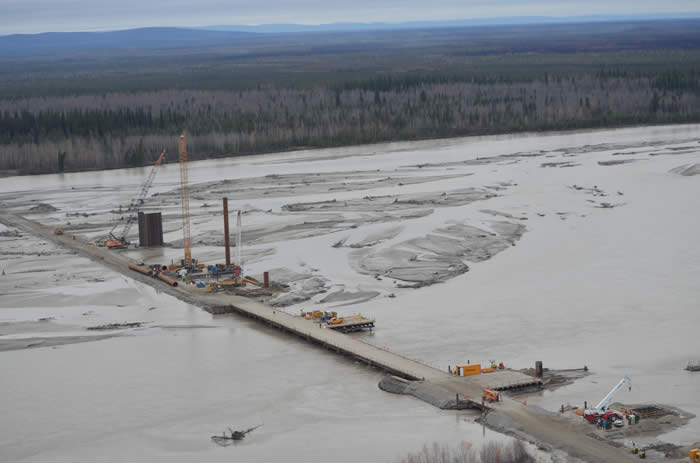
New Alaska RR bridge now being built to extend Alaska RR to the east.
------------
Alaskans have long wanted a rail link to Canada and the lower 48. The possibility of shipping Canadian oil to Asia through Alaska is just another component in the planning for such a rail link.
northern rail expansion---phase one
New Alaska RR bridge now being built to extend Alaska RR to the east.
------------
Alaskans have long wanted a rail link to Canada and the lower 48. The possibility of shipping Canadian oil to Asia through Alaska is just another component in the planning for such a rail link.
-
Plantagenet - Expert
- Posts: 26765
- Joined: Mon 09 Apr 2007, 03:00:00
- Location: Alaska (its much bigger than Texas).
Re: Oil via rail
by rollin » Sat 09 Nov 2013, 23:52:32
$this->bbcode_second_pass_quote('ROCKMAN', 'R')ollin - ...can involve new trackage " So far it seems the great majority of the infrastructure expansion has been expanding the terminals. Hooking up unit trains wasn't a problem but unloading 200 tankers in a few hours was the hang up. As I understand the process it involves installing piping that allowed many tankers to be unloaded simultaneously and adding the bulk tankage. Compared to the time and cost factors I gather it's a much easier option. I haven't heard anything yet about laying new track or difficulties with scheduling runs. Perhaps some additional sidings.
I meant if they use more southern routes to increase direct delivery by rail. Increasing yard sizes and adding parallel tracking (double tracking) in stretches has been going on for a few years now. Major railroads are often fully scheduled in sections, thus adding and routing more trains becomes problematical.
Single tracking was the answer to the economic fall after world war II but has proved a major bottleneck for fast freight across the country. The process is slowly being reversed. Right now a single problem propagates through major parts of a system. Adding a single train or changing it's schedule can cause major scheduling problems.
Once in a while the peasants do win. Of course then they just go and find new rulers, you think they would learn.
- rollin
- Lignite
- Posts: 294
- Joined: Thu 06 Dec 2012, 18:28:24
Re: Oil via rail
by Keith_McClary » Sun 10 Nov 2013, 02:12:56
$this->bbcode_second_pass_quote('Plantagenet', 'T')here is a new proposal afoot to ship Canadian tight oil and tar sands oil to Asia via a rail connection through Alaska.
...
A new idea is to build a rail link into central Alaska to connect with the trans-Alaska pipeline. The pipeline is already built and oil terminal infrastructure already exists at Valdez. The rail right-of-way can follow the existing Alaska Highway and connect the Canadian rail system to the Alaska rail system.
Why stop in Alaska:...
A new idea is to build a rail link into central Alaska to connect with the trans-Alaska pipeline. The pipeline is already built and oil terminal infrastructure already exists at Valdez. The rail right-of-way can follow the existing Alaska Highway and connect the Canadian rail system to the Alaska rail system.
Russia to build $65 billion tunnel to Alaska


Facebook knows you're a dog.
-

Keith_McClary - Light Sweet Crude

- Posts: 7344
- Joined: Wed 21 Jul 2004, 03:00:00
- Location: Suburban tar sands
