Peak Oil: a fertile concept
$this->bbcode_second_pass_quote('', 'W')e live in a world where scientific evidence is trashed by ideological opinion, where people who learn from experience are accused of being flip-floppers, where changing one's mind on the basis of new data is seen as admitting one's lack of moral fiber. The debate on peak oil is no exception and the recent demise of "The Oil Drum" site has been often seen as an admission that the whole idea of peak oil was wrong from the beginning.
But what is happening exactly with peak oil and why so much fuss about it? The problem may be simply that the idea had too much success. Let's go back to 1998, when Colin Campbell and Jean Laherrere raised up again a problem that had been first noticed by Marion King Hubbert, in 1956. Oil depletion, Campbell and Laherrere surmised, will be gradual: production will go through a symmetric “bell shaped” curve that will show a peak when, approximately, half of the available resources will have been used up. According to this study, the peak, that Campbell later dubbed “peak oil,” would have occurred around 2005.
The pioneering work by Cambell and Laherrere gave rise to a whole scientific field that used similar methods to study oil depletion. Most of these these studies arrived to the conclusion that troubles with oil would start within the first decade of the 21st century, or perhaps a little later. It was a view of the future in stark contrast with the generally optimistic attitude of the oil industry up to recent times. Just as an example, in 1999 "The Economist" published an article titled "Drowning in Oil" predicting oil at under 10 dollars per barrel.
But the predictions based on the peak oil concept turned out to be spectacularly successful, at least within the unavoidable uncertainties involved. Oil production stopped its growth in 2004 and oil prices spiked up to almost 150 dollars per barrel in 2008; about a factor of 5 higher than the price that was considered normal in the early years of the decade (and more than 15 times higher than the 1999 predictions of “The Economist”). Today, oil prices remain high; in the range of 100 dollars per barrel. We aren't seeing a production decline, but certainly we are seeing evidence of serious problems for the oil industry to maintain production at constant levels. As things stand, it seems impossible that we could return to the stable growth trends and the relatively low prices that were the rule until about 10 years ago.
So, “peakers” won their bet with cornucopians. The predicted troubles have materialized and peakers were also able to approximately identify the timing of the crisis. But, not everything is well in the world of peak oil. The elegant and symmetric “bell shaped” curve at the basis of most peak oil models did not appear for the global production data. What we are seeing, instead, is a plateau or, at most, a slow increase, in large part generated by the use of the so-called “non-conventional resources”, from biofuels to shale oil. The expected decline is not appearing; at least for the time being.


PeakOil is You
Peak Oil: a fertile concept
Human history becomes more and more a race between education and catastrophe. H. G. Wells.
Fatih Birol's motto: leave oil before it leaves us.
Fatih Birol's motto: leave oil before it leaves us.
-

Graeme - Fusion

- Posts: 13258
- Joined: Fri 04 Mar 2005, 04:00:00
- Location: New Zealand
Re: Peak Oil: a fertile concept
 by sparky » Thu 29 Aug 2013, 19:48:27
.
Excellent discussion , Peak Oil is not a revealed truth
it's a predictive horizon ,
the production numbers is not going to be a nice smooth curve
Crude is way too important not to be impacted by various circumstances
market overreaction , political troubles , accidents and development schedules
still it is a robust framework giving us insight into the future of our industrial society
I find it perfectly normal that as we sit on the top of the curve
the scream of " Peak oil is dead " should resonate ,
demand is the key , no kidding I though supply and demand were driving the prices ,
with demand subdued , prices should be soft
have you noticed a crash in the price ..... neither did I
Excellent discussion , Peak Oil is not a revealed truth
it's a predictive horizon ,
the production numbers is not going to be a nice smooth curve
Crude is way too important not to be impacted by various circumstances
market overreaction , political troubles , accidents and development schedules
still it is a robust framework giving us insight into the future of our industrial society
I find it perfectly normal that as we sit on the top of the curve
the scream of " Peak oil is dead " should resonate ,
demand is the key , no kidding I though supply and demand were driving the prices ,
with demand subdued , prices should be soft
have you noticed a crash in the price ..... neither did I
-

sparky - Intermediate Crude

- Posts: 3587
- Joined: Mon 09 Apr 2007, 03:00:00
- Location: Sydney , OZ
Re: Peak Oil: a fertile concept
by ralfy » Fri 30 Aug 2013, 00:46:05
What should be considered isn't a drop in oil production but oil production unable to meet demand, the need for increasing demand to maintain various needs and wants, and the consequences of insufficient production.
That is why an optimistic view of the future is now based on two things: maximizing production (and at some point, even if it is less profitable to do so) and lowering oil demand (but satisfying unmet energy demand using other means). The second is needed because even the first won't meet increasing demand due to a growing middle class. Also, we face the effects of using oil on the environment and the climate.
However, the only optimistic view that is logical given a global capitalist system that has to be maintained is increased crude oil production that exceeds demand needed for economic growth. That's because most human beings want a middle class lifestyle that guarantees all basic needs met for a population that is growing slowly but where resource needs are increasing. At the same time, the extra energy derived will be needed to prepare for peak oil and global warming, and that means using that and petrochemicals to manufacture components needed for renewable energy. Also, additional time bought will allow people to adjust to using less fossil fuels, and that means localization, permaculture, etc.
This view is based on the assumption that economies coordinate and cooperate with each other extensively, so that disruptions caused by wars, the effects of global warming and environmental damage, epidemics, financial crises, and others will be avoided or minimized.
But when we look at modern history, we see the opposite: two world wars, one Cold War with military powers preying on weaker ones, increased use of fossil fuels for more production and in order to meet increasing global demand for various goods and services, and economies barely preparing for peak oil and global warming.
Given that, one can say that an "optimistic" but realistic view of the future will involve high food and oil prices, those forcing people to cut down on resource use and adjust lifestyles, this contributing to more financial instability as a more desperate financial elite tries to engage in more speculation to continue the growth of its own wealth while passing on risks to governments, governments unable to meet those risks and forced to engage in austerity measures (which, with high prices and unemployment will make people angrier), military forces becoming edgier as they try to justify their resource-hungry costs and target countries that do not cooperate with economies that need (or want) more resources, and various disruptions caused by wars, such as oil production suddenly halted due to the same, epidemics, floods, droughts, and heat waves likely caused by global warming, and environmental damage.
Finally, the implication is that peak oil, and generally a resource shortage, should be seen in light of these other issues.
That is why an optimistic view of the future is now based on two things: maximizing production (and at some point, even if it is less profitable to do so) and lowering oil demand (but satisfying unmet energy demand using other means). The second is needed because even the first won't meet increasing demand due to a growing middle class. Also, we face the effects of using oil on the environment and the climate.
However, the only optimistic view that is logical given a global capitalist system that has to be maintained is increased crude oil production that exceeds demand needed for economic growth. That's because most human beings want a middle class lifestyle that guarantees all basic needs met for a population that is growing slowly but where resource needs are increasing. At the same time, the extra energy derived will be needed to prepare for peak oil and global warming, and that means using that and petrochemicals to manufacture components needed for renewable energy. Also, additional time bought will allow people to adjust to using less fossil fuels, and that means localization, permaculture, etc.
This view is based on the assumption that economies coordinate and cooperate with each other extensively, so that disruptions caused by wars, the effects of global warming and environmental damage, epidemics, financial crises, and others will be avoided or minimized.
But when we look at modern history, we see the opposite: two world wars, one Cold War with military powers preying on weaker ones, increased use of fossil fuels for more production and in order to meet increasing global demand for various goods and services, and economies barely preparing for peak oil and global warming.
Given that, one can say that an "optimistic" but realistic view of the future will involve high food and oil prices, those forcing people to cut down on resource use and adjust lifestyles, this contributing to more financial instability as a more desperate financial elite tries to engage in more speculation to continue the growth of its own wealth while passing on risks to governments, governments unable to meet those risks and forced to engage in austerity measures (which, with high prices and unemployment will make people angrier), military forces becoming edgier as they try to justify their resource-hungry costs and target countries that do not cooperate with economies that need (or want) more resources, and various disruptions caused by wars, such as oil production suddenly halted due to the same, epidemics, floods, droughts, and heat waves likely caused by global warming, and environmental damage.
Finally, the implication is that peak oil, and generally a resource shortage, should be seen in light of these other issues.
-

ralfy - Light Sweet Crude

- Posts: 5651
- Joined: Sat 28 Mar 2009, 11:36:38
- Location: The Wasteland
Re: Peak Oil: a fertile concept
by Plantagenet » Fri 30 Aug 2013, 01:40:24
It's premature to say the bell curve model of oil production decline isn't valid. We're just coming over the top now.
Scientific data is usually smoothed using running means or other methods. If we smooth oil production data w a 5 year running mean the bell curve model looks much better
Scientific data is usually smoothed using running means or other methods. If we smooth oil production data w a 5 year running mean the bell curve model looks much better
-

Plantagenet - Expert

- Posts: 26765
- Joined: Mon 09 Apr 2007, 03:00:00
- Location: Alaska (its much bigger than Texas).
Re: Peak Oil: a fertile concept
by ROCKMAN » Fri 30 Aug 2013, 09:36:51
P - Just a small point: a "bell shaped curve" doesn't mean a symmetric distribution. "Bell shaped" is just a simplistic term. Many bell curves of natural data are high skewed from such symmetry. Not only did Hubbert never say the US curve would be symmetrical but just the opposite: very skewed with a long tail. Which is exactly what the data shows. And for good reason: it's almost impossible to find the production curve of any well, field, trend, region, or country that plots such a nice symmetric curve. As such it amazes me that anyone would make such a prediction.
This obvious reality also makes it difficult to understand why anyone would assume the peak/plateau would represent the midpoint to ultimate recovery. Again you would be hard pressed to find such an analogy in the production history anywhere in the world. I can’t recall a single oil field where half of the URR was reached by the time that production had peaked. Just the opposite: I’ve seen many fields that produced 70% to 80% of their URR after their production rate peaked.
I appreciate the appeal of assuming such a simple model for the sake of making future projections. It’s especially appealing to cornucopians who want to base their optimism on how much we have left to produce as opposed to how fast we can get it out of the ground. The problem is that such models are almost non-existent in the data base of all past production.
Perhaps the some current misconception comes from the production curve of the hot fractured reservoir plays. Many of them show a high percentage of URR early on. But if you look loosely at such a curve and recognize that such a well begins at its peak and then constantly declines then virtually 100% of a fractured well’s recovery comes after its peak. Difficult to get more unsymmetrical than that. LOL.
This obvious reality also makes it difficult to understand why anyone would assume the peak/plateau would represent the midpoint to ultimate recovery. Again you would be hard pressed to find such an analogy in the production history anywhere in the world. I can’t recall a single oil field where half of the URR was reached by the time that production had peaked. Just the opposite: I’ve seen many fields that produced 70% to 80% of their URR after their production rate peaked.
I appreciate the appeal of assuming such a simple model for the sake of making future projections. It’s especially appealing to cornucopians who want to base their optimism on how much we have left to produce as opposed to how fast we can get it out of the ground. The problem is that such models are almost non-existent in the data base of all past production.
Perhaps the some current misconception comes from the production curve of the hot fractured reservoir plays. Many of them show a high percentage of URR early on. But if you look loosely at such a curve and recognize that such a well begins at its peak and then constantly declines then virtually 100% of a fractured well’s recovery comes after its peak. Difficult to get more unsymmetrical than that. LOL.
-

ROCKMAN - Expert
- Posts: 11397
- Joined: Tue 27 May 2008, 03:00:00
- Location: TEXAS
Re: Peak Oil: a fertile concept
by rockdoc123 » Fri 30 Aug 2013, 10:20:48
Rockman
I had the Gaussian nature of the curve explained to me decades ago by one of my thesis supervisors who had worked for King Hubbert at the Shell Research Centre. It was purely theoretical and assumes that a field is produced as quickly as possible with no external influences on production (which of course never happens). In nature most things are best described by a log-normal distribution (the assymetric curve you speak to) but when you combine a number of log normally distributed attributes the end result is theoretically a normal or Gaussian distribution. Hence combining all of the production in the US, each individually perhaps better described by a log normal distribution could be better described by a normal bell curve in theory.
The reality though is that there are many external influences on how fields are produced. Fields might be choked back for reasons such as short term price swings, transportation issues, plant bottlenecks etc. Operators may choose to either accelerate or delay drilling of development wells in a field for various economic considerations. Operators might also choose to take advantage of the time value of money by ramping up production to its maximum output for as many years as possible and then letting it tail off in which case the curve would be log normal in appearance and peak would have no bearing on half of the reserves having been recovered. The shale gas/liquids production profiles are good examples with long histories but half production occurring at some point during decline. The devil is in the details.
I had the Gaussian nature of the curve explained to me decades ago by one of my thesis supervisors who had worked for King Hubbert at the Shell Research Centre. It was purely theoretical and assumes that a field is produced as quickly as possible with no external influences on production (which of course never happens). In nature most things are best described by a log-normal distribution (the assymetric curve you speak to) but when you combine a number of log normally distributed attributes the end result is theoretically a normal or Gaussian distribution. Hence combining all of the production in the US, each individually perhaps better described by a log normal distribution could be better described by a normal bell curve in theory.
The reality though is that there are many external influences on how fields are produced. Fields might be choked back for reasons such as short term price swings, transportation issues, plant bottlenecks etc. Operators may choose to either accelerate or delay drilling of development wells in a field for various economic considerations. Operators might also choose to take advantage of the time value of money by ramping up production to its maximum output for as many years as possible and then letting it tail off in which case the curve would be log normal in appearance and peak would have no bearing on half of the reserves having been recovered. The shale gas/liquids production profiles are good examples with long histories but half production occurring at some point during decline. The devil is in the details.
-
rockdoc123 - Expert
- Posts: 7685
- Joined: Mon 16 May 2005, 03:00:00
Re: Peak Oil: a fertile concept
by ROCKMAN » Fri 30 Aug 2013, 10:41:08
oc - All true. I wish folks better understood how much Mother earth just loves log normal distribution of all her data. But: "Hence combining all of the production in the US, each individually perhaps better described by a log normal distribution could be better described by a normal bell curve in theory". When you look at the oil production rate of the US, which combines every one of those non-symmetric wells, you obviously see a very non-symmetric curve. Of course, we don't know what the curve will look like in the future. But can you imagine a falloff in production anywhere close as the dramatic increase in US production post WWII? I can't.
And the US will probably have a much more even pattern compared to the rest of the world a a result of all those variables you mentioned. As the say: data trumps theory. Can anyone show a curve of oil production rate for any country or even region that has passed through its PO that comes even close to a symmetric curve? I still can't.
And the US will probably have a much more even pattern compared to the rest of the world a a result of all those variables you mentioned. As the say: data trumps theory. Can anyone show a curve of oil production rate for any country or even region that has passed through its PO that comes even close to a symmetric curve? I still can't.
-
ROCKMAN - Expert
- Posts: 11397
- Joined: Tue 27 May 2008, 03:00:00
- Location: TEXAS
Re: Peak Oil: a fertile concept
by Pops » Fri 30 Aug 2013, 11:57:40
Thanks Graeme, that's Ugo Bardi at Cassandra's Legacy via Resilience, one of my few blogosphere stops anymore.
Laherrere's prediction from 8 years ago looks remarkably accurate just about like this one he just updated in February:
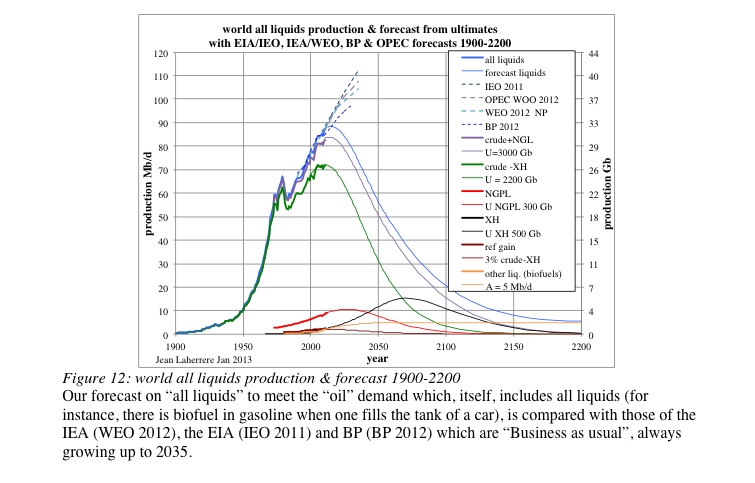
He still figures URR of 2200Gb of crude, 500Gb of extra heavy tar and miscellaneous other stuff.
Not surprisingly the governmental guessers no longer talk much about the real number at the heart of world production, which is crude oil (the green line in the top chart), they prefer to include lots of other stuff that is not oil, I can only assume that is to continue the illusion that all is well in the kingdom and the emperor feels not the slightest draft, no matter what your lying eyes say to the contrary, LOL!
The promoted number now is All Liquids and includes things like ethanol, which if you've ever seen a 24 row corn planter or combine in action you know actually consumes a whole lot of oil in its production and lots of natural gas and coal in it's distilling, effectively double counting that volume of FFs in the All Liquids number. Speaking of volume, oil, especially extra heavy oil, expands as it is refined (using energy of course) and amazingly this expansion of volume, known as "refinery gains", is actually counted as a liquid fuel! It is counted as an increase in production, even though it adds no usable energy and in fact uses energy to accomplish - but it makes the All Liquids number larger.
They include the non-methane portion of natural gas in the All Liquids number as well. Natural gas as it comes out of the ground contains various other compounds that are removed nowadays before it is pumped to homes and factories. These are called Natural Gas Plant Liquids (NGPL) and for some reason (well, we know the reason) they are counted as "oil" now even though the majority of these products never do (or ever did) enter the crude oil stream. About 40% of these "liquids" is ethane, which is the feed stock for plastic (we all know how important credit cards are) and about a third is propane, which is used for residential heating and cooking, leaving only about 20% to use as gasoline additives. So again a misleading number used to make better headlines for those who'd rather you to not think anything is amiss in the world of Oil
--
So anyway I didn't start out to rant about all liquids, LOL, I started to say that peak oil is proceeding just about as I thought it would. I couldn't understand the projections of total production declines of 3-5-7 percent manifesting overnight. That may be the underlying decline rate (the average amount production from oil individual wells falls each year) but that has always been the underlying rate.
The difference between pre- and post- peak is simply that pre-peak, new production can replace and exceed declines and post peak it can't. That's it.
Again, the only way for overnight 6% declines in total production to occur would be if there are no new wells left to drill and no new fields left to find. But even the most simplistic peak oil scenario says that drilling and even discovery doesn't stop after peak, it just can't keep up with the rate of decline. Obviously the second half must come from somewhere and that is new wells and new discoveries. I've always pooh-poohed Overnight Armageddon based solely on PO.
--
In addition to the point rocdoc made above about production with no external constraints being required for the nice bell curve, the other factor I think often overlooked is that the resource is not homogenous. Look at Laherrer's chart again, he shows several curves, the green is regular oil, but the x-heavy has a different line altogether because even though there is lots of it, it will never be produced at the rate that regular crude has been and certainly not at the rate the US tight oil has been.
The net effect is that though the "reserve to production" ratio may say that x-heavy oil will meet, say, 10 years of demand at current usage, it might take 100 years to produce it all because it just doesn't scale. Canada is the perfect example, it has been working on processing tar for 40 years and is up to a whopping 3Mbopd. The net effect is reserve numbers just don't matter except for PR because the rate those under and over cooked fossils can be developed is not comparable to regular crude. Look at the chart, the low shallow brown line is extra heavy oil/kerogen/bitumen, that is a picture of what the folks who say PO is no problem because there are trillions of barrels just waiting to be mined would have you believe is the savior of happy motoring.
And I'm counting on the march of technology to improve the amount we can extract, fracking I thought was going to be a big deal but aside from the 2 areas in the US it doesn't seem to be going global. And the sub-salt was the big new thing for a little while but it's not moved the needle a speck. And even if both were pumping tomorrow and grew as fast as US tigh they still would only add a few of years to the upslope.
--
Anyway, being an optimist I chose to put my chips on Laherrere's guess back in the day mainly because his message was (and still is) that although the data is too poor to make any definite projections, the simple "production follows discovery" logic indicates a peak sometime about now.
I haven't seen anything to convince me that is wrong.
ETA:
https://docs.google.com/viewer?url=http ... larmix.pdf
Laherrere's prediction from 8 years ago looks remarkably accurate just about like this one he just updated in February:
He still figures URR of 2200Gb of crude, 500Gb of extra heavy tar and miscellaneous other stuff.
Not surprisingly the governmental guessers no longer talk much about the real number at the heart of world production, which is crude oil (the green line in the top chart), they prefer to include lots of other stuff that is not oil, I can only assume that is to continue the illusion that all is well in the kingdom and the emperor feels not the slightest draft, no matter what your lying eyes say to the contrary, LOL!
The promoted number now is All Liquids and includes things like ethanol, which if you've ever seen a 24 row corn planter or combine in action you know actually consumes a whole lot of oil in its production and lots of natural gas and coal in it's distilling, effectively double counting that volume of FFs in the All Liquids number. Speaking of volume, oil, especially extra heavy oil, expands as it is refined (using energy of course) and amazingly this expansion of volume, known as "refinery gains", is actually counted as a liquid fuel! It is counted as an increase in production, even though it adds no usable energy and in fact uses energy to accomplish - but it makes the All Liquids number larger.
They include the non-methane portion of natural gas in the All Liquids number as well. Natural gas as it comes out of the ground contains various other compounds that are removed nowadays before it is pumped to homes and factories. These are called Natural Gas Plant Liquids (NGPL) and for some reason (well, we know the reason) they are counted as "oil" now even though the majority of these products never do (or ever did) enter the crude oil stream. About 40% of these "liquids" is ethane, which is the feed stock for plastic (we all know how important credit cards are) and about a third is propane, which is used for residential heating and cooking, leaving only about 20% to use as gasoline additives. So again a misleading number used to make better headlines for those who'd rather you to not think anything is amiss in the world of Oil
--
So anyway I didn't start out to rant about all liquids, LOL, I started to say that peak oil is proceeding just about as I thought it would. I couldn't understand the projections of total production declines of 3-5-7 percent manifesting overnight. That may be the underlying decline rate (the average amount production from oil individual wells falls each year) but that has always been the underlying rate.
The difference between pre- and post- peak is simply that pre-peak, new production can replace and exceed declines and post peak it can't. That's it.
Again, the only way for overnight 6% declines in total production to occur would be if there are no new wells left to drill and no new fields left to find. But even the most simplistic peak oil scenario says that drilling and even discovery doesn't stop after peak, it just can't keep up with the rate of decline. Obviously the second half must come from somewhere and that is new wells and new discoveries. I've always pooh-poohed Overnight Armageddon based solely on PO.
--
In addition to the point rocdoc made above about production with no external constraints being required for the nice bell curve, the other factor I think often overlooked is that the resource is not homogenous. Look at Laherrer's chart again, he shows several curves, the green is regular oil, but the x-heavy has a different line altogether because even though there is lots of it, it will never be produced at the rate that regular crude has been and certainly not at the rate the US tight oil has been.
The net effect is that though the "reserve to production" ratio may say that x-heavy oil will meet, say, 10 years of demand at current usage, it might take 100 years to produce it all because it just doesn't scale. Canada is the perfect example, it has been working on processing tar for 40 years and is up to a whopping 3Mbopd. The net effect is reserve numbers just don't matter except for PR because the rate those under and over cooked fossils can be developed is not comparable to regular crude. Look at the chart, the low shallow brown line is extra heavy oil/kerogen/bitumen, that is a picture of what the folks who say PO is no problem because there are trillions of barrels just waiting to be mined would have you believe is the savior of happy motoring.
And I'm counting on the march of technology to improve the amount we can extract, fracking I thought was going to be a big deal but aside from the 2 areas in the US it doesn't seem to be going global. And the sub-salt was the big new thing for a little while but it's not moved the needle a speck. And even if both were pumping tomorrow and grew as fast as US tigh they still would only add a few of years to the upslope.
--
Anyway, being an optimist I chose to put my chips on Laherrere's guess back in the day mainly because his message was (and still is) that although the data is too poor to make any definite projections, the simple "production follows discovery" logic indicates a peak sometime about now.
I haven't seen anything to convince me that is wrong.
ETA:
https://docs.google.com/viewer?url=http ... larmix.pdf
Last edited by Pops on Fri 30 Aug 2013, 12:55:24, edited 2 times in total.
Reason: link; clarity.
Reason: link; clarity.
The legitimate object of government, is to do for a community of people, whatever they need to have done, but can not do, at all, or can not, so well do, for themselves -- in their separate, and individual capacities.
-- Abraham Lincoln, Fragment on Government (July 1, 1854)
-- Abraham Lincoln, Fragment on Government (July 1, 1854)
-

Pops - Elite
- Posts: 19746
- Joined: Sat 03 Apr 2004, 04:00:00
- Location: QuikSac for a 6-Pac
Re: Peak Oil: a fertile concept
by ROCKMAN » Fri 30 Aug 2013, 12:44:21
Pops – “…obviously the second half must come from somewhere and that is new wells and new discoveries. Which is why I've always pooh-poohed Overnight Armageddon based solely on PO.”. I agree but also remember that much of our current production is coming from some very old wells still putting out the juice. Consider that the world’s third largest oil producer averages less than 10 bopd per well. Needless to say the vast majority of our great production is from old wells that produce a lot of oil COLLECTIVELY late in their lives. And during late life stages with very low decline rates.
Thus why I’ve also felt the need to pooh-pooh Overnight Armageddon for this reason as well as the ones you’ve pointed out. That’s why I say old oil fields are just like old geologists: they just keep sputtering along until Mother Earth mercifully puts them out of their misery.
Thus why I’ve also felt the need to pooh-pooh Overnight Armageddon for this reason as well as the ones you’ve pointed out. That’s why I say old oil fields are just like old geologists: they just keep sputtering along until Mother Earth mercifully puts them out of their misery.
-
ROCKMAN - Expert
- Posts: 11397
- Joined: Tue 27 May 2008, 03:00:00
- Location: TEXAS
Re: Peak Oil: a fertile concept
by dcoyne78 » Fri 30 Aug 2013, 13:41:01
$this->bbcode_second_pass_quote('ROCKMAN', 'P')ops – “…obviously the second half must come from somewhere and that is new wells and new discoveries. Which is why I've always pooh-poohed Overnight Armageddon based solely on PO.”. I agree but also remember that much of our current production is coming from some very old wells still putting out the juice. Consider that the world’s third largest oil producer averages less than 10 bopd per well. Needless to say the vast majority of our great production is from old wells that produce a lot of oil COLLECTIVELY late in their lives. And during late life stages with very low decline rates.
Thus why I’ve also felt the need to pooh-pooh Overnight Armageddon for this reason as well as the ones you’ve pointed out. That’s why I say old oil fields are just like old geologists: they just keep sputtering along until Mother Earth mercifully puts them out of their misery.
Thus why I’ve also felt the need to pooh-pooh Overnight Armageddon for this reason as well as the ones you’ve pointed out. That’s why I say old oil fields are just like old geologists: they just keep sputtering along until Mother Earth mercifully puts them out of their misery.
Hi Rockman,
I assume you are referring to the US. There is indeed a lot of old stripper wells form conventional fields with low decline rates. Of the 7.5 MMb/d produced currently by the US, about 1.7 MMb/d are from the Bakken and Eagle Ford and another 1.2 MMb/d is from the GOM, 1.2 MMb/d also comes from the Permian basin (some of this is conventional, but I have no way of estimating how much). My guess is that the oil wells producing tight oil and the deepwater GOM will behave differently than the old wells from conventional fields, so we have about 4 MMb/d which may decline slowly, but the other 3.5 MMb/d may decline rather quickly. My guess is that the fractured wells won't last beyond 20 years without another frack job and I doubt the economics will make sense for most wells when considering whether to frack the well to bring it back to life.
DC
- dcoyne78
- Coal

- Posts: 476
- Joined: Thu 30 May 2013, 19:45:15
Re: Peak Oil: a fertile concept
by ROCKMAN » Fri 30 Aug 2013, 14:33:21
In Nov 1970 the US was doing 310.4 mmbo per month. In Jan 2006, before the impact of the shales kicked in, we were doing 157.6 mmbo per month. That’s a 48% decrease in 36 years. Or an average of 1.3% per year. Looking even more recent from Dec 1990 to Jan 2006 we dropped from 227.5 mmbo per month and 30.1%. Or at a rate of 1.9% per year. And that includes the addition of many DW GOM oil fields. This compares to the increase in US production at a rate of 15.5% per year from 1920 to 1970.
No matter how you cut it the decline rate of old US oil wells is low. And when you say the fractured wells won’t last beyond 20 years I take it you mean individual wells and not the trends. Most of the EFS wells won’t be still producing in 10 years IMHO. Some Bakken wells might go 20 years but I’m suspect most will be strippers for at least the last 10 years of their lives with the typically very low decline rates of all stripper wells.
So when you take the bump out of the curve for the shale plays you end up with a projected decline rate of 2% or less. The US was the third largest oil producer on the planet long before the shales kicked in. I suspect we’ll still be the third largest producers for many years to come. We might even catch up to Saudi Arabia if they slip a little and high oil prices keep our shale plays going. But that’s not a great brag since we’ve been producing about 85% of what the KSA has been doing for a good while.
As far as how old conventional oil fields decline and the DW GOM fields there's no comparison: the overhead cost for maintaining a DW won't allow production anywhere close to stripper levels. Been a while but the last time I saw the estimate a DW field has a typical life of only around 7 to 8 years. I just completed a hz well in a conventional reservoir that has been producing continuously for 67 years. Most of the fields (of the same age) in this trend which has produced 4.5 billion bbls of oil are still producing.
As far as "tite oil" vs. conventional I'm not sure how to answer. In my world a "tite oil field" as I suspect you mean it. May be conventional or unconventional. I'm working on a project now that involves drilling some very "tite" NG reservoirs that exist in some very conventional traps in a series of Texas fields. In my world conventional vs. nonconventional relates to how the hydrocarbons are trapped and not the permeability of the reservoir rock.
No matter how you cut it the decline rate of old US oil wells is low. And when you say the fractured wells won’t last beyond 20 years I take it you mean individual wells and not the trends. Most of the EFS wells won’t be still producing in 10 years IMHO. Some Bakken wells might go 20 years but I’m suspect most will be strippers for at least the last 10 years of their lives with the typically very low decline rates of all stripper wells.
So when you take the bump out of the curve for the shale plays you end up with a projected decline rate of 2% or less. The US was the third largest oil producer on the planet long before the shales kicked in. I suspect we’ll still be the third largest producers for many years to come. We might even catch up to Saudi Arabia if they slip a little and high oil prices keep our shale plays going. But that’s not a great brag since we’ve been producing about 85% of what the KSA has been doing for a good while.
As far as how old conventional oil fields decline and the DW GOM fields there's no comparison: the overhead cost for maintaining a DW won't allow production anywhere close to stripper levels. Been a while but the last time I saw the estimate a DW field has a typical life of only around 7 to 8 years. I just completed a hz well in a conventional reservoir that has been producing continuously for 67 years. Most of the fields (of the same age) in this trend which has produced 4.5 billion bbls of oil are still producing.
As far as "tite oil" vs. conventional I'm not sure how to answer. In my world a "tite oil field" as I suspect you mean it. May be conventional or unconventional. I'm working on a project now that involves drilling some very "tite" NG reservoirs that exist in some very conventional traps in a series of Texas fields. In my world conventional vs. nonconventional relates to how the hydrocarbons are trapped and not the permeability of the reservoir rock.
-
ROCKMAN - Expert
- Posts: 11397
- Joined: Tue 27 May 2008, 03:00:00
- Location: TEXAS
Re: Peak Oil: a fertile concept
by Pops » Fri 30 Aug 2013, 15:23:45
The US is an exception, about 60% of global production comes from 500 fields. A majority of those are over 50 years old. One study of 300 of those found 80% in decline, the avg. decline rate was 6.9%/a.
And worse, the downside of new technology is that EOR - like all profit motivated technology, gets oil out today at the expense of higher decline tomorrow:
$this->bbcode_second_pass_quote('', 'L')and-based and offshore giants that went into decline in the last decade showed annual production declines on average above 10 percent.
And worse, the downside of new technology is that EOR - like all profit motivated technology, gets oil out today at the expense of higher decline tomorrow:
$this->bbcode_second_pass_quote('', 'L')and-based and offshore giants that went into decline in the last decade showed annual production declines on average above 10 percent.
So again the US is exceptional in its oil biz and infrastructure. It is a big mistake to try to extrapolate US performance to other areas.
http://www.csmonitor.com/Environment/En ... oil-fields
The legitimate object of government, is to do for a community of people, whatever they need to have done, but can not do, at all, or can not, so well do, for themselves -- in their separate, and individual capacities.
-- Abraham Lincoln, Fragment on Government (July 1, 1854)
-- Abraham Lincoln, Fragment on Government (July 1, 1854)
-
Pops - Elite
- Posts: 19746
- Joined: Sat 03 Apr 2004, 04:00:00
- Location: QuikSac for a 6-Pac
Re: Peak Oil: a fertile concept
by ROCKMAN » Fri 30 Aug 2013, 15:55:38
Pops - Exactly. BTW I just saw ABOSLUTE PROOF OF PO:
A plant traditionally used to make tequila could be turned into fuel in Whyalla after the local council committed to support the project. Agave plants could be cultivated and processed into green crude oil if the region's second biofuel project gets Federal funding. The project is a collaboration between University of Adelaide research centres and Australian Agave Proprietary Limited. The Whyalla Council will contribute $25,000, five hectares of land and assistance from staff if the project gets Government support.
If the Aussies are giving up alcohol for fuel you know we're in deep do-do. What next...bootleg diesel? Bathtub ethanol? Speakeasy unleaded? LOL.
A plant traditionally used to make tequila could be turned into fuel in Whyalla after the local council committed to support the project. Agave plants could be cultivated and processed into green crude oil if the region's second biofuel project gets Federal funding. The project is a collaboration between University of Adelaide research centres and Australian Agave Proprietary Limited. The Whyalla Council will contribute $25,000, five hectares of land and assistance from staff if the project gets Government support.
If the Aussies are giving up alcohol for fuel you know we're in deep do-do. What next...bootleg diesel? Bathtub ethanol? Speakeasy unleaded? LOL.
-
ROCKMAN - Expert
- Posts: 11397
- Joined: Tue 27 May 2008, 03:00:00
- Location: TEXAS
Re: Peak Oil: a fertile concept
by ROCKMAN » Fri 30 Aug 2013, 17:01:26
pstarr - It just occurred to me that some Aussie was probably drinking when this idea popped to mind. He probably can't even remember it by now.
Now if he could figure out how to refine a roo into fuel he might have something.
Now if he could figure out how to refine a roo into fuel he might have something.
-
ROCKMAN - Expert
- Posts: 11397
- Joined: Tue 27 May 2008, 03:00:00
- Location: TEXAS
Re: Peak Oil: a fertile concept
by dolanbaker » Fri 30 Aug 2013, 17:22:49
Religion is regarded by the common people as true, by the wise as false, and by rulers as useful.:Anonymous
Our whole economy is based on planned obsolescence.
Hungrymoggy "I am now predicting that Europe will NUKE ITSELF sometime in the first week of January"
Our whole economy is based on planned obsolescence.
Hungrymoggy "I am now predicting that Europe will NUKE ITSELF sometime in the first week of January"
-

dolanbaker - Intermediate Crude
- Posts: 3855
- Joined: Wed 14 Apr 2010, 10:38:47
- Location: Éire
Re: Peak Oil: a fertile concept
by Graeme » Fri 30 Aug 2013, 20:48:58
Pops, Excellent summary! Thanks. Also I like Rockman's post acknowledging that we are well passed PO when we start using tequilla for fuel!! Can't we just give up O/G exploration altogether? R still likes to dig for the remaining drops though. Seems crazy to me.
Human history becomes more and more a race between education and catastrophe. H. G. Wells.
Fatih Birol's motto: leave oil before it leaves us.
Fatih Birol's motto: leave oil before it leaves us.
-
Graeme - Fusion
- Posts: 13258
- Joined: Fri 04 Mar 2005, 04:00:00
- Location: New Zealand
Re: Peak Oil: a fertile concept
by ROCKMAN » Fri 30 Aug 2013, 23:00:12
Graeme - Can't stop...someone has got to keep all those kiwi cars fueled. Can't run them all with the power from Rotorua. I've also been lucky enough to see the glow worms.
-
ROCKMAN - Expert
- Posts: 11397
- Joined: Tue 27 May 2008, 03:00:00
- Location: TEXAS
Re: Peak Oil: a fertile concept
by Graeme » Fri 30 Aug 2013, 23:50:45
Have you thought about joining Oil Methane Gas Addiction Anonymous (OMGAA)? 
Human history becomes more and more a race between education and catastrophe. H. G. Wells.
Fatih Birol's motto: leave oil before it leaves us.
Fatih Birol's motto: leave oil before it leaves us.
-
Graeme - Fusion
- Posts: 13258
- Joined: Fri 04 Mar 2005, 04:00:00
- Location: New Zealand
41 posts
• Page 1 of 3 • 1, 2, 3
Return to Peak oil studies, reports & models
Who is online
Users browsing this forum: No registered users and 3 guests