Donate Bitcoin

Donate Paypal


PeakOil is You

PeakOil is You

Study: EROEI on Marcellus Shale is 85:1!!!!

Discuss research and forecasts regarding hydrocarbon depletion.

Re: Study: EROEI on Marcellus Shale is 85:1!!!!

Unread postby h2 » Sat 22 Jun 2013, 19:47:02

rockdoc, rockman, this is an interesting exchange, but I'm wondering one thing, it's not clear to me. When rockdoc talks about profitability it sounds to me like he's talking about your basic yearly income / costs, the extra being 'profit', but it sounds to me like rockman is talking about the bigger picture, ie, what did the company cost, what income has it generated, and can that income ever match the actual full cost of the company, even with yearly operating 'profits', particularly within the fairly short time period that the company has to get back its costs, including the purchase price of the company.

This is as near as I can come to getting what you are both saying and having it make sense, it sounds to me like rockman, having lived in this world a long time, has learned to ignore yearly income/cost statements that ignore the actual cost of the company.

To put it simply: I decide, wisely, to give up my current career, and to open up a lemonade stand. Because it's a hot location, both in terms of traffic and temp, I pay the kid down the block 150k for the rights to the location, and for the physical stand. Now I'm set, and I get ready to make my fortune, so I sell $1 cups of lemonade which cost me only 28 cents each. This gives me excellent profits in terms of my income/costs, but I will never actually pay for the true cost of the enterprise, so the stuff I dutifully file with the SEC after incorporating and doing everything right, correctly notes that my income is much greater than my costs, and thus makes my stock a very attractive option for those wishing to break into this niche of the lemonade stand market, except that they, too, when they try to buy me out, at $225k, will also never actually make any money in any real sense, though their SEC filings will also consistenly show high profits from their lemonade sales.

I'd have to get into the specifics of what rockdoc is talking about in terms of the actual papers and what they do and do not include when they value a company, but my feeling is that this is roughly what is being said as to why these companies for the most part are in fact frauds that will never recoup their actual price/costs.

That would be perfectly in tune with the true scum that run wall street, their public track record is filled with such games and manipulations and lies, so citing those industries as anything other than mere data points is not something I would trust at all as a source, it's not valid and the so called 'regulation' was routinely mocked and openly scorned by wall street, so rockdoc I'd have to say you slightly discredit your point by actually citing those sources as truly reliable, they simply are not. You are aware that ratings agencies were total frauds, still are, right? And stock / bond prices were directly governed by those fake ratings, not by some seriously great regulations that prevented fraud from happening.

So I think pulling away from general statements that rely on stock manipulations etc and reporting standards that are still not fixed does not do anyone's argument or point any credit at all, in fact, it makes it suspect. Now, if you have worked at a company, and can state, our company cost this much to purchase or build up, it generates this cash flow per well, and our total costs / income have long since paid for our company purchase price, etc, then it's a different story.

It's always interesting to see different viewpoints exchanging views, from their perspective, but then you have to at some point go, how credible is the source of the data? Wall street, SEC, is not credible, otherwise 2008 would never have occurred, and those issues have not been fixed, which you as the person citing those types of sources, should be well aware of, and if you aren't, then you'd have no credibility at all. This is not saying that one can't make money flipping stocks, mind you, that's an unrelated game, funded by free gov money at this point, also totally unreal of course...
h2
Peat
Peat
 
Posts: 111
Joined: Fri 31 May 2013, 16:15:15

Re: Study: EROEI on Marcellus Shale is 85:1!!!!

Unread postby rockdoc123 » Sun 23 Jun 2013, 11:53:41

$this->bbcode_second_pass_quote('', 'r')ockdoc, rockman, this is an interesting exchange, but I'm wondering one thing, it's not clear to me. When rockdoc talks about profitability it sounds to me like he's talking about your basic yearly income / costs, the extra being 'profit', but it sounds to me like rockman is talking about the bigger picture, ie, what did the company cost, what income has it generated, and can that income ever match the actual full cost of the company, even with yearly operating 'profits', particularly within the fairly short time period that the company has to get back its costs, including the purchase price of the company.


When I talk about profits it is in the frame of full cycle economics or point forward economics. When someone is starting out an operation (say acquiring land for shale drilling) full cycle economics are looked at which includes all of the costs including land, drilling, facilities, transportation, people etc. Decisions made during the middle of an operation are usually based on point forward economics given previous costs are sunk. In that case a decision to drill a well is based on payout of the well ignoring previous land and facilites capital expenditures. My comments regarding profitiability in the Eagle Ford are based on full-cycle economics as I have been directly subject to reviewing those particular numbers in the past. As well the break-even cost point I made is in terms of full-cycle economics as that cost includes all costs related to the project historically.

$this->bbcode_second_pass_quote('', 'I')'d have to get into the specifics of what rockdoc is talking about in terms of the actual papers and what they do and do not include when they value a company, but my feeling is that this is roughly what is being said as to why these companies for the most part are in fact frauds that will never recoup their actual price/costs.


This is all included in the annual financial reports. Write downs, impairments, long term debt are all captured. Any money spent in making acquisitions, income from sale of assets, depreciation of assets etc are captured in those statement. If you don’t know how to make heads or tails of financial statements (it’s a bit more difficult with ISFR reporting standards) there are a few decent books out there that explain it in language someone without an accounting background can understand. Using the case that ROCKMAN suggested BHP would have recorded the purchase of the Eagle Ford acreage as capital outlay for asset acquisition. That would have shown up directly against their bottom line. If they were in a position that income from other operations could not offset that capital outlay then they would have recorded a loss and that would be carried forward. If they needed to acquire bank loans or issue additional shares to increase operating capital as a result then that would have shown up as debt in their financials and would create share dilution which is easily measured by EBITDA/share.

$this->bbcode_second_pass_quote('', 'S')o I think pulling away from general statements that rely on stock manipulations etc and reporting standards that are still not fixed does not do anyone's argument or point any credit at all, in fact, it makes it suspect. Now, if you have worked at a company, and can state, our company cost this much to purchase or build up, it generates this cash flow per well, and our total costs / income have long since paid for our company purchase price, etc, then it's a different story.


I think you are confused somewhat. What you are suggesting should be stated is actually submitted every quarter by public oil and gas companies to the SEC. It has even more detail than that. False submissions to the SEC are punishable under law. I’ve pointed out in another thread sometime ago that there are numerous SEC investigations ongoing that are reported to the public but there are countless queries and questions for clarification being asked by the SEC to companies all the time. Just try submitting a 10K that is even slightly out of compliance, you won’t have to wait very long for the official call from the SEC.

$this->bbcode_second_pass_quote('', 't')'s always interesting to see different viewpoints exchanging views, from their perspective, but then you have to at some point go, how credible is the source of the data? Wall street, SEC, is not credible, otherwise 2008 would never have occurred, and those issues have not been fixed, which you as the person citing those types of sources, should be well aware of, and if you aren't, then you'd have no credibility at all. This is not saying that one can't make money flipping stocks, mind you, that's an unrelated game, funded by free gov money at this point, also totally unreal of course...



I’m sorry but it seems you are completely confused here. Are you blaming the SEC for the crash in 2008? The problems that lead to the crash from the banking standpoint were well known, many financial analysts were warning about the potential issues well in advance. The information was all there, people just chose to ignore it. As to controls being in place all the SEC can do is require reporting to certain standards, which they do. Companies that lie in their reports are caught, it isn’t a matter of will they be caught but when.
User avatar
rockdoc123
Expert
Expert
 
Posts: 7685
Joined: Mon 16 May 2005, 03:00:00

Re: Study: EROEI on Marcellus Shale is 85:1!!!!

Unread postby ian807 » Mon 24 Jun 2013, 11:35:54

Isn't this whole claim a little meaningless without time data? Even if true, I'm skeptical that any well or field has a constant EROEI over time. Where's the curve? And where's the correlating cost curve over time that would answer the question "Is it worth getting?"
User avatar
ian807
Tar Sands
Tar Sands
 
Posts: 899
Joined: Mon 03 Nov 2008, 04:00:00

Re: Study: EROEI on Marcellus Shale is 85:1!!!!

Unread postby oilfreeandhappy » Mon 24 Jun 2013, 17:16:35

I would agree with this. I sure don't think the oil companies thing of emissions as inputs, when it comes to profit.

$this->bbcode_second_pass_quote('', 'I') don't see how measures of carbon dioxide and nitrogen oxides emitted from the gas extraction processes area are considered "inputs?" Pollution is an externality, not a cost to production. Inputs are typically considered process energy costs (energy embodied in field development, energy lost in delivery etc.) weighed against energy profits, i.e. "energy return on energy input".

But that is a minor criticism. The real problem with this story is that 85:1 has no meaning without noting the EROEI from other more conventional gas plays. What is their EROEI's? It would be safe to be that (repeat) fracturing of hard rock incurs energy costs, and lowers the final net energy returned.
Last edited by Tanada on Mon 24 Jun 2013, 17:22:15, edited 1 time in total.
Reason: fixed broken quote
Earth_Wind_and_Solar
User avatar
oilfreeandhappy
Lignite
Lignite
 
Posts: 318
Joined: Sun 29 Jan 2006, 04:00:00
Location: Colorado Springs, CO
Top

Re: Study: EROEI on Marcellus Shale is 85:1!!!!

Unread postby Pops » Mon 24 Jun 2013, 18:04:48

Not following this closely but I'd have to say that externalities should be included in eroei because they are a cost - born by the public if management is doing it's job but a cost nonetheless.

Isn't that the idea of eroei? It isn't a gauge of profitability but of sustainability. Ponzi made profits they just weren't sustainable, some low eroei number probably implies unsustainability.
The legitimate object of government, is to do for a community of people, whatever they need to have done, but can not do, at all, or can not, so well do, for themselves -- in their separate, and individual capacities.
-- Abraham Lincoln, Fragment on Government (July 1, 1854)
User avatar
Pops
Elite
Elite
 
Posts: 19746
Joined: Sat 03 Apr 2004, 04:00:00
Location: QuikSac for a 6-Pac

Re: Study: EROEI on Marcellus Shale is 85:1!!!!

Unread postby ROCKMAN » Tue 25 Jun 2013, 09:10:54

Pops – “…eroei? It isn't a gauge of profitability but of sustainability.” A gauge…I like that. In this manner it could have some usefulness but more as a trend line than a control IMHO. Obviously the sustainability of any commercial operations is its profitability. Except when the govt steps in and financially supports unprofitable operations. LOL. The shale plays will remain sustainable as long as there are locations left to drill which create positive value for the pubcos. Tracking EROEI may allow a hint as to how far ahead that brick wall might be but so would tracking profit margins. As has been pointed out before an unacceptable rate of return will kill any play long before the EROEI gets close to 1:1.

Also, it occurred to me that I’m making an assumption that probably isn’t valid: folks think that when the cost of producing oil from shale play X is $45 or $50 per bbl that this a great profit. First, when such stats are offered they typically aren’t fully quantified. Does that $X/bbl include the huge land and seismic costs? Does it include the overhead as well as the interest payments on the $billions borrowed by the shale players? Does it include the cost of acreage that won’t ever be drilled? And one would hope it’s been adjusted to net bbls to account for royalty payments and production taxes.

But let’s assume it is a complete and honest number. Producing oil at $45/bbl and selling it for $90/bbl is generally not considered a very attractive proposition. As you know there’s a very involved and accurate way to calculate the rate of return on any drilling venture. But there’s also a less accurate but very easy metric to calculate: $90/$45 for instance is simply a 2:1 deal. Of course it doesn’t take into account all those variables between projects and, more important, the time factor of the cash flow stream. But it’s real easy. And it does very roughly correspond to ROR. But from my conversations with many EFS players is that the trend is a little better: maybe ranging from 2.5/2.8 to 1. For a pubco trying to increase/maintain its stock value that may be acceptable. But I’ve mentioned that my private company (as well as many others) don’t find such metrics delivering an acceptable ROR. Our target is around 5 to 6 to 1. IOW for my owner to get interested in developing reserves in the EFS the costs has to get down to $15 to $18 per bbl. He wouldn’t bend over to pick a 2:1 deal off the ground. LOL. He can make a better return on his investment sitting at his desk and not paying exorbitant salaries to the Rockman and his cohorts.

Perhaps I should have gone over this before. If we were a pubco we would have been all over the shales from the start. Trust me: my owner is even better than the Rockman at rolling up trash, pumping stock and walking away with many tens of $billions in his pocket. But, believe it or not, he doesn’t enjoy such a process. A very long time ago he reached a point where he didn’t have to make any more money to live a lifestyle many dream about. But he likes to create things. Like a 180’ sailboat, the greenest island in the Caribbean, one of the most successful trading business in the history of Wall Street (he only trades his family’s money), some of the most significant medical breakthroughs in my lifetime, etc.

Making $20 billion flipping some oil acreage? What fun is that? LOL
User avatar
ROCKMAN
Expert
Expert
 
Posts: 11397
Joined: Tue 27 May 2008, 03:00:00
Location: TEXAS

Re: Study: EROEI on Marcellus Shale is 85:1!!!!

Unread postby rockdoc123 » Tue 25 Jun 2013, 15:14:06

$this->bbcode_second_pass_quote('', 'B')ut let’s assume it is a complete and honest number. Producing oil at $45/bbl and selling it for $90/bbl is generally not considered a very attractive proposition. As you know there’s a very involved and accurate way to calculate the rate of return on any drilling venture. But there’s also a less accurate but very easy metric to calculate: $90/$45 for instance is simply a 2:1 deal. Of course it doesn’t take into account all those variables between projects and, more important, the time factor of the cash flow stream. But it’s real easy. And it does very roughly correspond to ROR. But from my conversations with many EFS players is that the trend is a little better: maybe ranging from 2.5/2.8 to 1. For a pubco trying to increase/maintain its stock value that may be acceptable. But I’ve mentioned that my private company (as well as many others) don’t find such metrics delivering an acceptable ROR. Our target is around 5 to 6 to 1. IOW for my owner to get interested in developing reserves in the EFS the costs has to get down to $15 to $18 per bbl. He wouldn’t bend over to pick a 2:1 deal off the ground. LOL. He can make a better return on his investment sitting at his desk and not paying exorbitant salaries to the Rockman and his cohorts.

I'm glad your owner is so wealthy, however this is incredibly good business for most of the Eagle Ford players in the better parts of the play. You can't look at shale like small independents look at individual wells. For a small player in a conventional play they might want a half section of land where a single well might have a high IRR but it also has a pretty low free cash flow or EBITDA. Players like EOG and CHK have always said the beauty in the shale plays is they are relatively predictable and scalable. That is why they have huge land positions (CHK has something like 14 million net acres) and invest billions in capex drilling and completing wells (CHK drilled around 900 wells in the first quarter of 2012). With large parts of the risk taken out of the equation a doubling of your investment is actually quite attractive when you think you might be investing several billion. Be aware that the breakeven costs are essentially NPV=0 numbers of the full scale process which includes all expenditures from start (land purchase) to finish (abandonment) are are discounted usually at 10% although some use 15%.
My experience with the larger independents is that IRR (internal rate of return) is seldom used as a standalone measure as it varies throughout a given project. The numbers commonly looked at are NPV discounted at 10% with anything over a $1/bbl being a minimum hurdle for a project to proceed, DPI (discounted profit to investment ratio) where anything over 0.35 or 0.40 range is worth considering to move forward with (in a rough way that would correspond to a 30% IRR or so), time to payout with anything under 3 years being the goal, free cash flow/bbl (cashflow after all operating costs and capex), net back/bbl (after taxes and royalties). Any one measure on it's own is recognized as being problematic as you could have a project with a NPV10 of a billion dollars with a smaller rate of return or DPI than a project with a NPV10 of 1 million dollars. If you only have enough capital available to pursue the smaller project you would of course do it, but if you have the capital available to pursue the larger project you would regardless that the IRR and DPI are smaller.
Risk is a big factor in all of this as well. When comparing project investments I always looked at risked economics. As I've mentioned the main risk in the shales is being statistically at the average EUR you have used for your economics with the sum of your wells. The geologic risk is negligible as is the risk for drilling and completion. This isn't the case with most conventional exploration where it is very unusual to see geologic risk better than 50% COS (chance of success, development projects being more in the 90% COS range). When you add in the risk of both finding hydrocarbons and then finding economic volumes your COS drops perhaps into the 35% range. So when comparing a shale play with conventional play on a IRR basis alone you might find that in terms of risked IRR the shale play, which delivers a lower unrisked IRR is actually more attractive.
Shale isn't for everyone. Certainly smaller companies with limited access to capital shouldn't be in the business unless they are strictly looking at trying to drill a few wells, prove up produceability and sell or farmout to one of the bigger independents. That model is fraught with risk, however as it requires almost perfect timing with respect to the market...right now being very bad timing.
User avatar
rockdoc123
Expert
Expert
 
Posts: 7685
Joined: Mon 16 May 2005, 03:00:00
Top

Re: Study: EROEI on Marcellus Shale is 85:1!!!!

Unread postby Keith_McClary » Fri 28 Jun 2013, 16:59:31

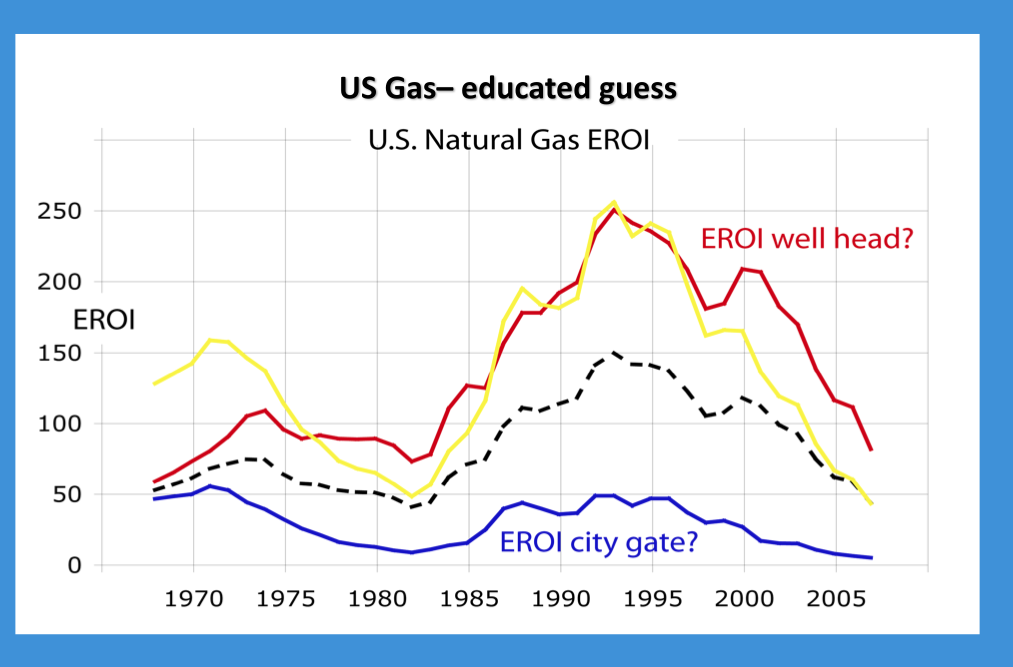
Here is a non-paywalled paper from 2011 (PDF):
http://www.mdpi.com/2071-1050/3/10/1986/pdf
(can't find mention of it on PO.com)
They show:
Image
Compare with
Image
from the OilDrum page agramante mentioned:
http://www.theoildrum.com/node/7062
Facebook knows you're a dog.
User avatar
Keith_McClary
Light Sweet Crude
Light Sweet Crude
 
Posts: 7344
Joined: Wed 21 Jul 2004, 03:00:00
Location: Suburban tar sands

Previous

Return to Peak oil studies, reports & models

Who is online

Users browsing this forum: No registered users and 1 guest

cron