kublikhan asks
$this->bbcode_second_pass_quote('', 'H')ow many more giant oil discoveries do you think will be made in say, the next 2 decades? Not old discoveries that are now economical like Bakken. And not kerogen like Green River, but actual oil. Like how many more Lula(Tupi) oil fields do you think we will be finding in the next few decades?


PeakOil is You
Oil School: How Much Oil is Left To Find
Oil School: How Much Oil is Left To Find
 by Pops » Wed 15 May 2013, 16:15:13
The legitimate object of government, is to do for a community of people, whatever they need to have done, but can not do, at all, or can not, so well do, for themselves -- in their separate, and individual capacities.
-- Abraham Lincoln, Fragment on Government (July 1, 1854)
-- Abraham Lincoln, Fragment on Government (July 1, 1854)
-

Pops - Elite

- Posts: 19746
- Joined: Sat 03 Apr 2004, 04:00:00
- Location: QuikSac for a 6-Pac
Re: Oil School: How Much Oil is Left To Find
by Plantagenet » Wed 15 May 2013, 16:43:48
I can think of four new areas that will probably yield up some more giant fields:
(1) Tight oil in China, South America, Russia etc. Thanks to horizontal drilling and frakking, there could be major discoveries in these regions
(2) Deepwater targets. The "sub-salt" off Brazil may have major resources. But there are also "sub-salt" sediments off northern So. America, off Africa, and even in the Gulf of Mexico. Could be some giant fields down there. Other deepwater targets will also likely exist
(3) Arctic Ocean. Exploration is just starting. Given the known oil province in northern Alaska, it seems likely more giant fields will be found there and elsewhere in the Arctic Ocean.
(4) Deeper in the Williston Basin and elsewhere in other north American basins. The obama administration just announced that the Williston basin contains twice as much oil ---7.4 BILLION bbls---then the previously thought, partially because a shale just below the Bakken also contains oil. But there are multiple shales present below the Bakken----each of them may have oil. Similarly in Texas, the Eagle Ford has turned into a giant oil field---but there are other shales that may also be giant fields. One of these---the Spraberry/Wolfcap Shale, may have 50 BILLION bbls.
(1) Tight oil in China, South America, Russia etc. Thanks to horizontal drilling and frakking, there could be major discoveries in these regions
(2) Deepwater targets. The "sub-salt" off Brazil may have major resources. But there are also "sub-salt" sediments off northern So. America, off Africa, and even in the Gulf of Mexico. Could be some giant fields down there. Other deepwater targets will also likely exist
(3) Arctic Ocean. Exploration is just starting. Given the known oil province in northern Alaska, it seems likely more giant fields will be found there and elsewhere in the Arctic Ocean.
(4) Deeper in the Williston Basin and elsewhere in other north American basins. The obama administration just announced that the Williston basin contains twice as much oil ---7.4 BILLION bbls---then the previously thought, partially because a shale just below the Bakken also contains oil. But there are multiple shales present below the Bakken----each of them may have oil. Similarly in Texas, the Eagle Ford has turned into a giant oil field---but there are other shales that may also be giant fields. One of these---the Spraberry/Wolfcap Shale, may have 50 BILLION bbls.
-

Plantagenet - Expert
- Posts: 26765
- Joined: Mon 09 Apr 2007, 03:00:00
- Location: Alaska (its much bigger than Texas).
Re: Oil School: How Much Oil is Left To Find
by Pops » Wed 15 May 2013, 16:46:57
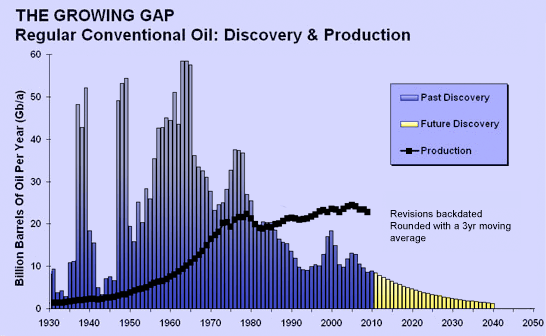
Here is the familiar Growing Gap plot, this one is updated to 2011, I found it at DoTheMath
Here is a logistics curve from the same blog
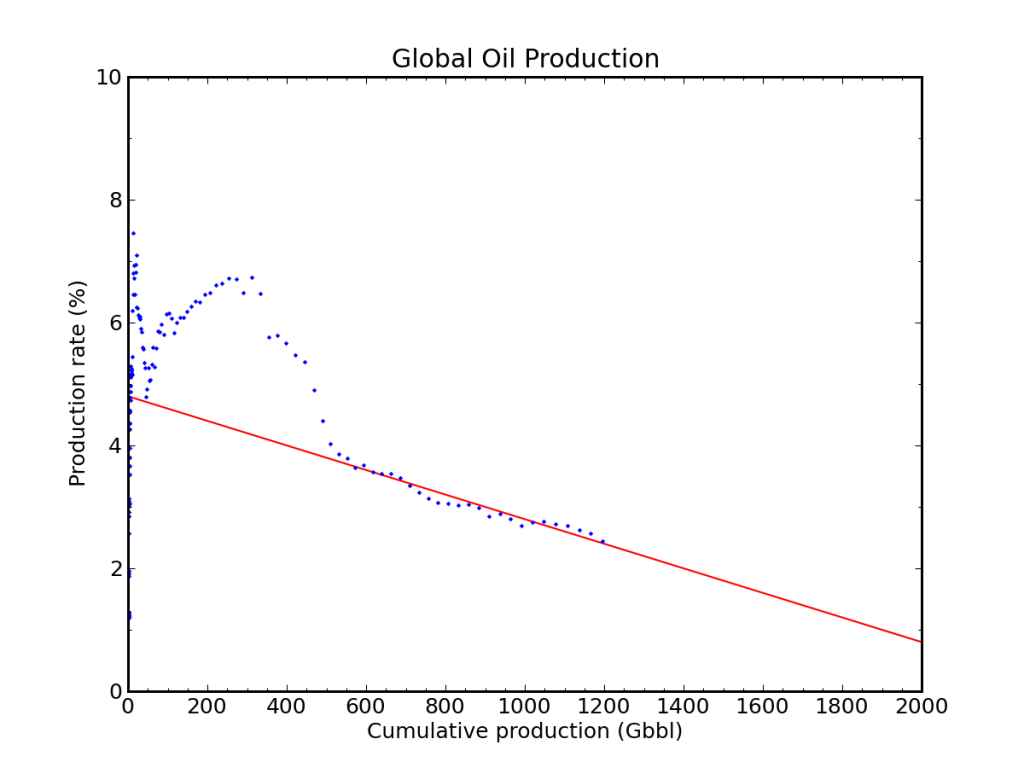
$this->bbcode_second_pass_quote('', 'F')or global oil resources (all liquids), we have consumed 1.2 trillion barrels so far. The data did not follow a logistic path in its early years, but has done so for the past three decades. If this portion is predictive, it says that our total resource is about 2.4 trillion barrels, putting us half-way along (therefore around the peak of the logistic rate). This by itself is a weak prediction. But the discovery rate we have seen (peaking in the 1960′s) does not lay the groundwork for us to expect a radical departure from the logistic line any time soon.
Here is a logistics curve from the same blog
$this->bbcode_second_pass_quote('', 'F')or global oil resources (all liquids), we have consumed 1.2 trillion barrels so far. The data did not follow a logistic path in its early years, but has done so for the past three decades. If this portion is predictive, it says that our total resource is about 2.4 trillion barrels, putting us half-way along (therefore around the peak of the logistic rate). This by itself is a weak prediction. But the discovery rate we have seen (peaking in the 1960′s) does not lay the groundwork for us to expect a radical departure from the logistic line any time soon.
Ibid
.
The legitimate object of government, is to do for a community of people, whatever they need to have done, but can not do, at all, or can not, so well do, for themselves -- in their separate, and individual capacities.
-- Abraham Lincoln, Fragment on Government (July 1, 1854)
-- Abraham Lincoln, Fragment on Government (July 1, 1854)
-
Pops - Elite
- Posts: 19746
- Joined: Sat 03 Apr 2004, 04:00:00
- Location: QuikSac for a 6-Pac
Re: Oil School: How Much Oil is Left To Find
by Plantagenet » Wed 15 May 2013, 17:17:26
$this->bbcode_second_pass_quote('Pops', 'H')ere is the familiar Growing Gap plot, this one is updated to 2011, I found it at DoTheMath
Yes. I started a thread a while back on just this topic. Graphs like the one above show only CONVENTIONAL oil. They don't show the new discoveries of UNCONVENTIONAL oil.
The 7.4 BILLION in the Bakken and the 3 BILLION in the Eagle Ford and the 15 (?) BILLION in the Monterey Shale and the 50 (?!?) BILLION in the Wolfcap are big enough to create a big bump on the end of the falling discovery curve. The new tight oil discoveries are real---they should be counted and shown.
-
Plantagenet - Expert
- Posts: 26765
- Joined: Mon 09 Apr 2007, 03:00:00
- Location: Alaska (its much bigger than Texas).
Re: Oil School: How Much Oil is Left To Find
by Pops » Wed 15 May 2013, 18:11:32
I really should be doing something productive... but since I'm not:
Released: 6/18/2012
$this->bbcode_second_pass_quote('', 'T')he U.S. Geological Survey has released a new global estimate for potential additions to oil and gas reserves due to reserve growth in discovered fields outside the United States. The USGS estimates that the mean undiscovered, conventional reserve additions in the world total 665 billion barrels of oil (bbo), 1,429 trillion cubic feet (tcf) of natural gas, and 16 billion barrels of natural gas liquids.
Released: 6/18/2012
$this->bbcode_second_pass_quote('', 'T')he U.S. Geological Survey has released a new global estimate for potential additions to oil and gas reserves due to reserve growth in discovered fields outside the United States. The USGS estimates that the mean undiscovered, conventional reserve additions in the world total 665 billion barrels of oil (bbo), 1,429 trillion cubic feet (tcf) of natural gas, and 16 billion barrels of natural gas liquids.
usgs-releases-global-oil-gas-reserve-growth-estimates-t65470.html
(April 18, 2012)
$this->bbcode_second_pass_quote('', 'T')he agency estimated mean volumes of 565 billion barrels of undiscovered conventional oil, 5,606 trillion cubic feet of undiscovered conventional natural gas and 166,668 million barrels of natural gas liquids in 171 priority geologic provinces of the world – exclusive of the United States.
http://www.usgs.gov/newsroom/article.as ... -UOHReOBXs
Add those 2 forecasts put out last year together and it works out to exactly the 1.2 trillion predicted by the logistic curve Murphy did in 2011!
About 400B more than Campbell and Laherrère came up with back in '97, btw.
The legitimate object of government, is to do for a community of people, whatever they need to have done, but can not do, at all, or can not, so well do, for themselves -- in their separate, and individual capacities.
-- Abraham Lincoln, Fragment on Government (July 1, 1854)
-- Abraham Lincoln, Fragment on Government (July 1, 1854)
-
Pops - Elite
- Posts: 19746
- Joined: Sat 03 Apr 2004, 04:00:00
- Location: QuikSac for a 6-Pac