From: http://www.bloomberg.com/news/2013-04-1 ... wdown.html
Interesting that for years some economics “experts” had predicted China’s collapse would be due to a much too high a growth rate and thus folks should be cautious investing there. And now that growth has plummeted to about 5X that of the US more “experts” are warning about the dangers. But I would imagine the new numbers could represent real concerns for manufacturers in other countries. If the current growth is the equivalent of Goldilocks’s “just right” condition it could lock China into a sustained long term growth pattern. Can’t last forever, of course. But as I said the other day: it doesn’t matter how fast the bear can run but how fast the other guy can run. The new China numbers imply to this economics non-expert that they’ll be leading the pack for a long time regardless of how much we’re all slowing down.
One interesting tidbit regarding sustainability: “China doesn’t need to expand faster than 8 percent in part because the number of new workers from 15 to 24 years old, the main source of job seekers, has been in decline since 2010, according to Li Wei, a Shanghai-based economist at Standard Chartered Plc.”



PeakOil is You
CHINA STUCK WITH SUB-8% GROWTH
CHINA STUCK WITH SUB-8% GROWTH
 by ROCKMAN » Mon 15 Apr 2013, 13:18:10
-

ROCKMAN - Expert

- Posts: 11397
- Joined: Tue 27 May 2008, 03:00:00
- Location: TEXAS
Re: CHINA STUCK WITH SUB-8% GROWTH
by Plantagenet » Mon 15 Apr 2013, 13:43:08
AT first glance it seems bizarre that people are concerned that China's growth has slowed to only a bit under 8%----isn't that still great?
But
(1) you can't trust the Chinese data----if the government is reporting growth has to slowed to under 8% it might well be quite a bit worse.
(2) the "trend is not your friend here"---growth in China is definitely slowing.
(3) put it in context---the EU is going into double (triple?) dip recession---the US is in the worst recovery ever, and seems to be slowing even more now, and the rest of the BRICs aren't doing too great either.
I sold out of the stock market a couple of weeks ago when the EU stole people's bank deposits in Cyprus. It reminded me of the collapse of Bear Stearns and other small but completely irrational financial disasters that sometimes presage even bigger disasters. I thought the appearance of that kind of government criminality a very bad sign for the EU, and now they are talking in the EU about "wealth taxes"---just seizing people's property anywhere in the EU. Since I'm out of the market I'm now a bit biased and predisposed to look for more bad signs in the global economy. I take the slowing in China as yet another bad sign.
But
(1) you can't trust the Chinese data----if the government is reporting growth has to slowed to under 8% it might well be quite a bit worse.
(2) the "trend is not your friend here"---growth in China is definitely slowing.
(3) put it in context---the EU is going into double (triple?) dip recession---the US is in the worst recovery ever, and seems to be slowing even more now, and the rest of the BRICs aren't doing too great either.
I sold out of the stock market a couple of weeks ago when the EU stole people's bank deposits in Cyprus. It reminded me of the collapse of Bear Stearns and other small but completely irrational financial disasters that sometimes presage even bigger disasters. I thought the appearance of that kind of government criminality a very bad sign for the EU, and now they are talking in the EU about "wealth taxes"---just seizing people's property anywhere in the EU. Since I'm out of the market I'm now a bit biased and predisposed to look for more bad signs in the global economy. I take the slowing in China as yet another bad sign.
-

Plantagenet - Expert
- Posts: 26765
- Joined: Mon 09 Apr 2007, 03:00:00
- Location: Alaska (its much bigger than Texas).
Re: CHINA STUCK WITH SUB-8% GROWTH
by ROCKMAN » Mon 15 Apr 2013, 14:10:26
P – I’m with you. Got out of the market and sunk all my savings into this really hot tapioca mine investment. LOL. Actually about to make one of the better investments I have in front of me: paying off the home mortgage. Given the low rates not for everyone but I have some unique circumstances.
Whatever the US economic future may be it just feels like we’re sliding off long term to a place we’ve never been at least in my lifetime. Not just PO and perhaps even more than my more inclusive POD…Peal Oil Dynamic. Maybe PE…Peak Economies. Or PIA…Peak Industrial Age. I now that may sound a tad over the top but I’ve been aware of PO for almost 4 decades and have seen the signs of it for that long. But matters feel much different to me these days. Or maybe I’m just getting too old and worn out. LOL.
Whatever the US economic future may be it just feels like we’re sliding off long term to a place we’ve never been at least in my lifetime. Not just PO and perhaps even more than my more inclusive POD…Peal Oil Dynamic. Maybe PE…Peak Economies. Or PIA…Peak Industrial Age. I now that may sound a tad over the top but I’ve been aware of PO for almost 4 decades and have seen the signs of it for that long. But matters feel much different to me these days. Or maybe I’m just getting too old and worn out. LOL.
-
ROCKMAN - Expert
- Posts: 11397
- Joined: Tue 27 May 2008, 03:00:00
- Location: TEXAS
Re: CHINA STUCK WITH SUB-8% GROWTH
by Econ101 » Mon 15 Apr 2013, 18:25:11
8% growth in China is very good. They have been at abnormal growth levels for many years as they expanded into their capacity with a vicious wage/price war on the rest of the world. For a young, growing economy those numbers were normal. China is bigger than normal too so abnormal growth lasted a lot longer than normal.
Now they are maturing as a manufacturing and trade economy. They have shown the world the greatest gift to humanity in history. That economy, once it adopted capitalists principals, has lifted a billion people out of terrible, suffering poverty, into a new existence where happiness and security can replace fear and hunger. Their government however, is still too heavy handed.
As a mature economy their growth will slow similar to ours. They will begin to export work they have in excess. Others will then benefit from that. Its all a very good thing and happening right before our eyes.
Now they are maturing as a manufacturing and trade economy. They have shown the world the greatest gift to humanity in history. That economy, once it adopted capitalists principals, has lifted a billion people out of terrible, suffering poverty, into a new existence where happiness and security can replace fear and hunger. Their government however, is still too heavy handed.
As a mature economy their growth will slow similar to ours. They will begin to export work they have in excess. Others will then benefit from that. Its all a very good thing and happening right before our eyes.
- Econ101
- Lignite

- Posts: 322
- Joined: Sat 01 Sep 2012, 07:47:56
Re: CHINA STUCK WITH SUB-8% GROWTH
by SeaGypsy » Mon 15 Apr 2013, 23:48:06
Pretty pathetic that the world is now so hinged on Chinese growth that a .2% drop in expectation is enough to trigger a global market slump.
- SeaGypsy
- Master Prognosticator

- Posts: 9285
- Joined: Wed 04 Feb 2009, 04:00:00
Re: CHINA STUCK WITH SUB-8% GROWTH
by seahorse3 » Wed 17 Apr 2013, 11:51:32
We've all talked/preached for a long time that the world can't have economic growth (ak GDP growth) without oil production growth. But, are there any charts on that? Any charts that show oil production growth on a world wide basis with world GDP growth? Obviously oil production went gangbusters up to about 2005 and has increased some since then, but not enough to keep the illusion of economic BAU going. So, if there is a chart please link.
This leads to problem no. 2, when oil production goes flat, and GDP goes flat, it means the current system of "globalization" for everyone doesn't work. We need a new model. That model used the dollar as the reserve currency. That model assumed we could all grow and benefit together. Now, we can't. So, China to maintain its growth will cut deals to get what oil is there - we see that happening. We see China now negotiating deals to get the yuan accepted in trade deals and away from the dollar. So, the old model is changing or breaking down. Under the old model, we see bankers taking deposits in Cyprus. So, banks no longer make money by lending, but by charging fees and taking creditor deposits. Look at American banks. Under the old growth model, when growth was possible while oil production was rising, they made money the traditional way by lending. Now, over the last few years, they are making money off of fees, aka things like overdraft fees. So, the old system is changing. I believe its due to a stall in oil production, meaning no growth, meaning old system will change. Into what? Who knows. But the old assumptions have to go away.
On a personal note, I too believe the best investment is always investing in yourself, meaning get debt free. Then, if you have extra money, sock away enough to survive at least a year on; then, if you have anything left, "invest" it.
This leads to problem no. 2, when oil production goes flat, and GDP goes flat, it means the current system of "globalization" for everyone doesn't work. We need a new model. That model used the dollar as the reserve currency. That model assumed we could all grow and benefit together. Now, we can't. So, China to maintain its growth will cut deals to get what oil is there - we see that happening. We see China now negotiating deals to get the yuan accepted in trade deals and away from the dollar. So, the old model is changing or breaking down. Under the old model, we see bankers taking deposits in Cyprus. So, banks no longer make money by lending, but by charging fees and taking creditor deposits. Look at American banks. Under the old growth model, when growth was possible while oil production was rising, they made money the traditional way by lending. Now, over the last few years, they are making money off of fees, aka things like overdraft fees. So, the old system is changing. I believe its due to a stall in oil production, meaning no growth, meaning old system will change. Into what? Who knows. But the old assumptions have to go away.
On a personal note, I too believe the best investment is always investing in yourself, meaning get debt free. Then, if you have extra money, sock away enough to survive at least a year on; then, if you have anything left, "invest" it.
- seahorse3
- Lignite
- Posts: 375
- Joined: Tue 01 Mar 2011, 16:14:13
Re: CHINA STUCK WITH SUB-8% GROWTH
by Tanada » Wed 17 Apr 2013, 14:57:03
$this->bbcode_second_pass_quote('seahorse3', 'W')e've all talked/preached for a long time that the world can't have economic growth (ak GDP growth) without oil production growth. But, are there any charts on that? Any charts that show oil production growth on a world wide basis with world GDP growth? Obviously oil production went gangbusters up to about 2005 and has increased some since then, but not enough to keep the illusion of economic BAU going. So, if there is a chart please link.
I have argued more or less since I got here that Energy use goes up with GDP growth but not necessarily oil energy. Fission, Solar, Wind, Hydro, heck even Coal and Natural Gas can substitute for Oil use in different energy uses. You can build a ship that uses Fission or Coal as its driving force, or even wind like we did before Steam came along. You could still build coal fired steam locomotives today if you want to stop buying diesel fueled locomotives. My understanding is the PRC still runs a ferw dozen coal fired steam engines even in 2013.
$this->bbcode_second_pass_quote('Alfred Tennyson', 'W')e are not now that strength which in old days
Moved earth and heaven, that which we are, we are;
One equal temper of heroic hearts,
Made weak by time and fate, but strong in will
To strive, to seek, to find, and not to yield.
Moved earth and heaven, that which we are, we are;
One equal temper of heroic hearts,
Made weak by time and fate, but strong in will
To strive, to seek, to find, and not to yield.
- Tanada
- Site Admin

- Posts: 17094
- Joined: Thu 28 Apr 2005, 03:00:00
- Location: South West shore Lake Erie, OH, USA
Re: CHINA STUCK WITH SUB-8% GROWTH
by EdwinSm » Tue 04 Jun 2013, 00:06:10
Bump...
$this->bbcode_second_pass_quote('', '[')b]China: 'Scary' pace of change prompts investor rethink.
For the past 20 years, Taiwanese businessman Jimmy Chu, the head of a company that makes elevators and forklifts, has been spending most of his investments, and time, in mainland China.
Some 80,000 Taiwanese companies like Mr Chu's have poured a total of $120bn into the country in the past two decades, making Taiwan one of the biggest investors there and a key driver of China's economic growth.
But Mr Chu will soon open two new factories in Taiwan at a total investment of $70m, the biggest he has made at home in years.
He is among an increasing number of Taiwanese shifting at least some of their operations away from China - either to South East Asia or Taiwan - and adjusting their investment strategies in the mainland.
One of the main reasons is a significant rise in Chinese wages. Some estimate salaries have doubled in the past six to seven years. Companies are also now required to pay into Chinese workers' health insurance and pension plans.
"Labour costs in China are rising dramatically each year and the pace is scary," says Mr Chu, chief executive of Fair Friend Enterprise Group.
$this->bbcode_second_pass_quote('', '[')b]China: 'Scary' pace of change prompts investor rethink.
For the past 20 years, Taiwanese businessman Jimmy Chu, the head of a company that makes elevators and forklifts, has been spending most of his investments, and time, in mainland China.
Some 80,000 Taiwanese companies like Mr Chu's have poured a total of $120bn into the country in the past two decades, making Taiwan one of the biggest investors there and a key driver of China's economic growth.
But Mr Chu will soon open two new factories in Taiwan at a total investment of $70m, the biggest he has made at home in years.
He is among an increasing number of Taiwanese shifting at least some of their operations away from China - either to South East Asia or Taiwan - and adjusting their investment strategies in the mainland.
One of the main reasons is a significant rise in Chinese wages. Some estimate salaries have doubled in the past six to seven years. Companies are also now required to pay into Chinese workers' health insurance and pension plans.
"Labour costs in China are rising dramatically each year and the pace is scary," says Mr Chu, chief executive of Fair Friend Enterprise Group.
http://www.bbc.co.uk/news/business-22754725
China still has a high rate of growth, but news like this implies that that will slow down. Will jobs come back to Europe or North America?
- EdwinSm
- Tar Sands

- Posts: 601
- Joined: Thu 07 Jun 2012, 04:23:59
Re: CHINA STUCK WITH SUB-8% GROWTH
by ROCKMAN » Tue 04 Jun 2013, 08:24:46
pstarr - I get the idea but really: "stuck"? LOL. Macro-economics aren't my thing but I clearly recall the days when many were warning that China's 10%+ growth was dangerous with regards to their future stability. Based upon those thoughts Chinese growth slowing down a tad should be positive news.
Well, back to work for me now. Let me tell you it's a real pain in the ass to be 'stuck' with a portion of the profits when we flip the company in a couple of years. Poor lil' me...and China too. Boo hoo hoo. LOL.
Well, back to work for me now. Let me tell you it's a real pain in the ass to be 'stuck' with a portion of the profits when we flip the company in a couple of years. Poor lil' me...and China too. Boo hoo hoo. LOL.
-
ROCKMAN - Expert
- Posts: 11397
- Joined: Tue 27 May 2008, 03:00:00
- Location: TEXAS
Re: CHINA STUCK WITH SUB-8% GROWTH
by Arthur75 » Tue 04 Jun 2013, 08:55:53
About China, interesting analyis from Matt Mushalik, about the number of cars and oil usage in the world :
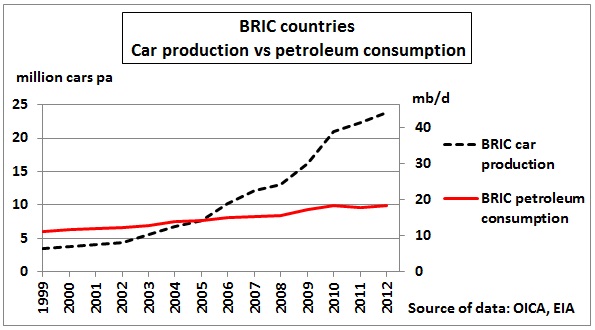
$this->bbcode_second_pass_quote('', 'U')sing the same ratio of petroleum consumption to car production as in the non-BRIC graph above we see that cars before 2005 were under-produced and after that over-produced. The trend line of car production and petroleum consumption have completely different directions, meaning that BRIC cars are driven less. If that should change, there would be an unbridgeable gap in oil production of more than 25 mb/d
$this->bbcode_second_pass_quote('', 'U')sing the same ratio of petroleum consumption to car production as in the non-BRIC graph above we see that cars before 2005 were under-produced and after that over-produced. The trend line of car production and petroleum consumption have completely different directions, meaning that BRIC cars are driven less. If that should change, there would be an unbridgeable gap in oil production of more than 25 mb/d
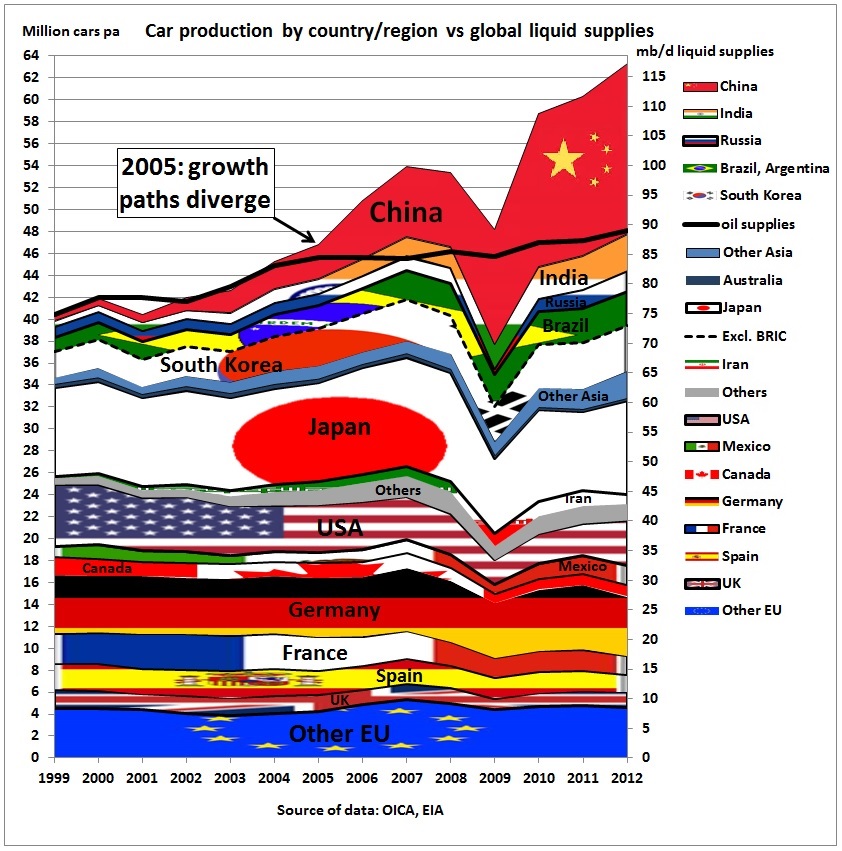
This is for the BRICS but China a major part of it :
-

Arthur75 - Tar Sands
- Posts: 529
- Joined: Sun 29 Mar 2009, 05:10:51
- Location: Paris, France