


PeakOil is You
Peak oil - true or fiction
Peak oil - true or fiction
 by LateGreatPlanetEarth » Thu 19 Jul 2012, 23:07:56
What's the latest consensus; were we duped by 'The party is over' or is the theory still valid or miscalculated? And is shale gas the game changer that renders the theory obsolete? Just asking about were we stand last half of 2012.
- LateGreatPlanetEarth
- Peat

- Posts: 97
- Joined: Tue 13 Jul 2004, 03:00:00
- Location: Cypress, CA
Re: Peak oil - true or fiction
by ralfy » Fri 20 Jul 2012, 01:20:00
-

ralfy - Light Sweet Crude

- Posts: 5651
- Joined: Sat 28 Mar 2009, 11:36:38
- Location: The Wasteland
Re: Peak oil - true or fiction
by Keith_McClary » Fri 20 Jul 2012, 02:01:45
When this graph turns down you can "party on".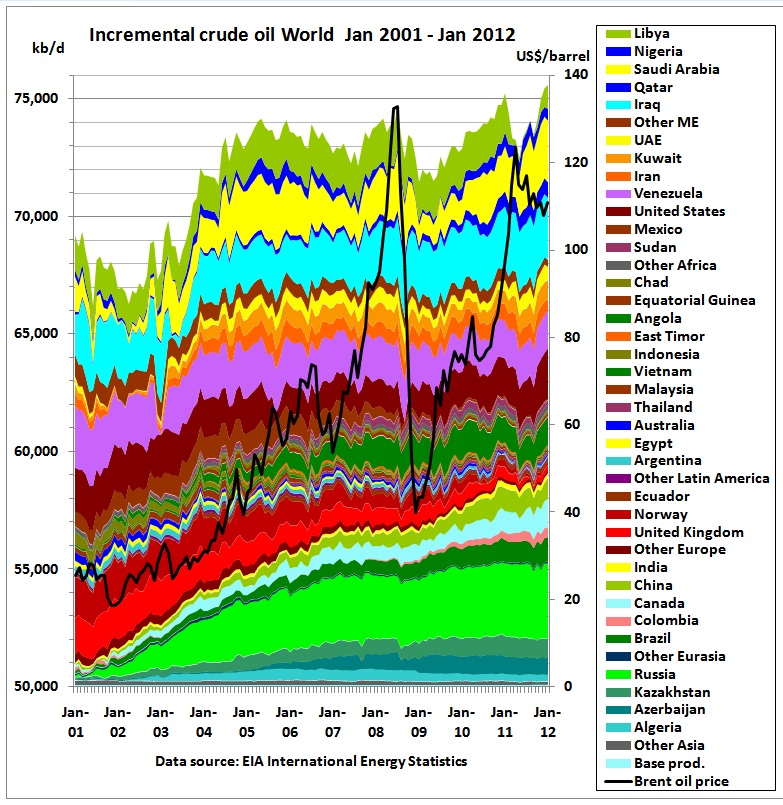
Facebook knows you're a dog.
-

Keith_McClary - Light Sweet Crude
- Posts: 7344
- Joined: Wed 21 Jul 2004, 03:00:00
- Location: Suburban tar sands
Re: Peak oil - true or fiction
by seenmostofit » Fri 20 Jul 2012, 07:29:04
$this->bbcode_second_pass_quote('LateGreatPlanetEarth', 'W')hat's the latest consensus; were we duped by 'The party is over' or is the theory still valid or miscalculated? And is shale gas the game changer that renders the theory obsolete? Just asking about were we stand last half of 2012.
Last half of 2012 will probably be similar to the last half of all the last halves of the past decade. Good for some, not so good for others, and will be so with an utter disregard for peak oil, whether it has already happened, or is still off in the future. Perhaps same-old same-old is the shorthand answer.
- seenmostofit
- Permanently Banned
- Posts: 399
- Joined: Mon 02 Apr 2012, 12:19:50
Re: Peak oil - true or fiction
by LateGreatPlanetEarth » Sat 21 Jul 2012, 00:29:33
looks like production is waning but other energy is coming on line to make up the difference. therefore, conclusion is: production has peaked but that's okay since consumption requirements are being met and will continue to be met.
- LateGreatPlanetEarth
- Peat
- Posts: 97
- Joined: Tue 13 Jul 2004, 03:00:00
- Location: Cypress, CA
Re: Peak oil - true or fiction
by Logic » Sat 21 Jul 2012, 03:31:00
$this->bbcode_second_pass_quote('LateGreatPlanetEarth', 'W')hat's the latest consensus; were we duped by 'The party is over' or is the theory still valid or miscalculated? And is shale gas the game changer that renders the theory obsolete? Just asking about were we stand last half of 2012.
'Peak Oil' is 100% a fact, not theory. The fact is that there is a finite amount of oil available.
The big question is "when will we hit peak"? By some accounts we have already. By others, not so, but soon.
The much more difficult question is what affect will it have on societies across the globe.
Many things other than a physical peak can (and have) affect availability of oil. All you can do is be as prepared as possible, and try to soften the blow.
"We do not inherit the earth from our ancestors... we borrow it from our children"
American Indian proverb
American Indian proverb
- Logic
- Peat
- Posts: 97
- Joined: Tue 21 Jun 2011, 08:11:38
Re: Peak oil - true or fiction
by ralfy » Sat 21 Jul 2012, 07:52:21
$this->bbcode_second_pass_quote('pstarr', '
')the picture? it makes no sense?
')the picture? it makes no sense?
Read the paragraph below the pic.
-
ralfy - Light Sweet Crude
- Posts: 5651
- Joined: Sat 28 Mar 2009, 11:36:38
- Location: The Wasteland
Re: Peak oil - true or fiction
by Pops » Sat 21 Jul 2012, 08:56:44
That oil is finite is established and that production will therefore peak at some point is obvious. I'd suggest that the average price at all time record highs is pretty conclusive evidence that either production can not increase much more or that some someones have a pretty good scam going. It looks more and more like the former to me.

I'm not sure what "other energy" is coming online. Coal, that newfangled 18th century energy source, is making a huge resurgence and still spewing crap into the atmosphere - no such thing as clean coal. Just like the stone age didn't end because we ran out of stones, the coal age didn't end because we ran out of coal, we just found something better. Now the supply of better stuff is becoming constricted and coal is once again about to take over as king of fuels. Smells like peak oil more and more.
Other energy coming online certainly doesn't include nat gas, it's use is increasing at almost exactly the same rate it's been for decades.
You hopefully haven't bought into the pump and dump fracking hype, if I were a believer in evil conspiracy theories I'd guess Chenny's buddies at Halliburton dreamed up that whole scam to keep drillers in business, ol' Dick certainly played his part:
$this->bbcode_second_pass_quote('', 'I')n 2005 Congress—at the behest of then Vice President Dick Cheney, a former CEO of gas driller Halliburton—exempted fracking from regulation under the Safe Drinking Water Act.
I'm not sure what "other energy" is coming online. Coal, that newfangled 18th century energy source, is making a huge resurgence and still spewing crap into the atmosphere - no such thing as clean coal. Just like the stone age didn't end because we ran out of stones, the coal age didn't end because we ran out of coal, we just found something better. Now the supply of better stuff is becoming constricted and coal is once again about to take over as king of fuels. Smells like peak oil more and more.
Other energy coming online certainly doesn't include nat gas, it's use is increasing at almost exactly the same rate it's been for decades.
You hopefully haven't bought into the pump and dump fracking hype, if I were a believer in evil conspiracy theories I'd guess Chenny's buddies at Halliburton dreamed up that whole scam to keep drillers in business, ol' Dick certainly played his part:
$this->bbcode_second_pass_quote('', 'I')n 2005 Congress—at the behest of then Vice President Dick Cheney, a former CEO of gas driller Halliburton—exempted fracking from regulation under the Safe Drinking Water Act.
A 70% decline the first 12 months it's makes for pretty consistent work for drillers, at least until all the E&P companies go broke.
There has been an uptick in renewables, the category however is still led by that even more newfangled energy source: camel chips

So I think the news isn't that "everything's OK", a quick look around the economy puts the lie to that:
The big news is that not only are high oil prices killing demand for oil, they're killing demand for all the stuff we "make" to earn a living and impacting our payments on all the crap we're on the hook already - could be why people and governments are going belly up right and left.
Here is a picture of GDP minus total debt, the bounce at the bottom is where we hit our credit limit:

And if you include the fact that government transfer payments are 28% of the GDP...
Well I think its pretty obvious that everything isn't OK but don't let me interrupt the tune you're whistling past the graveyard.

http://www.businessinsider.com/politics ... 012-6?op=1
http://www.scientificamerican.com/artic ... ing-second
http://sustainablejohn.com/?p=213
http://www.declineoftheempire.com/2011/ ... fairs.html
http://www.bp.com/sectionbodycopy.do?ca ... View=chart
The legitimate object of government, is to do for a community of people, whatever they need to have done, but can not do, at all, or can not, so well do, for themselves -- in their separate, and individual capacities.
-- Abraham Lincoln, Fragment on Government (July 1, 1854)
-- Abraham Lincoln, Fragment on Government (July 1, 1854)
-

Pops - Elite

- Posts: 19746
- Joined: Sat 03 Apr 2004, 04:00:00
- Location: QuikSac for a 6-Pac


